An air conditioner that stops working properly does not just create discomfort. In hot climates and peak summer months, it creates a genuine health concern. The frustrating reality is that most AC problems have clear causes and straightforward fixes that do not require an expensive service call.
I have diagnosed and worked through AC problems across central systems, window units, mini-splits, and portable air conditioners from Carrier, Lennox, Trane, LG, Friedrich, and Midea. The problems below represent the most common failures across all of those systems, along with what causes each one and exactly how to address it.
One important note before diving in: anything involving refrigerant handling requires EPA Section 608 certification in the United States. This air conditioner troubleshooting guide flags clearly where refrigerant is involved, so you know when a DIY approach ends and a licensed HVAC technician becomes necessary.
Quick Air Conditioner Troubleshooting Guide
| Problem | Most Common Cause | Quick Fix |
|---|---|---|
| AC won’t turn on | Tripped breaker or blown fuse | Reset breaker, replace fuse |
| Running but not cooling | Dirty evaporator coil or low refrigerant | Clean coil, call tech for refrigerant |
| Freezing up | Restricted airflow or low refrigerant | Replace filter, check for ice buildup |
| Leaking water indoors | Clogged condensate drain | Clear drain line with wet-dry vac |
| Short cycling | Dirty filter or oversized unit | Replace filter, check sizing |
| Making loud noise | Loose fan blade or failing motor | Tighten blade, replace motor |
| Blowing warm air | Dirty condenser or low refrigerant | Clean condenser coils |
| AC runs constantly | Dirty filter or undersized unit | Replace filter, check thermostat |
| Bad smell when running | Mold in drain pan or dirty evaporator | Clean evaporator, treat drain pan |
| Remote or thermostat not responding | Dead batteries or faulty thermostat | Replace batteries, recalibrate thermostat |
| Fan running but compressor off | Failed capacitor or faulty contactor | Test and replace capacitor |
What’s Wrong With My AC? Common Air Conditioner Problems
The process of diagnosing a problematic air conditioner starts with identifying the exact problem, and below are the most typical AC problems you can troubleshoot.
1. AC Won’t Turn On At All
When your AC won’t turn on, the instinct is to assume the worst. In reality, the most common causes are entirely outside the AC unit itself and take minutes rather than hours to address. Start with the power supply before touching the unit.
| Cause | Sign | Fix |
|---|---|---|
| Tripped circuit breaker | No power to unit, breaker flipped | Reset breaker, monitor for repeat trips |
| Blown fuse in disconnect | No power after breaker reset | Replace fuses in outdoor disconnect |
| Dead thermostat batteries | Blank thermostat display | Replace batteries |
| Float switch tripped | Unit off, drain pan full of water | Clear condensate drain, reset float switch |
| Failed capacitor | Click sound but no startup | Test and replace capacitor |
Tripped Circuit Breaker or Blown Disconnect Fuse
Air conditioners draw a significant surge of current at startup. An aging breaker, a momentary voltage spike, or a unit working harder than usual during a heat wave can trip the breaker or blow the disconnect fuses. The AC loses all power while everything else in the house works normally.
Recommended Fix
Go to your electrical panel and locate the breaker labeled for the air conditioner. If it has tripped to the middle position, push it fully to off first, then firmly back to on. For outdoor disconnect fuses, pull the disconnect block out of the box and test each fuse with a multimeter for continuity. Replace any fuse that reads open.
If the breaker trips again within minutes of resetting, stop resetting it. A repeatedly tripping breaker signals a deeper electrical or mechanical fault that needs professional diagnosis before you risk a fire.
Tripped Float Switch
The float switch sits in the condensate drain pan underneath the indoor air handler. When the drain line clogs and the pan fills with water, the float rises and cuts power to the entire system to prevent water damage. The unit simply stops running with no error, no noise, and no obvious explanation.
Recommended Fix
Locate the indoor air handler and check the condensate drain pan. If water is sitting in it, the drain line is clogged. Clear the drain line using a wet-dry vacuum at the exterior drain outlet, then flush it with a cup of distilled white vinegar. Once the pan is empty, the float switch resets automatically and the unit should restart.
Condensate Drain Pan Treatment Tablets (View on Amazon) dissolve slowly in the drain pan and prevent the algae and slime buildup that causes most drain line clogs, making them an excellent monthly maintenance addition that costs almost nothing.
2. AC Running But Not Cooling the House
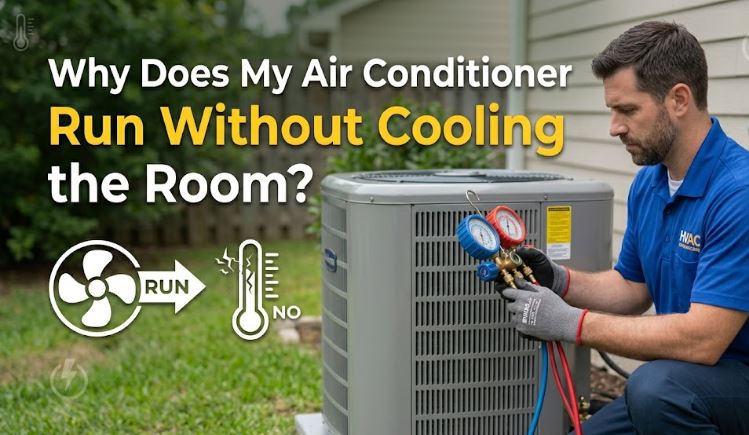
This is the most common air conditioner complaint during the summer months. The system runs, the fan blows air, the unit sounds normal, but the house stays warm. This symptom covers a wide range of causes with very different solutions. So working through them systematically saves time and money.
Below, we break down the reasons why your AC runs but won’t cool the room:
| Cause | Sign | Fix |
|---|---|---|
| Dirty air filter | Weak airflow from vents | Replace filter immediately |
| Dirty evaporator coil | Reduced cooling, higher bills | Clean evaporator coil |
| Dirty condenser coil | Outdoor unit hot to touch | Clean condenser coils |
| Low refrigerant | Ice on refrigerant lines | Call licensed HVAC technician |
| Thermostat set incorrectly | Cooling mode not selected | Check thermostat settings |
Dirty or Clogged Air Filter
A clogged filter restricts the airflow across the evaporator coil to the point where the coil cannot absorb heat effectively from the air passing over it. Cooling capacity drops significantly, energy bills rise, and in severe cases the coil freezes over completely. This single maintenance failure is responsible for more service calls than any other AC problem.
Recommended Fix
Locate the filter at the return air grille or inside the air handler cabinet. Hold it up to a light source. If you cannot see light through it clearly, replace it. Standard 1-inch filters need replacing every 30 to 60 days during heavy use. Thicker 4-inch media filters last three to six months. Never run the system without a filter installed.
The Filtrete 1500 MPR Air Filter (View on Amazon) traps significantly more dust, pollen, and particles than standard fiberglass filters while maintaining adequate airflow for your system, and replacing it on schedule is the single most impactful maintenance task you can perform on your AC.
Dirty Condenser Coil
The outdoor condenser unit releases the heat extracted from your home into the outside air. When the condenser coil fins become coated with grass clippings, cottonwood seeds, dirt, and debris, heat cannot escape efficiently. The system works increasingly harder for progressively less cooling output while energy consumption climbs.
Recommended Fix
Turn off power to the outdoor unit at the disconnect box before cleaning. Use a garden hose to spray the coil fins from the inside out through the top of the unit, working around the perimeter. Never use a pressure washer because the high pressure bends the delicate aluminum fins. Trim any vegetation to maintain at least 18 inches of clearance around all sides of the unit.
Low Refrigerant Level
Refrigerant does not get consumed during normal operation. If the level is low, the system has a leak somewhere in the refrigerant circuit. Low refrigerant reduces cooling capacity steadily, sometimes over months or years, until the system can no longer maintain temperature. You may notice ice forming on the refrigerant lines running into the house, or the system running continuously without reaching the set temperature.
Recommended Fix
This repair requires a licensed HVAC technician with EPA Section 608 certification. Do not attempt to add refrigerant yourself. The technician needs to locate and repair the leak first, then recharge the system to the correct specification. Simply adding refrigerant without fixing the leak is a temporary measure that will fail again quickly.
3. AC Freezing Up
An air conditioner covered in ice seems counterintuitive, but it happens frequently and always has a specific cause. Ice on the evaporator coil or refrigerant lines reduces cooling efficiency dramatically and can damage the compressor if the system keeps running in that condition.
| Cause | Sign | Fix |
|---|---|---|
| Restricted airflow | Ice on indoor coil, weak airflow | Replace filter, check all vents |
| Low refrigerant | Ice on refrigerant lines outside | Call HVAC technician |
| Dirty evaporator coil | Ice forms on coil surface | Clean evaporator coil |
| Running in cool weather | Ice during mild temperatures | Do not run AC below 60°F outdoor temp |
Restricted Airflow Across the Evaporator Coil
The evaporator coil needs a continuous flow of warm indoor air passing over its surface to absorb heat and keep the refrigerant temperature above freezing. When airflow drops below a critical threshold because of a clogged filter, closed vents, or a failing blower motor, the coil surface temperature drops below 32°F and moisture in the air freezes onto it.
Recommended Fix
Turn the system to fan-only mode immediately to begin thawing. Never run the compressor while the coil is frozen because liquid refrigerant can slug back to the compressor and cause serious mechanical damage. While the coil thaws, replace the filter and open all supply and return vents throughout the house. Once fully thawed, restart the system in cooling mode and monitor airflow.
Dirty Evaporator Coil Causing Ice Formation
Even with a clean filter, a coil that has accumulated a layer of dust and grime over several seasons restricts the heat exchange process enough to cause freezing. The layer of dirt acts as insulation between the warm air and the cold coil surface.
Recommended Fix
After thawing the coil completely, access the indoor air handler and spray the evaporator coil with a no-rinse evaporator coil cleaner. The foam expands into the fins, breaks up the dirt, and drains away through the condensate line without rinsing. Allow it to work for 15 minutes before restarting the system.
The AC Evaporator Coil Cleaner (View on Amazon) is a professional-grade product that HVAC technicians use routinely, and applying it yourself once a year before the cooling season begins keeps the coil clean and the system running at full efficiency.
4. AC Leaking Water Indoors
Water dripping from the indoor air handler or pooling around the base of the unit is one of the most urgent AC problems to address. Left unattended, even a slow indoor water leak causes significant damage to ceilings, walls, insulation, and promotes mold growth within 24 to 48 hours.
| Cause | Sign | Fix |
|---|---|---|
| Clogged condensate drain line | Water in drain pan, overflow | Clear drain line, flush with vinegar |
| Cracked or rusted drain pan | Water on floor despite clear drain | Replace drain pan |
| Frozen evaporator coil thawing | Large water release when defrosting | Fix freeze cause, not just the water |
| Disconnected drain line | Water pouring from air handler | Reconnect and secure drain line |
Clogged Condensate Drain Line
The condensate drain line removes humidity extracted from your home’s air as water. Algae, mold, and slime grow inside this warm, dark, moist pipe over time and eventually create a blockage. Water backs up into the drain pan, which overflows onto your ceiling or floor depending on where the air handler is installed.
Recommended Fix
Locate the PVC drain line running from the air handler to its drain point, typically at the exterior of the house or into a floor drain. Attach a wet-dry vacuum to the exterior end and run it for two to three minutes to pull the clog through. Flush the line afterward with a cup of distilled white vinegar to kill remaining algae. Do this every three months as preventative maintenance.
Cracked or Corroded Drain Pan
On older systems, the secondary drain pan underneath the air handler corrodes through or cracks, allowing water to escape even when the primary drain is functioning correctly. The water appears on the ceiling or floor in a consistent location regardless of whether the drain line is clear.
Recommended Fix
Inspect the drain pan with a flashlight while the system runs. A crack or rust-through will be visible. Replace the pan with an exact-fit model for your air handler. As a temporary measure, a drain pan liner or water alarm can alert you to overflow while you arrange for the permanent fix.
5. AC Short Cycling
Short cycling means the AC turns on, runs for only two to five minutes, shuts off, and then restarts again shortly after. This rapid on-off pattern is damaging to the compressor because startup draws the most electrical current and creates the most mechanical stress. A compressor that short cycles ages significantly faster than one that runs full cycles.
| Cause | Sign | Fix |
|---|---|---|
| Oversized system | House cools fast, high humidity | Consult HVAC professional for sizing |
| Dirty or clogged filter | Shuts off soon after starting | Replace filter immediately |
| Low refrigerant | Short cycles with ice on lines | Call HVAC technician |
| Failing thermostat | Erratic temperature readings | Recalibrate or replace thermostat |
| Frozen evaporator coil | Ice visible, rapid shutoff | Thaw coil, fix airflow restriction |
Oversized Air Conditioning System
An AC unit that is too large for the space it serves cools the house so quickly that it satisfies the thermostat before completing a proper dehumidification cycle. The result is a house that feels cold but clammy because the system never runs long enough to pull adequate moisture from the air. This is a design problem that requires professional assessment to address properly.
Recommended Fix
If your system was recently installed and has always short cycled, consult an HVAC professional about performing a Manual J load calculation to determine whether the unit is correctly sized. For an existing older system that has developed this pattern, check the filter and refrigerant level first since those are simpler and less expensive causes.
Failing or Miscalibrated Thermostat
A thermostat that reads temperatures inaccurately triggers the compressor too early and shuts it off too soon. Direct sunlight hitting the thermostat body, a thermostat mounted on an exterior wall, or one located near a supply vent creates false temperature readings that cause erratic cycling behavior throughout the day.
Recommended Fix
Check the thermostat location for direct sunlight exposure or proximity to supply vents. Place a calibrated thermometer next to the thermostat and compare readings. A difference of more than two degrees indicates a calibration problem. Most smart thermostats can be recalibrated in settings. Older analog thermostats may need replacing.
The Honeywell Home RTH7560E Programmable Thermostat (View on Amazon) is a straightforward and reliable replacement for older analog thermostats, and its precise temperature sensing eliminates the erratic short cycling that often develops when older thermostat sensors drift out of calibration.
6. AC Making Loud or Unusual Noises
Every air conditioner makes some sound during normal operation. The compressor hums, the fan moves air, and refrigerant flows through the lines. A new or loud noise that is distinctly different from those normal operating sounds is the system telling you something specific is wrong, and identifying the noise type points directly to the failing component.
| Cause | Sign | Fix |
|---|---|---|
| Banging or clanking | Loose or broken fan blade | Turn off unit, inspect fan immediately |
| Squealing or screeching | Worn fan motor bearings | Lubricate or replace fan motor |
| Rattling | Loose panels or debris in unit | Tighten panels, clear debris |
| Clicking repeatedly | Failing relay or contactor | Replace relay or contactor |
| Hissing or bubbling | Refrigerant leak | Call HVAC technician |
Banging or Clanking From the Outdoor Unit
A banging or clanking sound from the outdoor condenser unit almost always means something is physically loose or broken inside the cabinet. A fan blade that has cracked or come loose from the hub strikes the inside of the cabinet with every rotation. Continuing to run the unit in this condition causes rapidly escalating damage to the fan motor and surrounding components.
Recommended Fix
Turn off power to the outdoor unit at the disconnect box immediately. Remove the top grille and inspect the fan blade. Look for cracks, bends, or a blade that has shifted on its hub. A damaged blade must be replaced rather than repaired. Replace a loose blade by tightening the hub set screw if the blade itself is undamaged.
Squealing From the Air Handler or Outdoor Unit
Squealing typically comes from a fan motor bearing that has lost lubrication or worn beyond its serviceable limit. On older motors with oil ports, adding a few drops of non-detergent electric motor oil resolves the problem temporarily. On sealed bearing motors, which cover most units made after 2010, the bearing cannot be serviced and the motor needs replacing.
Recommended Fix
Identify which unit the sound comes from by listening while both the air handler and outdoor unit run, then switching to fan-only to isolate the indoor blower. Locate the motor producing the sound and check for an oil port. Add electric motor oil if present. Replace the motor if it has sealed bearings that cannot be serviced.
The Supplying Demand 4200740 SM0740 Refrigerator Condenser Fan Motor (View on Amazon) fits a wide range of outdoor units, which makes it an ideal replacement. It’s, however, important to check compatibility with your AC model before ordering, just to be sure that it will fit and work.
7. AC Blowing Warm Air
When the air conditioner blows air but that air is warm or barely cooler than room temperature, the cooling process has broken down somewhere in the refrigerant circuit or the heat exchange system. This is distinct from the unit not turning on at all, because here the system is running but failing to produce the desired result.
| Cause | Sign | Fix |
|---|---|---|
| Thermostat set to heat or fan only | Warm air from all vents | Check thermostat mode setting |
| Dirty condenser coil | Outdoor unit very hot, warm air inside | Clean condenser coil |
| Failed compressor | Outdoor unit runs quietly, no cooling | Call HVAC technician |
| Low refrigerant | Gradual loss of cooling | Call HVAC technician |
| Broken reversing valve (heat pumps) | Stuck in heat mode | Call HVAC technician |
Thermostat Mode Setting
This is the simplest possible cause and worth checking first every single time before doing anything else. A thermostat accidentally switched to heat mode, emergency heat, or fan-only blows unconditioned air through the vents. Someone adjusting the thermostat, a power outage resetting it, or a low battery causing erratic behavior can all trigger this.
Recommended Fix
Check that the system mode is set to Cool, the fan is set to Auto rather than On, and the set temperature is below the current room temperature. On smart thermostats, check the app as well as the physical display since settings can sometimes differ between them.
Failed Compressor
The compressor is the heart of the refrigeration cycle. When it fails, the fan on the outdoor unit keeps running because it has its own motor, but no refrigerant circulates and no cooling occurs. The outdoor unit sounds quieter than normal because the compressor hum is absent.
Recommended Fix
A failed compressor is one of the most expensive AC repairs possible. Before authorizing a compressor replacement, get a professional assessment of the overall system condition. On units older than ten years, replacing the entire outdoor unit or the full system (View on Amazon) often makes more financial sense than replacing the compressor alone.
8. AC Running Constantly Without Reaching Temperature
An air conditioner that never shuts off, running for hours on end without the house reaching the set temperature, is working at or beyond its capacity limit. Unlike short cycling, which damages the compressor through excessive starts, continuous running strains the compressor through sustained operation under difficult conditions.
| Cause | Sign | Fix |
|---|---|---|
| Extreme outdoor temperature | Only during heat waves | Normal behavior, give it time |
| Undersized system | Never reached temp even in mild weather | Consult HVAC professional |
| Dirty filter or coil | Getting worse over time | Replace filter, clean coil |
| Refrigerant leak | Gradual decline in performance | Call HVAC technician |
| Air leaks in ductwork | Some rooms much hotter than others | Seal duct leaks |
Air Leaks in Ductwork
Leaky ducts dump conditioned air into unconditioned spaces like attics, crawlspaces, and wall cavities before it reaches the living areas. The thermostat never sees the target temperature because the cold air never arrives at the rooms where it is needed. Energy consumption climbs while comfort declines, and the system runs continuously chasing a temperature it cannot reach.
Recommended Fix
Check supply and return ducts in accessible areas like the attic or basement. Look for disconnected joints, torn flex duct, or sections where the insulation wrapping has fallen away. Seal joints with UL 181 listed foil tape rather than standard duct tape, which dries out and fails within a few years. For extensive duct leakage, a professional duct sealing service using Aeroseal technology treats the entire duct system from the inside.
Dirty Evaporator Coil Reducing Capacity
A coil coated in a season’s worth of dust and debris loses heat exchange efficiency progressively. The system runs constantly because it is operating at maybe 60 to 70 percent of its rated capacity. This kind of gradual performance loss is easy to miss because it develops slowly over months rather than failing suddenly overnight.
Recommended Fix
Clean the evaporator coil with a no-rinse coil cleaner (View on Amazon). After cleaning, run the system and note how much sooner the thermostat satisfies. A dramatic improvement confirms the coil was the limiting factor.
9. AC Producing Bad Smells When Running
Different smells from an air conditioner point to different problems with reasonable specificity. A musty smell means something biological. A burning smell means something is overheating. A chemical smell points to refrigerant. Identifying the smell correctly is half the diagnostic work.
| Cause | Sign | Fix |
|---|---|---|
| Mold or mildew in drain pan | Musty smell, worse at startup | Clean drain pan, treat with biocide |
| Dirty evaporator coil | Musty smell throughout the house | Clean evaporator coil |
| Burning dust at season start | Burning smell first few cycles only | Normal, clears on its own |
| Burning electrical smell | Persistent burning, not just at start | Stop unit, call technician |
| Refrigerant leak | Sweet or chemical smell | Ventilate, call HVAC technician |
Mold and Mildew in the Drain Pan or Evaporator Coil
The condensate drain pan and evaporator coil sit in a constantly moist environment at the ideal temperature for mold and mildew growth. When microbial growth establishes itself in those areas, the air conditioner distributes the smell throughout the house every time it runs. The odor is typically most noticeable right at startup when the fan begins pushing air across the affected surfaces.
Recommended Fix
Clean the drain pan with a mixture of one part bleach to four parts water. Use a no-rinse evaporator coil cleaner on the coil surface. Place condensate pan treatment tablets in the drain pan to prevent regrowth between cleanings. If your system has a UV air purifier installed near the coil, replace the UV bulb annually since its germicidal effectiveness degrades over time regardless of whether it still glows.
Burning Electrical Smell
A burning electrical smell that persists beyond the first one or two cycles of the season indicates overheating wiring, a failing motor winding, or a capacitor beginning to fail inside the system. This smell will not resolve on its own and worsens with continued operation.
Recommended Fix
Turn off the system and call an HVAC technician. Do not continue running a unit that produces a persistent electrical burning smell. The risk of an electrical fire inside the air handler or outdoor cabinet is genuine and increases with every additional hour of operation.
10. AC Fan Running But Compressor Not Starting
When you hear the outdoor fan running but the system is not cooling, the compressor is not starting despite the fan motor receiving power. This is one of the most specific and diagnosable AC faults because it points to a small set of components that bridge the gap between the control circuit and the compressor.
| Cause | Sign | Fix |
|---|---|---|
| Failed run capacitor | Fan runs, compressor hums then stops | Test and replace run capacitor |
| Failed start capacitor | Compressor tries to start, fails | Replace start capacitor |
| Faulty contactor | Fan runs, no compressor attempt | Inspect and replace contactor |
| Locked rotor (seized compressor) | Loud hum, breaker trips | Call HVAC technician |
Failed Run or Start Capacitor
The capacitor is a cylindrical component inside the outdoor unit that provides the electrical boost the compressor and fan motors need to start and maintain running. It is one of the most common outdoor unit failures and one of the most accessible DIY repairs on a central AC system.
A failed run capacitor typically causes the compressor to hum loudly for a few seconds and then shut off on its thermal overload. A failed start capacitor prevents the compressor from getting going at all, even when the contactor closes and power reaches the compressor terminals.
Recommended Fix
Turn off power at the disconnect box and wait five minutes for the capacitor to discharge. Capacitors store electrical charge and can deliver a painful or dangerous shock if touched while charged. Photograph the wiring connections before removing the old capacitor. Replace it with an exact match for the microfarad rating and voltage rating printed on the side.
Faulty Contactor
The contactor is an electrically controlled switch inside the outdoor unit that connects line voltage to the compressor and condenser fan when the thermostat calls for cooling. The contact points wear and pit over time from the arcing that occurs every time they open and close. Badly worn contacts create high resistance that starves the compressor of voltage.
Recommended Fix
With power off at the disconnect, inspect the contactor contacts through the top of the unit. Burned, pitted, or melted contacts indicate a contactor that needs replacing. This is a straightforward swap that requires matching the voltage rating and pole configuration of the original part.
11. AC Remote or Thermostat Not Responding
A thermostat that’s not working or a remote control that stops responding to inputs brings the entire system to a halt, regardless of whether every other component is in perfect working order. Fortunately, the diagnosis here is usually simple and the fix is almost always inexpensive.
| Cause | Sign | Fix |
|---|---|---|
| Dead batteries | Blank display or no response | Replace batteries |
| Wiring fault at thermostat | Display on but no system response | Check low-voltage wiring connections |
| Failed thermostat | Replaced batteries, still no response | Replace thermostat |
| Blown control board fuse | No power to thermostat at all | Locate and replace 3-amp control fuse |
Dead or Weak Thermostat Batteries
This is the single most common cause of a non-responsive thermostat and the first thing to check before doing anything else. Batteries that are low but not fully dead sometimes power the display while failing to generate the signal strength needed to operate the system reliably.
Recommended Fix
Replace the batteries with fresh alkaline batteries even if the display appears lit. Low batteries in a thermostat produce exactly the same symptoms as a failed thermostat in many cases. If the system responds normally after a battery swap, set a reminder to replace thermostat batteries every 12 months going forward.
Faulty Low-Voltage Wiring Connection
The thermostat connects to the air handler through a bundle of thin low-voltage wires, typically 18-gauge, that carry 24-volt control signals. A wire that has pulled loose at the thermostat base or at the air handler control board breaks the communication path between them. The thermostat display may work perfectly while the system does nothing at all.
Recommended Fix
Remove the thermostat from its base and inspect every wire terminal. Each wire should be firmly secured under its terminal screw with no bare copper showing outside the terminal. Reattach any loose wires and ensure the correct wire is at the correct terminal. Take a photo of the wiring before disconnecting anything.
The Nest Learning Thermostat (View on Amazon) is a significant upgrade over older analog and basic programmable thermostats, and its clear wiring guide built into the setup app eliminates the confusion around correct wire placement that causes most DIY thermostat installation problems.
Frequently Asked Questions
How often should I replace my AC air filter?
Standard 1-inch filters need replacing every 30 days during heavy cooling season use. Thicker 4-inch media filters last three to six months. Homes with pets, allergy sufferers, or high dust levels need more frequent changes than the manufacturer’s stated interval suggests. The easiest way to judge is to hold the filter up to a light source. If you cannot see light through it clearly, replace it regardless of how recently you installed it.
Why does my air conditioner smell musty only when it first turns on?
A brief musty smell at startup that clears within a few minutes usually means a small amount of mold or mildew has grown on the evaporator coil or in the drain pan during a period of inactivity. A thorough coil cleaning and drain pan treatment typically resolves it completely. A smell that persists throughout the entire cycle indicates a more established mold presence that requires a deeper clean of the coil and ductwork.
Can I add refrigerant to my air conditioner myself?
No, and not just because of the legal requirement for EPA Section 608 certification. Adding refrigerant without first finding and repairing the leak that caused the level to drop is a temporary measure at best. An HVAC technician needs to recover any remaining refrigerant, pressure test the system to find the leak, repair it, and then recharge to the correct manufacturer specification. Adding refrigerant on top of an existing leak also causes the refrigerant to escape into the atmosphere, which is both environmentally harmful and illegal.
How do I know if my AC compressor is failing?
The clearest signs of a failing compressor are a system that blows warm air despite all other components working, a loud clanking or grinding sound from the outdoor unit during startup, a compressor that trips the breaker immediately after starting, and a unit that runs but never cools below a certain temperature regardless of outdoor conditions. A technician can confirm compressor health with electrical testing and refrigerant pressure readings.
Why is my energy bill so high even though the AC seems to be working?
Elevated energy bills with seemingly normal operation almost always point to one of four causes: a dirty filter or coil forcing the system to run longer to achieve the same result, refrigerant levels slightly below specification reducing efficiency without stopping cooling entirely, duct leakage wasting conditioned air in unconditioned spaces, or a system that has aged past its efficient operating range. An annual professional tune-up catches all of these issues before they compound into serious efficiency losses.
How long should a residential air conditioner last?
A well-maintained central air conditioner typically lasts 15 to 20 years. Mini-split systems are similar. Window units generally last 10 to 15 years depending on usage intensity. The most impactful factors in longevity are regular filter changes, annual professional maintenance, keeping the condenser coil clean, and ensuring the condensate drain stays clear. Systems that run in restricted airflow conditions or with chronic refrigerant leaks age significantly faster than their design lifespan.
When should I repair my AC versus replacing it entirely?
Use this straightforward framework: multiply the repair cost by the age of the unit in years. If that number exceeds $5,000, replacement is generally the better financial decision. An aging system that needs a major repair like a compressor replacement is also likely to need additional repairs within the next two to three years as other components reach the end of their service life simultaneously. A new system also brings significantly higher energy efficiency ratings that reduce operating costs from day one.
Wrapping Up the Air Conditioner Troubleshooting
Air conditioner problems are far more predictable than most homeowners realize. The overwhelming majority of faults covered in this guide come down to deferred maintenance, a single worn component, or a blocked airflow path. Working systematically through the relevant section will get you to the right diagnosis faster than any service call, and for many of these repairs, the cost is a fraction of what a technician charges just to show up.
Start with the quick reference table, follow the symptom that matches your situation, and address the root cause rather than just the symptom. A reliably cooling home is not a luxury. This air conditioner troubleshooting guide gives you the knowledge to make sure yours delivers it.