Walk into a room on a hot afternoon, hit the thermostat, and instead of relief you get a wave of something musty, chemical, or downright foul spreading through every vent in the house. The smell tells you something specific, and that specificity is actually your fastest route to the fix.
Unlike most AC problems where sound or performance is the clue, a bad smell narrows the diagnosis remarkably well. A musty odor points to one set of causes. A chemical smell points to another. A rotten egg smell is in a category of its own that requires immediate action. The smell type is your first diagnostic tool, so use it before reading further.
One firm rule applies throughout this post: if the smell is gas-like, similar to rotten eggs or sulfur, stop reading, evacuate the home, and call the gas company from outside immediately. That smell is not an AC problem. It is a potential gas emergency that overrides every other consideration.
What Type of Smell Is Your AC Producing?
Below is an overview of why your AC is producing a bad smell when running.
| Smell Description | Most Likely Cause |
|---|---|
| Musty, damp, or mildewy | Mold or mildew on evaporator coil or in ductwork |
| Dirty socks or gym locker | Bacteria buildup on evaporator coil |
| Rotten eggs or sulfur | Gas leak emergency or dead animal in ductwork |
| Burning or electrical | Overheating component or burning dust on startup |
| Sweet or chemical, like coolant | Refrigerant leak |
| Sewage or stagnant water | Clogged condensate drain pan with bacteria growth |
| Stale or dusty | Dirty air filter or debris in return vents |
Why is My AC Producing Bad Smell When Running?
These are the causes behind virtually every bad AC smell, organized by odor type for the fastest possible diagnosis.
1. Mold or Mildew on the Evaporator Coil or in Ductwork
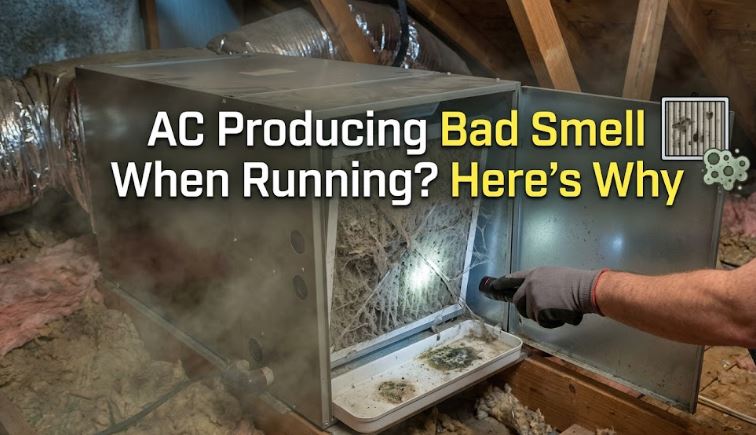
A musty, damp smell from the vents is the most common AC odor complaint and it almost always traces back to mold or mildew growing on the evaporator coil, in the drain pan, or inside the ductwork.
The evaporator coil creates a perfectly hospitable environment for biological growth. It runs cold and wet during operation, accumulating moisture from the air it conditions. When the system shuts down, that moisture sits in a warm, dark enclosure. Over weeks and months, mold and mildew establish colonies on the coil fins and surrounding surfaces. When the system restarts, air moving across those colonies picks up the spores and musty odor and distributes them through every vent in the home.
Here Is How to Fix It
- Turn the system off and access the air handler’s evaporator coil through the access panel
- Inspect the coil visually for any dark, fuzzy, or discolored patches on the fin surface
- Apply an AC Evaporator Coil Cleaner No-Rinse Spray (View on Amazon) directly to the coil surface. This foaming cleaner kills biological growth and drips into the condensate drain pan as it works without requiring rinsing
- For ductwork mold suspected after coil cleaning does not resolve the smell, an HVAC professional performs duct cleaning and antimicrobial treatment to address contamination deep in the duct runs
- Run the system in Fan Only mode for 30 minutes after cleaning to dry the coil and confirm the smell has cleared before switching back to Cool
2. Bacteria Buildup Causing Dirty Sock Syndrome
If the smell is more specifically like sweaty gym clothes or dirty socks rather than general mustiness, the cause is bacterial rather than fungal. This condition is even given an official name in the HVAC industry: Dirty Sock Syndrome.
Certain bacteria thrive on the evaporator coil and produce volatile organic compounds as metabolic byproducts. These compounds have a distinctly organic, locker-room quality that is noticeably different from mold odor. The smell is typically worst at startup when the coil first gets warm and then dissipates somewhat as the system cools down into its operating range. Systems that cycle frequently between heating and cooling modes, such as heat pumps in transitional climates, are particularly susceptible.
Here Is How to Fix It
- Clean the evaporator coil with the no-rinse foaming cleaner described above, since many bacterial colonies live on the same surfaces as mold
- For persistent bacterial odor after coil cleaning, an antimicrobial coil treatment applied by an HVAC technician targets the specific bacteria responsible for dirty sock syndrome more aggressively than consumer sprays
- Consider replacing a foam-style filter with a pleated filter that has better antimicrobial properties. The Filtrete 16x25x1 Air Filter MPR 1500 (View on Amazon) reduces the particle load reaching the coil, which reduces the food supply sustaining bacterial colonies
- An UV light germicidal lamp installed in the air handler near the evaporator coil is the most effective long-term prevention. The AIRDOCTOR AD4000 Air Purifier (View on Amazon) continuously irradiates the coil surface during operation, preventing biological growth from establishing between maintenance visits
3. The Condensate Drain Pan Is Stagnant and Contaminated
A sewage-like or stagnant water odor that is stronger than musty almost always points to the condensate drain pan rather than the coil surface. The drain pan sits beneath the evaporator coil and collects the condensation that drips from it during operation. When the condensate drain line is clogged, water sits in the pan rather than draining away.
Stagnant water in a warm, dark enclosure becomes a breeding ground for bacteria, algae, and sometimes insects within days. The resulting biological soup produces an odor that the air handler circulates through the duct system with every cycle, and it gets noticeably worse as the colony matures.
Here Is How to Fix It
- Locate the condensate drain line access port near the air handler and pour one cup of white vinegar slowly into it to begin dissolving algae and bacteria in the line
- Use a wet/dry vacuum pressed firmly against the outdoor end of the drain line for two to three minutes to pull the clog through
- Clean the drain pan itself with a diluted bleach solution, one part bleach to ten parts water, wiping every surface thoroughly and rinsing before replacing
- Drop a Condensate Pan Treatment Tablet (View on Amazon) into the clean pan before closing the access panel. These slow-release tablets inhibit algae and bacteria growth in the pan and drain line for the entire cooling season
- Pour a quarter cup of vinegar into the drain line access port monthly to prevent algae from rebuilding
4. The Air Filter Is Dirty and Circulating Stale Air
A stale, dusty smell that is not quite musty but makes the air feel thick and unwashed almost always comes from a neglected air filter. This is not a safety concern like some other odors, but it meaningfully reduces indoor air quality and is one of the most common AC smell complaints with the simplest resolution.
A filter saturated with dust, pollen, pet dander, and debris has been collecting airborne particles for weeks or months. Every cubic foot of air passing through that filter picks up odor from the accumulated material before it reaches the living space. On the first day the AC runs after a long dormant period, this effect is especially pronounced as dust that settled on internal components during the off-season burns off with the initial heat of operation.
Here Is How to Fix It
- Replace the filter immediately with the correct size. The Filtrete 20x25x1 Air Filter MPR 1000 (View on Amazon) captures fine particles, pollen, and pet dander without restricting airflow, keeping the air passing through the system genuinely clean
- Also vacuum the return air grilles throughout the home since these accumulate dust on the surface and can contribute to stale air odors independently of the filter condition
- Replace filters every 30 to 60 days during the cooling season and immediately after any period of system dormancy longer than two to three weeks
5. A Sweet or Chemical Smell Indicates a Refrigerant Leak
Safety level: Stop system immediately. Refrigerant work requires EPA Section 608 certification.
A sweet, slightly chemical smell, sometimes described as similar to coolant or ether, coming from the vents almost always indicates refrigerant leaking from somewhere in the system. Refrigerant is not a natural gas and does not create an explosion risk, but it is harmful to breathe in concentrated amounts and causes symptoms including dizziness and respiratory irritation at sufficient exposure levels.
Refrigerant leaks also reduce cooling performance significantly as the charge drops, as covered in our post on AC running constantly without reaching temperature.
Here Is What to Observe and Do
- Note whether the sweet chemical smell coincides with reduced cooling effectiveness, which strongly confirms refrigerant loss
- Listen for a hissing or bubbling sound near either unit which indicates active leakage under pressure
- Turn the system off and open windows to ventilate the space before the next cooling cycle
- Contact a licensed HVAC technician immediately for refrigerant leak detection, repair, and system recharge. Do not attempt to add consumer refrigerant since this cannot address the underlying leak source
6. A Burning Smell at Startup or During Operation
A burning smell from the AC has two completely different meanings depending on when it occurs, and telling them apart before calling a technician saves both time and money.
A burning dust smell at the very start of the season, specifically the first one or two cycles after a long dormant period, is completely normal. Dust that settled on the heating elements, motor housings, and internal components during the off-season burns off during the first heat cycle and produces a temporary dusty burning smell that disappears within 30 to 60 minutes of operation. If the smell is gone by the end of the first cycle, it was simply burn-off and requires no action.
A burning plastic or electrical smell that persists beyond the first cycle, appears in the middle of the season without warning, or carries a sharp electrical quality is a different matter entirely.
Here Is How to Respond to Each Scenario
- For burn-off smell at season startup: open windows, run the system through one full cycle, and confirm the smell has completely cleared before running it on a closed house
- For persistent burning smell mid-season: turn the system off at the thermostat and breaker immediately
- Check accessible electrical connections at the air handler for any visible scorching or melted insulation
- Contact a licensed HVAC technician for diagnosis before restarting. Burning electrical smells from HVAC systems indicate a component overheating and the risk of fire increases with continued operation
7. A Rotten Egg or Sewage Smell Has a Serious Source
This smell category gets its own section because the responses are dramatically different depending on the specific odor quality.
A rotten egg smell that is distinctly sulfuric and chemical is a gas emergency. Natural gas is odorized with mercaptan, a sulfur compound, precisely so leaks are detectable. If the smell from your vents has this sharp, chemical sulfur quality, do not touch any switches or electronics, evacuate everyone from the home, and call the gas company from outside. This is not an AC problem and must be treated as an emergency without exception.
A sewage smell with a more organic, biological quality, closer to drain smell than sulfur, almost always points to a dead animal in the ductwork or a sewer gas issue where a dry plumbing trap near an HVAC return is allowing sewer gases into the return air stream.
Here Is How to Address Each Scenario
- For sharp chemical sulfur: evacuate and call the gas company immediately. Do not attempt to investigate the source
- For organic sewage odor from ductwork: contact an HVAC professional for duct inspection. Dead animals are removed and the affected duct section is sanitized and sometimes replaced
- For drain-like sewer gas smell near a specific return vent: pour water down any nearby floor drains or infrequently used plumbing fixtures. Dry p-traps allow sewer gas to enter the home, and refilling them with water often resolves the smell within one cycle
AC Producing Bad Smell When Running Fix Cost Overview
| Smell Type and Cause | DIY Safe | Fix Cost | Pro Service Cost |
|---|---|---|---|
| Replace dirty air filter | Yes | $8 – $25 | N/A |
| Clean condensate drain line and pan | Yes | Free – $15 | $80 – $150 |
| Clean evaporator coil with spray | Yes | $10 – $20 | $100 – $200 |
| Add drain pan treatment tablet | Yes | $8 – $15 | N/A |
| Professional antimicrobial coil treatment | No | N/A | $150 – $300 |
| Install UV germicidal lamp | Partial DIY | $50 – $150 | $200 – $400 |
| Refrigerant leak repair and recharge | No | N/A | $250 – $600 |
| Duct cleaning for mold or dead animal | No | N/A | $300 – $800 |
Frequently Asked Questions
Why does my AC smell musty only when it first turns on but then the smell fades?
A smell that is strongest at startup and fades within 15 to 30 minutes of operation almost always points to biological growth on the evaporator coil. The coil surface warms very slightly at startup relative to its coldest operating temperature, causing the mold or bacteria to release more volatile compounds briefly before the coil cools back into its normal operating range. Cleaning the coil eliminates the source rather than just the initial intensity.
Can a bad AC smell make my family sick?
Some can. Mold spores circulated through the home exacerbate asthma and allergic rhinitis, particularly in sensitive individuals and children. Refrigerant vapors cause respiratory irritation and dizziness at sufficient concentrations. Bacteria producing dirty sock syndrome release volatile organic compounds that cause headaches and nausea in some people. Gas leaks are immediately dangerous. Treating bad AC smells promptly is both a comfort issue and a health consideration.
How do I prevent my AC from developing a musty smell every summer?
Three habits together prevent the vast majority of musty AC smells. Replace the air filter every 30 to 60 days during the cooling season to reduce the particle load reaching the coil. Pour a quarter cup of white vinegar into the condensate drain line monthly to prevent algae buildup. Schedule a professional coil cleaning and drain pan flush annually as part of a spring tune-up. A UV germicidal lamp installed near the coil provides continuous biological control between maintenance visits.
My AC smells like it is burning but only for the first few minutes of the season. Should I be concerned?
Not if it clears completely within one cycle and does not return. Dust accumulation on motor housings, heating elements, and internal components during the off-season burns off during the first heat cycle and produces a brief burning dust smell that is normal across all HVAC brands. If the burning smell persists beyond the first cycle or returns mid-season without explanation, treat it as a potential electrical fault and turn the system off until a technician can assess it.
Wrapping Up “AC Producing Bad Smell When Running”
Most bad AC smells resolve with a filter replacement, a coil clean, and a clear condensate drain. Those three free or nearly free maintenance steps address the overwhelming majority of musty, dusty, and stale odor complaints and take under an hour combined.
Use the smell type to work from the right starting point rather than guessing. Musty goes to the coil. Sewage goes to the drain pan. Chemical goes to refrigerant. Burning at startup goes to dust burn-off. That matching approach prevents unnecessary service calls and gets fresh air back through your vents in the shortest possible time. Remember to check our ultimate air conditioner troubleshooting guide for diagnosis and troubleshooting tips for many other common AC problems.