
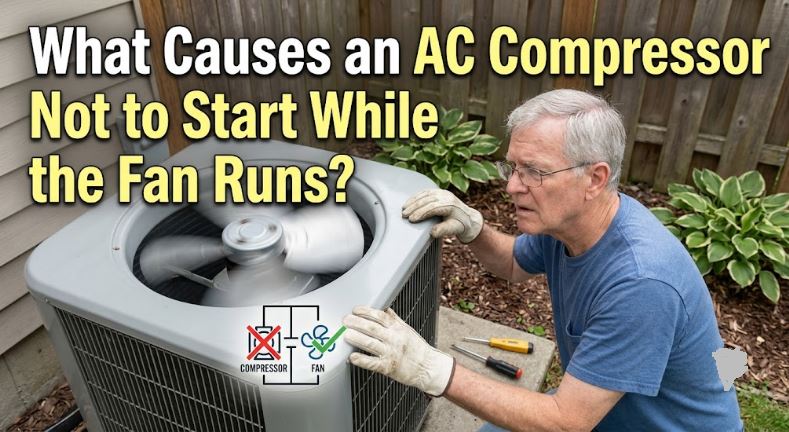
Stand outside near your AC on a hot afternoon and you will hear the condenser fan spinning steadily. Go back inside and the air from the vents is room temperature or warmer. The outdoor unit has power, something is running, but the house is not cooling at all.
What you are experiencing is one of the clearest diagnostic scenarios in residential HVAC. The fan and compressor run on different electrical circuits within the outdoor unit. When the fan runs but the compressor does not, power is reaching the unit but something specific is preventing the compressor circuit from completing. That narrows the suspect list considerably and gives you a structured path through the diagnosis.
Understanding the split between fan and compressor operation is what makes this symptom so useful. The fan circulates air across the condenser coil. The compressor pressurizes refrigerant and drives the entire cooling cycle. Without the compressor running, no heat is removed from the home regardless of how well the fan spins. Every cause below sits somewhere in that compressor circuit or in the conditions the compressor needs to safely start.

What Is Keeping the Compressor From Starting?
Here’s an overview when the Ac fan is running but the compressor is not starting:
| What You Notice | Most Likely Cause |
|---|---|
| Fan spins, compressor completely silent | Failed capacitor or tripped breaker leg |
| Fan spins, compressor hums then stops | Failing capacitor or overheating compressor |
| Fan spins, repeated clicking without compressor starting | Failing capacitor or low refrigerant pressure switch |
| Fan spins, outdoor unit breaker trips repeatedly | Electrical fault or compressor winding failure |
| Fan spins, no cooling despite recent service | Low refrigerant triggering low-pressure cutout |
| Fan spins, compressor worked earlier in day | Compressor overheating and thermal protector tripping |
Why is My AC Fan Running But Compressor Not Starting?
These are the causes behind virtually every fan-runs-compressor-silent scenario, starting with the ones you can safely check yourself before calling anyone.
1. The Thermostat Is Not Sending a Compressor Call
Before concluding anything is mechanically wrong, spend thirty seconds at the thermostat. This resolves more service calls than it should.
The fan and compressor receive separate signals from the thermostat. Setting the fan to On rather than Auto runs the fan continuously and independently of whether a cooling call is active. If no cooling call is being sent, the compressor never receives the signal to start, and the fan runs alone exactly as it was instructed.
Here Is How to Check and Fix It
- Confirm the thermostat is set to Cool mode and the target temperature is at least five degrees below the current room reading
- Switch the fan setting from On to Auto so the fan only runs when the compressor is also running
- Replace thermostat batteries since low batteries cause erratic signal output before the display shows any obvious problem
- Wait five full minutes after making any thermostat change since most systems have a built-in compressor delay to prevent rapid cycling damage
- If the compressor still does not start after five minutes with correct settings, move to the next cause
2. A Circuit Breaker Leg Has Tripped
Safety level: Checking the breaker panel is safe. Do not reset more than once if it trips again.
This is one of the most common causes of a fan-runs-compressor-silent scenario and one that every homeowner can check in two minutes at the electrical panel.
Central AC outdoor units run on a 240-volt supply made up of two 120-volt circuit legs. Both legs power the compressor. Only one leg is typically needed to run the condenser fan motor. When one breaker leg trips, the fan continues operating on its remaining 120-volt leg while the compressor, which requires both legs at full voltage, cannot start. The outdoor unit appears to have power and the fan runs, but zero cooling occurs.
Here Is How to Check and Fix It
- Go to the main electrical panel and locate the double-pole breaker for the AC or condenser
- A partially tripped breaker sits in the middle position rather than fully on or off
- Flip it fully to Off first, wait 30 seconds, then flip it firmly back to On
- Also check the outdoor disconnect box near the condenser unit. The pull-out fuse block must be fully seated
- If the breaker trips again immediately after resetting, do not reset it a second time. Repeated tripping signals an underlying fault that a licensed electrician or HVAC technician must diagnose before further use
3. The Capacitor Has Failed
Safety level: Observation and listening only. Capacitor replacement requires a licensed HVAC technician.
A failed capacitor is the single most common mechanical cause of a compressor not starting while the fan runs, and it accounts for a significant portion of all summer HVAC service calls.
The capacitor is a cylindrical component inside the outdoor unit that provides the high-current electrical boost the compressor motor needs to overcome inertia and start spinning on each cooling cycle. Most residential systems use a dual run capacitor that serves both the fan motor and the compressor motor. When it fails, the fan motor section may continue working while the compressor motor section fails, which is exactly why the fan runs and the compressor sits silent.
A capacitor in partial failure often produces a loud hum or buzz from the outdoor unit as the compressor tries to start without adequate electrical support. A completely failed capacitor produces silence from the compressor with the fan spinning normally.
Here Is What to Observe and Do
- Listen at the outdoor unit immediately after the thermostat calls for cooling. A hum or buzz from the compressor area that fades within a few seconds without the compressor engaging points directly to a capacitor failure
- Do not attempt to start-assist the compressor by any manual means since this creates injury and equipment damage risk
- Do not open the outdoor unit cabinet since the capacitor stores a dangerous electrical charge even after the power is disconnected
- Contact a licensed HVAC technician for capacitor testing and replacement. This is one of the fastest professional AC repairs with most technicians completing it in under an hour. Capacitor replacement typically costs $150 to $300 including labor
4. The Contactor Is Worn or Stuck Open
Safety level: Observation only. Contactor replacement requires a licensed HVAC technician.
The contactor is an electrical switch inside the outdoor unit that connects line voltage directly to the compressor when the thermostat sends a cooling call. It sits between the incoming power and the compressor motor. When its contact points pit, corrode, or burn from the repeated arcing of switching high-current loads over years of operation, it gets stuck in the open position and never delivers power to the compressor even when the thermostat is calling for cooling.
The condenser fan motor connects through a different circuit path in many systems, which is why the fan continues operating while the compressor receives no power at all.
Here Is What to Observe
- Listen for a clicking sound from the outdoor unit when the thermostat calls for cooling. A healthy contactor makes a firm click when it closes. A contactor stuck open makes no sound at all
- Note whether the compressor is completely silent from the very start of a cooling call versus humming briefly before going silent, since complete silence at startup favors the contactor while humming favors the capacitor
- Contact a licensed HVAC technician for contactor testing and replacement. Contactor replacement typically costs $150 to $350 including labor
5. The Compressor Is Overheating and Tripping Its Thermal Protector
The compressor has a built-in thermal overload protector that cuts power to the compressor motor when internal temperatures exceed a safe threshold. This protects the motor windings from the insulation damage that sustained overheating causes. When the protector trips, the compressor goes silent while the condenser fan continues running, since the fan is what is supposed to cool the compressor by moving air across the condenser coil.
After the compressor cools down, the thermal protector resets and the compressor starts again, only to overheat and trip again within minutes if the underlying cause has not been addressed.
Here Is What to Check and Do
- Turn the system off completely and allow the outdoor unit to cool for 30 minutes before attempting a restart
- Check the condenser coil fins for dirt, grass clippings, or debris coating the exterior surfaces, since a dirty coil prevents the heat rejection that keeps the compressor cool
- Clear all vegetation from within two feet of the unit on all sides
- Rinse the condenser coil fins from the inside outward with a garden hose. The Universal Air Conditioner A-Coil Evaporator Condenser Foam Coil Cleaner (View on Amazon) dissolves stubborn debris from aluminum fins without the need to use a pressure washer
- If the compressor overheats again within an hour of restarting after cleaning, low refrigerant or a failing compressor is the more likely cause and a technician is needed
6. Low Refrigerant Has Triggered the Low-Pressure Safety Switch
Safety level: Observation only. Refrigerant work requires EPA Section 608 certification.
Modern AC systems have a low-pressure safety switch that cuts power to the compressor when refrigerant pressure drops below a safe operating threshold. This protection prevents the compressor from running in a dry system, which would rapidly destroy the compressor’s internal lubrication and bearings. When refrigerant leaks reduce system charge to a point that triggers this switch, the compressor shuts off while the condenser fan continues running because the fan does not depend on refrigerant pressure to operate.
This cause produces a recognizable pattern. The compressor starts, runs briefly, then shuts off as the low-pressure switch trips. The cycle repeats every few minutes in what looks like short cycling rather than a complete failure to start.
Here Is What to Observe and Do
- Listen for whether the compressor attempts to start briefly before going silent, which distinguishes a pressure switch shutdown from a capacitor or contactor failure where the compressor never starts at all
- Check refrigerant lines near the indoor air handler for frost or ice formation with a clean filter installed
- Listen near both units for a hissing or bubbling sound indicating active refrigerant leakage
- Turn the system to Fan Only mode and contact a licensed HVAC technician for refrigerant leak detection, repair, and system recharge.
7. The Compressor Has Failed Internally
Safety level: Professional diagnosis and repair only.
When every other cause above has been eliminated and the compressor still does not start, internal compressor failure becomes the final conclusion. The compressor motor windings can short, open, or ground to the compressor housing. The mechanical components inside, pistons, valves, and connecting rods, can seize. Either failure mode leaves the compressor completely unable to start regardless of how healthy the capacitor, contactor, and refrigerant charge are.
A compressor that hums loudly under normal starting voltage but cannot turn over despite a good capacitor strongly suggests a seized mechanical compressor or a shorted motor winding that is drawing excessive current without generating rotation.
Here Is What to Observe and Do
- Note the age of the system. Compressors on systems over twelve years old that are making loud startup attempts without engaging are approaching the end of serviceable life rather than experiencing a repairable fault
- Listen for a loud, straining hum from the compressor area that lasts several seconds before going silent on every cooling call. This specific sound pattern suggests the motor is receiving power but cannot overcome internal resistance
- Contact a licensed HVAC technician for compressor testing using a clamp meter and multimeter. Compressor motor testing confirms whether a winding fault, ground fault, or mechanical seizure is present
- Compressor replacement typically costs $1,200 to $2,500 including labor. On systems over ten years old, the cost of compressor replacement often approaches the cost of a new system with a full warranty, making replacement the more financially sensible choice in many cases
AC Compressor Not Starting Fix Cost Overview
| Cause | DIY Safe | Fix Cost | Pro Service Cost |
|---|---|---|---|
| Correct thermostat settings | Yes | Free | N/A |
| Check and reset circuit breaker | Yes | Free | N/A |
| Clean condenser coil and clear vegetation | Yes | Free – $15 | $80 – $150 |
| Capacitor replacement | No | N/A | $150 – $300 |
| Contactor replacement | No | N/A | $150 – $350 |
| Refrigerant leak repair and recharge | No | N/A | $250 – $600 |
| Compressor replacement | No | N/A | $1,200 – $2,500 |
Frequently Asked Questions
Can I keep running the AC if the fan is spinning but the compressor is not starting?
Running the system with the fan spinning and the compressor not starting circulates uncooled room temperature air and does nothing to cool the home. More importantly, if the compressor is attempting to start and failing repeatedly from a bad capacitor or voltage issue, those repeated failed start attempts stress the motor windings and can accelerate a repairable fault into a complete compressor failure. Turn the system off and diagnose the cause before running additional cycles.
How do I tell whether it is the capacitor or the contactor causing the compressor not to start?
Listen carefully immediately after the thermostat calls for cooling. A clicking sound from the outdoor unit followed by a hum that fades without compressor engagement points to the capacitor. Complete silence from the compressor without even a startup hum or click, despite the fan running normally, points more toward the contactor not closing. Both determinations are confirmed with electrical testing by a technician, but this listening test narrows the diagnosis before the service call.
My AC compressor worked fine this morning but stopped this afternoon. What changed?
A compressor that works in the morning but stops by afternoon almost always points to overheating. Afternoon outdoor temperatures are significantly higher than morning temperatures, and a condenser coil coated with a season’s worth of debris that barely manages heat rejection in the morning cannot keep up with the higher thermal load of peak afternoon heat. Cleaning the condenser coil and clearing vegetation resolves this time-of-day pattern in most cases. If overheating persists after cleaning, low refrigerant reducing lubrication flow to the compressor is the next suspect.
Is it worth replacing the compressor on an older AC system?
Generally no on systems over ten to twelve years old. A compressor replacement costs $1,200 to $2,500 in parts and labor. A new AC system with a full manufacturer warranty and significantly better energy efficiency typically costs $4,000 to $8,000 installed. On a ten-year-old system already showing compressor failure, the remaining components are likely approaching the end of their service life simultaneously. Spending compressor replacement money on a system that may need other major repairs within two to three years rarely represents good value compared to a planned new system purchase.
Why does my compressor hum for a few seconds then stop every time it tries to start?
A hum followed by silence after a few seconds is the clearest possible symptom of a failed or failing run capacitor. The contactor closes, power reaches the compressor motor, the motor attempts to start, the capacitor cannot sustain the current needed to overcome inertia, the thermal overload on the motor trips from the high current draw of the failed start, and the motor goes silent. The cycle repeats on the next start attempt. A technician confirms this with a capacitance meter and replaces the capacitor to restore normal compressor starting.
Wrapping Up “AC Fan Running But Compressor Not Starting”
An AC fan running with a compressor that will not start is a problem with a clear diagnostic sequence. Thirty seconds at the thermostat, two minutes at the breaker panel, and five minutes listening at the outdoor unit give you enough information to tell a technician exactly what you observed before they arrive, which shortens diagnosis time and often reduces the service call cost.
The capacitor is the most common mechanical cause and one of the most affordable professional repairs available. Confirm the thermostat and breaker are correct, describe what the compressor sounds like at startup, and let a licensed technician take it from there. For many other AC issues, our complete air conditioner troubleshooting guide provides diagnosis directions and troubleshooting tips to fix the AC yourself and save on service calls.