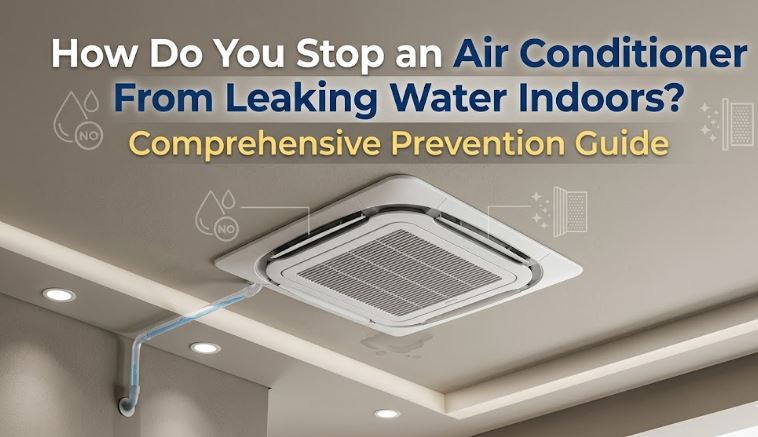
Water dripping from your indoor AC unit, pooling on the floor around the air handler, or staining your ceiling below an attic-mounted system is never something to ignore and deal with later. Even a slow indoor AC leak can cause significant water damage to drywall, flooring, and ceiling materials within days. Left longer, it creates the ideal conditions for mold growth in your walls and ductwork.
Before diving into causes, here is one clarification that saves unnecessary panic. A small amount of condensation dripping from the outdoor unit during operation is completely normal. The cooling process pulls moisture from the air and it has to go somewhere. Indoor dripping and pooling, however, is never normal and always points to something that needs fixing.
The first step when you discover an indoor AC leak is to turn the system off at the thermostat and the breaker. This stops further condensation production, protects the system from electrical hazards near standing water, and prevents the drain pan from overflowing further while you diagnose the cause.
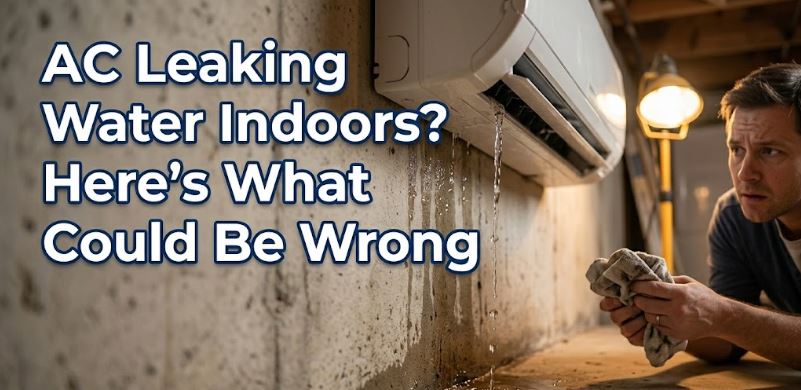
What Is Causing Your AC to Leak Water Inside?
Use this table to match your specific symptom to the most likely cause before reading further.
| What You Notice | Most Likely Cause |
|---|---|
| Water pooling around the base of the air handler | Clogged condensate drain line or cracked drain pan |
| AC shuts off on its own alongside indoor leak | Float switch tripped from overflowing drain pan |
| Water dripping from ceiling vents or light fixtures | Attic-mounted unit with overflowing drain pan |
| Sudden large puddle after AC was running fine | Frozen evaporator coil melting after shutdown |
| Musty smell alongside water leak | Mold growing in clogged drain line or drain pan |
| Water leak in a newly installed mini-split | Improper tilt angle preventing drainage |
| Intermittent leaking with no clear pattern | Partially clogged drain line or failing condensate pump |
7 Reasons Your AC Is Leaking Water Indoors and How to Fix Each One
These causes cover the vast majority of indoor AC water leaks, starting with the ones you can address safely.
1. The Condensate Drain Line Is Clogged
This is the most common cause of an indoor AC water leak by a significant margin, and every HVAC technician starts here without exception.
During normal operation, your AC removes moisture from the indoor air as it cools. That moisture drips from the evaporator coil into the drain pan below and flows out through the condensate drain line, typically a white PVC pipe that exits the air handler and drains outside or into a floor drain. Over time, algae, mold, and debris accumulate inside this narrow pipe and restrict or completely block the drainage path. Water backs up into the pan, overflows, and drips from the air handler onto whatever is below it.
Here Is How to Fix It
- Locate the condensate drain line access port on the PVC pipe near the air handler, usually a capped fitting on the side of the pipe
- Pour one cup of white vinegar slowly into the access port to dissolve algae and biological buildup inside the pipe
- Use a wet/dry vacuum at the outdoor end of the drain line, pressing the hose firmly against the pipe opening, and run it for two to three minutes to pull the clog through
- For stubborn clogs, the Deflecto Drain Cleaning Brush Kit (View on Amazon) reaches deep into the condensate line to dislodge compacted debris that vinegar alone cannot clear
- Pour a quarter cup of vinegar into the access port monthly during cooling season to prevent algae from rebuilding
2. The Drain Pan Is Cracked or Corroded
Even with a fully clear drain line, a cracked or corroded drain pan cannot hold the condensation long enough for it to drain away. Water drips straight through the crack onto the floor or ceiling below, and no amount of drain line cleaning addresses it.
Metal drain pans on older systems develop rust holes over years of constant moisture exposure. Plastic pans crack from age, temperature cycling, or from being stepped on during maintenance access. Both produce a steady drip that appears to come from the bottom of the air handler rather than from the drain line connection.
Here Is How to Inspect and Fix It
- Turn off the system and inspect the drain pan beneath the air handler by shining a flashlight into the access panel
- Look for rust staining, visible holes, or hairline cracks anywhere on the pan surface
- For small cracks in a plastic pan, Loctite Repair Putty (View on Amazon) creates a waterproof seal that adheres firmly to plastic and cures in minutes as a temporary fix while sourcing a replacement
- A pan with significant rusting, multiple cracks, or structural deterioration needs full replacement. Search your air handler model number alongside “drain pan” on Amazon or through an HVAC supply store to find the correct replacement for your unit
3. The Air Filter Is Clogged and the Coil Has Frozen
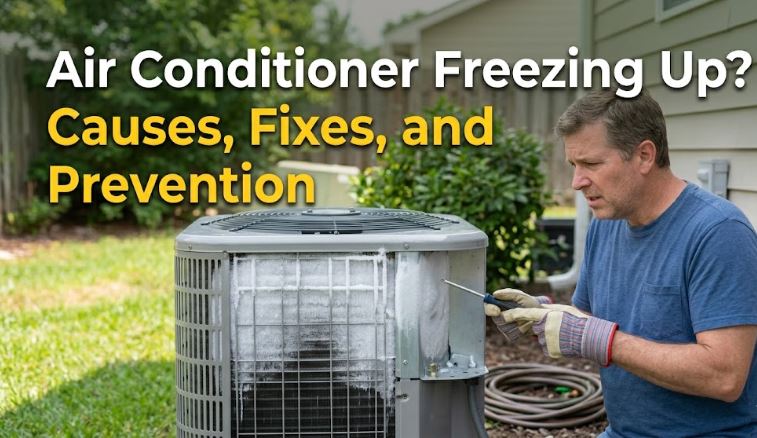
A dirty air filter causes the evaporator coil to freeze over for the same reason explained in our post on AC freezing up. When that ice eventually melts, it produces a large volume of water in a short period that overwhelms the drain pan’s capacity and spills over indoors.
This cause produces a characteristic pattern: the AC runs for a while, stops cooling effectively, and then produces a significant indoor puddle either when the system shuts off or during the next cycle as the accumulated ice melts.
Here Is How to Fix It
- Turn the system off and switch to Fan Only mode to thaw the coil controlled into the drain pan
- Replace the air filter immediately with the correct size. The Filtrete 20x25x1 Air Filter MPR 1500 (View on Amazon) maintains strong airflow while capturing the fine particles that accumulate on evaporator coils
- Allow 2 to 3 hours of thaw time before switching back to Cool
- Confirm all supply and return vents are open throughout the home before restarting
- Change filters every 30 to 60 days during the cooling season to prevent coil freezing from recurring
4. The Float Switch Is Stuck or Faulty
Most modern AC systems have a safety float switch mounted in the drain pan. When water in the pan rises above a safe level from a clog or crack, the float rises and triggers the switch to shut the system off completely. This prevents the pan from overflowing and causing water damage.
When the float switch itself sticks in the raised position or fails electrically, one of two things happens. Either the system shuts off when the pan is not actually full, stopping the AC without any visible water leak, or the switch fails to trigger when it should and the pan overflows freely. Both are worth understanding because the switch is often the reason a system shuts down alongside a leak rather than continuing to run.
Here Is How to Check and Fix It
- Locate the float switch in the drain pan, usually a small plastic device with a wire leading to the control board
- Press the float down gently by hand. If the system restarts, the pan had accumulated water from a clog that has since drained
- Clean the drain line to address the underlying cause then test again to confirm the switch resets freely
- If the switch is stuck mechanically or the system shuts off despite an empty pan, the Rectorseal Condensate Safety Switch (View on Amazon) is a universal replacement that installs in minutes and fits most residential air handler drain pans
5. The Condensate Pump Has Failed
Safety level: Pump replacement is a straightforward DIY repair.
In homes where the air handler sits in a basement or utility room below the level of any available drain, a condensate pump is installed to lift the collected water upward and out through a drain line running to a sink or exterior wall. When this pump fails, water fills the pump reservoir and overflows onto the floor since there is nowhere for it to drain by gravity.
This cause is easy to identify because the air handler will be in a basement or lower level and a small white plastic pump unit will be visible near the base of the air handler with tubing running from it.
Here Is How to Fix It
- Check the pump reservoir for standing water. A full reservoir with no drainage confirms the pump is not operating
- Test whether the pump receives power by confirming its power cord is plugged in and the outlet is live
- Pour a cup of water into the reservoir and listen for the pump motor to activate. No sound indicates a failed pump
- The Little Giant VCMA-20ULST Condensate Pump (View on Amazon) is a highly reliable replacement compatible with most residential HVAC systems. It includes a safety switch that shuts the AC off if the reservoir overflows, adding automatic protection against future water damage
6. Low Refrigerant Is Causing Coil Freeze and Melt
Safety level: Observation only. Refrigerant work requires EPA Section 608 certification.
Low refrigerant from a system leak causes the evaporator coil to run far colder than its designed operating temperature. Ice forms rapidly on the abnormally cold coil surface, and when the system cycles off or shuts down, that accumulated ice melts quickly and floods the drain pan beyond its drainage capacity.
Unlike a filter-caused freeze that is resolved with a filter change, a refrigerant-caused freeze returns within a few hours of each restart regardless of how clean the filter is.
Here Is What to Observe and Do
- After replacing the filter and thawing the coil, restart the system and monitor for refreezing within two to three hours
- Listen near both the indoor and outdoor units for a hissing or bubbling sound indicating active refrigerant leakage
- Check the refrigerant lines for frost formation on a system with a clean filter and open vents
- If refreezing recurs, turn the system to Fan Only mode and contact a licensed HVAC technician for refrigerant diagnosis and leak repair
- Do not add consumer refrigerant products since these mask the leak without repairing it and can damage the compressor over time
7. The Mini-Split or Window Unit Is Incorrectly Tilted
This cause applies specifically to window units and ductless mini-split wall cassettes rather than central split systems, and it is one of the most overlooked installation errors.
Window AC units must tilt slightly downward toward the exterior so condensate drains outward rather than back into the room. Even a perfectly level installation allows condensate to pool at the back of the unit and eventually drip indoors. Mini-split wall cassettes need to be installed level side-to-side but with the drain outlet positioned correctly so water flows toward the drain connection rather than pooling in the cassette.
Here Is How to Inspect and Correct the Tilt
- For window units, place a spirit level on top of the unit and confirm it tilts at least one degree lower on the outdoor side than the indoor side
- If the unit is level or tilting inward, adjust the window brackets or add a small shim under the indoor edge to create the correct outward slope
- For mini-split cassettes, confirm the drain hose connection is properly seated and the hose runs downward continuously from the unit to its exit point without any upward loops that trap water
- For units recently installed, check whether the foam insulation around the window frame has shifted and is directing exterior moisture inward rather than outward
Indoor AC Water Leak Fix Cost Overview
| Cause | DIY Safe | Fix Cost | Pro Service Cost |
|---|---|---|---|
| Clear condensate drain line | Yes | Free – $25 | $80 – $150 |
| Patch or replace cracked drain pan | Yes | $10 – $60 | $100 – $200 |
| Replace clogged air filter | Yes | $8 – $25 | N/A |
| Correct window unit tilt angle | Yes | Free | N/A |
| Replace float switch | Yes | $15 – $30 | $80 – $150 |
| Replace condensate pump | Yes | $35 – $80 | $150 – $250 |
| Refrigerant leak repair and recharge | No | N/A | $250 – $600 |
Frequently Asked Questions
How much water leaking from an indoor AC unit is normal?
Zero. Any water pooling or dripping from an indoor air handler, ceiling cassette, or window unit is abnormal and requires investigation. The only AC-related water that is normal is condensation dripping from the outdoor condenser unit, which is the system shedding heat and moisture collected from inside the home.
Can I keep running my AC if it is leaking water indoors?
No, and there are two reasons for this. First, continued operation produces more condensation that adds to the leak and accelerates water damage to surrounding structures. Second, standing water near electrical components in the air handler creates a shock hazard. Turn the system off at the thermostat and the breaker before doing anything else.
Why does my AC only leak water when it is very humid outside?
High outdoor humidity means your AC is pulling significantly more moisture from the indoor air than usual. The condensate drain system handles a higher water volume than on drier days. A drain line that is partially clogged but functioning adequately in normal conditions overflows on high-humidity days when the water volume exceeds its restricted capacity. Clearing the drain line fully resolves this humidity-dependent leaking pattern.
My AC started leaking after a power outage. What happened?
A power outage mid-cycle often leaves the system in a state where the evaporator coil has already accumulated some ice. When power restores and the system restarts, that residual ice melts faster than the drain system can handle and overflows the pan. If the leak is a one-time event after an outage and does not recur, the ice melt was the cause. If it repeats on the next cycle, a clog or low refrigerant is the underlying issue.
How do I prevent my AC from leaking water every summer?
Three maintenance habits prevent the majority of indoor AC water leaks. Replace the air filter every 30 to 60 days during the cooling season. Pour a quarter cup of white vinegar into the condensate drain line access port monthly to prevent algae buildup. Schedule a professional annual tune-up that includes drain line flushing, coil cleaning, and refrigerant level verification. Together these three habits eliminate the root causes of almost every indoor AC water leak.
Stop the System First and Then Trace the Water Back to Its Source
An AC leaking water indoors is almost always a drainage problem, and the drain line is almost always where that problem lives. Clearing the condensate line, replacing the filter, and checking the drain pan resolve the vast majority of indoor AC leaks without any professional help needed.
If the leak recurs after the drain line is clear and the filter is fresh, a frozen coil from low refrigerant or a failing condensate pump becomes the next logical suspect. And if you are also dealing with other AC issues, our air conditioner troubleshooting guide should come in handy.