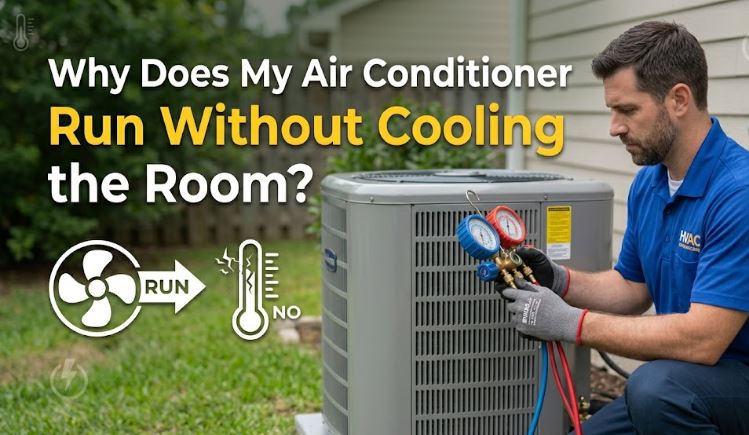
You hear the AC humming, feel air coming from the vents, and the system is clearly running. But the room stays warm, the temperature barely drops, and your energy bill keeps climbing for absolutely zero comfort in return.
An AC running without cooling is actually one of the more telling symptoms because it separates electrical faults from performance faults. The system has power and is operating. Something specific is preventing it from doing the one thing it exists to do: remove heat from the room.
Work through the causes below in order. Several are completely free to fix yourself, and identifying the right one early prevents unnecessary service calls.
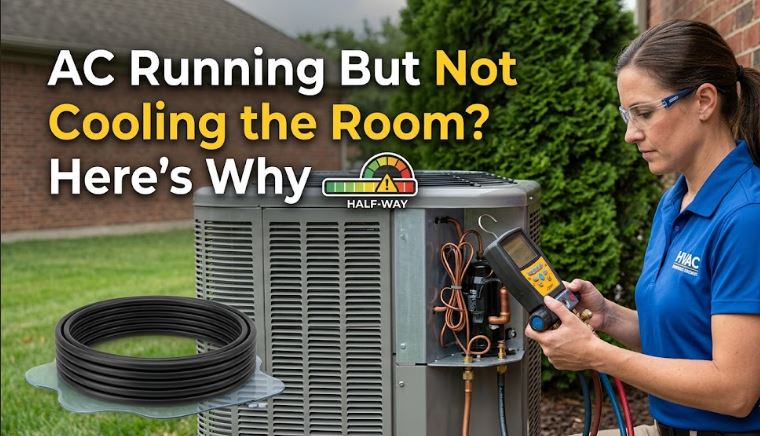
What Is Stopping Your AC From Cooling?
Use this quick table to match your specific symptom to the most likely cause before reading further.
| What You Notice | Most Likely Cause |
|---|---|
| Warm air from vents despite system running | Clogged air filter or frozen evaporator coil |
| Weak airflow from all vents | Blocked return vent, dirty filter, or failing blower motor |
| Some rooms cool, others stay warm | Leaking or disconnected ductwork |
| Outdoor unit running but no cooling inside | Low refrigerant or dirty condenser coil |
| System runs constantly but never reaches set temp | Undersized unit or thermostat fault |
| Cold air at vents but room stays warm | Leaking ductwork or poor insulation |
| AC cools for a while then stops | Frozen evaporator coil from restricted airflow |
8 Reasons Your AC is Running But Not Cooling the Room
These are the most common causes of a running AC that delivers no meaningful cooling, starting with the ones you can check and fix for free right now.
1. The Air Filter Is Clogged
A dirty air filter is the single most common cause of an AC running without cooling, and it is the first thing every HVAC technician checks on a no-cooling call.
The filter sits in the return air path and captures dust, pet hair, and debris before they reach the evaporator coil. When it packs solid, airflow across the coil drops dramatically. The coil then gets too cold, moisture freezes on its surface, and ice blocks all remaining airflow. The system runs continuously but blows nothing more than slightly cooled air because the coil is encased in ice.
Here Is How to Check and Fix It
- Pull the filter from the return air vent or air handler and hold it up to a light
- If you cannot see light through the filter material, it is time for an immediate replacement
- Replace with the correct size filter. The Filtrete 20x25x1 Air Filter MPR 1000 (View on Amazon) captures dust, pollen, and debris while maintaining strong airflow
- After replacing, switch to Fan Only mode for 30 minutes to melt any ice on the coil before switching back to Cool
- Replace filters every one to three months to prevent recurrence
2. The Thermostat Is Faulty or Mispositioned
A running AC that never reaches the set temperature often has nothing wrong mechanically. The thermostat is either reading the room temperature incorrectly or failing to communicate cycle commands properly to the system.
A thermostat placed in direct sunlight, near a lamp, or close to the kitchen reads a higher ambient temperature than the rest of the room. It keeps calling for cooling because it thinks the room is warmer than it actually is. Conversely, a thermostat with failing sensors shuts the cycle off too early and never achieves the set temperature.
Here Is How to Diagnose and Fix It
- Confirm the thermostat is set to Cool with the target temperature at least five degrees below the current room reading
- Replace the batteries even if the display looks normal, since low batteries cause erratic temperature sensing before a full failure
- Check whether the thermostat is positioned near a heat source like a sunny window, lamp, or oven
- If repositioning is not possible, a smart thermostat with remote sensor capability solves placement issues permanently. The Honeywell TH6320WF2003 T6 Pro Smart Thermostat (View on Amazon) is a reliable replacement that works with most split systems and installs in under 30 minutes
3. The Condenser Unit Is Dirty or Blocked
The outdoor condenser unit is where your AC dumps the heat it extracts from your home. When its coil fins get coated with grass clippings, leaves, cottonwood seeds, or dust, heat cannot escape efficiently. The system runs continuously but cannot complete the heat exchange process that makes cooling possible.
Vegetation growing too close to the unit causes the same problem by blocking the airflow the condenser fan needs to push heat away from the coil.
Here Is How to Clean and Clear the Condenser
- Turn the system off at the thermostat before approaching the outdoor unit
- Clear all vegetation, debris, and clippings from within two feet of the unit on all sides
- Rinse the condenser coil fins gently with a garden hose from the inside out, never from the outside in since that pushes debris deeper into the fins
- For heavy buildup, the AC Evaporator Coil Cleaner (View on Amazon) is a professional-grade foam cleaner that dissolves debris from condenser fins without requiring a pressure washer
- Allow the unit to dry for 15 minutes before restarting the system
- Trim back any shrubs or plants to maintain at least two feet of clearance permanently
4. The Evaporator Coil Is Frozen
A frozen evaporator coil is often a symptom of another problem, most commonly a clogged filter or low refrigerant, rather than a standalone failure. However, it is worth addressing as its own cause because once the coil is frozen, no amount of fixing the underlying cause will restore cooling until the ice melts.
A frozen coil encases itself in ice that blocks all airflow through the system. The air handler blows but the air barely cools, and sometimes the only sign is water pooling around the base of the indoor unit as the ice melts between cycles.
Here Is How to Defrost and Prevent Refreezing
- Turn the thermostat to Off but leave the fan set to On to run continuously
- Allow 2 to 3 hours for the coil to defrost completely before switching back to Cool
- While it defrosts, replace the air filter if it is dirty since restricted airflow is the most common cause of coil freezing
- Check that all supply and return vents throughout the home are open and unobstructed
- If the coil refreezes within a few hours of restarting, low refrigerant is the likely cause and a licensed HVAC technician needs to assess the system
5. The Vents or Return Air Are Blocked
This one is simpler than most people expect and is frequently the cause of uneven cooling where some rooms are comfortable and others stay warm regardless of how long the system runs.
Supply vents deliver cooled air into each room. Return vents pull warm air back to the air handler to be cooled again. Both directions of airflow are essential. When furniture, rugs, curtains, or stored items block either type of vent, the room loses its air exchange and stays warm even though the system is running at full capacity.
Here Is How to Restore Proper Airflow
- Walk through every room and confirm all supply vents are open and unobstructed
- Check return vents specifically for furniture pushed against them or items stored in front of them
- Ensure interior room doors are not fully sealed, since AC systems need airflow between rooms to function correctly
- Consider adding a HVAC Vent Booster Fan (View on Amazon) to rooms consistently cooler than others. These small fans fit inside standard supply vents and increase airflow to underserved rooms without modifying the ductwork
6. The Ductwork Is Leaking
Leaking ducts are responsible for some of the most baffling no-cooling complaints because the AC system itself is functioning perfectly. The cooled air simply never reaches the room because it is escaping into the attic, crawl space, or wall cavities through cracks and disconnected joints in the ductwork.
Homes with older flex duct or ductwork running through unconditioned attic space are particularly susceptible. Energy bills climbing steadily while comfort levels drop is one of the clearest signs of duct leakage.
Here Is What to Check and Do
- Feel along accessible duct runs in the attic or basement for air escaping from joints and seams
- Check that all supply and return duct connections at the air handler are firmly seated and not pulling away
- Seal accessible leaks with BOMEI PACK Aluminum Foil Tape (View on Amazon), which adheres firmly to metal ductwork at temperature extremes. Never use standard duct tape since it degrades quickly under the heat cycling of HVAC systems
- For extensive leakage or ducts in inaccessible spaces, a professional duct sealing service restores full cooling efficiency and pays for itself in energy savings relatively quickly
7. The Refrigerant Level Is Low
Safety level: Observation only. Refrigerant handling requires EPA Section 608 certification.
Refrigerant is the substance that carries heat from inside the home to the outdoor condenser. It does not get consumed during normal operation, so low refrigerant always means a leak exists somewhere in the system. A system with low refrigerant cannot absorb enough heat from the indoor air to make meaningful cooling happen, and the harder it runs the less effective it becomes.
Signs of low refrigerant include ice forming on the refrigerant lines, a hissing or bubbling sound near the indoor unit, and a system that runs constantly without ever reaching the set temperature.
Here Is What to Observe and Do
- Check the refrigerant lines running from the outdoor unit inside for ice or frost formation
- Listen near the indoor unit and outdoor unit for a hissing sound which indicates active refrigerant leakage
- If either sign is present, turn the system to Fan Only mode and call a licensed HVAC technician
- Do not attempt to add refrigerant from a consumer kit since these products cannot address the underlying leak and can damage the compressor
- A technician locates the leak, repairs it, and recharges the system to the correct level
8. The AC Unit Is Undersized for the Space
This is the one cause on this list with no repair solution, because the system is working exactly as designed. It is simply not large enough to overcome the heat load of the space it is trying to cool.
An undersized AC runs continuously at full capacity, never reaches the set temperature, and wears out its components faster than a correctly sized system would. Common triggers include a room addition that was not accounted for in the original system design, a previously uninsulated attic that was later finished as living space, or a system that was undersized from the original installation.
Here Is How to Confirm and Address It
- Note whether the AC runs without pause yet the room temperature never drops to the set point even on moderate weather days
- Check whether the problem is worse in the hottest part of the day and better in the evening, which confirms the system is simply overwhelmed by heat gain
- Add window coverings, attic insulation, or weatherstripping to reduce the heat load before considering a system upgrade
- The Blackout Thermal Curtains (View on Amazon) significantly reduce solar heat gain through windows and are one of the most cost-effective ways to reduce AC load in overheated rooms
- If efficiency improvements do not help, consult with a licensed HVAC technician about a system sizing assessment.
AC Running But Not Cooling Fix Cost Overview
| Cause | DIY Safe | Cost to Fix | Pro Service Cost |
|---|---|---|---|
| Replace clogged air filter | Yes | $8 – $25 | N/A |
| Fix thermostat or replace | Yes | Free – $40 | N/A |
| Clear blocked vents | Yes | Free | N/A |
| Clean outdoor condenser coil | Yes | Free – $15 | $80 – $150 |
| Defrost frozen evaporator coil | Yes | Free | N/A |
| Seal accessible duct leaks | Yes | $10 – $25 | $300 – $1,000 |
| Add window coverings to reduce load | Yes | $20 – $60 | N/A |
| Refrigerant leak repair and recharge | No | N/A | $250 – $600 |
| Blower motor replacement | No | N/A | $300 – $600 |
| System resizing assessment | No | N/A | $150 – $300 |
Frequently Asked Questions
Why does my AC run all day but the house stays warm?
Continuous running without reaching the set temperature almost always points to one of three causes: a clogged air filter starving the coil of airflow, low refrigerant preventing adequate heat absorption, or an undersized system overwhelmed by the heat load. Start with the filter since it is free to check and fix, then move to the condenser cleaning and refrigerant assessment.
Can a dirty outdoor unit really stop the AC from cooling inside?
Yes, significantly. The outdoor condenser needs to release the heat it extracted from your home. When its coil fins are coated with debris, that heat release is severely restricted and the refrigerant returns to the indoor coil still carrying heat it could not shed outside. The result is an indoor unit blowing air that is warmer than it should be despite the system running at full capacity.
Why is only one room in my house warm when the AC is running?
Room-specific warmth almost always points to a closed or blocked supply vent in that room, a disconnected or leaking duct serving that room, or a door that is fully sealed cutting off return air circulation. Check the vent first, then feel along any accessible duct runs serving that room for air escaping at joints before calling a technician.
How do I know if my AC is low on refrigerant?
The clearest signs are ice forming on the refrigerant lines near the indoor unit, a hissing or bubbling sound near either unit, and a system that runs continuously without ever bringing the temperature down to the set point. Refrigerant diagnosis requires a technician with a manifold gauge set. Never add consumer refrigerant without first locating and repairing the leak.
Can closing interior doors improve AC cooling?
Closing doors can actually reduce AC performance in forced-air systems by blocking the return air path the system needs. Most HVAC systems are designed for doors to remain open or at least ajar so air can circulate between the supply vents in each room and the return vents elsewhere in the home. Keeping doors open generally improves temperature distribution throughout the house.
Your Air Condtioner Can Start Cooling Today!
An AC running without cooling has a specific point of failure somewhere between the filter and the condenser, and working through the system logically from the air filter outward finds it without unnecessary service calls.
Clean the filter, check the thermostat, clear the condenser, and confirm the vents are open before considering any mechanical diagnosis. Those four free steps resolve the majority of running-but-not-cooling complaints every summer. For related reading, our complete air conditioner troubleshooting guide is your go-to resource for every major AC symptom across all leading brands.