
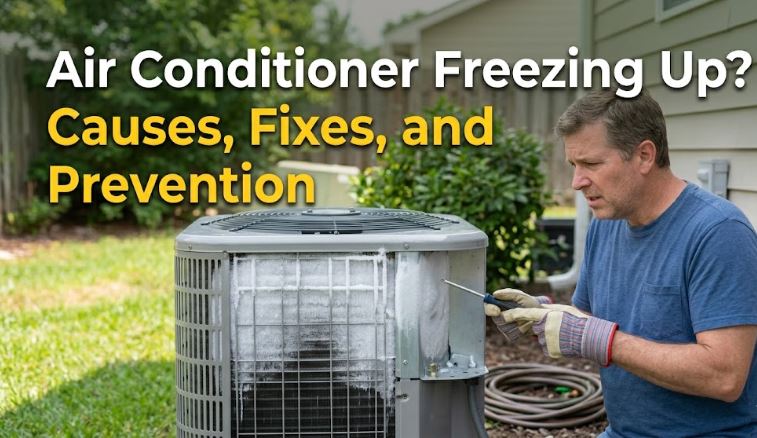
Finding ice on your air conditioner on a scorching summer day feels completely backwards. The system is supposed to cool your home, not turn itself into a glacier. Yet a frozen AC is one of the most common HVAC problems homeowners face, and it almost always happens at the worst possible time.
Here is the most important thing to understand before anything else. Ice on the coil is not the problem itself. It is a symptom. Something upstream in the system is creating conditions cold enough for moisture in the air to freeze on the evaporator coil, and that something needs to be found and fixed. Otherwise the coil will freeze again within hours of the ice melting.
The first step whenever you discover a frozen AC is always the same: turn the system off immediately. Running a frozen AC compresses ice through components not designed to handle it and risks expensive compressor damage. Switch the thermostat to Fan Only mode and let the coil thaw completely before moving to the diagnosis below.
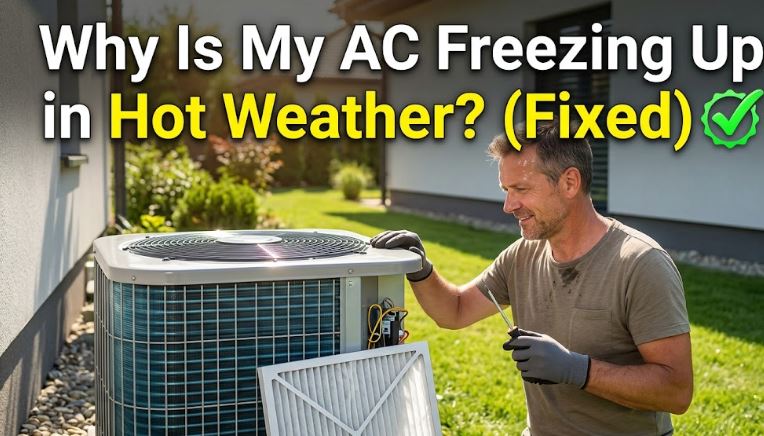
What Is Causing Your AC to Freeze Up?
Use this table to match what you are seeing to the most likely cause before reading further.
| What You Notice | Most Likely Cause |
|---|---|
| Ice on refrigerant lines and evaporator coil | Clogged air filter restricting airflow |
| Ice forms within hours of a filter change | Low refrigerant from a system leak |
| Ice only on part of the coil | Partially blocked vents or dirty evaporator coil |
| Ice forms at night, melts during the day | AC running on too low a temperature setting |
| Water pooling around the indoor air handler | Frozen coil melting and overflowing the drain pan |
| Ice on outdoor unit and refrigerant lines | Low refrigerant or restricted airflow |
| AC freezes repeatedly despite clean filter | Blower motor issue or refrigerant leak |
7 Reasons Your AC Is Freezing Up and How to Fix Each One
These are the causes behind virtually every AC freeze-up, starting with the ones you can check and correct yourself at no cost.
1. The Air Filter Is Clogged
A dirty air filter is responsible for the majority of AC freeze-ups, and it is always the first thing to check. The fix takes two minutes and costs under $25.
Your AC’s evaporator coil needs a continuous supply of warm indoor air passing over it to stay above freezing temperature. The filter sits directly in that airflow path. When it packs solid with dust, pet hair, and debris, airflow across the coil drops dramatically.
The refrigerant inside the coil gets colder than it should because there is no warm air carrying heat to absorb. Moisture from the remaining trickle of air freezes on contact with the super-cold coil surface, and the ice builds progressively until the coil is completely encased.
Here Is How to Fix It
- Turn the system off immediately and switch the fan to On to start thawing
- Pull the filter and hold it up to a light source. If you cannot see light through it, replace it immediately
- Replace with the correct size filter. The Filtrete 16x25x1 Air Filter MPR 1500 (View on Amazon) captures fine particles without restricting airflow, which is the balance that matters for freeze prevention
- Allow 2 to 3 hours for full thaw before switching back to Cool
- Change filters every 30 to 60 days during heavy use season to prevent recurrence
2. Blocked or Closed Supply Vents
This cause works exactly like a dirty filter but from the other direction. Instead of restricting airflow at the entry point, closed or blocked vents restrict it at the exit points throughout the home.
Every closed vent in the system reduces the volume of air the blower can move across the evaporator coil. Close enough vents and the coil temperature drops below freezing for the same reason it does with a clogged filter. Many homeowners close vents in unused rooms thinking it saves energy. In reality, it creates exactly the conditions that cause freeze-ups.
Here Is How to Fix It
- Walk through every room and confirm every supply vent is fully open regardless of whether the room is being used
- Move any furniture, rugs, curtains, or stored items that are positioned directly over or against vents
- Check return air vents specifically since blocking these is even more damaging to coil temperatures than blocking supply vents
- Keep all interior doors open or ajar to allow proper air circulation throughout the system
3. The Evaporator Coil Is Dirty
Even with a clean filter, the evaporator coil accumulates a fine layer of dust, pollen, and debris over months of operation. A dirty coil insulates itself from the warm air passing over it, reducing heat transfer efficiency and allowing coil temperatures to drop low enough for freezing to occur.
This cause typically develops gradually over one to two seasons rather than appearing suddenly, and it becomes more likely if the filter has been neglected for even a single season.
Here Is How to Fix It
- Turn the system completely off and let the coil thaw fully before attempting any cleaning
- Once thawed, apply AC Coil Cleaner (View on Amazon) to the coil surface. A no-rinse foaming cleaner is the correct product here since it drips into the condensate drain pan as it works without requiring you to rinse with water
- Allow the cleaner to work for 10 minutes then restart the system in Fan Only mode for 15 minutes before switching to Cool
- Annual coil cleaning as part of a professional tune-up prevents this from becoming a recurring problem
4. The Thermostat Is Set Too Low
Running the AC at an extremely low temperature setting on a humid day creates conditions that push the evaporator coil temperature toward freezing even in a system with adequate airflow and refrigerant. The lower the thermostat setting, the longer the compressor runs without cycling off, and the colder the coil gets during that extended run time.
This cause is more common in humid climates where moisture in the air provides plenty of raw material for ice formation on a coil that runs continuously at very low temperatures.
Here Is How to Fix It
- Raise the thermostat setting to 72 to 74 degrees Fahrenheit during humid conditions rather than pushing it to 65 or 68
- Switch to Fan Only mode and allow the coil to thaw completely before restarting
- Use ceiling fans to improve the perceived cooling effect at higher thermostat settings. The Honeywell Home Ceiling Fan (View on Amazon) helps circulate cooled air more effectively, making 74 degrees feel as comfortable as 70 in most rooms
- Run the AC in short cycles rather than setting it extremely low and walking away for hours
5. The Condensate Drain Line Is Clogged
This cause does not directly freeze the coil but contributes significantly to freeze-ups by allowing water to back up in the drain pan and around the coil base. A clogged condensate drain causes the float safety switch to shut the system off repeatedly, and each restart without resolving the clog creates a cycle of partial cooling and shutdown that prevents the system from maintaining stable coil temperatures.
Additionally, a backed-up drain pan allows water to contact the coil and freeze in layers during the brief periods the system does run.
Here Is How to Fix It
- Locate the condensate drain line, usually a white PVC pipe exiting the air handler
- Pour one cup of white vinegar into the drain line access port to dissolve algae and debris
- Use a wet/dry vacuum at the outdoor end of the drain line to pull the clog out from the other direction
- Clear stubborn clogs with a Drain King Blowout Adapter (View on Amazon) which attaches to a garden hose and uses water pressure to blast clogs through the line
- Pour a quarter cup of vinegar into the access port monthly during cooling season to prevent algae buildup
6. Low Refrigerant From a System Leak
Safety level: Observation only. Refrigerant handling requires EPA Section 608 certification.
Low refrigerant is the second most common cause of AC freeze-ups after airflow restriction, and it is also the most important to identify correctly because it always means a leak exists somewhere in the system. Refrigerant does not get consumed during normal operation, so a low level is never simply about topping up.
When refrigerant is low, the pressure inside the evaporator coil drops below its designed operating range. Lower pressure causes the refrigerant to boil at a lower temperature, and the coil gets significantly colder than it should. Moisture freezes rapidly on the abnormally cold coil surface even with adequate airflow.
Here Is What to Observe and Do
- After the coil thaws and a new filter is installed, run the system for 30 minutes on a day above 60 degrees Fahrenheit
- Check the refrigerant lines running from the outdoor unit to the indoor handler for frost or ice reforming on a clean system with open vents
- Listen near both units for a hissing or bubbling sound indicating active leakage
- If the coil refreezes within a few hours with a clean filter and open vents, contact a licensed HVAC technician for refrigerant diagnosis
- Do not add consumer refrigerant kits since these cannot locate or repair the underlying leak and can damage the compressor over time
7. The Blower Motor Is Weak or Failing
Safety level: Observation and filter check safe. Motor diagnosis and replacement requires a professional.
The blower motor drives the fan that pulls warm air across the evaporator coil. When it weakens from worn bearings, a failing capacitor, or a motor winding that is starting to fail, it moves significantly less air than it should even with a clean filter and open vents. The resulting reduced airflow creates the same conditions as a clogged filter, and the coil freezes for the same reason.
A weak blower motor often produces other symptoms alongside the freeze-up, including noticeably weaker airflow from all vents and a humming or grinding sound from the air handler that was not present before.
Here Is What to Observe
- After replacing the filter and opening all vents, check whether airflow from the supply vents feels noticeably weaker than it used to be
- Listen at the air handler for grinding, humming, or a labored motor sound during operation
- Hold a piece of tissue near a return vent. Strong suction indicates a healthy blower. Weak pull alongside a frozen coil points toward the motor
- Contact a licensed HVAC technician for blower motor testing and replacement if these signs are present.
AC Freeze-Up Fix Cost and DIY Overview
| Cause | DIY Safe | Fix Cost | Pro Service Cost |
|---|---|---|---|
| Replace clogged air filter | Yes | $8 – $25 | N/A |
| Open blocked or closed vents | Yes | Free | N/A |
| Clean evaporator coil | Yes | $10 – $20 | $100 – $200 |
| Raise thermostat setting | Yes | Free | N/A |
| Clear condensate drain line | Yes | Free – $25 | $80 – $150 |
| Refrigerant leak repair and recharge | No | N/A | $250 – $600 |
| Blower motor replacement | No | N/A | $300 – $600 |
Frequently Asked Questions
What should I do first when I discover my AC is frozen?
Turn the system off immediately at the thermostat and switch the fan to On mode. This is not optional. Running a frozen AC forces ice through the compressor and causes expensive mechanical damage. Switch to Fan Only and allow 2 to 3 hours for the coil to thaw completely before attempting a restart or any diagnosis.
Can I speed up the defrost process after the AC freezes?
Yes, but carefully. The Fan Only mode setting is the safest way to accelerate thawing since the blower moves warm air across the coil continuously without running the compressor. Never use a heat gun, hair dryer, or sharp tools to remove ice from the coil since even mild heat applied directly can warp the delicate aluminum fins and a sharp tool punctures the coil permanently.
Why does my AC keep freezing even after I changed the filter?
Recurring freeze-ups after a fresh filter replacement almost always point to low refrigerant from a leak. The refrigerant pressure drop creates the same coil super-cooling effect as restricted airflow, but no filter change resolves it. A licensed HVAC technician with a manifold gauge set confirms a low charge and locates the leak source for repair.
Is it safe to run the AC on Fan Only while the coil thaws?
Yes, and it is the recommended approach. Fan Only mode runs the blower without activating the compressor or refrigerant circuit. This moves warm room air across the frozen coil continuously, melting the ice into the condensate drain pan below rather than allowing it to melt slowly and overflow onto the floor around the air handler.
Can a frozen AC damage the compressor?
Yes, seriously so. A fully frozen evaporator coil can cause liquid refrigerant to return to the compressor rather than vapor, a condition called slugging that can crack the compressor valves or connecting rods immediately. This is why shutting the system off the moment ice is discovered is the most important step. Compressor replacement typically costs $1,200 to $2,500, making early shutdown one of the most valuable habits an AC owner can develop.
Unfreeze Your Air Conditioner Today!
An AC freezing up is the system signaling that something has disrupted its carefully balanced operating conditions. The ice is the result, not the problem, and melting it without addressing the underlying cause simply restarts the clock on the next freeze-up.
Thaw the coil, replace the filter, open every vent, and raise the thermostat to a moderate setting. If those free steps do not prevent the next freeze within 24 hours of restarting, low refrigerant or a failing blower motor is the likely cause and a technician is the next call. For other AC issues worth fixing, check out our latest air conditioner troubleshooting guide, where we share tips and recommendations for solving everyday AC problems.