

There is something uniquely frustrating about an AC that runs perfectly well in every way except the one way that matters: actually cooling the air. The fan blows, the system hums, the thermostat ticks along, but the air coming from the vents is warm or even hot.
The reason this happens is that cooling and circulation are two completely separate functions. The blower fan can run and distribute air throughout the home independently of whether the refrigeration cycle that removes heat from that air is operating correctly. When something disrupts the refrigeration side of the system, you get air movement without temperature reduction.
Work through the causes below in order. Several are completely free to check and fix in under five minutes.
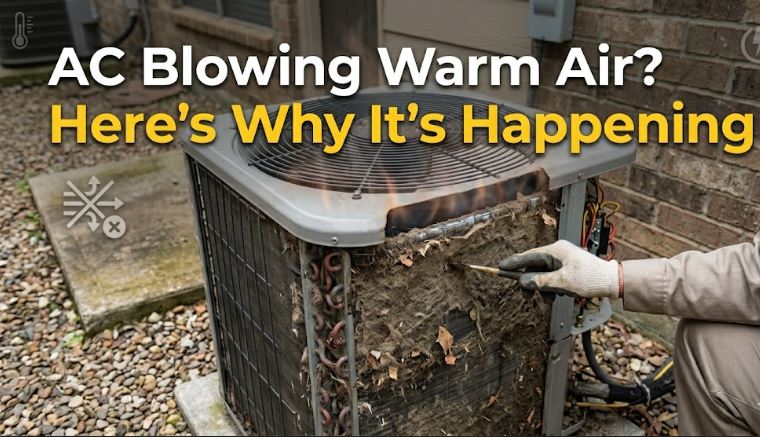
Why Is My AC Blowing Warm Air Instead of Cold?
Here’s a summary of why your air conditioner blows warm air and not cold air.
| What You Notice | Most Likely Cause |
|---|---|
| Warm air from all vents, outdoor unit not running | Outdoor unit lost power or thermostat set incorrectly |
| Warm air despite outdoor unit running normally | Dirty condenser coil or low refrigerant |
| Slightly warm air that gradually worsens | Clogged air filter or frozen evaporator coil |
| Warm air from some vents, cool from others | Leaking ductwork or blocked supply vents |
| Warm air after system ran fine all season | Refrigerant leak or failing capacitor |
| Air feels uncooled but thermostat looks correct | Fan set to On instead of Auto |
8 Reasons Your AC Is Blowing Warm Air and How to Fix Each One
These are the causes behind virtually every case of an AC blowing warm air, starting with the free checks every homeowner should complete before spending anything.
1. The Thermostat Is Set Incorrectly
This resolves more warm air calls than any other single cause, and it takes about thirty seconds to check. Before assuming anything mechanical has failed, confirm the thermostat is telling the system to cool.
A thermostat accidentally switched to Heat mode blows genuinely hot air from the vents. A thermostat set to Fan Only circulates uncooled room-temperature air that feels warm on a hot day. A set temperature above the current room temperature means the system has no reason to run the cooling cycle at all and simply blows uncooled air through the fan.
Here Is How to Check and Fix It
- Confirm the system mode is set to Cool rather than Heat, Fan Only, or Auto
- Set the target temperature at least five degrees below the current room reading to confirm a cooling call
- Switch the fan setting from On to Auto. The On setting runs the fan continuously regardless of whether the compressor is operating, which means uncooled air blows between compressor cycles
- Replace thermostat batteries even if the display looks normal, since low batteries cause erratic mode behavior before a complete failure
- If the thermostat settings look correct but warm air continues, move to the next cause
2. The Outdoor Unit Has Lost Power
This is one of the most deceptive causes of warm air because the indoor system continues running completely normally while the outdoor unit sits completely off. The indoor blower circulates air through the home, but without the outdoor compressor and condenser operating, no heat is being removed from that air. The result is the indoor fan blowing warm uncooled air through every vent.
The clearest sign of this cause is standing near the outdoor unit and hearing nothing while the indoor air handler is running.
Here Is How to Check and Fix It
- Go to the outdoor condenser unit and listen and look for any sign of operation. A running condenser produces a steady hum and the fan blade should be spinning visibly
- If the outdoor unit is completely silent and still while the indoor unit runs, check the circuit breaker panel for a tripped breaker labeled AC, Air Conditioner, or Condenser
- Flip any tripped breaker fully to Off, wait 30 seconds, then flip firmly back to On
- Also check the outdoor disconnect box mounted near the condenser unit. The pull-out fuse block or disconnect switch must be fully seated and in the On position
- If the breaker trips again immediately after resetting, do not reset it a second time and contact a licensed HVAC technician since repeated tripping signals an underlying electrical fault
3. The Air Filter Is Clogged
A severely clogged filter does not just reduce cooling efficiency. It causes the evaporator coil to freeze over from a lack of airflow, and a frozen coil produces exactly the warm air symptom described in our post on AC freezing up. Additionally, restricted airflow forces the system to work much harder and overheat, triggering safety shutoffs that interrupt cooling.
What starts as a gradual reduction in cooling effectiveness becomes warm air blowing from every vent as the coil progressively ices over and the system struggles against the restriction.
Here Is How to Fix It
- Pull the air filter from the return vent or air handler and hold it to a light source
- A filter you cannot see light through needs immediate replacement
- The Filtrete 20x25x1 Air Filter MPR 1500 (View on Amazon) maintains strong airflow while capturing the fine particles that accumulate on evaporator coils and restrict performance
- After replacing, switch to Fan Only mode for 30 minutes to thaw any ice that has formed on the coil before switching back to Cool
- Replace filters every 30 to 60 days during the cooling season without exception
4. The Condenser Coil Is Dirty or Blocked
The outdoor condenser unit is where your AC releases the heat it extracted from your home into the outside air. When the condenser coil fins get coated with dirt, grass clippings, cottonwood seeds, or pollen, that heat release process becomes increasingly inefficient. The refrigerant returns to the indoor coil still carrying heat it could not shed outside, and the air blowing from your vents is warmer than it should be despite the system running at full capacity.
This cause develops gradually over a season and is often the reason an AC that cooled effectively in spring struggles by midsummer without any mechanical change.
Here Is How to Clean and Clear the Condenser
- Turn the system off at the thermostat before approaching the outdoor unit
- Clear all vegetation, clippings, and debris from within two feet of the unit on all sides
- Rinse the condenser coil fins gently with a garden hose from the inside outward, never from the outside in since pushing debris deeper into the fins worsens the restriction
- For heavy buildup, the Air Pure Shop AC Evaporator Coil Cleaner (View on Amazon) dissolves debris from condenser fins without the need for pressure washing and is metal-safe.
- Allow 15 minutes to dry before restarting and confirm the outdoor fan runs freely before the first cycle
5. The Evaporator Coil Is Dirty
While the condenser handles heat rejection outside, the evaporator coil inside the air handler is where heat absorption from indoor air actually happens. When the evaporator coil accumulates a layer of dust, pollen, and debris over one or two seasons of operation, it insulates itself from the warm air passing over it. Heat transfer efficiency drops, the air leaving the coil is warmer than it should be, and eventually cooling effectiveness drops enough that the air from the vents feels warm rather than cool.
This cause typically develops gradually across one to two seasons and often coincides with a period of neglected filter changes that allowed more particles to reach the coil.
Here Is How to Clean It
- Turn the system completely off and allow the coil to come to room temperature before cleaning
- Apply AC Evaporator No-Rinse Coil Cleaner (View on Amazon) to the coil surface through the air handler access panel. A no-rinse foaming cleaner drips into the condensate drain pan as it works without requiring water rinsing
- Allow the cleaner 10 minutes to work then restart on Fan Only for 15 minutes before switching to Cool
- Annual professional tune-ups that include coil cleaning prevent this from becoming a recurring cause of warm air
6. The Refrigerant Level Is Low
Safety level: Observation only. Refrigerant work requires EPA Section 608 certification.
Refrigerant is the substance that physically carries heat from inside the home to the outdoor condenser for release. It does not get consumed during normal operation, so low refrigerant always means a leak exists somewhere in the system. A system running low cannot absorb adequate heat from the indoor air no matter how efficiently everything else operates, and the air leaving the evaporator coil is warmer than it should be.
As refrigerant level drops further, the evaporator coil gets progressively colder from the pressure drop rather than warmer, which eventually leads to freezing rather than just warm air. But in early-stage refrigerant loss, warm air from the vents without obvious ice is the primary symptom.
Here Is What to Observe and Do
- Check the refrigerant lines near the indoor air handler for any frost or ice forming despite a clean filter and open vents
- Listen near both units for a hissing or bubbling sound indicating active leakage
- Note whether the warm air symptom has appeared gradually over a season or appeared suddenly, since gradual onset suggests a slow leak while sudden onset suggests a more significant failure
- Turn the system to Fan Only mode and contact a licensed HVAC technician for refrigerant diagnosis and leak repair
- Do not add consumer refrigerant products since they cannot locate or fix the underlying leak
7. The Capacitor or Compressor Is Failing
Safety level: Observation only. Electrical component repair requires a licensed HVAC technician.
The capacitor provides the electrical boost that starts the compressor and condenser fan on each cooling cycle. A capacitor in the early stages of failure allows the system to start but cannot sustain the compressor at full operating efficiency. The compressor runs but underperforms, and the refrigeration cycle produces less cooling than required to lower the air temperature to the set point.
A failing compressor itself produces a similar warm air outcome since the compressor is what maintains refrigerant pressure throughout the cooling cycle. Both produce warm air without the obvious shutdown of a complete failure.
Here Is What to Observe
- Note whether the warm air is accompanied by a buzzing sound from the outdoor unit, which points toward capacitor stress
- Listen for a chattering or ticking sound from the outdoor compressor area when the system starts, which suggests the compressor is struggling to engage
- Check whether the outdoor condenser fan is spinning freely and at full speed. A fan turning slowly alongside warm air suggests the capacitor is supplying insufficient power to both the fan motor and compressor
- Contact a licensed HVAC technician for capacitor and compressor testing. Do not open the outdoor unit cabinet since the capacitor retains a dangerous charge even after power is disconnected
8. The Ductwork Is Leaking Cooled Air Before It Reaches the Vents
This is the cause that produces warm air from the vents when the entire refrigeration system is working perfectly. The AC generates cold air at the air handler, but that cold air escapes into the unconditioned attic or crawl space through cracks and disconnected joints in the ductwork before reaching the living areas. By the time air makes it to the supply vents, it has mixed with hot attic air and arrives warm.
Leaking ducts also allow hot attic air to be pulled into the return side of the system, pre-warming the air before it even reaches the evaporator coil. Both directions of leakage reduce cooling effectiveness dramatically and drive energy costs higher simultaneously.
Here Is How to Find and Fix It
- Feel along accessible duct runs in the attic or basement while the system is running for air escaping from joints, seams, or connection points
- Check that all supply and return duct connections at the air handler cabinet are firmly seated and not pulling away from the unit
- Seal accessible leaks with Nashua 324A HVAC Foil Tape (View on Amazon) which adheres firmly through the temperature extremes of HVAC operation. Never use standard duct tape since it deteriorates rapidly under heat cycling and eventually falls off entirely
- For duct leakage in inaccessible wall cavities or long attic runs, professional duct sealing using aerosol sealant is the most effective and permanent solution
AC Warm Air Fix Cost Overview
| Cause | DIY Safe | Fix Cost | Pro Service Cost |
|---|---|---|---|
| Correct thermostat settings | Yes | Free | N/A |
| Reset outdoor unit breaker | Yes | Free | N/A |
| Replace clogged air filter | Yes | $8 – $25 | N/A |
| Clean condenser coil | Yes | Free – $15 | $80 – $150 |
| Clean evaporator coil | Yes | $10 – $20 | $100 – $200 |
| Seal accessible duct leaks | Yes | $10 – $20 | $300 – $1,000 |
| Capacitor replacement | No | N/A | $150 – $300 |
| Refrigerant leak repair and recharge | No | N/A | $250 – $600 |
| Compressor repair or replacement | No | N/A | $1,500 – $2,500 |
Frequently Asked Questions
Why does my AC blow cold air in the morning but warm air by afternoon?
This almost always points to the outdoor condenser unit overheating during the hottest part of the day. A condenser coil coated with dirt and debris manages to operate adequately in the cooler morning temperatures but reaches its thermal limit as the day heats up, triggering the high-pressure safety switch. Clean the condenser coil and ensure two feet of clear airflow space on all sides to resolve this time-of-day pattern.
My AC just started blowing warm air suddenly. What is the most likely cause?
A sudden onset rather than gradual worsening almost always points to either the outdoor unit losing power from a tripped breaker, or the thermostat settings changing accidentally. Check both before considering any mechanical fault. A sudden onset alongside a hissing sound points to a refrigerant leak that should be addressed by a licensed technician immediately.
Can I tell whether my AC has low refrigerant without a technician?
Partially. The cup of water test gives a useful field indication: place a thermometer in a supply vent while the system runs. A healthy system on a moderate day should produce air 15 to 20 degrees Fahrenheit cooler than the return air temperature. Air that is barely cooler than the room temperature alongside a clean filter and clear condenser suggests inadequate refrigerant. However, refrigerant diagnosis and recharging require a manifold gauge set and EPA certification, so technician involvement is always necessary for the actual repair.
Why does my AC blow warm air only from certain vents?
Vent-specific warm air almost always points to a disconnected or leaking duct serving those specific vents, or a supply damper in that duct run that has closed accidentally or failed shut. Check that the relevant supply vent is fully open, then feel along the accessible portion of its duct run for air escaping at joints before calling a technician.
Does running the fan on On instead of Auto really make the air feel warm?
Yes, noticeably so. The Auto setting only runs the fan when the compressor is actively cooling, which means every cubic foot of air through the vents has been cooled. The On setting runs the fan continuously, including the periods between compressor cycles when the coil is warming back up. Air blown during those between-cycle periods is effectively room temperature rather than cooled, creating an overall sensation of warm air even though the system is technically operating correctly.
Youe AC Can Start Blowing Cold Air Today!
An AC blowing warm air has a clear diagnostic hierarchy: start with the thermostat settings and the air filter since those two free checks resolve the majority of warm air complaints before anything more involved is considered.
From there, confirm the outdoor unit has power, clean the condenser, and check the ductwork before drawing any conclusions about refrigerant or compressor issues. Then check out our complete air conditioner troubleshooting guide for other issues that air conditioning units face on a day-to-day basis.