
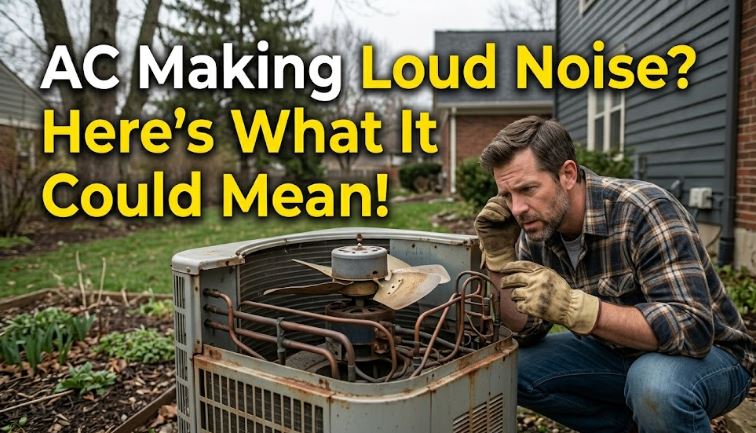
A quiet hum from the outdoor unit and a gentle whoosh of air through the vents is normal. Everything beyond that is your AC trying to communicate a problem. The good news is that different types of loud noises point to very different causes, and knowing which sound you are hearing dramatically shortens the diagnostic process.
This guide is organized by sound type because that is the most useful starting point. Match what you are hearing to the right cause and you avoid spending time and money investigating components that are working perfectly fine.
One rule applies regardless of the sound: if you hear loud banging, electrical crackling, or hissing alongside a burning smell, turn the system off at the thermostat and the breaker immediately. Some noise causes are dangerous to ignore even for a few minutes.
What Type of Loud Noise Is Your AC Making?
| Noise Type and Location | Most Likely Cause |
|---|---|
| Rattling from outdoor unit | Debris inside condenser or loose panels and screws |
| Loud banging from outdoor unit | Loose or broken internal compressor component |
| Squealing from indoor air handler | Worn blower belt or dry blower motor bearings |
| Buzzing from outdoor unit | Failing capacitor, contactor, or loose electrical connection |
| Hissing from indoor or outdoor unit | Refrigerant leak or high-pressure buildup |
| Clicking when turning on or off | Normal relay operation or failing thermostat |
| Repeated clicking that does not stop | Failing capacitor preventing compressor startup |
| Banging from ductwork | Normal thermal expansion or loose duct joints |
8 Loud AC Noises, Their Causes, and How to Fix Each One
These are the most common loud noises an AC system produces and what each one means.
1. Rattling From the Outdoor Condenser Unit
Rattling is the most common AC noise complaint and also the most likely to have a simple, free fix. Start here before drawing any conclusions about mechanical failure.
Leaves, twigs, seed pods, and cottonwood debris are pulled into the outdoor condenser fan during operation and rattle against the fan blades or housing continuously during the cycle. Loose access panels, screws that have worked free from vibration, and worn rubber vibration isolators under the unit also produce rattling that sounds similar to debris-related noise from outside.
Here Is How to Fix It
- Turn the system off at the thermostat and the outdoor disconnect before approaching the unit
- Clear all vegetation and debris from within two feet of the unit on all sides
- Remove the top grille by unscrewing the mounting screws around the perimeter and look inside the unit for leaves, twigs, or seed debris around the fan blades
- Remove any debris carefully by hand then replace the grille and tighten all screws firmly
- Tighten any loose access panel screws on all sides of the unit
- Place AC Unit Rubber Vibration Isolation Pads (View on Amazon) under the condenser base to dampen vibration that loosens panels and hardware over time
- If rattling persists after cleaning and tightening, a bent fan blade or failing fan motor bearing requires a professional technician
2. Loud Banging From the Outdoor Unit
Banging is one of the sounds on this list that warrants shutting the system off immediately rather than running through a gradual diagnosis. Loud, persistent banging from the outdoor unit almost always points to a mechanical failure rather than a maintenance issue.
The most common sources are a loose or broken compressor piston or connecting rod bouncing inside the compressor housing, a fan blade that has bent and is striking the unit housing with every rotation, or an internal compressor component that has become severely unbalanced. All three cause rapid additional damage if the system continues running.
Here Is What to Do
- Turn the system off at the thermostat and breaker immediately
- Look through the top grille at the condenser fan blades for any that appear bent, cracked, or are visibly out of alignment with the others
- A bent fan blade striking the housing is a professional repair since it requires replacement of the blade or motor assembly
- Banging that cannot be attributed to a visible fan blade issue almost certainly originates from inside the compressor, which requires a licensed HVAC technician to diagnose and repair
- On compressors over ten years old, a banging compressor often signals the end of serviceable life rather than a repairable fault.
3. Squealing From the Indoor Air Handler
A squealing sound from the indoor unit is the AC equivalent of a car with worn brakes. It is telling you that two surfaces are in friction-based contact they were not designed to maintain, and the longer it runs that way the more wear accumulates.
The two most common sources on the indoor side are a worn or slipping blower belt on older belt-drive air handlers, and dry blower motor bearings on direct-drive systems. Both produce a high-pitched squeal that is clearly audible from inside the home during operation.
Here Is What to Check and Do
- Locate the indoor air handler and listen to confirm the squeal originates from this unit rather than the outdoor condenser
- For older systems with a belt-drive blower, turn the system off and inspect the belt through the access panel for fraying, glazing, or visible cracking. Check out the most suitable Blower Belt Replacement on Amazon.
- For direct-drive systems where the motor sits directly on the blower shaft, squealing bearings require professional motor replacement since lubricating sealed bearings on residential HVAC motors is not a lasting repair
- Do not continue running a squealing air handler since bearing failure leads to complete motor seizure and potential blower wheel damage
4. Buzzing From the Outdoor Unit
A buzzing or humming sound from the outdoor condenser that is louder than the normal operational hum almost always points to an electrical component under stress. Unlike rattling, which is mechanical, buzzing in this context is almost exclusively electrical in origin.
The most common sources are a capacitor beginning to fail, a contactor with pitted or corroded contact points, loose electrical connections vibrating under current flow, or a condenser fan motor whose bearings are starting to wear. Each produces a buzzing quality rather than the grinding of a mechanical contact.
Here Is What to Observe and Do
- Confirm the buzzing comes from the outdoor unit specifically rather than the indoor air handler or ductwork
- Note whether the outdoor fan is running when the buzzing is present. Fan running with buzzing suggests a capacitor or electrical issue. Fan not running but compressor buzzing suggests a capacitor failure preventing fan startup
- Turn the system off and check the exterior of the outdoor unit for any obviously loose wiring connections visible without opening the cabinet
- Do not open the outdoor unit cabinet for any internal inspection or repair. The capacitor retains a dangerous electrical charge even after the power is disconnected
- Contact a licensed HVAC technician for electrical diagnosis. Capacitor replacement typically costs $150 to $300 including labor and is one of the most common professional AC repairs
5. Hissing From the Indoor or Outdoor Unit
Safety level: Turn off system immediately. Refrigerant work requires EPA Section 608 certification.
Hissing from an AC system has two possible sources and both require prompt attention. A hissing sound from the refrigerant lines or either unit almost always indicates refrigerant escaping from a leak under pressure. A hissing or screaming sound specifically from the compressor may indicate dangerous high-pressure buildup inside the compressor that requires emergency shutdown.
The refrigerant leak version produces a steady, moderate hiss that is most noticeable when the compressor is running. The high-pressure compressor version produces a louder, more urgent sound and the compressor may have a built-in high-pressure switch that shuts it off automatically.
Here Is What to Do
- Turn the system off at the thermostat and breaker immediately upon hearing hissing
- Do not attempt to locate or inspect the source of a refrigerant leak yourself since refrigerant under pressure is harmful to inhale and requires professional handling
- Contact a licensed HVAC technician for refrigerant leak detection, repair, and system recharge
- A screaming or wailing compressor sound specifically requires emergency shutdown and immediate professional assessment since high-pressure buildup can cause the compressor to rupture under extreme conditions
6. Repeated Clicking That Does Not Stop
A single click when the AC starts or stops is the sound of the relay or contactor switching, and it is completely normal. The sound you are listening for that signals a problem is rapid, repeated clicking that continues for more than a few seconds at startup without the compressor successfully engaging.
That repeated clicking pattern is the electrical signature of a failing capacitor. The contactor receives the start signal and clicks closed, the capacitor attempts to provide the startup surge, fails to deliver enough charge, the compressor does not start, and the whole sequence repeats. The result is a rapid series of clicks from the outdoor unit with no compressor engagement and no cooling.
Here Is What to Do
- Count the time between the start command and the clicking. Rapid clicking beginning immediately at startup and continuing for more than five seconds without the compressor engaging confirms the capacitor pattern
- Turn the system off to prevent the repeated failed startups from stressing the compressor windings
- Contact a licensed HVAC technician for capacitor testing and replacement. Do not attempt to test or replace the capacitor yourself since it stores a lethal electrical charge even after the power is disconnected
- Note that the AC short cycling post covers the related symptom where the compressor does start but runs for only a few minutes before repeating the cycle
7. Banging or Popping From the Ductwork
Not all loud AC noises come from the mechanical units. Ductwork throughout the home makes its own sounds during operation, and distinguishing normal duct noise from a genuine problem saves unnecessary service calls.
Normal duct sounds include a light popping or ticking when the system first starts as metal ducts expand slightly from the temperature change of cooled air flowing through them. These sounds are brief, occur only at startup, and fade as the duct reaches operating temperature. Duct sounds that are louder than a light tick, persist throughout the cycle, or produce a significant bang point to a structural issue rather than normal expansion.
Here Is What to Check and Fix
- Listen to determine whether the sound is a brief startup tick or a continuous noise throughout the cycle
- Brief startup ticking from supply vents is normal and requires no action
- Loud popping at startup points to undersized duct sections creating pressure fluctuations as the blower engages. An HVAC technician can assess duct sizing during an annual tune-up
- Rattling from accessible duct runs in the attic or basement points to loose joint connections. Secure loose joints with BOMEI PACK Aluminum Foil Tape (View on Amazon), which adheres firmly through the temperature extremes of HVAC operation. Never use standard duct tape since it degrades rapidly from heat cycling
- A banging sound from a specific duct location that is consistent and loud points to a loose or failed damper blade inside the duct that needs professional replacement
8. Grinding From the Indoor Air Handler or Outdoor Unit
Grinding is one of the clearest sounds in the AC noise diagnostic vocabulary because it almost always means metal-on-metal contact that was not designed to happen.
Inside the air handler, grinding comes from a blower wheel that has slipped on its motor shaft and is now scraping against the blower housing on every rotation. In the outdoor unit, grinding comes from condenser fan motor bearings that have completely failed, allowing the motor shaft to wobble against the motor housing as it turns.
Here Is What to Do
- Turn the system off immediately. Grinding causes rapid additional damage to motor windings, blower housings, and fan assemblies with every minute of continued operation
- For indoor grinding, check whether the blower wheel is centered in its housing through the access panel. A visibly off-center wheel that is contacting the housing has slipped its set screw and needs reseating or replacement
- For outdoor grinding from the condenser fan motor, the motor bearings have failed and the motor needs professional replacement
- Do not restart the system until the grinding source is identified and repaired. Continued grinding destroys the blower wheel or fan blade in addition to the motor, turning a motor replacement into a motor plus wheel replacement
AC Loud Noise Fix Cost and Safety Overview
| Noise Type | DIY Safe | Fix Cost | Pro Service Cost |
|---|---|---|---|
| Clear debris from condenser | Yes | Free | N/A |
| Tighten loose panels and screws | Yes | Free | N/A |
| Add vibration isolation pads | Yes | $15 – $30 | N/A |
| Seal loose duct joints with foil tape | Yes | $10 – $20 | N/A |
| Blower belt replacement | Yes | $8 – $15 | $80 – $150 |
| Capacitor replacement | No | N/A | $150 – $300 |
| Condenser fan motor replacement | No | N/A | $200 – $400 |
| Blower motor replacement | No | N/A | $300 – $600 |
| Compressor repair or replacement | No | N/A | $1,500 – $2,500 |
| Refrigerant leak repair | No | N/A | $250 – $600 |
Frequently Asked Questions
Is it normal for an AC to make some noise when it starts?
Yes. A single click at startup from the relay or contactor, a brief pop from ductwork expanding, and a steady hum from the compressor and fan are all completely normal. What is not normal is any noise that is new, significantly louder than before, or persistent throughout the cycle when it was not previously present.
My AC suddenly started making a loud noise it never made before. Should I turn it off?
If the new noise is banging, hissing, grinding, or repeated clicking without compressor engagement, yes. Turn the system off at the thermostat and breaker and investigate before restarting. A sudden onset of loud noise almost always signals a component failure or foreign object rather than a gradual wear issue, and continued operation accelerates the damage significantly.
Can debris really cause that much noise in my outdoor unit?
Yes, surprisingly so. A single twig caught between a fast-spinning condenser fan blade and the housing produces a dramatic rattling noise that sounds far more serious than it is. Clearing the debris takes two minutes and costs nothing. This is the most common cause of sudden loud outdoor unit noise and also the easiest to resolve, which is why clearing debris is always the first check on an outdoor unit noise complaint.
Why does my AC make noise at night but not during the day?
Noise that appears at night and disappears during the day almost always comes from ductwork. As the outdoor temperature drops at night, the temperature differential between the cooled air inside the ducts and the surrounding structure increases. This causes more significant thermal expansion and contraction that produces louder popping or ticking from metal duct sections. This is normal unless the sound is a dramatic bang rather than a light tick.
How do I describe my AC noise to a technician so they can diagnose it faster?
Note the following details before calling: where the sound comes from (indoor or outdoor unit, or ductwork), what type of sound it is (rattle, bang, squeal, buzz, hiss, click, grind), when it occurs (startup only, throughout the cycle, shutdown only, or constant), how long it has been happening, and whether it is accompanied by reduced cooling performance. Those five data points allow a technician to arrive with the right tools and parts for the most likely cause rather than discovering the problem from scratch on site.
Match the AC Sound to the Cause and Act Accordingly
An AC making a loud noise is always communicating something specific, and the sound type is the most useful diagnostic tool available. Rattling almost always means debris or loose hardware. Buzzing almost always means electrical stress. Hissing almost always means refrigerant. Grinding always means stop the system immediately.
Start with the free external checks for rattling and loose panels before concluding anything needs professional attention. We also explore many other AC problems you can troubleshoot at home in our latest air conditioner troubleshooting guide. So, check it when dealing with other air conditioning problems.