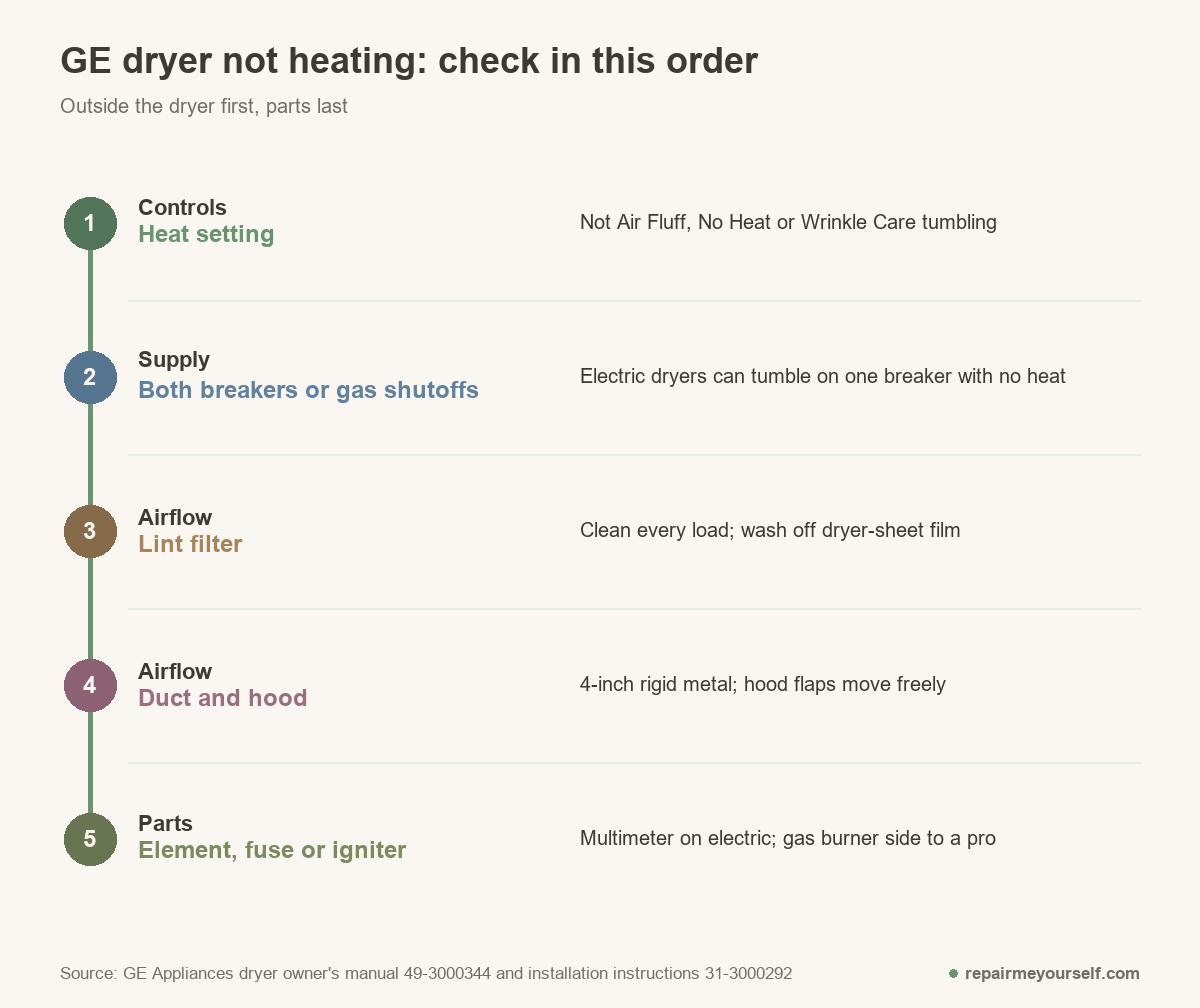
A GE dryer not heating while the drum still turns is often a power or airflow problem, not a dead part. GE’s own manual lists a tripped breaker first: an electric dryer can tumble on one breaker and still have no heat.
So start with the free checks. Then work your way in to the parts, the way a tech would.
Gas or electric? Start with the right supply
Your first job is to know which dryer you have. An electric GE dryer has a thick 240-volt cord. A gas model has a gas line and a regular plug.
The heat source decides what you check first.
GE’s owner’s manual has a troubleshooting table for “Dryer doesn’t heat” that covers both:
| Dryer type | What GE’s manual blames | What it says to do |
|---|---|---|
| Electric | Blown fuse or tripped breaker; the dryer may tumble but not heat | Replace both fuses or reset both breakers |
| Gas | Gas service is off | Make sure the shutoff at the dryer and the main shutoff are fully open |
| Gas (LP) | Empty tank or a utility interruption | Refill or replace the tank; heat should return when service is restored |
| Either | No heat temperature selected | Select another heat setting |
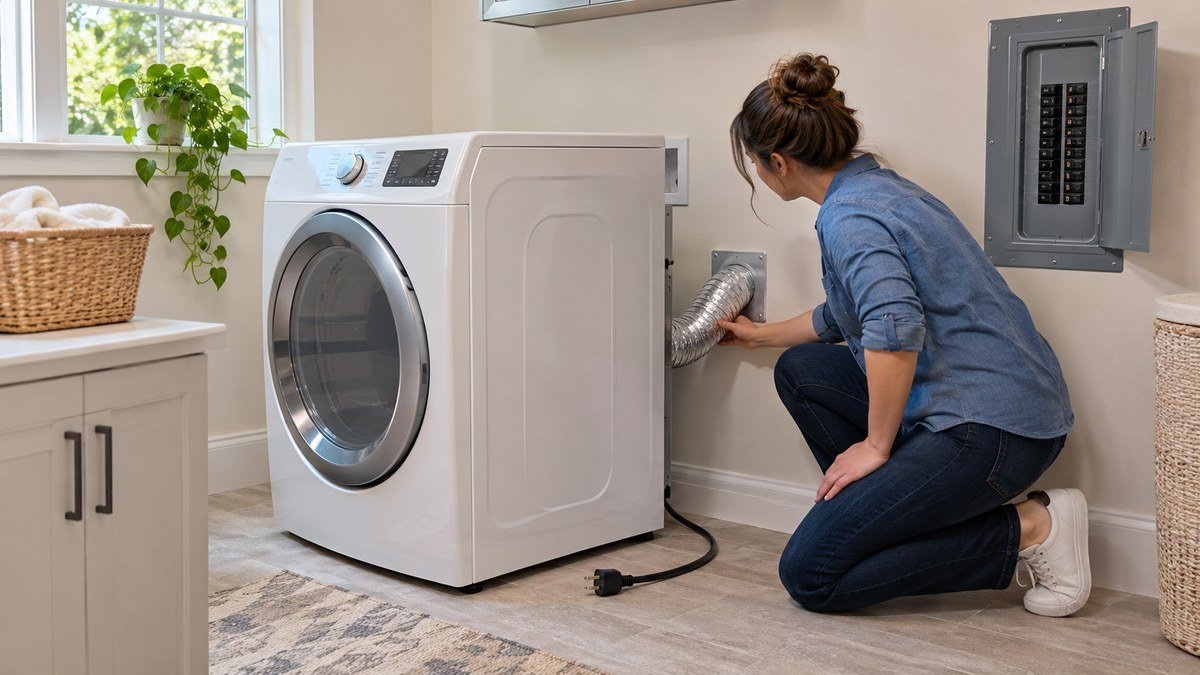
On an electric dryer, go to your panel and find the dryer breaker, which is a double breaker, and switch it fully off and then back on even if it looks fine. Don’t trust the handle position.
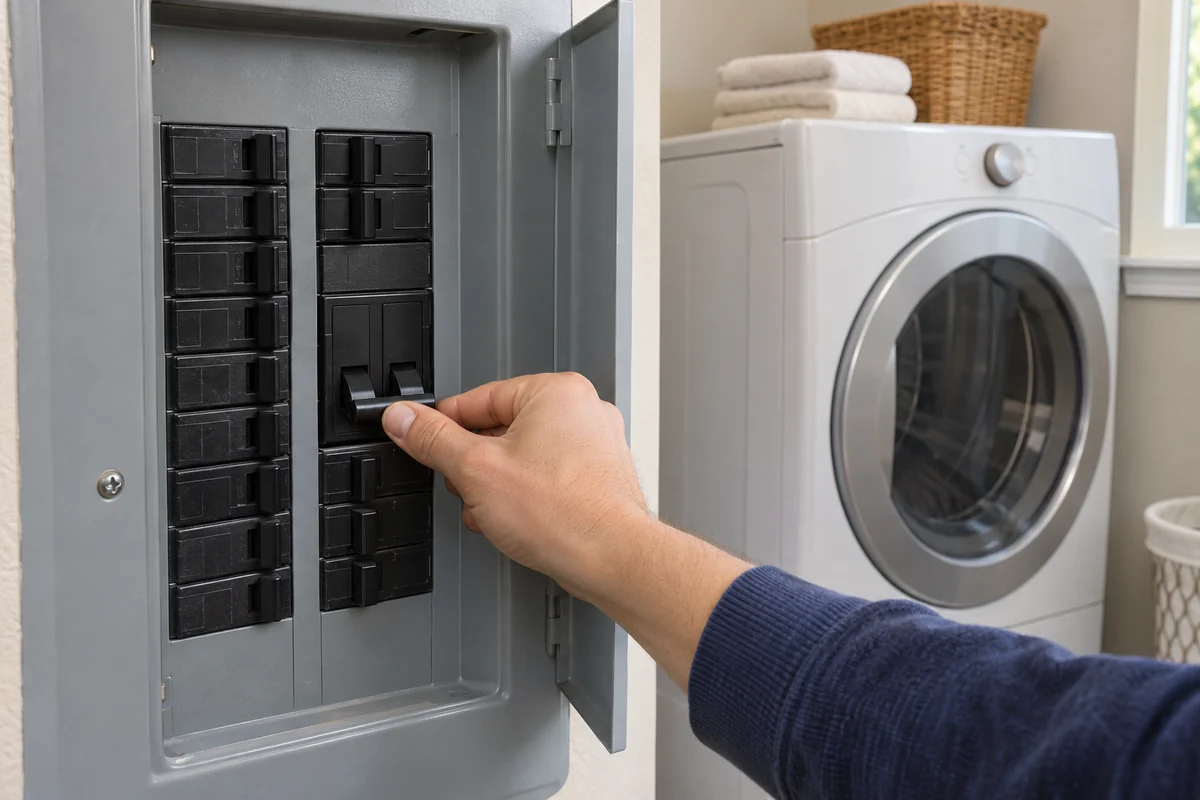
GE’s note is plain: “Some electric dryers use 2 fuses/breakers, make sure both are operating.”
Make sure it isn’t set to tumble without heat
Before you unplug anything, look at the controls. Did someone use Air Fluff last? GE dryers have settings that tumble on purpose with no heat, and you can easily leave one on.
- Air Fluff or No Heat. GE’s manual says Air Fluff gives 10 minutes of tumbling with no heat. No Heat is the temperature setting that goes with it.
- Wrinkle Care. It adds no-heat tumbling after the clothes are dry, about an hour on one GE model and about 15 minutes on another.
- The cool-down. The last part of every cycle runs without heat, so cool air at the end is normal.
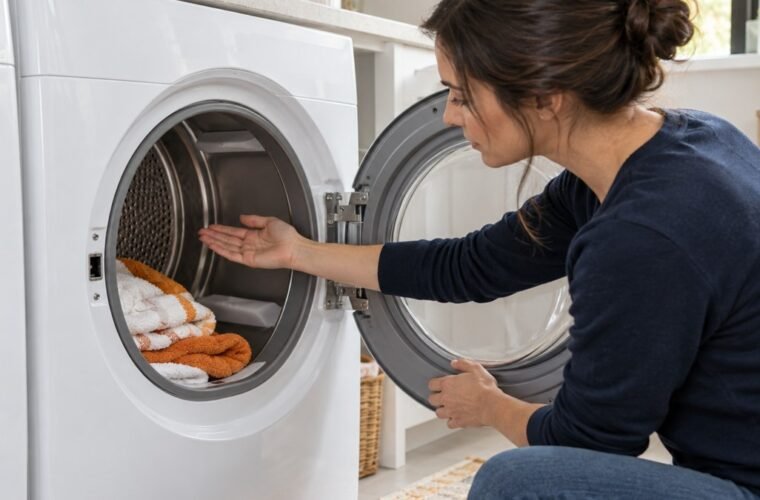
Then I’d run a regular cycle on high heat with a damp towel inside and feel the air at the lint filter after a few minutes. If it’s warm, your heat is working, so look at drying time and the vent instead.
Clear the lint filter and the vent
A blocked vent doesn’t always stop the heat outright, but it causes most of the slow drying I’ve seen. On the calls where I found a blown thermal fuse, a choked vent was usually the reason.
That’s why I clean the vent before I fit a new fuse.
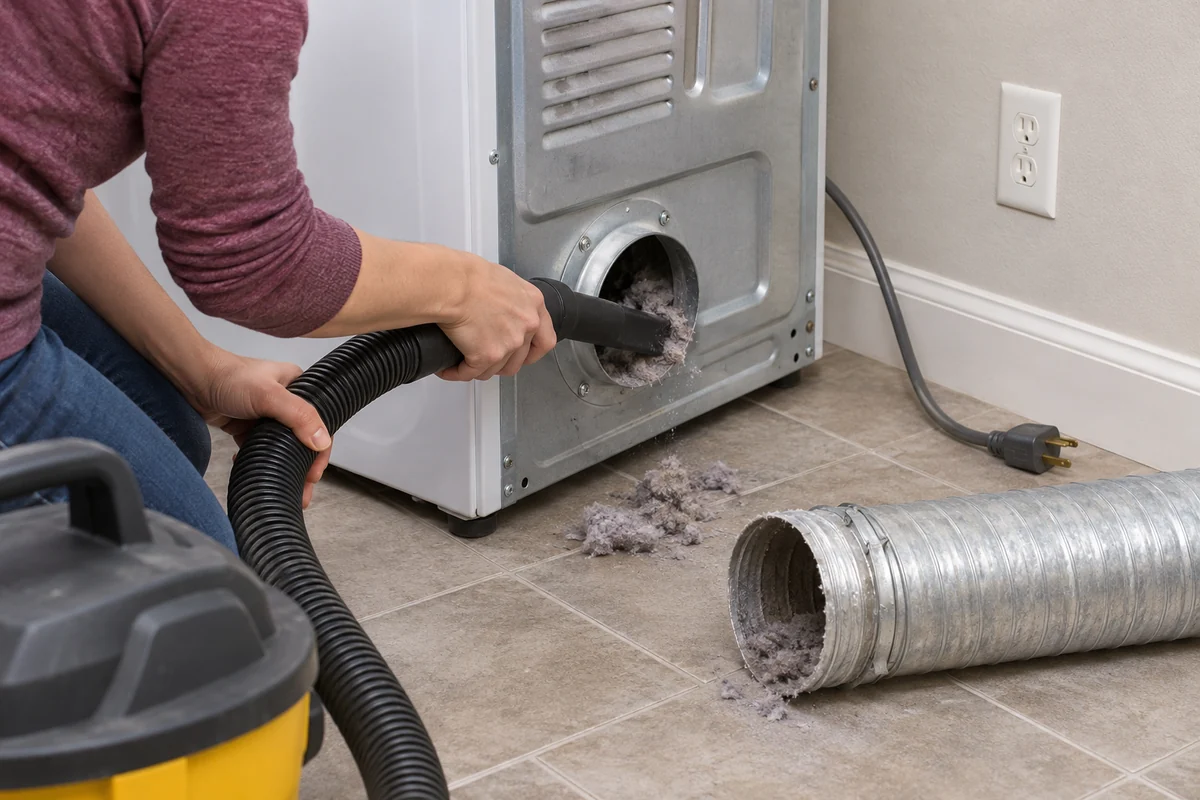
Here’s what GE says to do:
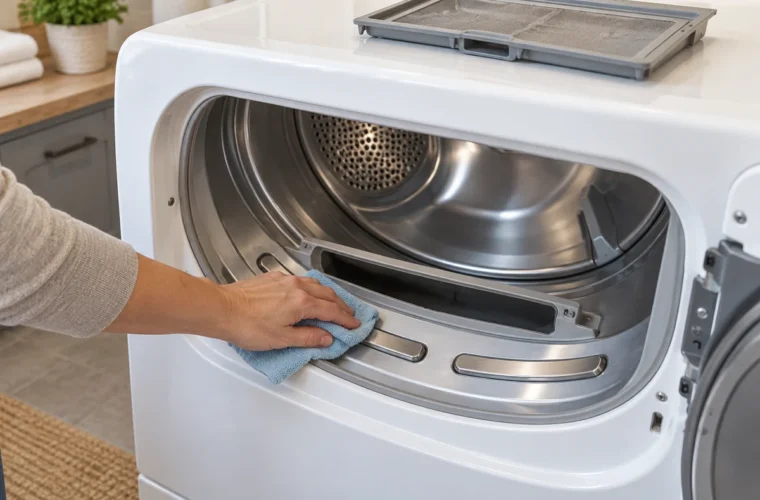
- Clean the lint filter before every load. If dryer sheets have left a waxy film, wash the screen in warm, soapy water and dry it.
- Vacuum the filter slot if you notice a change in drying.
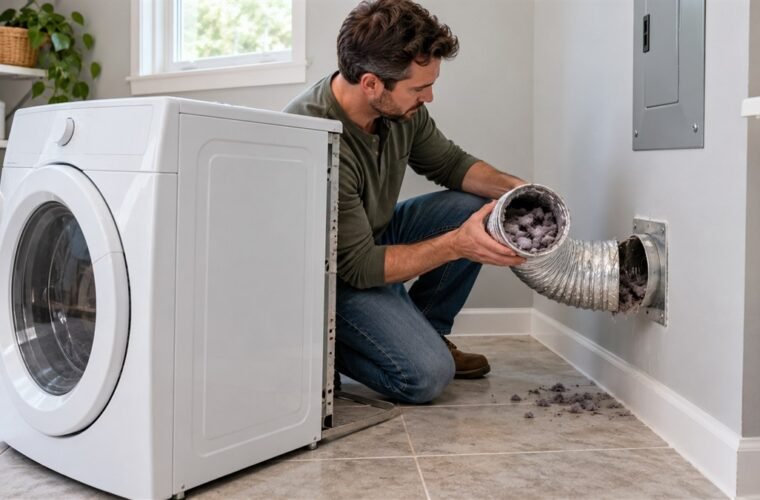
- Clean the duct. Unplug the dryer, disconnect the duct, vacuum it, and reconnect it. GE says to inspect and clean it at least once a year.
- Check the hood outside. GE says to use a mirror to confirm the flaps move freely while the dryer runs, and that nothing’s nesting inside.
Look at what your duct is made of, too. GE’s manual calls for 4-inch rigid metal duct to the outside, and it says not to use plastic or crush the duct.
Its installation guide cuts the allowed length by 10 feet for every extra 90-degree elbow.
If clothes were taking two cycles before the heat quit, read our guide to a dryer taking longer than normal as well.
Electric GE: look at the heating element and its terminal
If you’ve got 240 volts, your settings are right and the vent is clear, the fault is inside the heater circuit. On an electric GE, the suspects are the heating element, the thermal fuse and the high-limit thermostat.
Unplug the dryer before you open it.
Check the element’s wire connections while you’ve got it open. A burned spade terminal is a common GE failure. When one owner on r/appliancerepair posted a melted connector on a GE electric dryer with no heat, the top reply was short:
“Known issue with GE dryers. Part number WE49X37037 Make sure the connection is tight.” u/Trollo_Baggins on Reddit
Another reply warned against crimping a fresh connector onto a charred spade, since a second burn-up can mean a new element. If the terminal on the element is burned too, plan on replacing both.
Test each part with a multimeter for continuity before you buy one.
An open thermal fuse is a symptom. Replace it, but find out why it blew, or the new one will go the same way.
Gas GE: check the supply, then call a pro
On a gas GE, make sure both gas shutoffs are fully open and, on propane, that the tank isn’t empty. GE lists those first. If they’re fine and the burner still won’t light, the problem is somewhere in the ignition parts, and that’s where a homeowner’s checks should stop.
One owner with a GE gas dryer was told to start by checking whether the igniter was getting power. That’s a reasonable test. But I’m not licensed for gas work, and I’d hand the burner side to a licensed pro.
If you smell gas, GE’s installation guide says not to light any appliance or touch any electrical switch. Get everyone out, then call your gas supplier from a neighbor’s phone.
If the parts check out, look at the timer or control
Sometimes you’ll get heat on one cycle and not another. One GE owner with a GTX33EASK0WW found that Cottons and Casuals tumbled with no heat while Timed Dry still worked. A pro tech who replied described the order I’d use as well:
“Pro appliance tech here…my troubleshooting starts outside the appliance and then moves inward.” u/Constant-Swim-2709 on Reddit
The same reply pointed to the tech sheet taped inside the control panel. It has the timer’s contact chart.
That chart shows which contacts should close in each cycle. I pull that sheet before I touch a part.
If your display shows a code, our GE dryer error codes guide lists what each one means. A light you don’t recognize is in the GE dryer symbols guide.
GE dryer not heating: questions
Why does my GE dryer tumble but not heat?
On an electric model, the most common reason is that one of the two breakers or fuses is off. GE’s manual says the dryer may tumble if only one is blown or tripped. Reset both, then check the heat setting and the vent.
How do I reset a GE dryer?
GE’s troubleshooting table doesn’t list a reset button for the heat. It says to reset both breakers or replace both fuses. If the control panel looks asleep, GE says that’s normal: press Power to wake it.
Where is the thermal fuse on a GE dryer?
It depends on the model, so check the parts diagram for your model number or the tech sheet inside the dryer. Unplug the dryer before you look. For the general no-heat checks on any brand, see our guide to a dryer not heating but the drum spins.