
You load the dryer, press start, and the drum turns perfectly. Twenty minutes later you open the door and the clothes are still cold and wet. The drum worked fine, but zero heat was produced.
This combination is actually one of the more helpful dryer symptoms because it narrows the problem significantly. A spinning drum confirms the motor is running and the machine is getting power. The heat system, however, is a separate circuit entirely, and the fault lives somewhere within it.
Let’s go through every cause from the simplest to the most involved so you can find the fix and get back to dry clothes today.
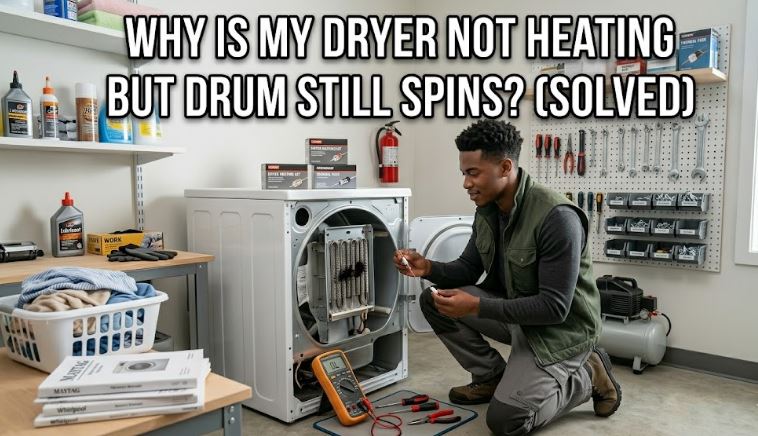
Quick Diagnosis for a Dryer Not Heating But Drum Spins
| What You Notice | Most Likely Cause |
|---|---|
| Drum spins, no heat at all | Blown thermal fuse or tripped breaker |
| Drum spins, very slight warmth only | Partially clogged vent or weak heating element |
| Drum spins, heat cuts off mid-cycle | Cycling thermostat or high-limit thermostat fault |
| Gas dryer spins, no heat | Gas valve solenoid or igniter failure |
| Electric dryer spins, no heat | Heating element or single tripped breaker leg |
| Dryer runs fine then stops heating | Overheating due to blocked lint trap or vent |
What Causes a Dryer to Spin but Not Produce Heat?
Just because the drum spins doesn’t mean your dryer will produce heat and do its job – that of drying clothes. Sometimes the dryer won’t heat even though the drum moves and if so, it could be a result of any of these issues:
1. A Circuit Breaker Leg Has Tripped (Electric Dryers)
This one surprises most people and is the first thing to check on any electric dryer that spins but produces no heat.
Electric dryers run on a 240-volt supply made up of two separate 120-volt circuit legs. One leg powers the motor and controls, which runs the drum. The other leg powers the heating element exclusively. When just one of those two legs trips at the breaker, the drum keeps spinning on its 120-volt leg while the heating element gets zero power.
The machine appears to work perfectly from the outside, but the heat simply never comes on.
How to Fix a Tripped Breaker Leg
Go to your electrical panel and locate the double-pole breaker for the dryer. Even if it looks like it is in the on position, flip it fully to off first, then back to on. A partially tripped breaker often does not look tripped from the outside.
If the breaker trips again immediately or repeatedly, there is an underlying electrical fault and a licensed electrician should inspect the circuit before you continue using the dryer.
2. The Thermal Fuse Has Blown
The thermal fuse is the most common mechanical cause of a dryer that spins but produces no heat, and it is also one of the least expensive fixes on this list.
The thermal fuse is a one-time safety device that cuts power to the heating element permanently when the dryer overheats. Once it blows, no heat is produced regardless of what cycle you select. The drum keeps spinning because the motor runs on a separate circuit, but the heating element stays completely dead.
The most frequent cause of a blown thermal fuse is a clogged lint trap or blocked exhaust vent restricting airflow and causing the dryer to overheat internally.
How to Test and Replace a Blown Thermal Fuse
Unplug the dryer and access the thermal fuse from the rear panel. It is a small oblong component typically located on the exhaust duct near the heating element housing. Test it with the best multimeter set to continuity mode. No continuity confirms it has blown and needs replacing.
Find compatible thermal fuse replacements for your dryer on Amazon.
3. The Lint Trap or Exhaust Vent Is Blocked
A blocked lint trap or clogged exhaust vent does not just cause overheating. It actively prevents the dryer from producing useful heat by trapping hot air inside the drum with nowhere to go.
Dryers need a constant flow of fresh air through the system to generate and distribute heat effectively. When that airflow is restricted, the heating element either trips the thermal fuse or cycles off repeatedly through the thermostat, leaving clothes cold and damp at the end of every cycle.
Beyond the heating problem, a severely blocked vent is also a significant fire hazard. Lint is highly flammable, and a dryer fire almost always starts with a neglected vent.
How to Clear a Blocked Lint Trap and Vent
Clean the lint trap before every single load. This is non-negotiable for both heat efficiency and fire safety.
For the exhaust vent, disconnect the vent hose from the back of the dryer and vacuum out any lint buildup from both the hose and the wall duct. The Holikme Dryer Vent Cleaning Brush Kit (View on Amazon) includes flexible rods that attach to a drill, making it easy to reach deep into long vent runs that a vacuum alone cannot clear. Also check the exterior vent cap outside your home to confirm the flap opens freely and is not blocked by debris or a bird’s nest.
4. The Heating Element Has Failed (Electric Dryers)
The heating element is a coiled wire that heats up when electricity passes through it, warming the air that flows through the drum. When it burns out or breaks, no heat is generated regardless of every other component working perfectly.
A failed heating element is the second most common cause of a no-heat electric dryer after the thermal fuse, and the two are often related since a failing element can cause overheating that then blows the fuse.
How to Test and Replace a Heating Element
Unplug the dryer and remove the back panel to access the heating element housing. Inspect the coil visually for any breaks or burnt sections in the wire. Then test it with a multimeter for continuity. A broken coil shows no continuity and needs a reliable replacement (View on Amazon).
5. The Cycling Thermostat Has Failed
The cycling thermostat regulates the temperature inside the dryer by switching the heating element on and off throughout the cycle to maintain a consistent heat level. When it fails in the open position, it cuts power to the heating element permanently, mimicking the symptom of a blown thermal fuse but for a different reason.
A failed cycling thermostat is often overlooked because it is less well-known than the thermal fuse, but it is a common cause of a no-heat dryer, particularly on older machines.
How to Test and Replace the Cycling Thermostat
Unplug the dryer and locate the cycling thermostat on the exhaust duct or blower housing depending on your model. Test it with a multimeter for continuity at room temperature. A working thermostat should show continuity when cold. No continuity at room temperature means it has failed open and needs replacing.
6. The Gas Valve Solenoids Have Failed (Gas Dryers)
This cause applies exclusively to gas dryers, and it is the most common reason a gas dryer spins without producing heat.
Gas dryers use a set of solenoid coils to open the gas valve and allow fuel to reach the burner when heat is needed. When one or more of these solenoids fail, the valve stays closed and gas never reaches the burner. The igniter may still glow briefly as it tries to light a flame, but no flame ever appears and no heat is produced.
A telltale sign of failed solenoids is a dryer that lights and heats briefly at the start of the cycle, then loses heat partway through as the valve fails to reopen.
How to Replace Gas Valve Solenoids
Unplug the dryer and turn off the gas supply before opening the machine. Access the gas valve assembly from the front panel. The solenoid coils clip directly onto the valve body and disconnect from the wiring harness.
7. The Igniter Has Failed (Gas Dryers)
The igniter in a gas dryer glows hot enough to light the gas flowing from the valve. When it fails, gas is present but never ignites, and the dryer runs cold through every cycle.
A working igniter glows bright orange for several seconds at the start of each heat cycle. If you can safely observe the burner assembly during a cycle and see no glow at all, the igniter has most likely failed.
How to Test and Replace the Igniter
Unplug the dryer and turn off the gas supply. Access the igniter from the front panel near the burner assembly. Test the igniter with a multimeter for continuity. No continuity confirms it needs a replacement (View on Amazon).
8. The High-Limit Thermostat Has Tripped
The high-limit thermostat is a safety device that cuts power to the heating element if the dryer reaches a dangerously high temperature, similar in function to the thermal fuse but with one key difference. On some models it can be reset, while on others it is also a one-time device.
When it trips and fails to reset, the dryer spins normally but produces no heat at all for every subsequent cycle.
How to Test and Address a Tripped High-Limit Thermostat
Unplug the dryer and locate the high-limit thermostat on the heating element housing or exhaust duct. Test it with a multimeter for continuity at room temperature. A failed thermostat shows no continuity and needs replacing.
Just like the thermal fuse, always identify and fix the underlying cause of overheating before replacing this part. A blocked vent or lint trap is the most common trigger.
No-Heat Dryer Fix Cost and Difficulty Overview
| Cause | DIY Difficulty | Part Cost | Pro Repair Cost |
|---|---|---|---|
| Reset tripped breaker | Very easy | Free | N/A |
| Clean lint trap and vent | Easy | Free – $20 | $80 – $150 |
| Thermal fuse replacement | Easy | $5 – $15 | $80 – $150 |
| Cycling thermostat | Easy | $10 – $25 | $100 – $180 |
| High-limit thermostat | Easy | $10 – $20 | $100 – $180 |
| Heating element (electric) | Moderate | $20 – $50 | $150 – $300 |
| Gas valve solenoids | Moderate | $15 – $30 | $120 – $220 |
| Gas igniter | Moderate | $15 – $30 | $120 – $220 |
Frequently Asked Questions
Why does my electric dryer spin but produce no heat at all?
The two most common causes are a blown thermal fuse and a single tripped circuit breaker leg. Check the breaker panel first since it takes 30 seconds and costs nothing. Then test the thermal fuse with a multimeter since it is the most common mechanical cause of a completely cold electric dryer.
Can a clogged dryer vent really stop the dryer from heating?
Yes, in two ways. A blocked vent first causes overheating, which then blows the thermal fuse and cuts power to the heating element permanently. Even before the fuse blows, severely restricted airflow reduces heat efficiency so dramatically that clothes take multiple cycles to dry. Cleaning the vent is maintenance every household should do at least once a year.
My gas dryer heats briefly then goes cold. What is the cause?
This pattern almost always points to the gas valve solenoids. They open the valve to allow gas to reach the burner, but when they wear out they can only hold the valve open briefly before failing. The dryer lights, heats for a short time, then loses heat as the valve closes and never reopens.
Is it safe to use a dryer that is not heating?
The dryer itself is not immediately dangerous if it is not heating, but it is worth diagnosing promptly. A blown thermal fuse often means the dryer overheated, and the cause of that overheating, usually a blocked vent, is a genuine fire hazard that needs addressing regardless of whether you repair the heating system.
How do I know if it is the heating element or the thermal fuse that failed?
Test both with a multimeter set to continuity mode. A blown thermal fuse shows zero continuity and is a completely open circuit. A failed heating element also shows no continuity but may have visible damage to the coil. Testing both at the same time is smart since a failed heating element often causes the overheating that then blows the fuse.
Start at the Breaker and Work Toward the Heat Source
A dryer not heating but spinning is a focused problem with a clear list of suspects, and most of them cost under $25 to fix. Start at the breaker box, then check the thermal fuse, then clean the vent system before touching anything else. Those three steps resolve the majority of no-heat dryer complaints without needing a single specialist tool.
For many other dryer problems, you can check out this dryer troubleshooting guide, which is your go-to resource for major dryer diagnostics across all major brands.

Hi, I’m Barlgan! I created Repair Me Yourself to empower homeowners to tackle appliance repairs with confidence. From decoding error codes to fixing cooling issues, I break down complex repairs into simple, actionable steps that save you time and money.