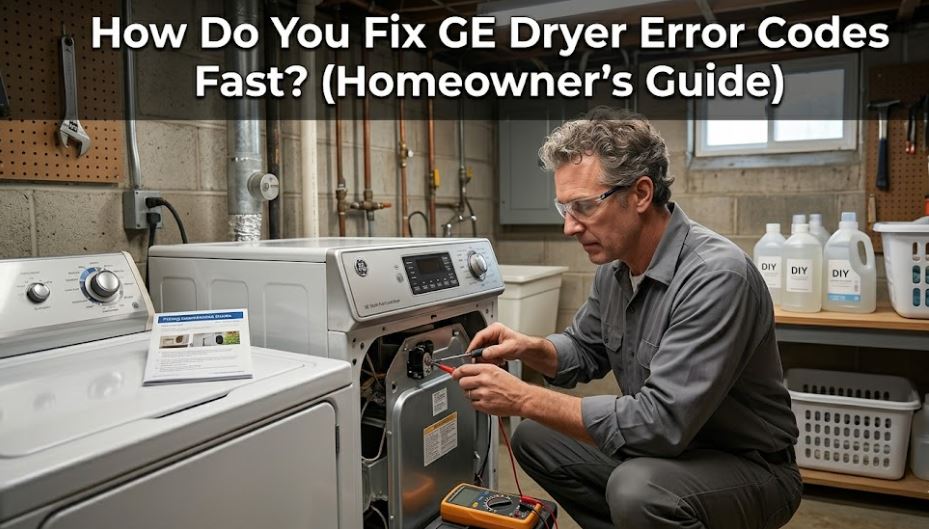
Your GE dryer stops mid-cycle, and instead of the familiar end-of-cycle chime, a cryptic code flashes on the display: “E5” or “E2F” or “d80.” Your family’s laundry is still damp, you have clothes needed for tomorrow morning, and you’re wondering if your smart dryer’s technology is helping or complicating the diagnosis.
GE dryer error codes are intelligent diagnostic messages identifying sensor failures, WiFi connectivity issues, dual thermistor malfunctions, moisture sensor contamination, airflow restrictions detected by smart monitoring, door lock failures on connected models, and control board communication errors unique to GE’s smart appliance ecosystem.
Common codes include airflow monitoring alerts (d80, d90, d95 indicating varying restriction levels), thermistor sensor failures (E5, E2F for temperature monitoring issues), door lock malfunctions (E1F on WiFi models), power supply interruptions (PF), moisture sensor errors (E64, E65), control board communication failures (E3F, E4F), and WiFi diagnostic codes that appear in the SmartHQ app rather than on the display.
This smart diagnostic guide decodes every major GE dryer error code with troubleshooting procedures leveraging their intelligent systems. You’ll learn what codes mean for GE’s dual thermistor sensors, how to use the SmartHQ app for remote diagnostics, when sensor contamination versus sensor failure causes errors, repair cost expectations for smart components, and preventive maintenance that keeps sensor-driven systems running optimally.
GE Dryer Error Codes: Smart Diagnostic Reference
GE error codes reflect their sensor-driven design and smart home integration. This chart shows common codes with GE-specific troubleshooting considerations.
Understanding how smart sensors and connectivity affect error diagnosis helps you troubleshoot effectively using GE’s technology.
| Error Code | System Affected | GE Smart Feature | Typical Cause | App Diagnostic Available? | DIY Fix Possible? |
|---|---|---|---|---|---|
| d80 / d90 / d95 | Airflow restriction | Smart airflow monitoring | Clogged lint filter/vent (80-95% blocked) | Yes – app shows exact % | Yes – clean vents |
| E5 | Inlet thermistor | Dual thermistor system | Temperature sensor failure | Yes – sensor readings shown | Moderate DIY |
| E2F | Exhaust thermistor | Dual thermistor monitoring | Exhaust temp sensor malfunction | Yes – temp graph available | Moderate DIY |
| E1F | Door lock | WiFi-enabled safety | Door switch/lock failure | Yes – lock status shown | Check door alignment |
| E64 / E65 | Moisture sensors | Sensor Dry technology | Contaminated sensor bars | Yes – moisture readings | Yes – clean sensors |
| PF | Power failure | Smart power monitoring | Power interruption during cycle | Yes – event logged | Yes – reset only |
| E3F / E4F | Control board | Smart connectivity | Board communication failure | Yes – diagnostic report | Usually requires service |
| E8 | Heating element | Dual sensor verification | Element circuit failure | Yes – temperature tracking | Service recommended |
| WiFi icon flashing | Connectivity | SmartHQ integration | Network connection issue | Full diagnostics in app | Yes – reconnect WiFi |
| No code (app alert) | Various | Remote monitoring | Issue detected, no display code | Complete diagnostics in app | Depends on specific alert |
App Diagnostic Available: Whether the SmartHQ app provides additional diagnostic information beyond the display code
Understanding GE Dryer Error Codes: Sensor-Based Diagnostic Systems
GE’s smart technology means error codes often relate to sensor systems and connectivity features unique to their intelligent dryers. Let’s decode codes with GE-specific diagnostic approaches.
GE Dryer Airflow Error Codes
GE’s airflow codes are more sophisticated than simple “check vent” warnings, providing specific restriction percentage data.
d80 / d90 / d95 – Restricted Airflow (80%, 90%, 95%): The number indicates the percentage of airflow restriction detected by GE’s airflow sensors.
How GE’s smart airflow monitoring works:
- Pressure sensors measure back-pressure in exhaust system
- Compares actual airflow to expected airflow for current cycle
- Calculates restriction percentage based on pressure differential
- Displays specific code showing severity level
GE airflow code meanings:
- d80: 80% restriction – warning level, dryer still operates but inefficiently
- d90: 90% restriction – serious blockage, cycle time significantly extended
- d95: 95% restriction – critical blockage, dryer may stop to prevent overheating
SmartHQ app enhancement: The app shows airflow restriction history over multiple cycles, helping you identify gradually worsening blockages before they trigger error codes. Graph displays track restriction percentage over time.
d80/d90/d95 troubleshooting progression:
- Clean lint filter thoroughly (rinse with water if residue buildup present)
- Check dryer exhaust opening behind dryer for lint accumulation
- Disconnect vent hose and inspect for crushing, kinking, or blockages
- Verify exterior vent hood opens freely and isn’t clogged
- For d95, professional vent cleaning often needed (severe restriction)
Airflow code prevention: GE’s sensors are highly sensitive—triggering at restriction levels that wouldn’t affect basic dryers. Clean your lint filter before every load without exception, and schedule professional vent cleaning annually for households running 7+ loads weekly.
GE Dryer Thermistor Error Codes
GE’s dual thermistor system uses two temperature sensors for precision drying, and each can fail independently.
E5 – Inlet Air Thermistor Failure: The temperature sensor monitoring incoming air temperature has failed or is reading out of range.
GE’s dual thermistor advantage: Most dryers use a single temperature sensor. GE uses two—inlet and exhaust—to monitor temperature differential for precise Sensor Dry operation.
E5 diagnostic approach:
- Open SmartHQ app and check “Diagnostics” section
- App shows last recorded inlet temperature before failure
- Normal inlet temperature: 70-90°F during operation
- Infinite reading or -40°F indicates open circuit (sensor disconnected)
- 200°F+ indicates short circuit (sensor failed internally)
E5 resolution steps:
- Unplug dryer for 60 seconds to clear temporary sensor errors
- Restart cycle and monitor SmartHQ app temperature readings
- If E5 returns immediately, inlet thermistor replacement needed
- Thermistor location: typically near blower housing or vent entrance
Replacement considerations: GE thermistors cost $30-$60 and are moderately DIY-friendly for homeowners comfortable with basic tools. However, accessing the thermistor requires partial disassembly on many models.
E2F – Exhaust Air Thermistor Failure: The temperature sensor in the exhaust path has malfunctioned, preventing the dryer from monitoring dry air temperature.
Why exhaust thermistor matters: This sensor is critical for Sensor Dry cycles—it detects when air temperature rises (indicating dry clothes) versus stays lower (moisture evaporation cooling effect).
E2F troubleshooting:
- Check SmartHQ app for exhaust temperature history
- Normal exhaust temp during drying: 120-160°F depending on setting
- Consistently low readings suggest airflow restriction (check d80/d90 codes)
- No reading or extreme values indicate sensor failure
SmartHQ diagnostic advantage: The app’s temperature graph shows you whether the sensor failed suddenly (likely electrical) or gradually (possibly wiring degradation), helping diagnose root cause.
GE Dryer Door Lock Error Codes
GE dryers with WiFi connectivity include enhanced door lock systems with more sophisticated error reporting.
E1F – Door Lock System Failure: The door lock mechanism cannot engage or the control board doesn’t receive confirmation of proper locking.
GE smart door lock features:
- Lock status visible in SmartHQ app real-time
- Cycle won’t start if door not properly secured
- Safety interlock prevents opening during high-temperature cycles
- Enhanced on Profile and Café WiFi models
E1F diagnostic sequence:
- Open SmartHQ app and check “Dryer Status” – shows door lock state
- Visually inspect door strike plate and latch for damage
- Clean door latch area with cloth to remove lint buildup
- Close door firmly and listen for audible “click” of engagement
- App should show “Door Locked” status within 2 seconds
Common E1F causes:
- Lint accumulation preventing full door closure (70% of cases)
- Misaligned door strike from repeated door closing (20% of cases)
- Failed door lock actuator (8% of cases)
- Loose door hinge allowing gap (2% of cases)
DIY fix success rate: 90% of E1F codes resolve through cleaning lint from latch area and ensuring door sits flush. Only 10% require actual lock mechanism replacement.
GE Dryer Moisture Sensor Error Codes
GE’s Sensor Dry technology relies on moisture sensor bars inside the drum that can become contaminated or fail.
E64 / E65 – Moisture Sensor Errors: The moisture sensor bars aren’t providing valid readings to the control board.
How GE’s moisture sensors work:
- Two metal strips inside drum (usually near lint filter opening)
- Wet fabric conducts electricity between strips
- Dry fabric doesn’t conduct electricity
- Control board measures conductivity to determine dryness
Moisture sensor contamination causes:
- Fabric softener and dryer sheet residue (most common)
- Detergent residue transferred from washer
- Hard water mineral deposits
- Lint coating sensor surfaces
E64/E65 cleaning procedure:
- Locate sensor bars inside drum (4-5 inch metal strips)
- Mix solution of equal parts white vinegar and water
- Scrub sensor bars with fine steel wool (000 or 0000 grade)
- Wipe thoroughly with vinegar solution on microfiber cloth
- Dry completely before running test cycle
Prevention strategy: Clean sensor bars monthly if you use dryer sheets regularly, quarterly if you don’t. GE’s sensors are more sensitive than basic dryers—requiring cleaner surfaces for accurate readings.
SmartHQ diagnostic data: The app shows moisture sensor readings in real-time during Sensor Dry cycles. Erratic readings (jumping between wet/dry rapidly) indicate contamination. No readings at all indicate sensor failure.
Control Board Communication Error Codes
GE’s smart dryers use sophisticated control boards that can experience communication failures unique to connected appliances.
E3F / E4F – Control Board Communication Failure: The main control board cannot communicate with the user interface or other electronic components.
GE control board complexity: Profile and Café models use advanced boards managing WiFi connectivity, app communication, sensor monitoring, and cycle algorithms simultaneously. More complexity means more potential failure points.
E3F/E4F troubleshooting approach:
- Unplug dryer for 5 minutes (force complete power cycle)
- Check SmartHQ app – may show additional diagnostic information
- App might display “Control Board Offline” with error details
- Plug dryer back in and attempt simple Timed Dry cycle
- If E3F/E4F persists, control board replacement likely needed
Control board costs for GE smart dryers:
- Basic GE models: $150-$250 for control board
- Profile models: $250-$350 (includes WiFi module)
- Café models: $300-$400 (premium board with advanced features)
When to repair vs. replace: For dryers under 5 years old, control board replacement makes sense. For dryers 8+ years old showing E3F/E4F, evaluate total repair cost against replacement—new dryers include warranties and improved efficiency.
Power and Electrical Error Codes
PF – Power Failure: The dryer detected a power interruption during operation. On GE smart models, this is logged in the app with timestamp.
GE smart power monitoring: Unlike basic dryers that simply display PF, GE’s system logs when power failures occurred, duration, and whether it was a complete outage or voltage sag.
PF resolution:
- Press and hold Start/Pause for 5 seconds to clear code
- Check SmartHQ app “Event Log” for power failure details
- If PF occurs frequently without actual outages, check:
- Circuit breaker for dryer (should be 30-amp dedicated)
- Outlet connection for looseness
- Other high-draw appliances sharing circuit
- Restart cycle normally
Smart GFCI monitoring: GE Profile and Café models include Smart GFCI protection. If this triggers, the app displays specific information about the ground fault event, helping electricians diagnose wiring issues.
WiFi and Connectivity Diagnostics
Unlike error codes displayed on the dryer, WiFi issues appear primarily through app notifications and status indicators.
WiFi Icon Flashing: Indicates connection attempt or connectivity problem between dryer and home network.
SmartHQ app WiFi diagnostics:
- Open app and select your dryer
- Check “Connection Status” – shows WiFi signal strength
- “Disconnected” status indicates network issues
- “Connected” but features unavailable suggests cloud server issues
WiFi troubleshooting steps:
- Verify home WiFi is operational (test on phone)
- Ensure dryer is within 30-40 feet of router
- Check if router uses 2.4GHz network (GE requires 2.4GHz, not 5GHz)
- Power cycle dryer and router simultaneously
- Re-run WiFi setup in dryer settings menu
App-only error notifications: Some issues generate app alerts without display codes. The SmartHQ app might notify you of “Extended Cycle Time” (indicates airflow restriction developing) or “Temperature Anomaly” (thermistor drift) before codes appear.
Preventive Maintenance for GE Sensor-Driven Dryers
GE’s sensor technology requires maintenance calibrated to their intelligent systems.
Weekly maintenance:
- Clean lint filter before every single load
- Wipe moisture sensor bars if you use dryer sheets
- Check SmartHQ app “Maintenance” section for alerts
Monthly maintenance:
- Deep clean moisture sensors with vinegar and steel wool
- Vacuum lint filter housing with crevice attachment
- Review app’s “Cycle History” for increasing dry times (indicates developing issues)
Quarterly maintenance:
- Check SmartHQ app airflow restriction trend
- Professional vent cleaning if d80 codes appearing
- Verify WiFi connectivity and app functionality
Annual professional service:
- Complete vent system inspection and cleaning
- Thermistor calibration testing (if available)
- Control board connection inspection
- Sensor system verification
Smart maintenance advantage: The SmartHQ app tracks cycle times and can alert you to gradual performance degradation before failures occur. Enable all maintenance notifications for proactive problem prevention.
Also Read: Complete Guide to Understanding GE Washing Machine Symbols
FAQs
How do I access the detailed diagnostics in the SmartHQ app when an error code appears?
When your GE dryer displays an error code, open the SmartHQ app and select your dryer from the appliances list. Tap “Diagnostics” or “Appliance Information” (depending on app version) to access detailed diagnostic data. The diagnostics screen shows real-time sensor readings including inlet temperature, exhaust temperature, moisture sensor conductivity, airflow restriction percentage, and error code history with timestamps.
For active error codes, the app displays additional context beyond what appears on the dryer panel. For example, an E5 thermistor code shows the last recorded temperature before failure, helping determine if it’s a wiring issue (sudden failure from normal temps) or sensor degradation (gradually erratic readings). The app also provides guided troubleshooting specific to your error code with step-by-step instructions and videos.
If you contact GE support, you can share diagnostic reports directly from the app, giving technicians complete information before they arrive. Enable notifications so the app alerts you to developing issues before they trigger error codes—extended dry times, increasing airflow restriction, or temperature anomalies often show in app data days or weeks before codes appear.
What’s the difference between d80, d90, and d95 airflow error codes?
The numbers in GE’s airflow codes represent the percentage of exhaust restriction detected by the pressure sensors—d80 means 80% restricted, d90 means 90% restricted, and d95 means 95% restricted. These aren’t arbitrary severity levels but actual measured restriction percentages based on back-pressure in your vent system. d80 is a warning that your vent system is significantly restricted but the dryer can still operate (though cycles take longer and energy efficiency drops). d90 indicates serious blockage where drying performance is severely impaired and fire risk increases. d95 is critical restriction where the dryer may automatically stop to prevent overheating.
The progression helps diagnose your vent system’s condition. If you see d80 one week, then d90 the next, then d95, you have a rapidly worsening blockage (possibly bird nest in exterior vent or major lint accumulation). If codes jump directly to d95 without progression, you likely have a sudden blockage (vent hose crushed or kinked). The SmartHQ app tracks these codes over time in a graph, showing restriction percentage trends. For d80, clean your lint filter and vent hose yourself. For d90, inspect the entire vent run and consider professional cleaning. But for d95, don’t run the dryer until you’ve professionally cleaned the full vent system—this restriction level creates genuine fire hazard conditions.
Can I still use my GE dryer when it shows an error code or should I stop immediately?
It depends on the specific error code and what system is affected. For PF (power failure), you can clear the code and restart the cycle immediately—this is informational only and indicates no damage. For d80 airflow restriction, you can finish your current load but should clean the vent system before the next use—continuing to run with restricted airflow wastes energy and accelerates lint buildup. In case of d90 or d95 airflow codes, stop using the dryer until you resolve the restriction—operating at this blockage level creates fire hazards and can damage the heating element.
For sensor errors (E5, E2F, E64, E65), the dryer will either stop automatically or continue in a degraded mode. Thermistor errors typically cause the dryer to abort Sensor Dry cycles but Timed Dry still works—you can dry clothes manually by time until you replace the sensor. Moisture sensor errors disable Sensor Dry but all other cycles function normally.
For door lock errors (E1F), the dryer won’t start at all as a safety measure—you must resolve the door issue before any operation. For control board errors (E3F, E4F), the dryer is unusable until repaired. The SmartHQ app shows whether each error allows continued operation or requires immediate service, plus safety warnings if fire or electrical hazards exist.
How much does it typically cost to repair a GE dryer based on common error codes?
Repair costs vary significantly based on which sensor or component failed. Simple fixes like clearing PF codes or cleaning moisture sensors (E64/E65) cost nothing beyond your time. Professional vent cleaning for d80/d90/d95 codes runs $100-$200 depending on vent complexity and length. Thermistor replacements for E5 or E2F cost $120-$200 including parts and labor if you hire a technician, or $30-$60 for parts if you DIY (moderate skill required).
Door lock assembly replacement for E1F codes runs $100-$150 installed. Heating element replacement for E8 codes costs $150-$250 for electric dryers or $200-$300 for gas igniter/valve assemblies. The expensive repairs are control board replacements for E3F/E4F errors—basic GE models cost $250-$350 total, while Profile and Café smart boards run $350-$500 including labor. For dryers under 5 years old, even control board replacement makes sense given GE’s overall quality.
For dryers 7+ years old showing expensive errors, calculate carefully: a $400 control board repair on an 8-year-old dryer may not be worthwhile when new and efficient dryers with warranties (View on Amazon) cost $600-$900. The SmartHQ app’s diagnostic reports help get accurate quotes from technicians before they arrive, potentially saving the $75-$100 diagnostic fee.
Why does my GE dryer show error codes only on certain cycles but not others?
Different cycles use different sensor systems, so failures only affect specific cycles that rely on the malfunctioning component. Moisture sensor errors (E64/E65) only affect Sensor Dry cycles because that’s the only cycle using the moisture sensors—Timed Dry, Air Fluff, and other manual cycles bypass moisture sensing entirely and work normally. Thermistor errors (E5, E2F) affect all heated cycles but Air Fluff (no heat) still functions since it doesn’t need temperature monitoring.
Airflow errors (d80/d90/d95) appear during any cycle that uses heat because restricted airflow affects temperature regulation, but may not trigger during no-heat Air Fluff cycles. The SmartHQ app helps identify these patterns by logging which cycles trigger errors. If you get E64 on Sensor Dry but Delicates (timed) works fine, you know moisture sensors are contaminated. If you get E5 on all heated cycles but Air Fluff works, the inlet thermistor has failed. This cycle-specific error behavior actually helps diagnosis—it tells you exactly which sensor system is failing without needing to test each component individually. The error pattern guides you to the specific component needing cleaning, recalibration, or replacement.
Leverage GE’s Smart Diagnostics for Faster Troubleshooting
Understanding GE dryer symbols and error codes through their smart diagnostic lens enables faster, more accurate troubleshooting than traditional trial-and-error methods. The SmartHQ app transforms error codes from cryptic messages into detailed diagnostic reports with sensor readings, historical data, and guided troubleshooting—capabilities basic dryers can’t match.
Start by enabling all SmartHQ app notifications and checking the app weekly for maintenance alerts and performance trends. The app often detects developing issues days or weeks before error codes appear, allowing preventive action rather than reactive repairs. An airflow restriction trend showing gradual increase from 40% to 60% to 75% warns you to schedule vent cleaning before hitting d80 code levels.
Leverage GE’s dual thermistor system and moisture sensors by maintaining them properly—monthly sensor cleaning prevents 80% of E64/E65 codes, and annual vent cleaning prevents most d-series airflow codes. When errors do occur, use the app’s diagnostic data to make informed repair decisions: sudden sensor failures likely need replacement, while gradual degradation may indicate contamination needing cleaning. Understanding your GE dryer’s intelligent systems transforms error codes from frustrating mysteries into actionable diagnostic information that keeps your smart appliance running optimally for 12-15 years.

Hi, I’m Barlgan! I created Repair Me Yourself to empower homeowners to tackle appliance repairs with confidence. From decoding error codes to fixing cooling issues, I break down complex repairs into simple, actionable steps that save you time and money.