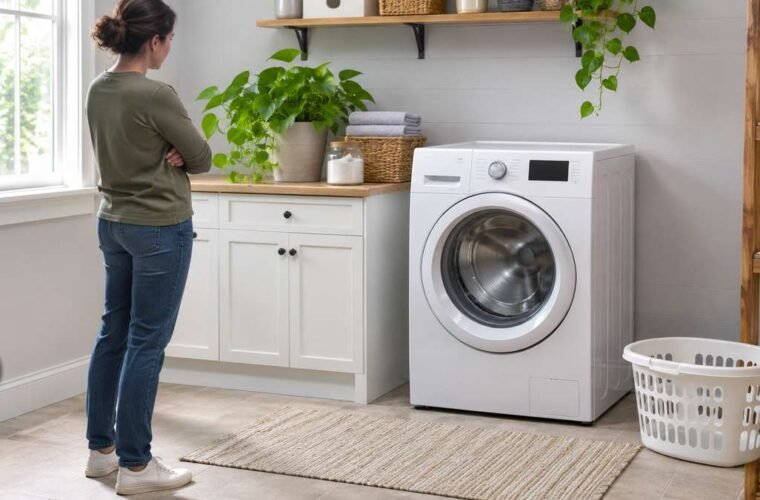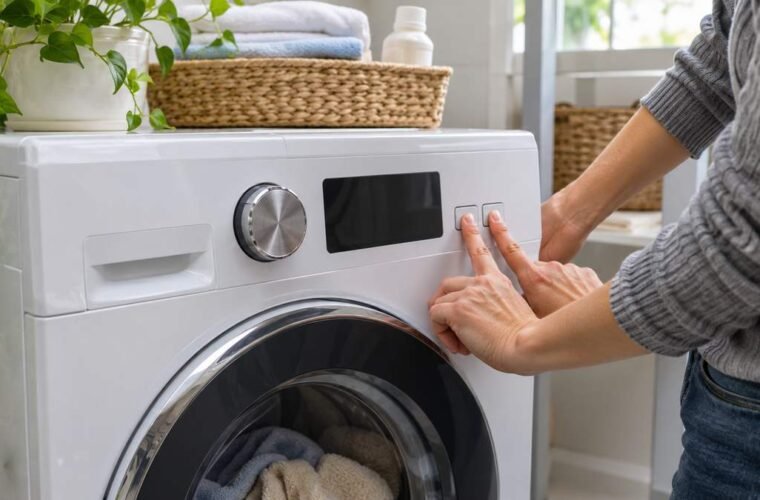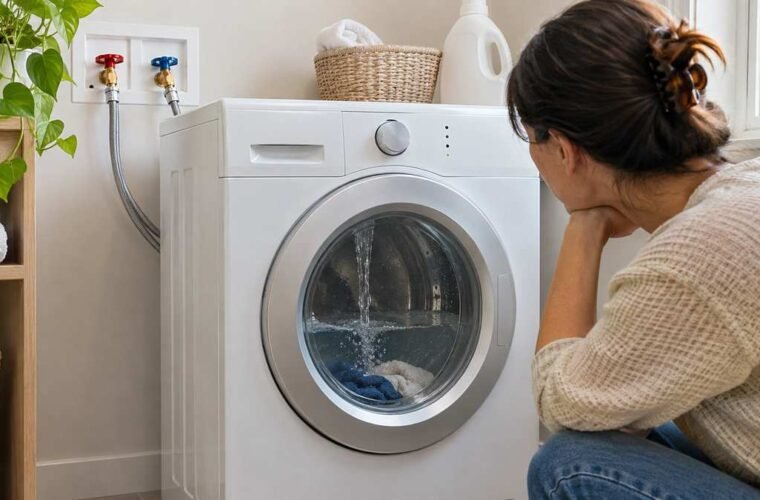
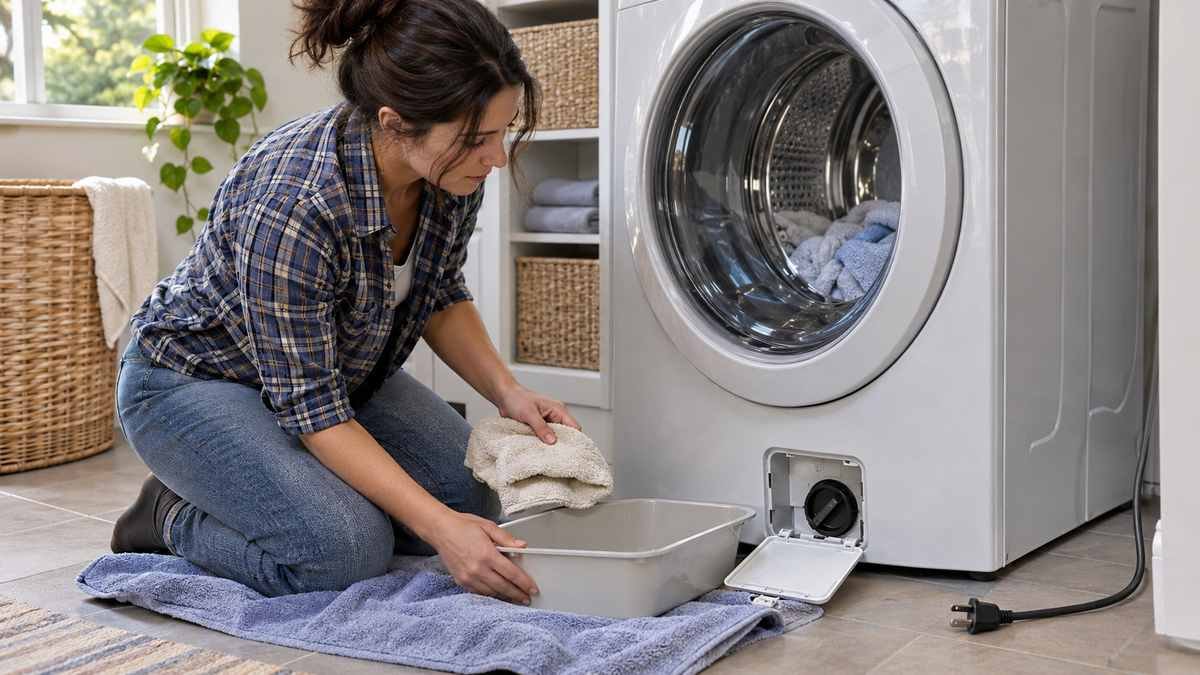
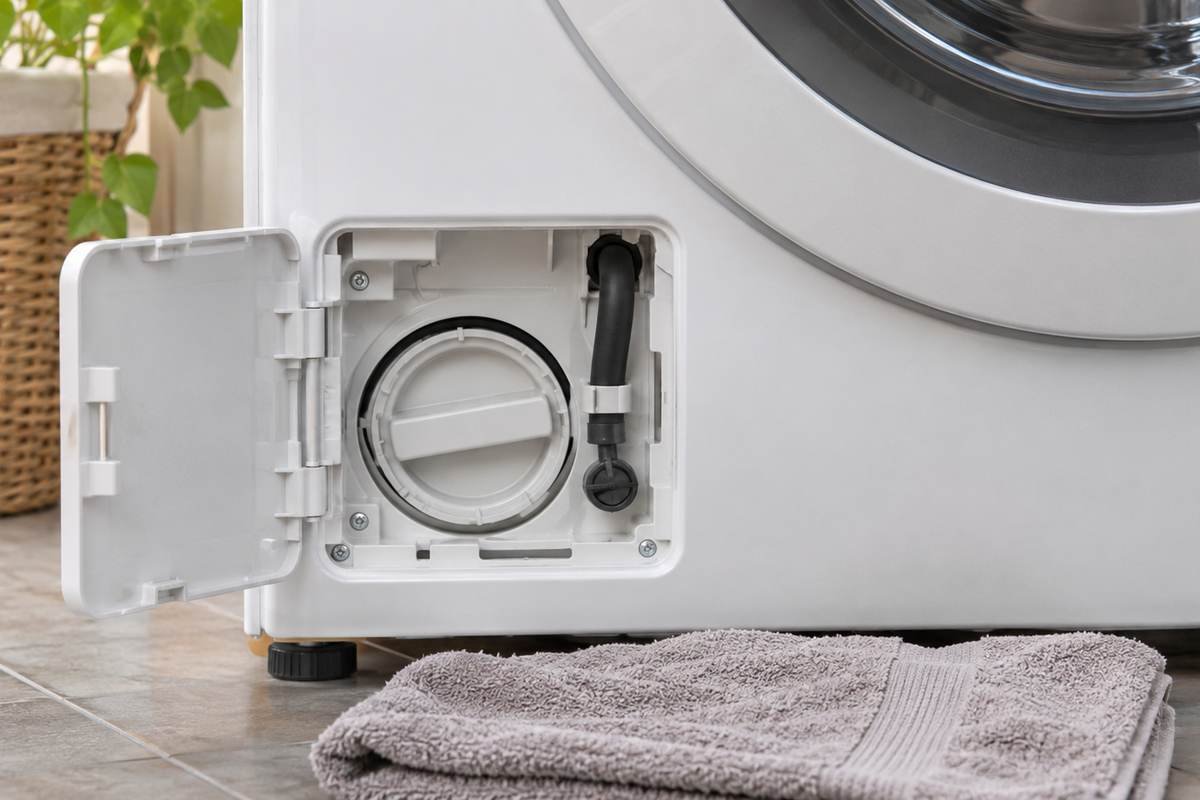
A washing machine drain pump filter sits behind a small panel at the bottom front of most front loaders. It catches coins, buttons and lint before they reach the pump. Drain the little hose behind the panel first, then twist the filter out counterclockwise.
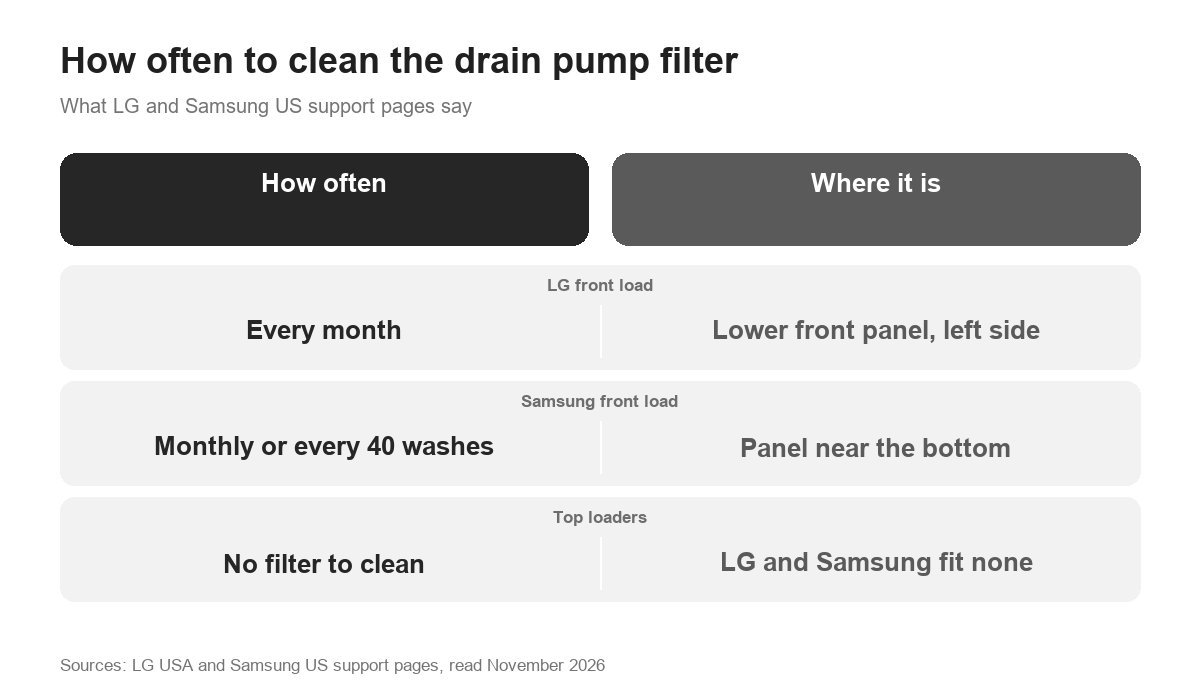
Most top loaders don’t have one. LG and Samsung both say their top-load washers have no drain pump filter at all, so there’s nothing to open on those.
Where the drain pump filter is on a front loader
On your front-load washer, the drain pump filter is behind a small access panel at the bottom of the front, usually on one corner. LG puts it on the lower front left, and on some models on the right.
Samsung’s panel sits near the bottom and opens when you press its top or center. GE’s opens with a coin or a flat screwdriver in a notch.
Some Whirlpool and Amana front loaders hide it behind the storage drawer at the base instead. Pull the drawer out, then press the tab on the right side down and lift the tab on the left side up. The drawer comes free and the filter’s behind it.
Can’t find a panel or a drawer? GE says the pump-filter steps apply only to washers with an access cover at the bottom front, so check your owner’s manual. If your model has no front access, the filter’s inside the cabinet and that’s a service job.
Top loaders usually don’t have a pump filter
If you have a top-load washer, you likely don’t have a drain pump filter to clean. Samsung’s US support page says its top load washers don’t have one. LG says the same about its top loaders. Its drain pump filter is only on front loaders and combo units.
Some older top loaders had a lint filter under the agitator cap or along the rim of the basket instead. That’s a different part, and your manual will show it if your washer has one.
Drain the small hose first, then clean the filter
Clean a washing machine drain pump filter by draining the water through the small hose first, then twisting the filter out, rinsing it and turning it back in until it stops. The job takes a towel, a shallow pan and a few minutes.
Unplug the washer before you open the panel. On service calls, I unplugged it and laid towels down before I touched that panel, every time.
Hot water is the other hazard. If you just ran a hot cycle like Self Clean, Pure Cycle or Sanitize, Samsung says to wait an hour so the water in the tub can cool before you let it out onto your hands.
- Put towels on the floor and a shallow pan in front of the panel. If the tub’s still full, use something big. Samsung suggests a container like an oil drain pan.
- Open the panel. Behind it you’ll see the round filter cap and a small drain hose clipped beside it.
- Pull the small hose out into the pan and take off its plug or cap. LG warns not to pull the hose out too far, or it kinks and the water stops. Samsung’s cap seals tight, so it can take some effort to twist off.
- Let it drain. Empty the pan when it’s full, plug the hose, and go again until nothing comes out.
- Turn the filter counterclockwise and pull it out slowly. A little more water will come out, even after draining. GE calls about a cup normal.
- Pick out the coins, hair and lint by hand, then rinse the filter. LG and Samsung both suggest a soft brush.
- Shine a light into the opening. Samsung says to check that the drain pump impeller inside is clean.
- Turn the filter back in clockwise until it stops. On Samsung and Whirlpool models, the handle should end up close to vertical.
- Plug the small hose, clip it back, and close the panel.
Some Samsung filters push in and twist off like a medicine bottle cap. If yours won’t turn, press it in first.
That’s the whole job.
When the floor’s dry, run a short rinse and spin and watch the panel. If you see drips, turn the filter in again until it stops. Don’t force it past that point.
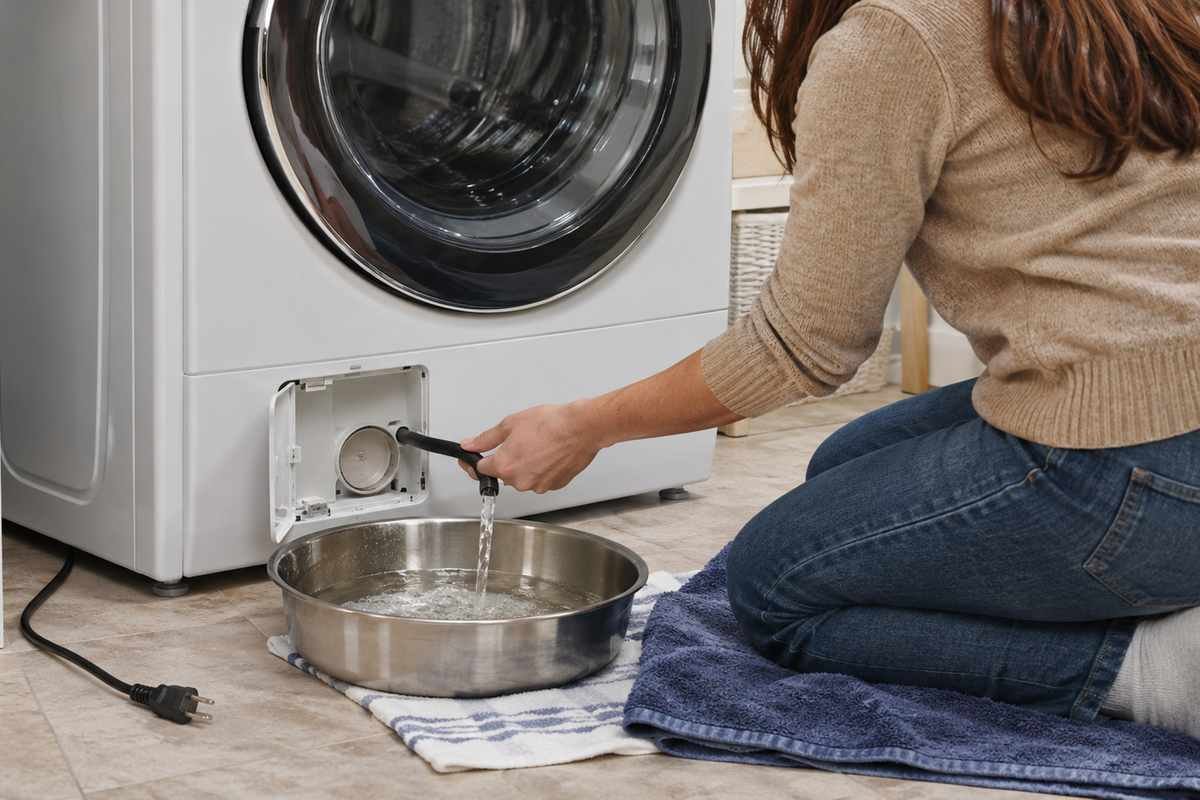
A tub that’s full of water is the messy version. One commenter on r/NoStupidQuestions handled it this way:
“First, do it between washes. Set a reminder for yourself or something. I put a towel down and a low rimmed container like a baking tray. I begin to open the filter, let some water out through the black hose, and close it back up. I dump out the tray and go back. Repeat as necessary. Then I pull the cylindrical plastic filter and clean that out.”
– r/NoStupidQuestions, October 2026 (6 upvotes)
How often to clean the drain pump filter
LG recommends cleaning the drain pump filter every month. Samsung says at least once a month or about every 40 washes, whichever comes first. Clean it sooner if the washer drains slowly or shows a drain code.
Samsung ties a clean filter to fewer odors and less mold and mildew, as well as to normal draining. LG tells you to check it whenever you notice a slow drain or an OE code on the display. Its OE code is a drain error.
If you run a load or two every day, you’ll hit 40 washes in a few weeks, well before the month is up. That’s when Samsung’s count beats the calendar, and it’s worth checking the filter sooner if you wash kids’ clothes, pet bedding or work pants with full pockets, since those are what feed the coins, hair and lint the filter exists to catch.
Filter’s clean but the washer still won’t drain
If the filter’s clean and the washer still won’t drain, the hose, the house drain or the pump is next. GE’s front-load drain troubleshooting page gives the order to check them in.
- Wait first. GE says pauses of up to 3 minutes between cycle stages can be normal.
- Hose. Check that the drain hose isn’t kinked or clogged behind the washer.
- Height. Most full-size GE washers pump up to 8 feet above the floor, and compact or portable ones up to 5 feet.
- House drain. Pull the hose out of the standpipe and pour in a quart of water. If it won’t go down, GE recommends a plumber.
- Load. An out-of-balance load can stop the drain and spin. Redistribute the clothes or add a few items.
A tub that stays full while the washer only hums needs service, according to GE. On those calls, the impeller was often jammed or the pump had quit, and that’s past a filter clean.
If the water leaves but the clothes come out soaked, see the page on a washer that won’t drain but still spins.
Washing machine drain pump filter questions
Does a top load washer have a drain pump filter?
A top-load washer usually doesn’t have a drain pump filter. Samsung and LG both state their top loaders have none, and LG fits the filter only to front loaders and combo units. Older top loaders may have a separate lint filter under the agitator.
What happens if you never clean the washing machine drain pump filter?
A washing machine drain pump filter that’s never cleaned can clog and slow or stop draining. GE says items the filter catches can block water during the cycle, and Samsung links a dirty filter to odors and mold.
How much does it cost to replace a drain pump?
Cleaning the filter costs nothing. A new drain pump costs the part plus labor, and the price depends on your brand, model and area. Get the part number from the tech sheet before you price one.