
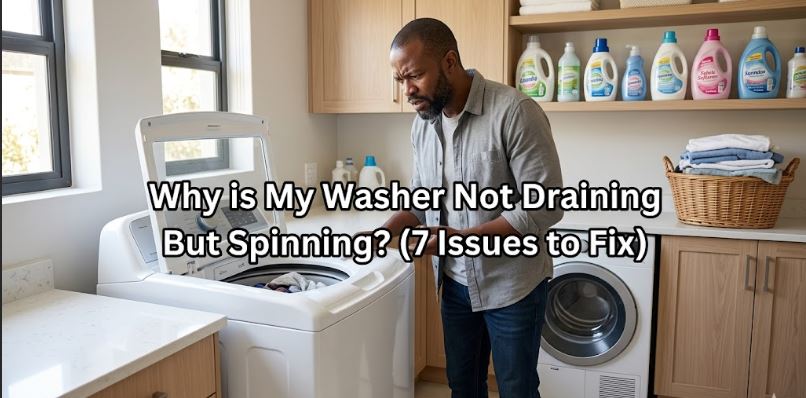
Picture this: the spin cycle runs, you hear the drum humming along, but when you open the lid your clothes are still dripping wet and water is pooling at the bottom of the drum. Your washer is spinning but simply not draining.
It is a confusing combination because the machine seems to be working. The truth is that spinning and draining are two separate functions, and one can fail while the other keeps going. Let’s figure out exactly which one is failing in your machine and get it sorted.
Symptom-to-Cause Quick Reference for a Washer Not Draining But Spinning
| What You Notice | Most Likely Cause |
|---|---|
| Water sitting in drum after spin | Clogged pump filter or drain hose |
| Clothes very wet but drum spun | Partial drainage blockage |
| Gurgling sound but no drainage | Drain hose inserted too deeply |
| Spin runs briefly then stops | Excess suds interfering with drainage |
| No drainage at any point in cycle | Failed drain pump |
| Spin works on some cycles, not others | Worn drive belt or lid switch fault |
What Causes a Spinning Washing Machine to Stop Draining Properly?
While spinning is important for washing machines to drain properly, sometimes a washer can spin but fail to drain. If so, it could be a result of one of these issues:
1. The Pump Filter Is Clogged
This is the most common cause of a washer that spins but leaves water behind. And honestly, it is also the most satisfying fix because the solution is right there at the front of the machine.
The pump filter catches lint, coins, hair ties, and small fabric debris before they reach the pump. Over time it gets packed so tightly that water simply cannot push through it, even while the drum keeps spinning above.
How to Clean the Pump Filter
Locate the small access panel near the bottom front of your machine. Place a shallow dish or old towels underneath it before opening, because water will spill out.
Unscrew the filter cap slowly and let the water drain into your dish. Pull the filter out completely, rinse it under running water, and use an old toothbrush to scrub away any buildup. Reinsert it firmly, making sure it is fully seated, then run a drain-only cycle to confirm the fix.
Make this a monthly habit, especially if you wash pet bedding, towels, or heavily soiled items regularly.
2. The Drain Hose Is Kinked or Clogged
A kinked or blocked drain hose is another top cause that often gets missed because it sits behind the machine where nobody looks.
When the hose is kinked, water cannot flow freely regardless of how hard the pump works. When it is clogged with lint or debris, the result is the same: spinning happens, draining does not.
How to Inspect and Clear the Drain Hose
Pull the machine away from the wall and trace the drain hose along its full length. Look for any sharp bends, kinks, or compressed sections and straighten them out.
Disconnect the hose at both ends and flush it through with running water to check for internal blockages. If the hose is cracked, brittle, or has visible damage, replacement is the smarter call. The Eastman Washing Machine Drain Hose on Amazon is a durable universal replacement that fits most brands and comes long enough to accommodate different laundry room layouts.
Also check that the hose sits no deeper than 6 to 8 inches into the standpipe. Inserting it too far creates a siphoning effect that interferes with proper drainage.
3. The Drain Pump Has Failed
If the filter is clean and the hose is clear but water still sits in the drum, the drain pump itself may have died.
The pump is what physically pushes water out of the machine. When it fails, the machine can still spin because the motor drives both functions separately. Spinning continues while drainage stops entirely.
A telltale sign of pump failure is silence where you would normally hear water rushing out during the drain phase. Sometimes a failed pump also makes a loud humming noise as it strains without moving water.
How to Replace a Faulty Drain Pump
Unplug the machine and access the pump from the front or rear depending on your model. Disconnect the wiring harness and hose clamps, then swap in the new pump.
The W11399437 W11259498 Washer Drain Pump Assembly (View on Amazon) is compatible with a wide range of top-load washing machines. It comes with mounting hardware and is a straightforward swap for anyone comfortable with basic appliance repair.
4. Excessive Suds Are Blocking Drainage
Using too much detergent, or the wrong type of detergent, creates a mountain of suds that the drain pump struggles to push through. The drum spins, but the thick foam acts as a barrier that prevents water from fully clearing.
This one is surprisingly common in households that switch from regular detergent to a higher-concentration formula without adjusting the amount used.
How to Clear a Suds Problem
Run a rinse-only cycle with no detergent added. This helps break down the foam and flush it out of the system.
Going forward, switch to an HE (High Efficiency) detergent if your machine calls for it, and use the amount on the label, not more. If suds keep appearing even with the correct detergent, mineral buildup in the drum may be causing residual foaming. A monthly drum cleaning cycle with a product like Affresh Washing Machine Cleaner from Amazon dissolves that buildup effectively.
5. The Drive Belt Is Worn or Broken
The drive belt connects the motor to the drum, and on many machines it also plays a role in driving the pump. When the belt wears thin, stretches, or snaps, the drum may still spin weakly using motor momentum, but the pump does not receive enough power to drain properly.
A squealing or slipping noise during the spin cycle is a strong clue that the belt is the problem.
How to Check and Replace the Drive Belt
Unplug the machine and remove the rear or front panel depending on your model. Locate the belt around the motor pulley and drum pulley. Look for visible cracking, fraying, or looseness.
A belt that slips off easily by hand is already too worn to function properly. Search your model number alongside “drive belt” on Amazon to find the exact replacement. Installation typically involves stretching the new belt onto the pulleys, which is manageable for most DIYers with a screwdriver and about 45 minutes.
6. The Lid Switch or Door Lock Is Interfering
Here is a counterintuitive one. A partially faulty lid switch can allow the spin cycle to run while silently blocking the drain function on certain cycle stages.
This happens because the control board checks the lid switch at multiple points in a cycle, not just at the start. If the switch sends an inconsistent signal, the machine may spin but skip or cut short the drain phase.
How to Test the Lid Switch
Close the lid firmly and listen for a solid click. Then use a multimeter to test the switch for continuity while it is in the closed position. An inconsistent or absent reading means the switch is sending unreliable signals.
Get a lid switch assembly that matches your washing machine on Amazon.
7. The Control Board Has a Drainage Fault
When everything mechanical checks out and the machine still does not drain, the control board may be failing to send the correct signal to the drain pump at the right moment in the cycle.
This is the least common cause but worth considering, particularly in machines that have experienced a power surge or are more than ten years old.
How to Address a Control Board Issue
Start with a hard reset. Unplug the machine for two full minutes, then plug it back in and run a drain-only cycle to see if the board recovers.
If the drain fails consistently regardless of what cycle you choose, run your machine’s diagnostic mode to check for stored error codes. These codes often point directly to the failed component. Search your model number alongside “diagnostic mode sequence” to find the right steps for your brand.
Frequently Asked Questions
Why is my washer spinning but leaving clothes soaking wet?
Partial drainage is almost always the cause. The pump filter or drain hose is likely partially blocked, allowing some water to clear but not all of it. Start by cleaning the pump filter since it takes under ten minutes and resolves this issue in the majority of cases.
Can too much detergent really stop a washer from draining?
Yes, it genuinely can. Thick suds create resistance in the drainage system that the pump cannot overcome at normal operating pressure. Always measure your detergent and use HE formula if your machine requires it.
How do I manually drain a washer that is full of water?
Locate the drain pump filter access panel at the front base of the machine. Place towels and a shallow dish underneath, then slowly unscrew the filter cap to let the water drain out in a controlled flow. This is the safest manual drain method for most front-loaders.
Is a washer that spins but does not drain worth repairing?
In most cases, yes. Drain pump replacements and hose fixes are among the least expensive washer repairs, often costing under $65 in parts. Only if the control board or motor has failed does the repair cost start approaching the value of an older machine.
How often should I clean my washer’s pump filter?
Once a month is ideal for average households. If you wash pet bedding, heavily soiled work clothes, or items with loose fibres regularly, cleaning it every two to three weeks will prevent buildup from becoming a problem.
Start With the Filter and Work Your Way Down
A washer that spins but does not drain almost always has a mechanical blockage somewhere between the drum and the standpipe. Clean the pump filter first, check the drain hose second, and test the pump third. Those three steps alone resolve the vast majority of drainage issues without spending anything beyond a little time.
For more tips and fixes for common washer problems, our washing machine troubleshooting guide should come in handy.