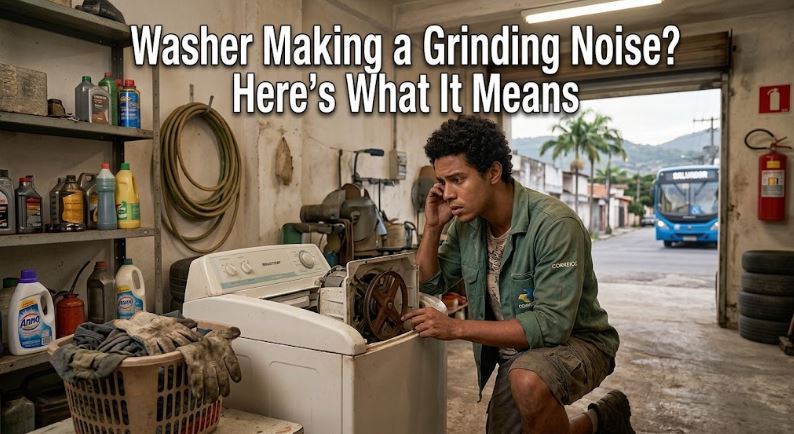
You start a load and hear it: a harsh, metal-on-metal grinding sound that has no business coming from a washing machine. It’s not the usual hum or splash, and you know something’s genuinely wrong.
You wonder, “why is my washer making a grinding noise?” A washer grinds when metal parts rub together without lubrication, usually from a worn tub bearing, a jammed drain pump, or an object caught between the drum and tub.
Grinding is different from banging, squealing, or rattling, and it’s worth being precise about which one you’re hearing before you start troubleshooting, since each points to a different part. If your washer is banging or thumping instead, our guide to washer banging noise during the spin cycle covers that separately. For true grinding, here are the seven causes worth checking.
Quick-Reference for a Washer Making a Grinding Noise
| Cause | How Common | DIY Difficulty | Typical Fix Cost |
|---|---|---|---|
| Worn tub or drum bearing | Very common | Advanced | $150–$500 |
| Foreign object between drum and tub | Common | Moderate (30-45 min) | $0 |
| Jammed or damaged drain pump | Common | Moderate | $30–$60 |
| Worn motor bearing | Occasional | Advanced | $150–$300 |
| Failing transmission or gearcase | Occasional | Advanced | $200–$400 |
| Worn motor coupling | Common (direct-drive) | Moderate | $15–$30 |
| Dry or damaged pulley bearing | Occasional (belt-drive) | Moderate | $20–$50 |
Why Is My Washing Machine Making a Grinding Noise?
You may want to consider these issues if your washing machine makes a grinding sound during the spin or wash cycle:
1. A Worn Tub or Drum Bearing
The bearing lets the drum spin smoothly on its shaft, supporting the full weight of the drum, water, and laundry with every rotation. Once it wears out, metal grinds directly against metal, and that friction gets louder as spin speed increases.
With the washer unplugged and empty, grab the drum opening and try rocking it side to side. Excessive play, or a grinding sensation when you spin it slowly by hand, confirms the bearing has failed.
This is one of the more expensive washer repairs, since it typically requires full drum disassembly. A front-load tub bearing and seal kit (View on Amazon) covers many LG and Kenmore models. Though confirm the exact bearing size against your model before ordering.
2. A Foreign Object Trapped Between the Drum and Outer Tub
Coins, bra underwires, buttons, and bobby pins slip through the drum’s holes with surprising regularity and land in the gap between the inner drum and outer tub. As the drum spins, the object gets ground against the tub wall with every rotation.
This cause is worth ruling out before assuming a bearing has failed, since it’s free to fix and often produces a nearly identical sound. Check pockets before every load, and shake out small items that regularly work loose from clothing.
Removing a lodged object usually means accessing the tub from behind or below, which varies significantly by model, so check your washer’s service manual for the exact panel to open.
3. A Jammed or Damaged Drain Pump
The drain pump’s impeller spins at high speed to push water out at the end of each cycle. A coin or piece of debris caught between the impeller and housing grinds with every rotation, and if left long enough, can chip or crack the impeller itself.
This grinding is usually most noticeable during the drain phase specifically, rather than throughout the entire cycle, which helps distinguish it from a bearing issue.
Our guide to Kenmore washers that won’t drain walks through accessing and clearing the pump filter and impeller. If the impeller is visibly damaged after clearing debris, a universal replacement drain pump (View on Amazon) resolves it for most major brands.
4. A Worn Motor Bearing
Separate from the tub bearing, the motor itself has its own set of bearings that allow the shaft to spin freely. As these wear down, they produce a grinding or roaring noise that originates from the motor housing rather than the drum area.
Listen closely to pinpoint the source. A motor bearing issue tends to sound the same whether the washer is agitating, spinning, or draining, since the motor runs throughout all three phases.
5. A Failing Transmission or Gearcase
On older top-load washers with a belt-driven or geared transmission, internal gear teeth wear down over years of use. As they degrade, metal shavings can appear in the transmission oil, and the grinding gets progressively worse with each cycle.
This is most common on washers well past ten years old, and it’s rarely worth repairing on its own, since transmission replacement often costs close to half the price of a comparable new machine.
6. A Worn Motor Coupling Grinding Before It Breaks
Direct-drive washers use a small plastic coupling to connect the motor shaft to the transmission. As it wears, it can grind briefly before failing completely, since the worn teeth catch and slip against each other under load.
This differs from a fully broken coupling, which usually produces a hum with no drum movement at all rather than a grinding sound. A worn coupling grinds because it’s still partially engaging, just imperfectly.
A replacement motor coupling kit (View on Amazon) is one of the cheaper parts on this list and a common point of failure on Whirlpool and Kenmore direct-drive models specifically.
7. A Dry or Damaged Pulley Bearing
On belt-drive washers, the motor pulley and drum pulley each ride on their own small bearings. When one runs dry or wears out, it grinds continuously whenever the belt is turning it, regardless of which phase the cycle is in.
Spin each pulley by hand with the washer unplugged. Roughness, resistance, or an audible grinding sensation as you turn it points directly to that pulley’s bearing rather than the tub or motor.
Diagnosing Grinding by When It Happens
Timing tells you almost as much as the sound itself, so pay attention to exactly when the grinding shows up during a cycle before you start opening panels.
| When You Hear It | Likely Cause |
|---|---|
| Only during spin, gets louder at high speed | Tub or drum bearing |
| Only during the drain phase | Drain pump |
| Throughout the entire cycle, including agitation | Motor bearing or worn coupling |
| Only right at spin startup | Failing motor coupling |
| Constant, low-pitched grinding whenever running | Pulley bearing (belt-drive models) |
When to Call a Professional Instead
Foreign objects, drain pumps, and motor couplings are all approachable repairs for most homeowners. A worn tub bearing or failing transmission involves more disassembly than most people want to take on, and on washers over ten years old, it’s worth getting a repair quote before committing to parts. For a complete walkthrough of less common washer issues beyond noise, our washing machine troubleshooting guide covers the rest of what can go wrong.
FAQs
Why does my washer grind only when spinning fast?
This points almost directly to a worn tub or drum bearing, since bearing noise typically gets louder as centrifugal force increases with spin speed. Lower speeds may sound nearly normal even with a failing bearing.
Can a grinding washer still be safe to use?
It’s not immediately dangerous, but continued use accelerates damage to the bearing, drum, and surrounding components. Stop using the washer once you’ve confirmed a genuine grinding sound rather than running more loads through it.
Why does my washer grind but only sometimes?
Intermittent grinding often points to a foreign object that shifts position between cycles, sometimes catching against the tub and sometimes not. A consistent bearing failure, by contrast, usually grinds every time the drum spins.
Is grinding always a bearing problem?
No. Bearings are the most common cause, but drain pumps, motor couplings, and pulley bearings all produce a similar sound. Timing the noise against which phase of the cycle it happens in narrows things down quickly.
Should I repair or replace a washer with a grinding noise?
If the cause is a bearing or transmission on a washer over ten years old, get a repair estimate before committing, since those repairs can approach half the cost of a new machine. Pump and coupling issues are almost always worth repairing regardless of age.
Getting the Grinding Out of Your Wash Cycle
A washer making a grinding noise is telling you exactly where to look, since the timing and location of the sound point to a specific part almost every time. Start with the free checks: rule out a foreign object and listen for when in the cycle the noise occurs.
From there, the bearing, pump, coupling, and pulley causes above cover nearly everything else. Address it promptly, since grinding parts wear down everything around them the longer they run.