You start a load, walk away, and come back ten minutes later to find the washer still taking on water like it’s never going to stop. The level keeps climbing and nothing signals a halt.
You wonder, “why won’t my washer stop filling with water?” A washer that won’t stop filling usually can’t reach its target level, either because water drains out as fast as it enters, or the valve or sensor has failed.
This is a different problem from a washer that overflows and spills onto the floor. Here, the machine can run for a very long time chasing a fill level it may never reach. The seven causes below, listed in the order worth checking, cover nearly every case.
If It’s Filling Right Now and Won’t Stop
Before diagnosing the cause, take these steps to stop the immediate situation and protect against water damage:
- Turn off both hot and cold water supply valves behind the washer.
- Unplug the washer or flip its breaker to cut power to the fill circuit.
- Check the drain hose position at the standpipe or sink, since a hose sitting too low is one of the most common triggers below.
- Once water is off, work through the causes in order to find the actual source.
Quick-Reference for a Washer That Won’t Stop Filling With Water
| Cause | How Common | DIY Difficulty | Typical Fix Cost |
|---|---|---|---|
| Drain hose siphoning water back out | Very common | Easy (10 min) | $0–$20 |
| Water inlet valve stuck open | Common | Moderate (30-45 min) | $25–$60 |
| Pressure switch never reaches trip point | Common | Moderate | $15–$40 |
| Blocked pressure switch air tube | Common | Easy (15 min) | $0 |
| Mechanical timer stuck in the fill step | Occasional | Advanced | $30–$80 |
| Very low household water pressure | Occasional | Moderate | $40–$100 |
| Crossed or reversed hot/cold hoses | Rare | Easy | $0 |
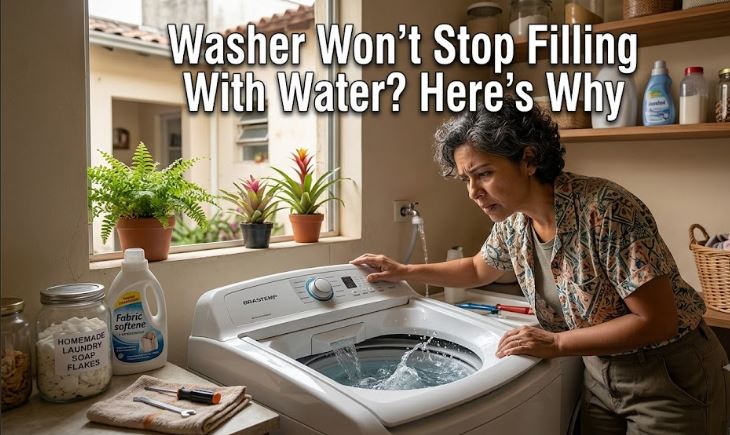
Washer Won’t Stop Filling With Water? Here’s Why
Some of these causes are mechanical failures inside the washer, while others are installation issues that have nothing to do with a broken part. They include:
1. The Drain Hose Is Siphoning Water Back Out
This is the cause most people never suspect, and it’s one of the most common. If the drain hose sits too low, or lacks a proper air gap where it enters the standpipe, water can continuously siphon back out through the drain while the washer is still trying to fill.
From the washer’s perspective, the water level never rises to the target, so it just keeps adding more, creating what looks exactly like a stuck fill even though nothing inside the machine has actually failed.
Check that the drain hose enters the standpipe with a loop, positioned well above the trap, typically between 30 and 96 inches off the floor depending on your washer’s specifications. A drain hose kit with a U-bend holder (View on Amazon) makes it easy to secure the hose at the correct height and maintain that gap.
2. The Water Inlet Valve Won’t Shut Off
The inlet valve uses an electric solenoid to control water flow into the tub. Mineral buildup or a worn solenoid can keep it mechanically stuck open, so water keeps entering even after the control board signals it to stop.
Unplug the washer and watch the inlet area for a few minutes. If water still flows with zero power to the machine, the valve has failed mechanically rather than electronically. A replacement universal inlet valve (View on Amazon) covers most modern two-coil configurations.
3. The Pressure Switch Never Reaches Its Trip Point
The pressure switch monitors water level through air pressure and signals the board to stop filling once it reaches the correct reading. A switch that’s drifted out of calibration, or degraded internally, may simply never reach the pressure needed to trigger that stop signal, no matter how high the water actually gets.
This differs from a stuck valve, since here the valve is working exactly as told; the switch just never tells it to close. A multimeter (View on Amazon) set to continuity mode can confirm whether the switch changes state as pressure builds.
4. A Blocked Pressure Switch Air Tube Sends No Signal at All
Even a perfectly good pressure switch is useless if the small air tube feeding it is fully blocked. Soap residue and mineral buildup can clog this tube over time, and once it’s completely obstructed, the switch never receives any pressure signal, so it never trips.
Disconnect the tube and blow through it. It should offer minimal resistance. A fully blocked tube explains a fill that genuinely never stops rather than one that stops inconsistently.
5. A Mechanical Timer Is Stuck in the Fill Step
Older top-load washers with mechanical timers advance through each phase of the cycle using a small motor that turns the timer dial. If that motor stalls or the timer cam sticks while parked in the fill position, the washer never advances to agitate or drain, regardless of water level.
Listen for the timer motor’s faint hum during the fill phase. Silence, combined with a dial that isn’t slowly advancing, points to this cause rather than a water-system component.
6. Very Low Household Water Pressure Extends the Fill Endlessly
Some washers time out and display an error after a set fill window, but others simply keep the valve open and keep waiting, which can feel identical to a stuck fill if your home’s water pressure is unusually low.
Time how long it takes to fill a 5-gallon bucket from the same supply line. Anything beyond two minutes suggests a pressure problem upstream of the washer rather than a failed component inside it.
7. Crossed or Reversed Hot and Cold Hose Connections
If the hot and cold supply hoses were swapped during installation or after moving the washer, some models repeatedly restart or extend the fill phase while trying and failing to reach the correct water temperature for the selected cycle.
Turn off the water, disconnect both hoses at the back of the washer, and confirm hot connects to the left inlet and cold to the right when facing the machine from behind.
When to Call a Professional Instead
The drain hose, inlet valve, and pressure tube are all approachable weekend fixes. A stuck mechanical timer or a control board that won’t advance past the fill step is worth having a licensed technician diagnose, since testing those components properly requires more specialized tools. If your washer fills, then stops with clothes still soaking, that’s actually the opposite problem; our guide to Kenmore washers that fill then stop covers that scenario specifically.
FAQs
Why does my washer keep filling even when unplugged?
This points to a mechanically stuck inlet valve rather than an electrical or control issue. Since the valve controls water flow directly, a failed solenoid can let water through with zero power to the machine.
Can a bad drain hose really cause a washer to never stop filling?
Yes, and it’s one of the most overlooked causes. If the hose siphons water back out as fast as it enters, the washer never reaches its target level and just keeps adding more indefinitely.
Why does my washer only sometimes get stuck filling?
An intermittent pattern usually points to a partially, rather than fully, blocked pressure switch tube, or a valve with a solenoid that’s beginning to wear but hasn’t failed completely. Both tend to worsen gradually.
Is a slow fill the same problem as a fill that won’t stop?
Not exactly, though they can look similar. A slow fill from low water pressure eventually reaches the target level; a true stuck fill never does, regardless of how long you wait. Our LG washer error codes guide explains how pressure sensor errors distinguish between the two.
Should I repair or replace a washer that won’t stop filling?
If you’ve checked the drain hose height, tested the inlet valve, and confirmed the pressure switch and tube are clear, and the issue persists on a washer over 10 years old, a control board fault may make replacement the more practical choice.
Getting Your Washer’s Fill Cycle Back to Normal
A washer that won’t stop filling almost always comes down to one of two things: water escaping somewhere it shouldn’t, or a component that never receives the signal to stop. Start with the drain hose height, since that single check resolves more cases than any part replacement.
If the hose checks out, work through the inlet valve and pressure switch next. Together, those three causes account for the vast majority of washers stuck in an endless fill.