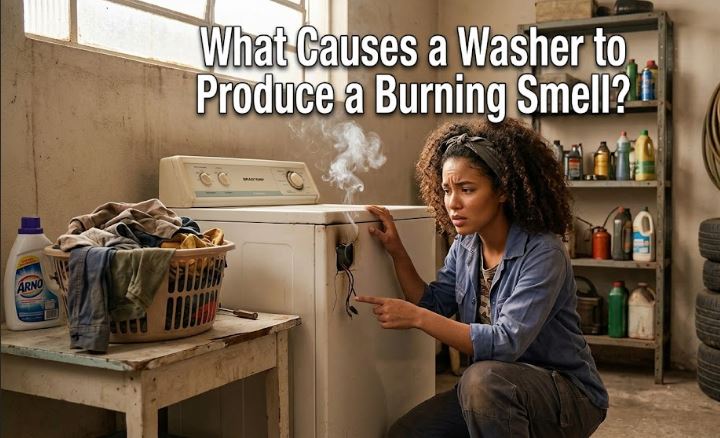
You open the lid mid-cycle and catch it: an acrid, hot smell that has no place near your laundry. Your first thought is probably right to be cautious, since burning smells are your washer’s way of flagging real heat somewhere it shouldn’t be.
You wonder, “why is my washer making a burning smell?” A burning smell usually comes from friction heat in a slipping belt or clutch, an overloaded motor, or a bad electrical connection overheating nearby components.
Not every burning smell means disaster, but every one deserves a quick, careful check before running another load. Here’s how to tell the difference and work through each cause safely.
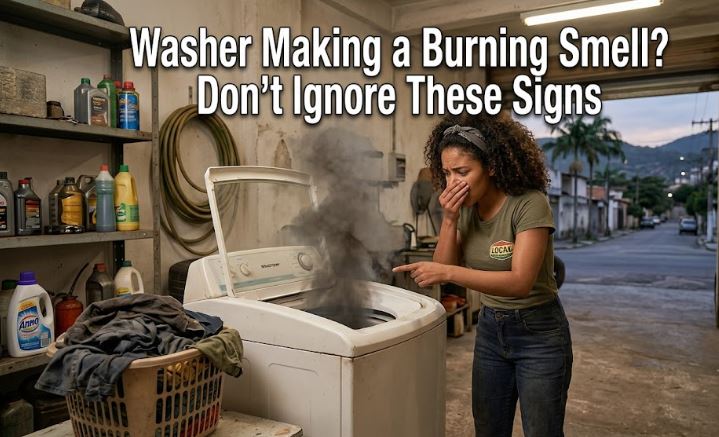
If You Smell Burning Right Now
Take these steps immediately, since a genuine electrical or friction fire risk isn’t worth waiting out:
- Stop the cycle and unplug the washer rather than pressing pause.
- Check for visible smoke, scorch marks, or a hot spot on the cabinet before touching anything else.
- If you see smoke or flames, treat it as a fire emergency and call 911 rather than continuing to troubleshoot.
- Once it’s unplugged and cooled, work through the causes below to find the source.
Quick-Reference for a Washer Making a Burning Smell
Some of these causes are urgent mechanical or electrical failures, while one is completely harmless. Here’s how they compare:
| Cause | Severity | DIY Difficulty | Typical Fix Cost |
|---|---|---|---|
| Slipping or worn drive belt | Moderate | Moderate (45 min) | $15–$30 |
| Worn clutch pads overheating | Moderate | Advanced | $30–$60 |
| Overloaded motor drawing excess current | Moderate | Easy | $0 |
| Burnt control board component or wiring | Serious | Advanced | $150–$300 |
| Worn motor coupling slipping under load | Moderate | Moderate | $15–$30 |
| Dust and lint buildup trapping heat | Low | Easy (20 min) | $0 |
| New washer break-in smell | Harmless | No | $0 |
What Causes a Washer to Produce a Burning Smell?
If your washing machine is producing a burning smell, it’s often a result of one of these issues:
1. A Slipping or Worn Drive Belt
On belt-drive washers, the belt connects the motor to the drum pulley. As it wears, glazes, or loses tension, it slips against the pulley instead of gripping cleanly, and that friction generates real heat along with a distinct burning rubber smell.
This usually shows up alongside slow or weak spinning, since a slipping belt can’t transfer full power to the drum while it’s overheating.
Open the rear panel and inspect the belt for a shiny, glazed surface or visible cracking. A properly sized replacement drive belt (View on Amazon) resolves this on most Whirlpool, Maytag, Amana, and Kenmore top-load models.
2. Worn Clutch Pads Overheating From Friction
Many top-load washers use a clutch to engage the transmission during spin. As the friction pads inside wear down, they slip against the drive plate instead of locking firmly, and that repeated slipping generates enough heat to produce a burning smell.
You’ll typically notice this alongside weak spinning or clothes coming out wetter than usual, since the clutch isn’t transferring full power to the basket.
3. An Overloaded Motor Drawing Excess Current
Stuffing the drum well beyond its rated capacity forces the motor to work harder than designed, drawing more current and heating up the windings inside. That heat produces a warm, slightly electrical smell, different from the sharper rubber smell of a slipping belt.
Split oversized loads into two smaller ones, particularly with heavy items like comforters or towels, and give the motor a break between large loads.
4. A Burnt Control Board Component or Wiring Connection
This is the cause that deserves the most caution. Control boards can develop burnt components from power surges, moisture intrusion, or age, and a loose or corroded wiring connection can arc and generate localized heat inside the cabinet.
A sharp, acrid, plastic-like smell, especially one that doesn’t correlate with any particular part of the cycle, points here rather than to a mechanical part.
Our guide to Maytag Bravos washers that won’t spin covers inspecting a control board for visible burn marks or scorching. If you find any, that board needs replacement, and it’s worth having a technician confirm before ordering a part.
5. A Worn Motor Coupling Slipping Under Load
Direct-drive washers use a small plastic coupling between the motor shaft and transmission instead of a belt. As it wears, the coupling can slip and generate friction heat before failing completely, producing a burning plastic or rubber smell similar to a slipping belt.
If your washer is also making a grinding noise alongside the smell, that combination points strongly to this cause, since a worn coupling often produces both symptoms as it deteriorates.
Our guide to Kenmore Elite washers not draining or spinning walks through coupling replacement alongside other transmission failures on that model line.
6. Dust and Lint Buildup Trapping Heat
Over years of use, dust and fine lint can accumulate around the motor housing and vents, insulating it and preventing normal heat dissipation. A motor running slightly warm under a coating of dust can produce a faint burning or hot-dust smell without any actual component failure.
Unplug the washer and vacuum around the accessible vents and motor area using a narrow attachment, careful not to disturb any wiring while you clean.
7. A Brand-New Washer’s Break-In Smell
New washers, like new dryers, sometimes carry a faint smell for the first several loads as protective coatings on internal components and belts burn off during initial use. This is a normal manufacturing byproduct, not a sign of a problem.
Run the first few cycles with the laundry room ventilated, and the smell should fade completely within three or four loads. If it persists well beyond that, treat it as one of the other causes above.
Diagnosing the Smell by What Else You Notice
The smell alone often isn’t enough to pinpoint the cause, so pay attention to what else happens during the cycle when you notice it.
| What Else You Notice | Likely Cause |
|---|---|
| Weak or slow spinning alongside the smell | Slipping belt or worn clutch |
| Grinding noise alongside the smell | Worn motor coupling |
| No correlation with any specific cycle phase | Control board or wiring issue |
| Only on an unusually large or heavy load | Overloaded motor |
| Washer is brand new, smell fading each load | Normal break-in |
When to Call a Professional Instead
Belt, clutch, and coupling replacements are all doable weekend repairs for a reasonably confident DIYer. Anything involving the control board or internal wiring is worth having a licensed technician inspect, since misdiagnosing an electrical fault carries real fire risk a mechanical part replacement doesn’t.
FAQs
Is it normal for a washer to smell a little burnt when new?
Yes, a faint chemical or warm smell during the first few loads is typically just protective coatings burning off, fading within three or four cycles. A persistent or strengthening smell isn’t part of normal break-in.
Why does my washer smell like burning rubber specifically?
A rubber smell almost always points to a slipping belt or a worn motor coupling, since both are made from rubber or rubber-like plastic and generate that odor as they overheat from friction.
Can an overloaded washer actually damage the motor?
Occasional overloading that produces a mild smell usually doesn’t cause lasting damage once you stop. Repeated heavy overloading over time does accelerate wear on the motor, belt, and clutch, so it’s worth avoiding as a habit.
Should I keep using my washer if it smells like burning?
No, stop the cycle and unplug it until you’ve identified the cause, especially if the smell is sharp, electrical, or comes with any smoke or visible scorching. Mechanical smells from a belt or clutch are less urgent but still shouldn’t be ignored.
How do I know if the smell means a fire risk?
A plastic or electrical smell with no clear mechanical explanation, especially alongside a hot cabinet or any visible smoke, is the combination that warrants immediate action. A rubbery smell tied to slow spinning is far more likely mechanical than a fire risk.
Getting the Burning Smell Out of Your Laundry Room
A washer making a burning smell is almost always pointing to real friction or electrical heat somewhere specific, and matching the smell to what else is happening during the cycle narrows it down quickly. Start with the belt and clutch, since those two causes are the most common and the most affordable to fix.
If the smell has no mechanical explanation, don’t guess at the control board yourself. A quick professional inspection is worth the cost compared to the risk of missing a genuine electrical fault.