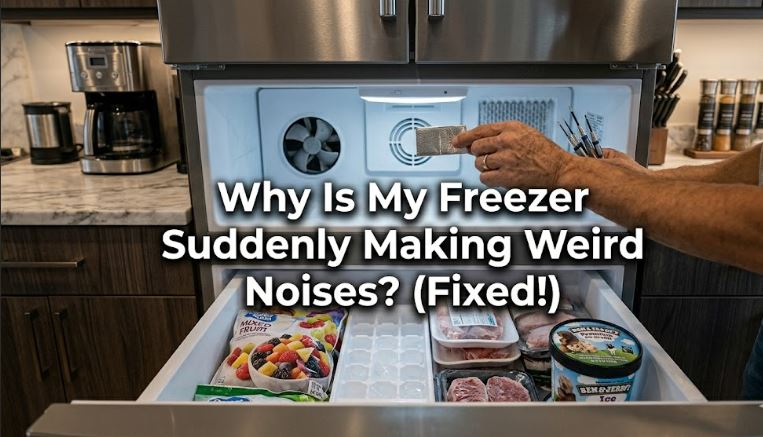
Your freezer has always been there in the background, a low, reassuring hum that tells you everything is working. Then one day a new sound appears. Maybe it is a grinding you hear when you walk past the kitchen. Maybe it is a loud clicking that starts and stops at random. Maybe it is a high-pitched squeal that hits every time the unit kicks on.
Strange freezer sounds are worth paying attention to for two reasons. First, different sounds point to completely different components, and knowing which sound you have tells you almost immediately where to look. Second, most strange sounds that get ignored become expensive component failures that get worse with every additional day of running.
The good news is that several common freezer sounds have entirely free fixes. And even the ones that require parts are often straightforward DIY replacements.
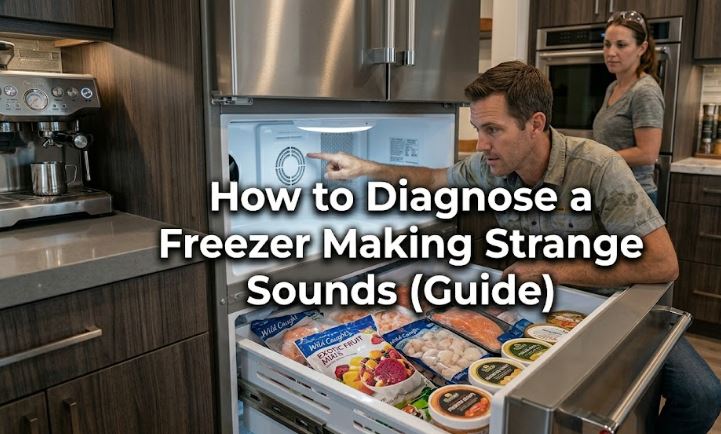
An Overview of Types of Freezer Noises & Their Causes
| Sound Type and Pattern | Most Likely Cause |
|---|---|
| Loud grinding or scraping from inside | Evaporator fan blade hitting ice buildup |
| High-pitched squealing or whining | Evaporator or condenser fan motor bearings failing |
| Repeated clicking without compressor starting | Failed start relay or failing capacitor |
| Loud buzzing or humming from rear | Dirty condenser coils or failing compressor |
| Rattling from the back or bottom of unit | Loose drain pan, condenser fan, or external vibration |
| Gurgling or hissing during defrost cycle | Normal defrost sounds, not a fault |
| Cracking or popping from walls | Normal thermal expansion of plastic, not a fault |
| Knocking from inside the unit | Foreign object in fan or loose internal component |
8 Strange Freezer Sounds, Their Causes, and How to Fix Each One
Shared below are the different types of freezer noises and how to troubleshoot them:
1. Grinding or Scraping From Inside the Freezer
A grinding or scraping noise from inside the freezer compartment is one of the clearest sounds on this list to diagnose because there is a simple door test that confirms the cause in about five seconds.
Open the freezer door while the sound is happening. On most frost-free models, the evaporator fan automatically stops when the door opens. If the grinding stops immediately when the door opens, the evaporator fan is the source. If it continues with the door open, something else inside the compartment is involved.
Ice buildup around the evaporator fan blades is the most common cause. When the defrost system partially fails or the door has been left open, ice accumulates around the fan and the spinning blades make contact with it on every rotation, producing the characteristic grinding or scraping sound.
Here Is How to Fix It
- Unplug the freezer and open the freezer compartment door
- Remove the back panel inside the freezer, usually secured by two to four screws, to expose the evaporator fan and coil
- Inspect the fan blades for ice buildup or contact with surrounding components
- If ice is the culprit, leave the freezer unplugged with the door open for 24 to 48 hours to defrost completely. Place towels inside to catch melt water
- After defrosting, check whether the defrost system is functioning correctly as described in our post on freezer frosting over excessively, since recurring ice buildup points to a defrost system fault
- If the fan blade itself is cracked or bent and contacting the housing, search your model number alongside “evaporator fan blade” on Amazon for the correct replacement.
2. High-Pitched Squealing or Whining
A high-pitched squeal or whine is the sound of bearings failing inside a fan motor. The lubrication inside the bearings dries out over years of continuous operation, and metal begins grinding against metal on every rotation. The pitch typically rises as the motor speeds up and may fluctuate as the bearing wears further.
Freezers have two fans that can produce this sound: the evaporator fan inside the freezer compartment and the condenser fan near the compressor at the back or bottom of the unit. Identifying which one is squealing narrows the repair immediately.
Here Is How to Diagnose and Fix It
- Open the freezer door while the sound is active. If the squeal stops immediately, the evaporator fan inside the compartment is the source since it shuts off when the door opens
- If the squeal continues with the door open, walk around to the back or bottom of the unit and listen near the compressor area. The condenser fan motor at this location is the source
- Unplug the freezer and access whichever fan is responsible by removing the relevant panel
- Spin the fan blade by hand. A bearing-failed motor produces a rough, grinding sensation and resistance even when spun slowly by hand
- Replace the failed motor.
3. Repeated Clicking Without the Compressor Starting
A single click when the compressor starts or stops is completely normal. It is the sound of the start relay closing and opening the compressor circuit. The sound that signals a problem is rapid, repeated clicking without the compressor successfully engaging and running.
This pattern is almost always the start relay failing to deliver the startup current surge the compressor motor needs. The relay clicks, attempts to start the compressor, fails, and resets to try again in a few minutes. It is the same cause described in our post on freezer not running at all but at an earlier stage where the relay is failing intermittently rather than completely.
Here Is How to Test and Fix It
- Unplug the freezer and locate the start relay on the side of the compressor at the back of the unit. It is a small plastic component that plugs onto the compressor’s side terminals
- Remove the relay and shake it next to your ear. A rattling sound inside confirms the internal PTC resistor has broken and the relay needs replacement (View on Amazon)
4. Loud Buzzing or Humming From the Rear
A buzzing or humming that is noticeably louder than the normal operational hum and comes from the rear or bottom of the unit points to one of two causes: dirty condenser coils making the compressor work significantly harder than normal, or the compressor itself developing an internal fault.
The distinction between these two causes is important because one is free to fix and the other requires professional assessment. Fortunately, the condenser coil cleaning always comes first in the diagnostic sequence.
Here Is How to Diagnose and Fix It
- Unplug the freezer and pull it away from the wall to access the condenser coils at the rear or beneath the unit behind the kick plate
- Inspect the coils for a visible layer of dust, pet hair, and debris. Even a moderate coating significantly increases the compressor’s workload and produces louder operational sounds
- Use a Refrigerator Coil Cleaning Brush (View on Amazon) to reach deep between the coil fins and dislodge accumulated debris, then vacuum the area thoroughly
- Plug the unit back in and listen after 30 minutes. A buzzing that reduces significantly after cleaning confirms the coils were the cause
- A loud buzzing that persists despite clean the coils points toward the compressor itself. Contact a licensed appliance technician for compressor testing since internal compressor diagnosis requires specialized equipment.
5. Rattling From the Back or Bottom of the Unit
Rattling sounds from the exterior of the freezer almost always have mechanical rather than refrigeration-related causes, and most are free to identify and fix. Unlike the sounds above that involve internal components, rattling typically involves the physical housing of the unit and its relationship with the surrounding space.
The drain pan, condenser fan guard, and rear access panel are the most common rattling sources. The freezer sitting on an uneven floor creates the same sound as internal vibration amplified by the unit rocking on its feet.
Here Is How to Identify and Fix It
- Confirm the freezer sits on a flat, stable surface. Place a spirit level on top of the unit and check both directions. Adjust the leveling feet by turning them clockwise to raise or counterclockwise to lower each corner
- Place Anti-Vibration Appliance Pads (View on Amazon) under all four feet. These rubber pads grip the floor surface, dampen vibration from the compressor, and prevent the unit from walking across smooth floors during operation
- Check the drain pan at the base of the unit, usually a shallow plastic tray that sits on a sliding bracket. Pull it out, confirm it is correctly seated, and push it firmly back into position
- Tighten any loose screws on the rear access panel and confirm the condenser fan guard is fully seated and not vibrating against the fan or housing
6. Gurgling, Hissing, or Sizzling During a Defrost Cycle
These three sounds alarm homeowners who hear them for the first time, but they are completely normal and require no action whatsoever.
During the automatic defrost cycle, the defrost heater melts frost from the evaporator coil. As the ice melts and water drips onto the still-warm heater surface, it produces sizzling and hissing sounds. The water then drains down through the defrost drain and produces gurgling as it flows through the drain tube into the drain pan. These sounds are the defrost system working exactly as designed.
Here Is What to Do
- Note whether the sounds occur at regular intervals, typically every 8 to 12 hours, and last for approximately 20 to 30 minutes before stopping. This timing pattern confirms normal defrost cycle sounds
- If the sizzling is accompanied by a burning smell, that is a different situation pointing to debris on the defrost heater element rather than normal ice melt. In that case, the heater and surrounding area need inspection and cleaning
- If gurgling sounds are present continuously rather than only during defrost cycles, the condensate drain line may be partially blocked.
7. Cracking or Popping From the Interior Walls
Cracking and popping from the freezer walls are sounds that concern homeowners because they suggest something is breaking. In reality, these sounds are almost always the normal thermal expansion and contraction of the plastic interior liner as the temperature cycles.
When the compressor shuts off at the end of a cooling cycle, the interior temperature rises slightly before the next cycle begins. The plastic liner expands minutely with this warming and contracts again when cooling resumes. These dimensional changes produce the cracking and popping sounds that are particularly noticeable in quieter homes during nighttime hours.
Here Is What to Confirm
- Note whether the cracking occurs specifically at the end of a cooling cycle when the compressor shuts off, or at the start of the next cycle when the temperature drops. This timing pattern confirms thermal expansion rather than structural damage
- Open the freezer and inspect the interior walls for any visible cracking, splitting, or separating of the liner material. Normal thermal cracking sounds leave no visible damage
- If visible cracks or splits are present in the liner itself, contact the manufacturer since liner damage allows moisture to enter the insulation layer and requires professional assessment
- Cracking that occurs throughout the cycle rather than specifically during temperature transitions, or cracking that is accompanied by unusual odors, warrants closer investigation
8. Knocking or Thumping From Inside the Unit
A knocking or thumping sound from inside the freezer is one that always warrants investigation since it almost always involves a physical contact that should not be happening.
The two most common sources are a foreign object that has made its way into the evaporator fan area, and loose tubing inside the refrigerant system vibrating against internal components during compressor operation.
Here Is How to Find and Fix It
- Open the freezer door and locate the sound. Knocking that stops when the door opens comes from the evaporator fan compartment behind the back panel
- Unplug the freezer and remove the back panel inside the compartment to inspect the fan area for any small object that may have fallen in from the compartment, including ice chunks, food debris, or a displaced component
- Remove any foreign object carefully. If the fan blade itself is cracking against ice, the defrost system needs attention as described in cause one above
- Knocking that continues with the door open and comes from the rear or bottom of the unit points to refrigerant tubing vibrating against the compressor housing or cabinet walls. This tubing can be gently repositioned by a technician and secured with foam insulation tape to eliminate contact-based knocking
Freezer Strange Sound Fix Cost Overview
| Sound and Cause | DIY Safe | Fix Cost | Pro Service Cost |
|---|---|---|---|
| Defrost ice from evaporator fan | Yes | Free | N/A |
| Level the unit and add anti-vibration pads | Yes | $10 – $20 | N/A |
| Reseat loose drain pan | Yes | Free | N/A |
| Clean condenser coils | Yes | Free – $15 | $80 – $150 |
| Replace start relay | Yes | $8 – $20 | $100 – $180 |
| Replace evaporator fan motor | Moderate DIY | $20 – $50 | $150 – $250 |
| Replace condenser fan motor | Moderate DIY | $20 – $50 | $150 – $250 |
| Compressor assessment | No | N/A | $150 – $300 |
Frequently Asked Questions
How do I tell whether the sound is coming from inside or outside the freezer compartment?
Open the freezer door while the sound is happening. Most evaporator fan sounds stop immediately when the door opens since a magnetic switch shuts the evaporator fan off automatically when the door is ajar. Any sound that stops when the door opens originates from inside the compartment. Any sound that continues with the door open comes from the exterior components, typically the condenser fan, compressor, or cabinet vibration.
Is a humming sound from my freezer normal?
A moderate, steady hum from the compressor during a cooling cycle is completely normal. It is the sound of the compressor motor pressurizing the refrigerant. The hum should be consistent and similar to what the unit has always sounded like. A hum that is noticeably louder than before, that has a buzzing or grinding quality, or that is accompanied by reduced cooling performance is no longer normal and points toward dirty condenser coils or a compressor under stress.
My freezer started making a grinding noise overnight. Why would it start suddenly?
A sudden onset of grinding almost always points to ice buildup reaching the evaporator fan blades. This can happen quickly when the door is left ajar overnight or when the defrost system stops working and a rapid frost accumulation reaches the fan. Unplug the freezer, remove the back panel inside the compartment, and check whether ice has surrounded the fan blades. A 24 to 48 hour unplugged defrost resolves the immediate sound while you assess whether the defrost system needs repair.
Should I be worried about a clicking sound from my freezer?
It depends on the pattern. A single click at the start and end of each compressor cycle is normal. Rapid, repeated clicking every few minutes without the compressor successfully starting and running is the sound of a failing start relay and needs addressing before the relay fails completely and the freezer stops running. Replacing the start relay at the first sign of this pattern prevents the total no-start failure and costs under $20.
Can a noisy freezer increase my electricity bill?
Yes, significantly in some cases. Dirty condenser coils that cause the compressor to work harder and produce a louder hum also cause it to run longer to achieve the same cooling, directly increasing energy consumption. An evaporator fan struggling against ice buildup consumes more power than one spinning freely. Addressing the cause of the noise typically restores normal energy efficiency at the same time.
Match the Sound Type to the Right Component
Strange freezer sounds are the appliance’s clearest form of communication. Unlike temperature problems that require measurement tools to confirm, a grinding, squealing, clicking, or rattling sound points you directly toward the component that needs attention using nothing more than your ears and the door-open test.
Start with the door-open test on any inside-the-compartment sound, and the condenser coil cleaning for any rear buzzing or humming. Together, those two checks resolve the majority of strange freezer noises without tools or parts. Remember to check our ultimate freezer troubleshooting guide for many other issues that may crop up while using the freezer and discover how to troubleshoot them yurself.