
You open the freezer door and the silence tells you everything before your hand even touches the food. No hum, no fan noise, nothing running. The interior light might come on, or it might not. But one thing is certain: the freezer is completely dead and whatever is inside it is quietly warming toward room temperature.
Unlike a freezer that runs too much or cools unevenly, a freezer not running at all is a situation with a ticking clock attached to it. Depending on how much food is inside and how often the door stays closed, you have roughly 24 to 48 hours before contents begin to thaw significantly. Acting quickly and methodically through the causes below is the fastest path to either getting the unit running again or making an informed decision about transferring food before it is lost.
Start at the power supply and work inward. The causes below are ordered from the most accessible to the most involved, which is also roughly the order of likelihood for most households.
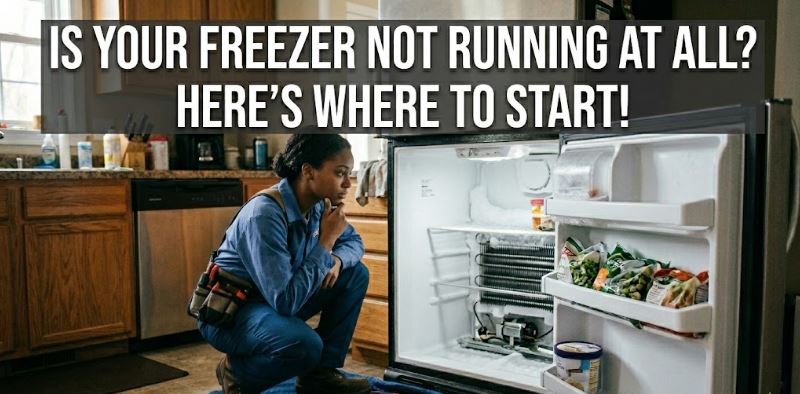
What Causes a Freezer to Stop Running Suddenly?
Here is an overview of what’s likely to stop your freezer from running and what you are likely to notice as a result.
| What You Notice | Most Likely Cause |
|---|---|
| No sound, no light, nothing works | Power supply failure, tripped breaker, or unplugged unit |
| Interior light works but no compressor or fan | Failed start relay, thermostat, or control board |
| Clicks once then goes silent | Failed start relay preventing compressor from engaging |
| Hums briefly then stops | Failed start capacitor or overheating compressor |
| Stopped after a power outage | Control board needs reset or surge damage |
| Display works but nothing runs | Demo mode active or control board fault |
| Recently moved or tilted | Compressor oil needs to settle, see below |
8 Reasons Your Freezer Is Not Running at All and How to Fix Each One
Consider these eight issues when your freezer stops running:
1. The Power Supply Has Failed
The most common reason a freezer stops running completely is also the simplest: it has lost power. Before drawing any conclusions about internal component failure, spend two minutes confirming the power supply is intact. This resolves a significant number of completely dead freezer calls without any further investigation.
A tripped circuit breaker, a loose plug, a failed outlet, or a tripped GFCI outlet serving the freezer circuit can all produce a completely dead appliance that looks like a serious mechanical failure when the fix is thirty seconds at the breaker panel.
Here Is How to Check and Fix It
- Confirm the freezer’s power cord is fully seated in the outlet with no looseness at either the plug or the socket
- Plug a lamp or phone charger into the same outlet to confirm the outlet itself is live
- Check the main electrical panel for a tripped breaker labeled Freezer, Kitchen, or the circuit number serving the freezer’s location. A tripped breaker sits in the middle position. Flip it fully off, wait 30 seconds, then flip firmly back on
- Check for a GFCI outlet in the same circuit by looking for outlets with Test and Reset buttons nearby. Press the Reset button firmly if it has popped out
- Confirm the freezer is not plugged into an extension cord since most residential extension cords cannot safely handle the startup current draw of a freezer compressor and cause intermittent or permanent power failures
- If the outlet and breaker are confirmed live but the freezer has no response, move to the next cause
2. The Freezer Has Been Recently Moved or Tilted
This cause applies specifically to freezers that have been transported, moved to a new location, or tilted significantly during installation or repositioning. It is worth knowing about because running the compressor too soon after tilting can permanently damage it, and the fix requires patience rather than parts.
Freezer compressors are lubricated by oil that sits in a specific reservoir inside the compressor housing. When the unit is tilted or laid on its side during transport, that oil migrates into the refrigerant lines. If the compressor is started before the oil drains back into the reservoir, it runs dry and can sustain immediate, irreversible damage. As a result, the compressor may hum and immediately shut off, or refuse to start at all, if it was run too soon after being moved.
Here Is How to Fix It
- If the freezer was moved recently, confirm it has been standing upright for at least two hours before attempting to start it. Four hours is safer after any significant tilting and 24 hours is the recommended wait after the unit was laid completely on its side
- Do not attempt to force-start a freezer that was recently transported by cycling power repeatedly. Allow the full rest period before the first startup
- After the appropriate rest period, plug in and listen for normal startup sounds. A normal startup includes a brief hum from the compressor followed by the sound of the evaporator fan circulating air
3. The Temperature Control Thermostat Has Failed
The temperature control thermostat is the component that initiates every compressor cycle. It monitors the compartment temperature and closes the circuit to the compressor when the temperature rises above the set point. When it fails in the open position, the circuit to the compressor stays permanently open and the compressor never receives the signal to run, leaving the freezer completely silent regardless of how warm it becomes inside.
This is one of the more common causes of a freezer that appears to have power at the interior light but shows no compressor or fan activity at all.
Here Is How to Test and Fix It
- With the freezer plugged in, slowly rotate the temperature control dial from the lowest setting to the highest setting while listening carefully. A working thermostat produces an audible click somewhere during this rotation as it closes the compressor circuit. No click at any setting indicates the contacts have failed open
- If rotating the dial to the coldest position produces a click and the compressor starts, the thermostat is working but was set too warm. Leave it at a colder setting and monitor
- If no click occurs at any setting, unplug the freezer and test the thermostat with a multimeter set to continuity at the coldest setting. No continuity confirms the contacts are stuck open
- Search your model number alongside “temperature control thermostat” on Amazon for the correct replacement part
4. The Compressor Start Relay Has Failed
The compressor start relay is a small but critical component that provides the initial electrical boost the compressor motor needs to overcome inertia and begin rotating on each startup. Without a functioning start relay, the compressor motor receives normal run voltage but lacks the startup surge, hums briefly as it tries to start, trips its internal thermal overload protector, and goes silent within a few seconds.
This cause produces a very recognizable symptom: a single click from the back of the freezer followed by a brief hum lasting two to five seconds, then complete silence. This sequence repeats every few minutes as the thermal overload cools and resets. A completely dead freezer with no click or hum at all may also have a failed relay in some configurations.
Here Is How to Test and Replace It
- Unplug the freezer and locate the start relay on the side of the compressor, usually a small plastic component that plugs directly onto the compressor’s side terminals
- Remove the relay by pulling it firmly from the compressor terminals
- Shake the relay near your ear. A healthy relay is silent when shaken. A relay with a rattle inside has a failed internal component and needs a replacement (View on Amazon).
5. The Defrost Timer Is Stuck in Defrost Mode
Safety level: Manually advancing the defrost timer is a safe DIY test.
This cause is specific to older frost-free freezers with mechanical defrost timers and produces a distinctive symptom: the freezer appears completely dead during normal operation but starts running after the defrost timer is manually advanced past the defrost phase.
The mechanical defrost timer has internal contacts that switch between the cooling cycle and the defrost cycle at regular intervals. When the timer motor fails or the internal contacts stick, the timer can get stuck in defrost mode. In defrost mode, power is diverted to the defrost heater and away from the compressor. The compressor and evaporator fan receive no power and the freezer appears to have stopped running entirely, when in reality it is stuck waiting for a defrost cycle to end that will never advance on its own.
Here Is How to Diagnose and Fix It
- Locate the defrost timer, usually at the back of the freezer compartment near the temperature control or behind the kick plate at the base
- Insert a flat-head screwdriver into the advancing slot on the face of the timer and turn it slowly clockwise until you hear a click, which advances the timer out of defrost mode and into the cooling cycle
- If the compressor and fan start running immediately after this manual advance, the timer motor has failed and is not advancing automatically through its cycle
- Search your model number alongside “defrost timer” on Amazon for the correct replacement.
6. The Evaporator Fan Motor Has Failed
A failed evaporator fan motor stops air circulation inside the freezer completely. On some freezer models, a safety circuit detects the loss of the evaporator fan and shuts down the compressor as well to prevent the compressor from running without adequate airflow. The result is a freezer that appears completely dead when the actual failure is the fan motor rather than the compressor.
Even on models without this safety interlock, a failed evaporator fan produces a freezer that is completely silent since both the fan and compressor noises are absent.
Here Is How to Test and Fix It
- Unplug the freezer and remove the back panel inside the freezer compartment to access the evaporator fan motor
- Spin the fan blade by hand. It should rotate freely without resistance or grinding
- Attempt to spin the blade and feel whether the motor shaft turns smoothly or is seized
- Test the fan motor with a multimeter for continuity across its terminals. No continuity confirms the motor has failed and needs a replacement (View on Amazon)
7. The Main Control Board Has Failed or Needs a Reset
Modern electronic freezers rely on a main control board to manage every function including the compressor cycle, defrost system, fan operation, and temperature monitoring. When the control board develops a fault, all of these functions can stop simultaneously, leaving the freezer completely unresponsive despite having power to the display and interior light.
A power surge is the most common trigger for sudden control board failure, and many board faults that appear complete are actually temporary glitches that clear with a proper reset rather than permanent hardware damage.
Here Is How to Reset and Assess It
- Unplug the freezer from the wall completely and wait five full minutes before plugging back in. This allows the board’s capacitors to fully discharge and performs a complete memory reset
- After plugging back in, listen for the normal startup sequence of the compressor clicking on followed by fan motor sound. A successful restart after a reset confirms the board had a temporary glitch rather than permanent damage
- Check whether the freezer entered Demo Mode, particularly on new appliances. Demo Mode keeps all lights and display functions active while disabling the compressor and fans. Check your user manual for the deactivation sequence since it varies between brands and models
- If the board fails to restart the compressor after a proper reset, and all other causes above have been eliminated, the board has developed a hardware fault and needs professional diagnosis or replacement. Control boards are model-specific. Search your model number alongside “control board” on Amazon to find the correct replacement
8. The Compressor Has Failed
Safety level: Observation only. Compressor diagnosis and replacement requires a licensed appliance technician.
When every cause above has been investigated and the freezer still does not run, the compressor itself has failed internally. The compressor is the heart of the entire refrigeration system. When its motor windings short, open, or ground to the housing, or when its mechanical components seize, the freezer stops working entirely regardless of how healthy every surrounding component is.
A completely failed compressor produces no sound at all during a cooling call. A compressor with a seized motor may produce a brief hum followed by silence as the thermal overload trips. A compressor with a failed winding may click the start relay repeatedly without any motor engagement.
Here Is What to Observe and Do
- After confirming the start relay is working, the thermostat clicks correctly, and power reaches the unit, place your hand on the compressor housing at the back of the unit. A running compressor is warm to the touch. A completely cold compressor after several minutes of the thermostat calling for cooling confirms no mechanical activity
- Contact a licensed appliance technician for compressor testing using a clamp meter and multimeter to confirm the failure type
- Compare the cost of compressor replacement against the age of the appliance before committing to repair. Compressor replacement typically costs $300 to $600 in parts and labor. On freezers over ten years old, this cost often approaches or exceeds the replacement value of the appliance.
Freezer Not Running Fix Cost Overview
| Cause | DIY Safe | Fix Cost | Pro Service Cost |
|---|---|---|---|
| Check power supply and reset breaker | Yes | Free | N/A |
| Allow rest period after moving | Yes | Free | N/A |
| Advance defrost timer manually | Yes | Free | N/A |
| Replace defrost timer | Moderate DIY | $15 – $25 | $100 – $200 |
| Replace start relay | Yes | $8 – $20 | $100 – $180 |
| Replace temperature control thermostat | Moderate DIY | $20 – $40 | $100 – $200 |
| Replace evaporator fan motor | Moderate DIY | $20 – $50 | $150 – $250 |
| Reset or replace control board | Moderate DIY | Free – $150 | $200 – $400 |
| Compressor replacement | No | N/A | $300 – $600 |
Frequently Asked Questions
How long can a freezer stay off before food starts to spoil?
A fully stocked freezer that remains closed maintains a safe temperature for approximately 48 hours after losing power. A half-full freezer maintains safe temperatures for roughly 24 hours. The key is keeping the door closed to preserve the cold mass inside. Place a thermometer inside and check after 24 hours. Food that still contains ice crystals or registers at 40°F or below is safe to refreeze once the unit is running again.
My freezer interior light works but nothing else runs. What does that mean?
An interior light that works confirms the freezer has power to at least one circuit. However, the light typically draws power from a simpler circuit than the compressor and fans. A failed temperature control thermostat, a start relay that is not delivering the startup surge, or a defrost timer stuck in defrost mode can all prevent the compressor from running while leaving the interior light operational. Work through causes three, four, and five above in that order.
Should I try unplugging and replugging my freezer if it stops working?
Yes, and wait five full minutes between unplugging and replugging rather than doing it immediately. A five-minute wait allows the control board’s capacitors to fully discharge and forces a complete memory reset. It also allows compressor pressure to equalize, which protects the compressor from the high-load start that occurs when refrigerant pressure is still elevated from the previous run cycle. Many temporary board glitches and pressure-related start failures clear completely with this simple reset.
Can a freezer stop working because it is too cold in the room around it?
Yes, in some cases. Freezers placed in garages or unheated spaces in winter may stop running if the ambient temperature drops below the minimum operating temperature specified by the manufacturer, typically around 55°F for most residential models. The thermostat senses that the space around the freezer is already cold enough and never calls for the compressor to run, even though the interior may be warming. A garage-ready freezer rated for wider ambient temperature ranges is the correct solution for cold garage installations.
The start relay on my freezer rattles. Does that definitely mean it needs replacing?
Yes. A rattling start relay has a broken internal component, typically the PTC (Positive Temperature Coefficient) resistor that provides the startup current surge. A broken PTC cannot deliver the current the compressor motor needs to start and the compressor either hums briefly without engaging or fails to start at all. Start relay replacement is one of the most affordable freezer repairs at under $20 for most models and is a straightforward plug-and-play replacement with no tools required.
Make Your Freezer to Start Running Today!
A freezer not running at all sounds like a catastrophic failure but the cause is often simpler than it appears. The power supply check and start relay replacement together resolve the majority of completely dead freezer complaints, and both are accessible to any homeowner with a willingness to spend fifteen minutes at the back of the appliance.
Work through the power supply confirmation, the post-move rest period check, and the start relay shake test before removing any panels or spending any money on parts. And you are dealing with other issues, our freezer troubleshooting guide should come in handy.

Hi, I’m Barlgan! I created Repair Me Yourself to empower homeowners to tackle appliance repairs with confidence. From decoding error codes to fixing cooling issues, I break down complex repairs into simple, actionable steps that save you time and money.