Here’s how to drain a dishwasher that’s holding water. First, cancel the cycle so the drain pump empties the tub. If it won’t, cut the power, bail the water out, and clean the filter. Then check the hose, air gap and disposal before the next run.
Dishwashers were among my service calls. Before I reach into a tub of dirty water, I unplug the machine and shut off its water supply. Do the same, and keep towels on the floor.
Is the water in the bottom normal?
A little water around the filter after a cycle is normal. A tub that’s still holding water above the filter isn’t. The makers draw the line in slightly different places, so use the one that matches the machine you own.
- Frigidaire: some water in the bottom after a wash is normal. Water that covers the filter screen means checking the drain system for debris.
- Whirlpool: water slightly above the filter screen often points to a partial restriction. Clean the filter and sump, then check the hose.
- KitchenAid: a small amount in the filter area is normal. More than an inch could mean a clog.
If your water’s past those lines, work through the steps below in order. The first one doesn’t need any tools.
How to drain a dishwasher by cancelling the cycle
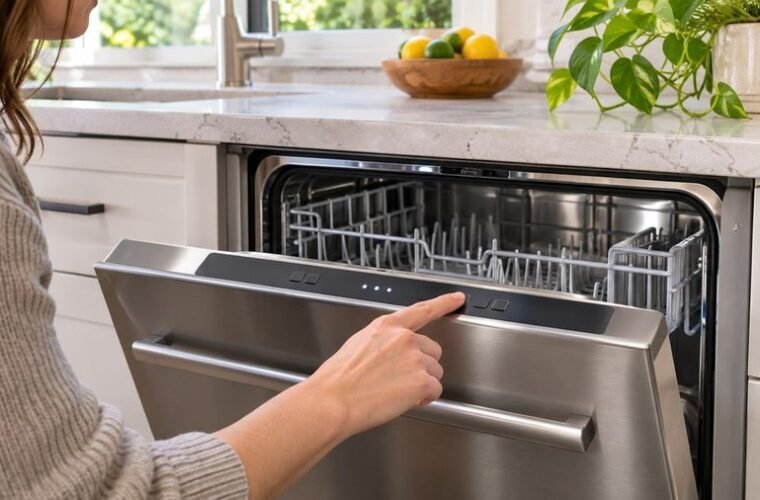
Cancelling a cycle tells the control to run the drain pump. That’s the cleanest way to get the water out. Each maker uses a different button press:
- GE: press and hold Start for 3 seconds, then close the door. The dishwasher drains, beeps, and the wash cycle light turns off.
- Frigidaire: press START/Cancel and close the door right away. It drains for 90 seconds, and then you can pick a new cycle.
- Bosch: hold ON/OFF for about 4 seconds. The leftover water is pumped out, and the cycle ends after about a minute.
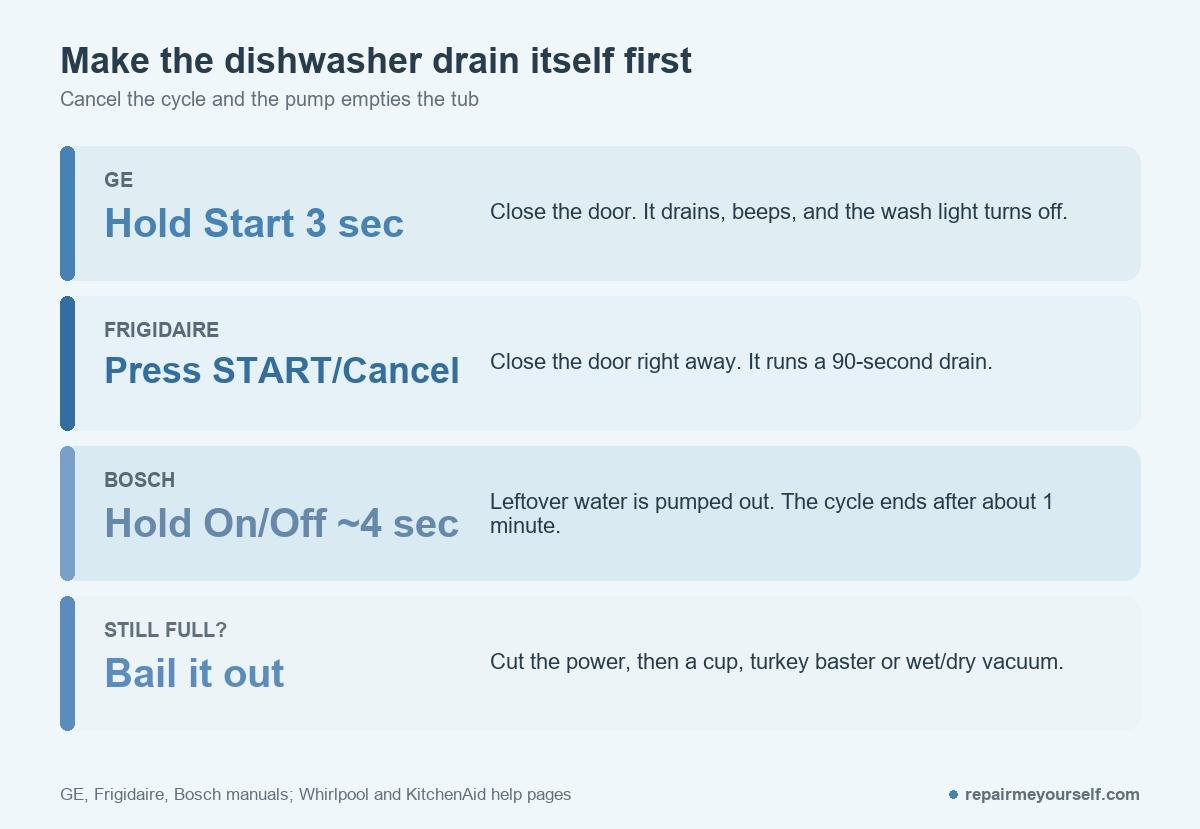
Another brand? Look up “cancel” in the owner’s manual you got with it. The model number is on a label, and on GE models it’s on the tub wall just inside the door.
Watch the water while it runs. If it drops, skip to cleaning the filter. If it doesn’t move, go to the next step.
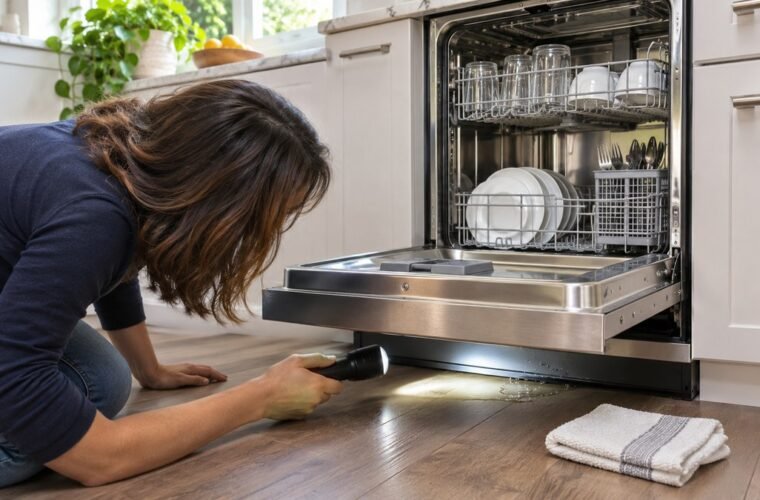
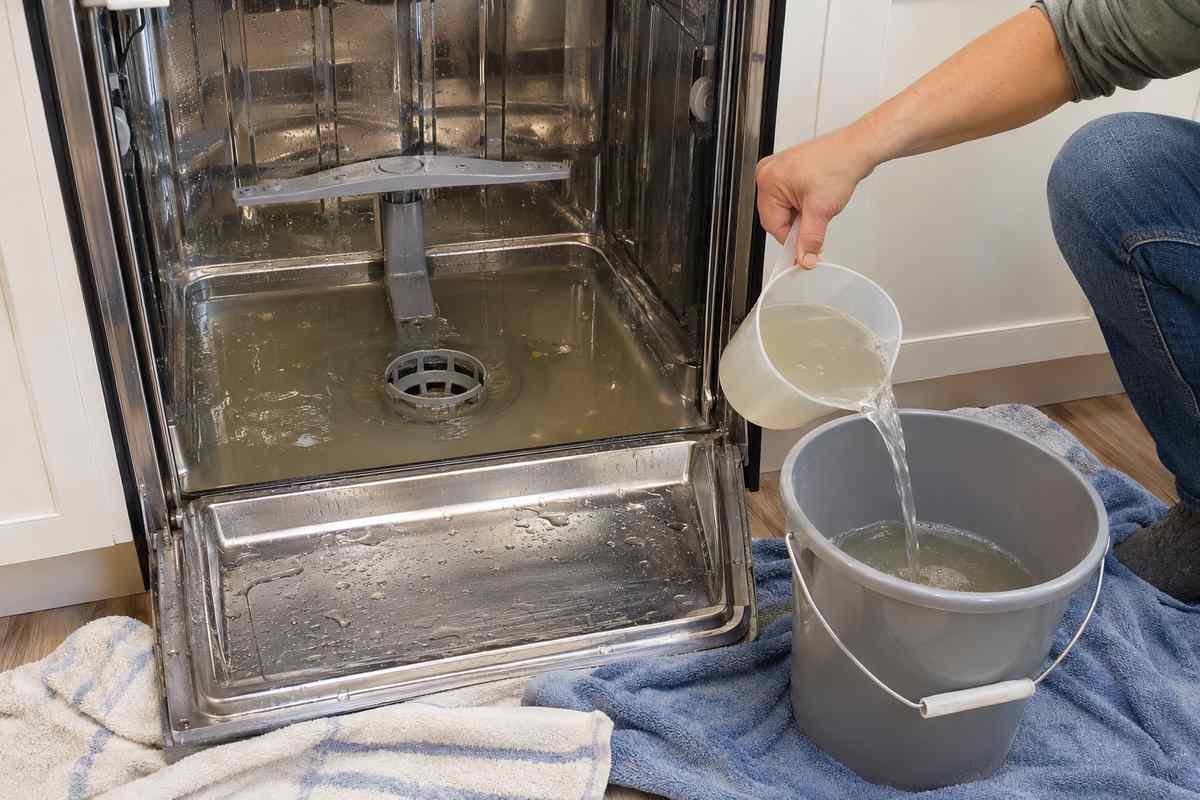
Bail out the water the pump won’t move
When cancelling doesn’t work, you’ll have to take the water out by hand. Whirlpool’s dishwasher not draining guide and KitchenAid’s clog steps cover the same basics:
- Cut the power. Turn off the breaker for a built-in unit. Whirlpool also says to shut off the water.
- Empty the racks so you can see the bottom of the tub. You’ll want both racks out.
- Lay down towels in front of the door.
- Scoop it out. Use a cup, a turkey baster, a sponge, or a hand pump on the sump. KitchenAid also lists a wet/dry vacuum.
- Dry the bottom with towels so you can see the filter.
Don’t pour a drain opener into the tub. Whirlpool says not to use drain-opening chemicals inside a dishwasher.
Clean the filter once the tub is empty
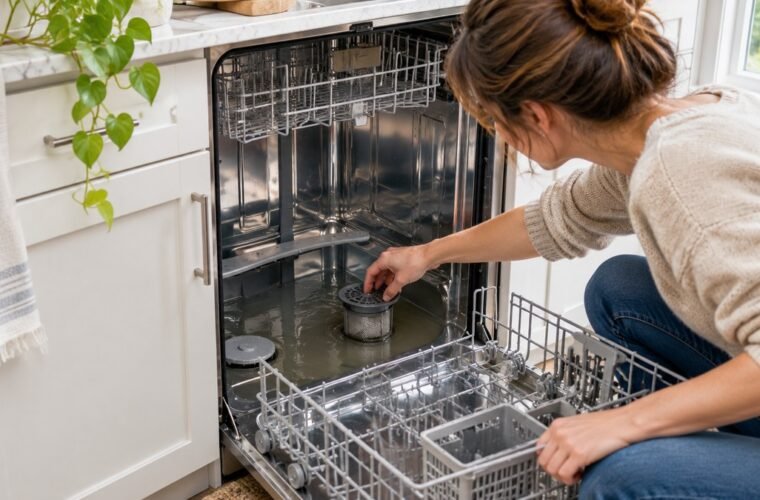
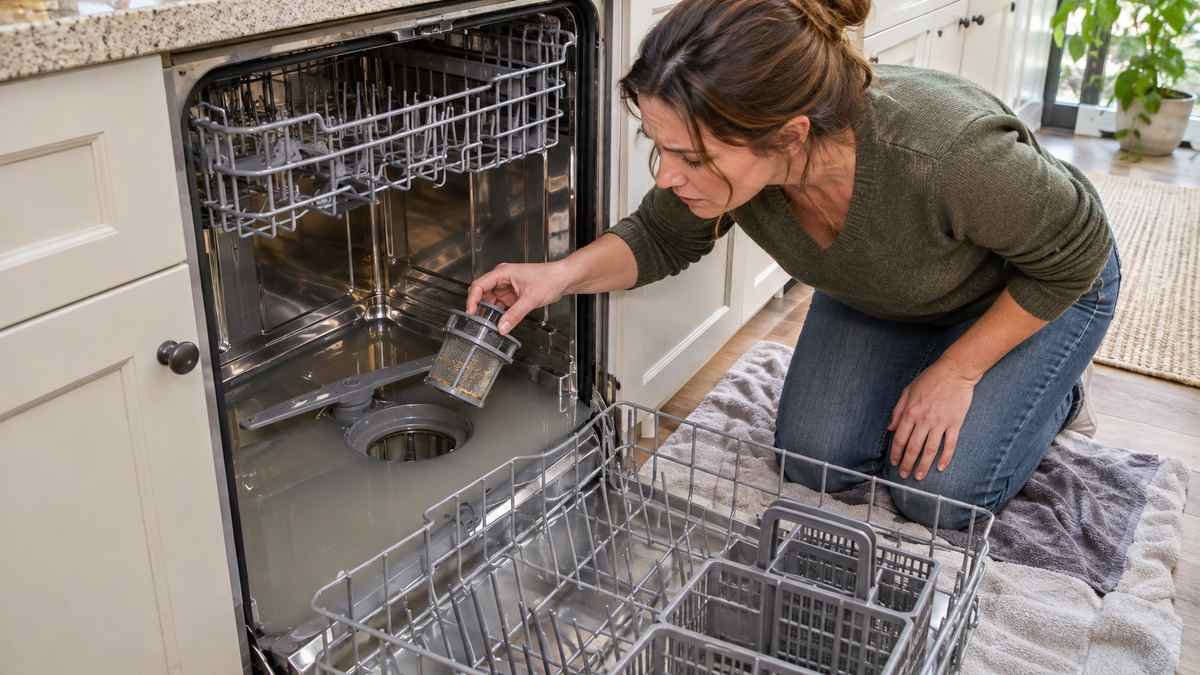
With the water gone, the filter’s the first thing you clear. Whirlpool’s steps go like this. Your model may lock differently, so check its manual.
- Remove the lower rack if it’s still in.
- Twist the upper filter counterclockwise and lift it out. Then lift out the lower filter.
- Rinse both under running water. If food’s stuck on, you can use a soft brush.
- Look into the sump and pull out any debris you find.
- Reseat the filters and turn the upper one clockwise until it locks.
- Run a short rinse and check for standing water.
GE warns that scouring pads or stiff brushes can scratch the fine filter. Use a soft brush or a sponge instead.
Check the hose, air gap and disposal before the next cycle
If your tub fills up again after you’ve cleaned the filter, the blockage is past the dishwasher. Check these in order, starting with the easiest.
- The disposal. If the dishwasher drains into one, run the disposal to clear it. GE and Frigidaire both list this.
- The knockout plug. On a new disposal, the plug at the dishwasher inlet has to come out. GE’s install guide says the dishwasher won’t drain if it’s left in.
- The air gap. Frigidaire says it’s usually on the countertop, if you have one. Lift off the cover, remove the cap, and clear it with a toothpick.
- The hose. Look for kinks behind and under your dishwasher, where you can’t see them from the front. Whirlpool says the hose needs a high loop or an air gap, so sink water can’t flow back in.
- The sink. If your kitchen sink drains slowly too, GE says you may need a plumber.
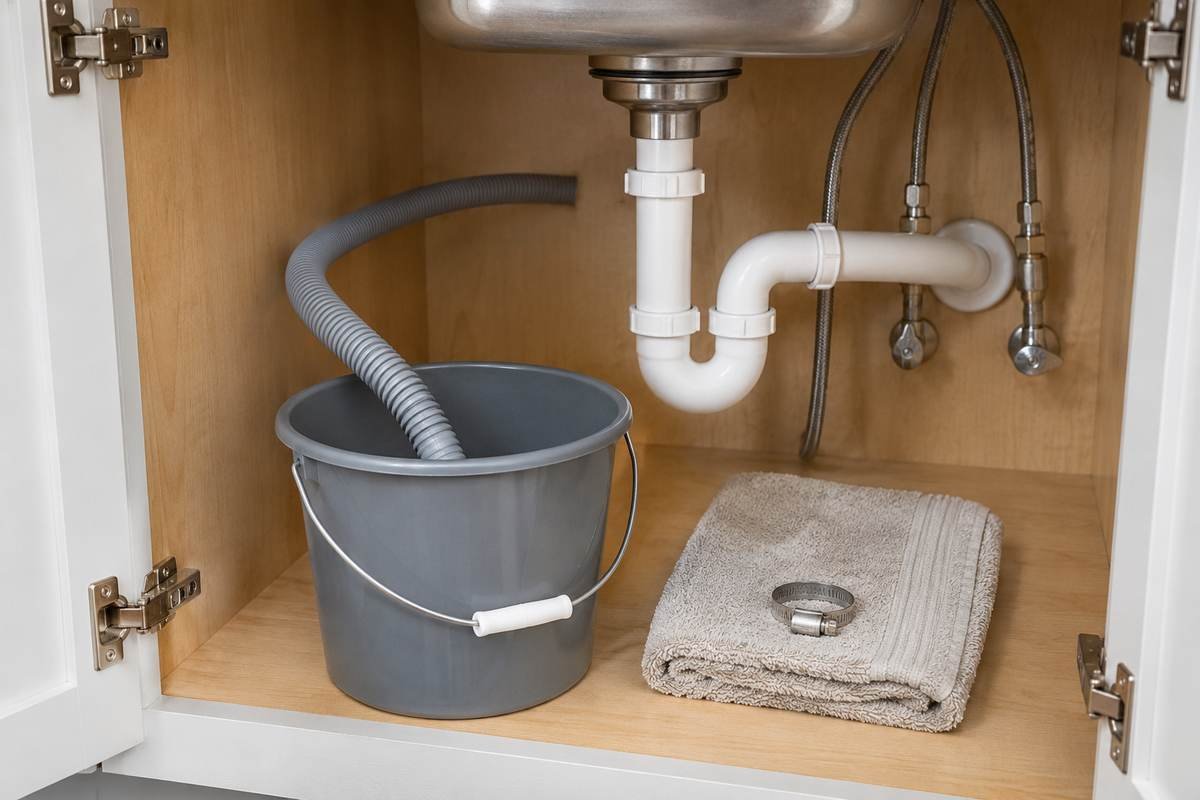
Still stuck? One reply on r/askaplumber gives a test that splits a hose clog from a pump problem:
“Pull that drain hose off and see if there is a blockage right there. While it’s off stick the dishwasher end in a pot or bucket.” u/PerformanceSolid3525 on Reddit
The same reply goes on to run a cycle with the hose in the bucket. If no water comes out, the poster calls it an appliance repair, not a plumbing one.
Brand differences worth knowing
The steps above are general, but each maker has its own error codes and filter layout. If you see a code, use the guide for your brand:
- GE: two filter pieces under the bottom rack, and a 3-second Start hold to force a drain. See GE dishwasher not draining.
- Whirlpool: F9E1 is the long drain code. See Whirlpool dishwasher not draining.
- Frigidaire: i20 means it didn’t drain, and i40 points to a clogged filter or sump. Some models have a glass trap in the center. See Frigidaire dishwasher not draining.
- Bosch: E24 means a drain problem, and E25 a blocked pump or loose pump cover. See Bosch dishwasher E24.
Dishwasher draining: questions
Does a dishwasher need to run to drain?
Yes, it needs power. The GE, Frigidaire and Bosch manuals all have the pump empty the tub when you cancel a cycle, so that’s the quickest way to start it. With the power off, you’ll have to bail the water out.
What does a dishwasher air gap do?
GE says it protects the dishwasher against water backing up if a drain clogs. It isn’t part of the dishwasher, and not every local code requires one. If you have one, check it any time the dishwasher isn’t draining well.
How should a dishwasher drain be positioned?
With a high loop or an air gap. GE’s install guide calls for an air gap if the waste tee or disposer connection is less than 18 inches above the floor. Frigidaire puts the drain hose at least 32 inches from the floor.