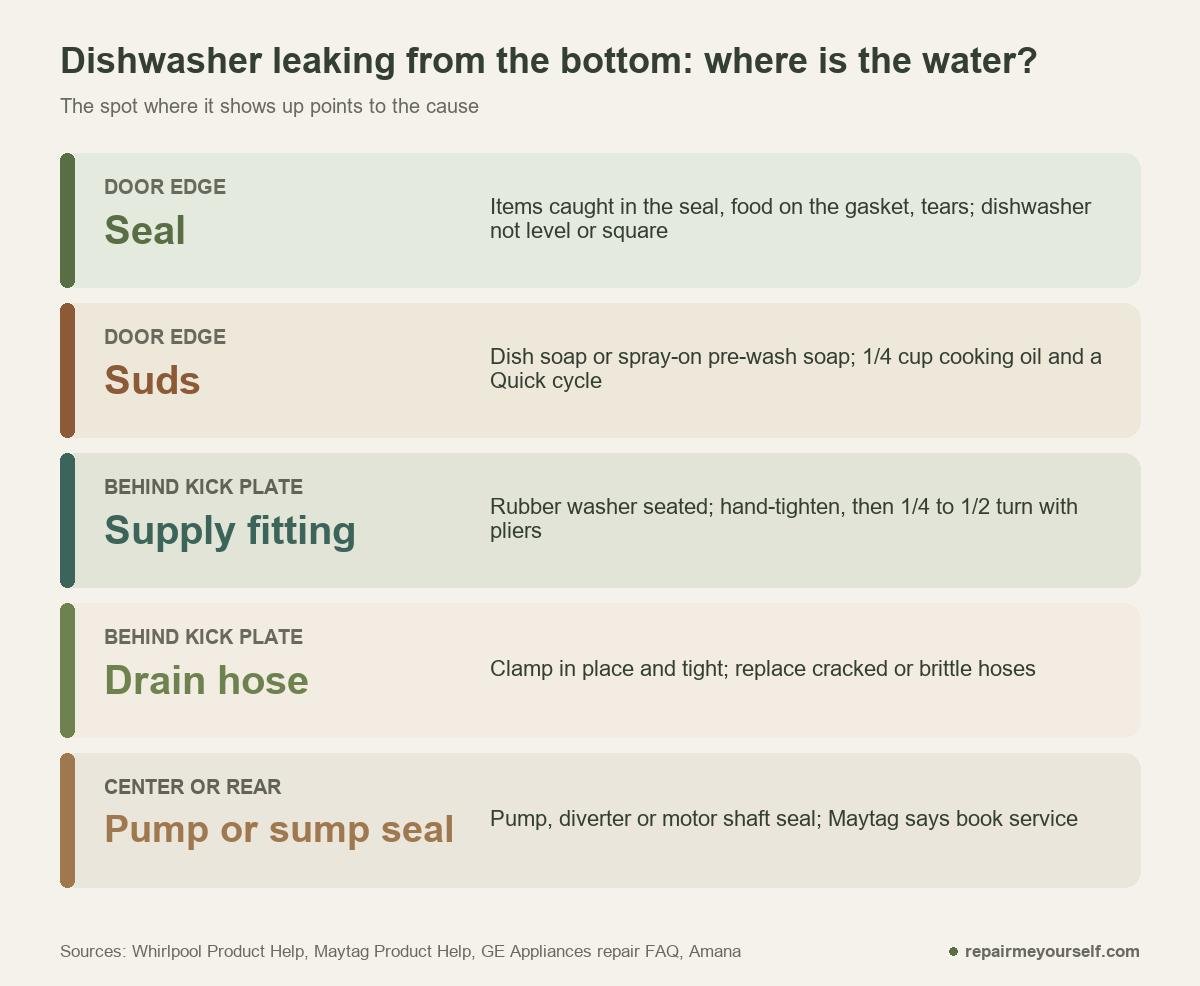
A dishwasher leaking from the bottom is easier to fix once you know where the water starts: the door’s bottom edge, or underneath behind the kick plate. Whirlpool, Maytag and GE all sort their leak advice by that spot, because the cause changes with it.
So start with the spot, then work through the causes for it, cheapest first.
Stop the leak, then find where it starts
If water is still coming out, Maytag says you should switch the dishwasher off at the breaker and shut the water supply.
Then deal with the water. Put towels or a shallow tray at the door, use a wet/dry vac on standing water, and don’t run it again until you’ve found the source.
Don’t stop at the puddle you can see, either. A KitchenAid owner caught a sump leak early, and a commenter who’d done a lot of these repairs explained why so many people don’t:
“I’ve seen some floors severely damaged because usually there is all that padding on the back of the kick plate that absorbs the water so some folks don’t notice it til its already jacked up their floors.” u/22LT on Reddit
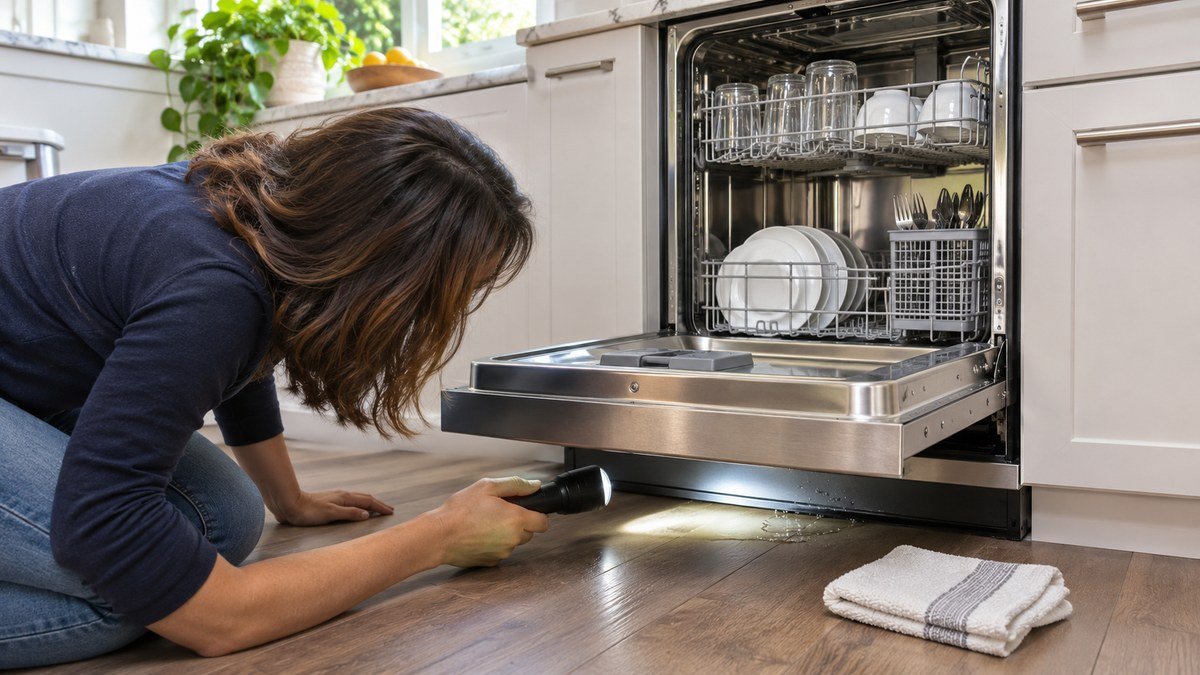
So take the kick plate off. On leak calls, that was the first thing I did, before I ran anything. Dry the floor, run a short cycle and watch where the first drop shows up.
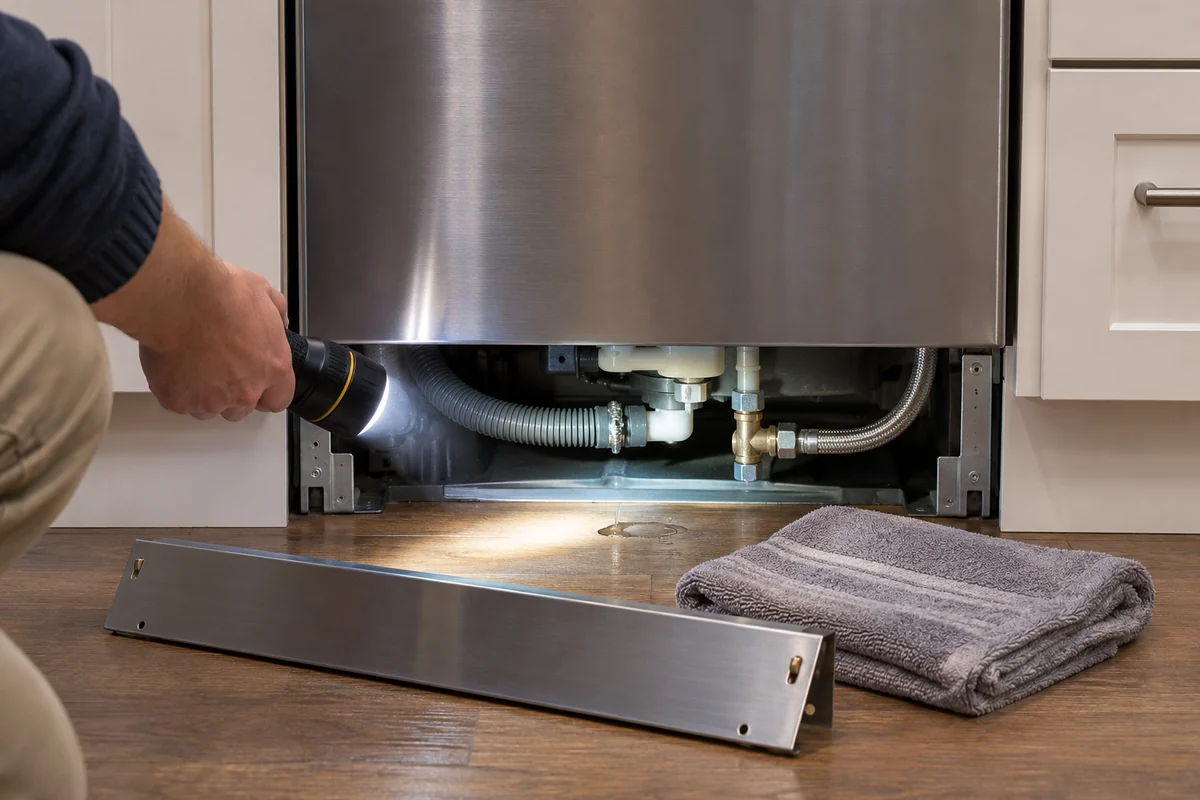
Where did the first drop show up? Maytag’s guide gives you a rough map:
- Front, at the door: the door gasket, too many suds, or a spray arm throwing water at the door.
- Bottom, front center: a pump seal, the sump, or a tub that’s overfilling.
- Behind or under the cabinet: hose connections, the inlet valve or the drain line.
Water at the bottom of the door
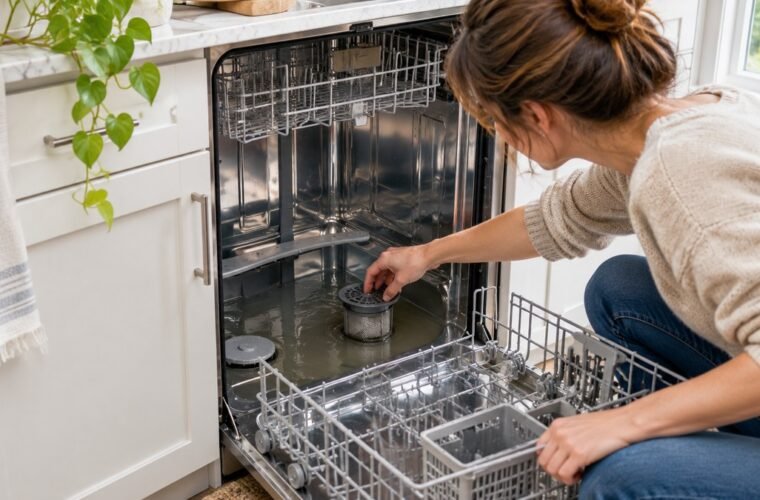
When you see the drip running down the front, your door isn’t sealing. Whirlpool’s page on a dishwasher leaking from the door lists what stops it from closing tight:
- Something in the way. Silverware or a dish poking out of a rack and caught between the seal and the tub.
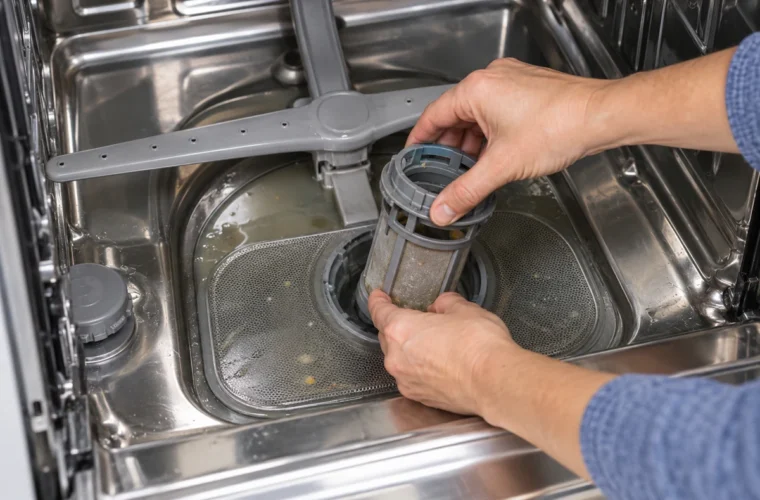
- Food on the seal. Large food particles around the door seal can keep it from sealing.
- A dishwasher that isn’t level. It has to sit on its leveling legs, flat on the floor, and square in the cabinet. Whirlpool says the door won’t seal if the tub opening isn’t square.
Look at the gasket while you’ve got the door open. Maytag and GE both say to replace one with tears, cuts or flattened spots.
That’s a part you can fit. Maytag says to press the new gasket in, then keep the door closed for several hours so it seats.
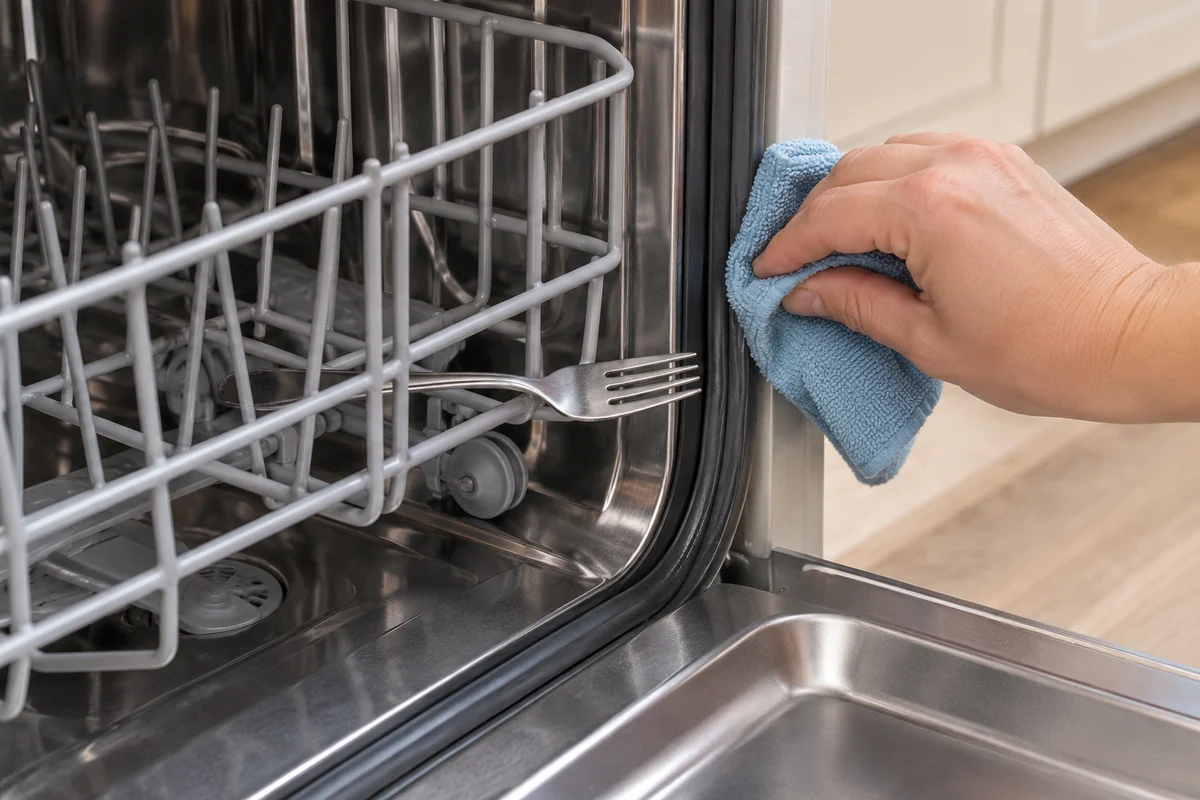
Watch your door close, too. One owner with a leak at the bottom right corner was asked if the door was butting against the counter, and decided to start there.
Two drips at the door are less serious than they look. Whirlpool says vapor from the door vent can condense and leave a spot on the floor after you open the door all the way.
GE adds that on a model with an external vent, a loose vent cap lets water out the door, and you can tighten it by hand.
Suds: the leak that looks like a broken part
Foam can push water straight out past a good seal, so you can have a leak with nothing broken. Whirlpool, Maytag and GE all say the same thing: never put dish soap in a dishwasher, because dishwasher detergent doesn’t make suds and dish soap does.
The cause isn’t always the bottle you poured in. Whirlpool says leftover soap from pre-washing, especially spray-on power dish soaps, can cause the same foam. You don’t need to pre-wash at all; scraping is enough.
If the tub is full of suds right now, here’s Whirlpool’s fix:
- Cancel the cycle and mop up the overflow so it can’t soak into the cabinet or floor.
- Take your dishes out.
- Pour 1/4 cup of vegetable oil or other cooking oil into the bottom of the tub.
- Run a Quick cycle with no detergent and no dishes. Repeat if suds are still there.
Water underneath or behind the kick plate
Water under the dishwasher with a dry door usually means plumbing, and most of it sits behind the kick plate.
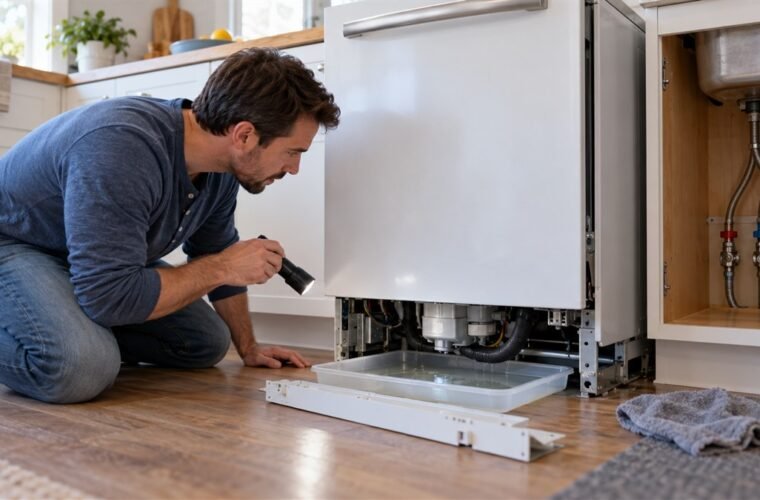
Pull the kick plate off. On Amana’s dishwashers, the panel comes off by turning its plastic fasteners with a flat-blade screwdriver, and the water hookup is in the front left corner.
Turn the water off before you touch the fittings, then work through them in this order:
- Water supply fitting. Whirlpool says the rubber washer has to be seated in the fitting. Hand-tighten the 90° elbow coupling so it can’t cross-thread, then check it with pliers. Whirlpool says sealing the gasket may take another 1/4 to 1/2 turn.
- Drain hose. Make sure the hose is connected properly and the clamp is in the right spot. GE says to tighten loose clamps with a flat-head screwdriver.
- Cracked or brittle hoses. Maytag says to replace them rather than tighten them.
If the water pools under the center or rear, Maytag points to the pump, the diverter or the motor shaft seal.
The KitchenAid above is a good example. On that one, the replies pointed to the diverter seal, which one said is built into the sump and can’t be replaced on its own.
That’s a bigger job, and Maytag lists it among the repairs to book service for. Get your model number first: Maytag says it’s on the tub frame.
When the dishwasher shuts itself off: the float switch
Your dishwasher may have a pan under the tub with a float in it. When a leak fills the pan, the float rises and the dishwasher stops.
On a Bosch, that’s the E15 code. The Bosch E15 support page says the safety switch has found water in the base and the leakage protection is on. Its only advice is to turn off the water and call Bosch support.
It doesn’t mention tipping the dishwasher back. Our Bosch dishwasher E15 error page goes into more detail.
On a Whirlpool, it’s F8 E4. Whirlpool says to check every connection on a new install, empty the drip tray if it has water in it, then press Cancel twice to clear the code. The Whirlpool dishwasher F8 E4 page has the tray steps.
Either way, the code means water got out of the tub. Clearing it won’t fix your leak, so find the leak before you run the dishwasher again.
Dishwasher leaking from bottom: questions
Why is my brand-new dishwasher leaking from the bottom?
If you just had it installed, look at the installation first. Whirlpool’s list for a new install is the water connections, the rubber washer in the fitting and the float switch plug. Make sure it’s level and square in the opening, too.
Why does my dishwasher leak when it’s off?
The supply line holds water even between cycles, so look at the fitting behind the kick plate first. If that’s dry, Maytag says a sticking inlet valve can overfill the tub, and that’s a service job.
Is it worth fixing a leaking dishwasher?
Usually, if the leak is a gasket, a clamp, a fitting or suds. Those are small fixes.
Age changes the math. Amana suggests that a dishwasher more than 10 years old may be due for replacement, and that’s worth weighing against a pump or sump repair. Our page on how long dishwashers last helps with that call. For other faults, see our dishwasher troubleshooting guide.