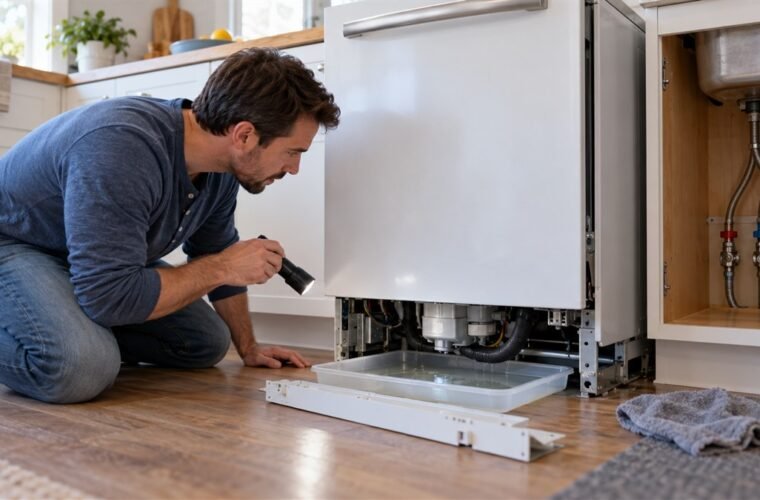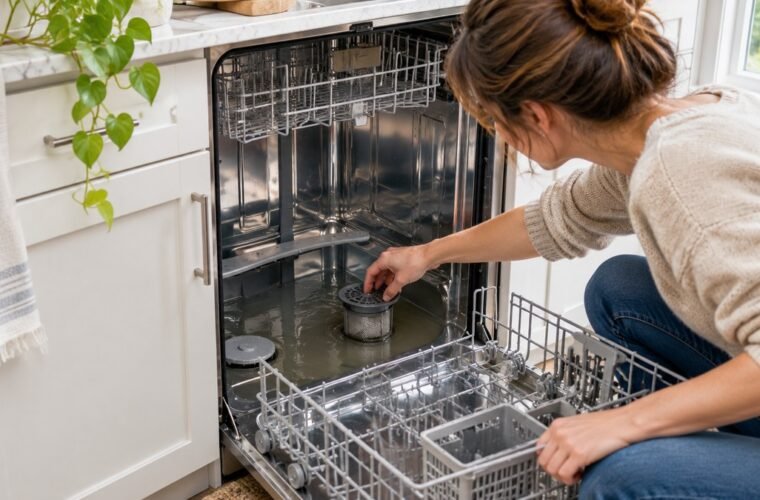
Whirlpool dishwasher not draining? It’s usually blocked at the filter. Whirlpool’s own help page names a clogged filter as a common cause, and cleaning it doesn’t take a single tool.
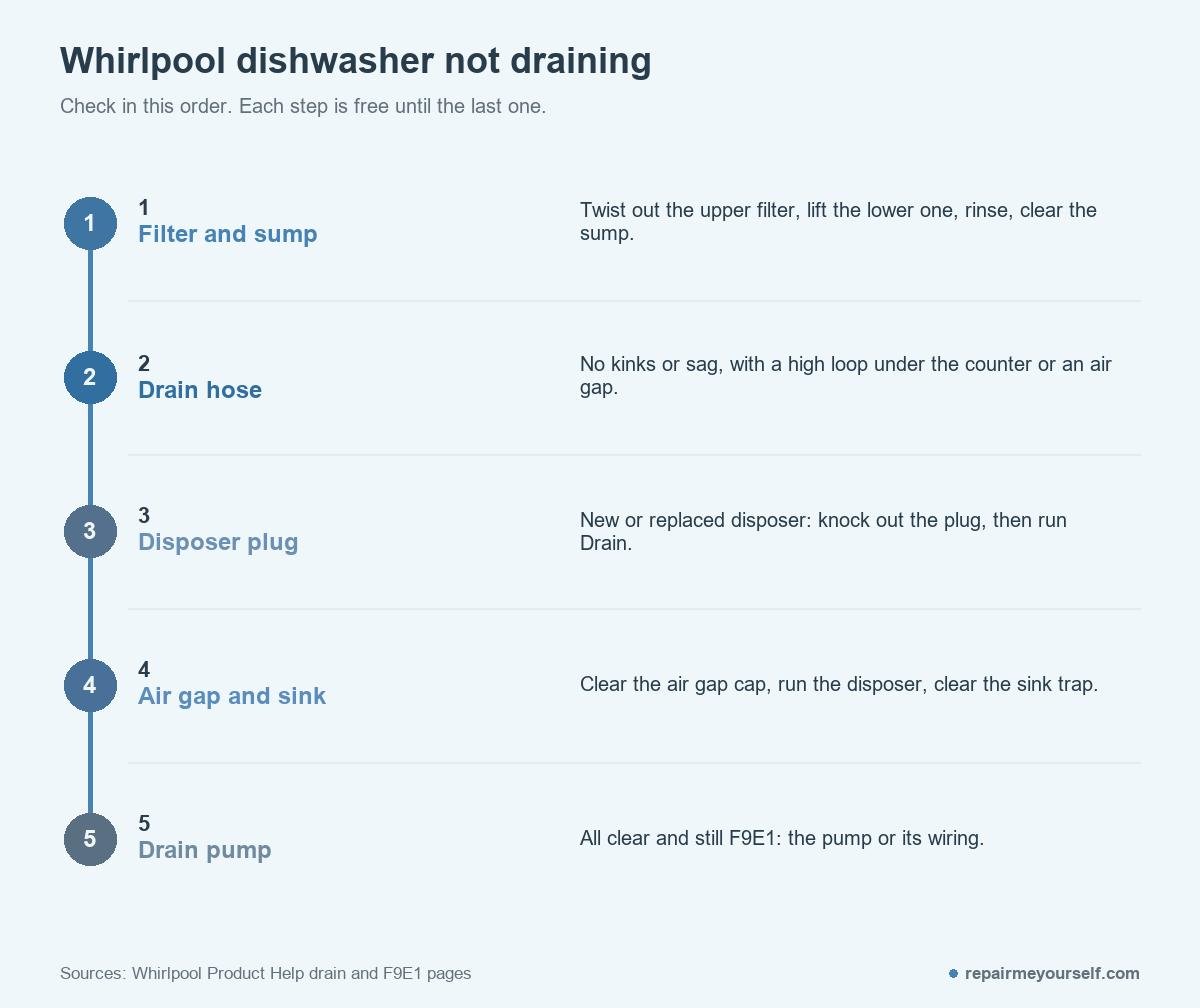
If the filter’s clean, follow the water out of the machine. Check your drain hose for a kink or a missing high loop. Then the garbage disposer. Then the air gap, if you have one. The drain pump comes last.
A flashing F9 E1 code means the same thing. Whirlpool calls it a long drain, and the checks are identical.
How much water is too much?
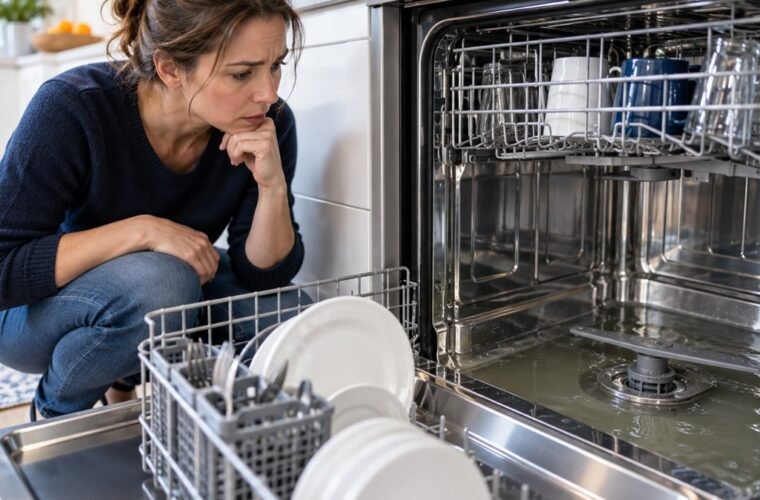
Lift out the bottom rack and look at the filter area. Whirlpool says water sitting slightly above the filter screen often points to a partial restriction. You’re looking at a filter or a hose that’s half blocked. Not a dead pump.
A tub with inches of dirty water is a full blockage. You’ll need to bail some out before you can reach the filter, and the section on standing water below shows you how to do it without a mess or a shock.
Clean the filter and sump
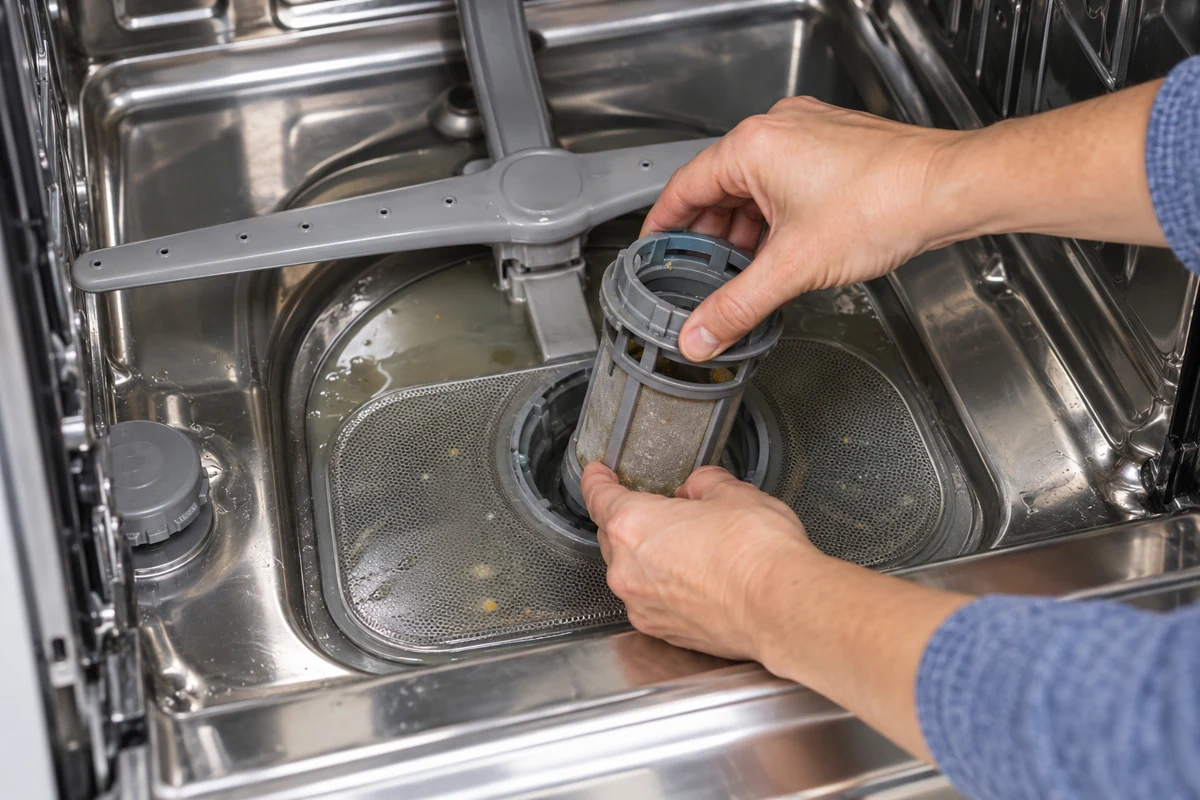
Many Whirlpool models have a two-part filter you can take out by hand. Whirlpool’s not-draining page gives the steps:
- Remove the lower rack.
- Twist the upper filter counterclockwise and lift it out, then lift out the lower filter.
- Rinse both under running water and scrub gently with a soft brush.
- Look into the sump for broken glass, seeds or labels, and pick them out.
- Put the lower filter back, then turn the upper filter clockwise until it locks.
- Run a short rinse cycle and check for standing water.
Don’t skip the lock. An upper filter that isn’t seated lets debris straight into the pump, and that turns a free fix into a parts job.
Check the drain hose
The hose runs from the back of your dishwasher to the sink drain or the disposer. Whirlpool says it shouldn’t be kinked, crushed or sagging. Open the cabinet under the sink. Follow the hose as far as you can see it.
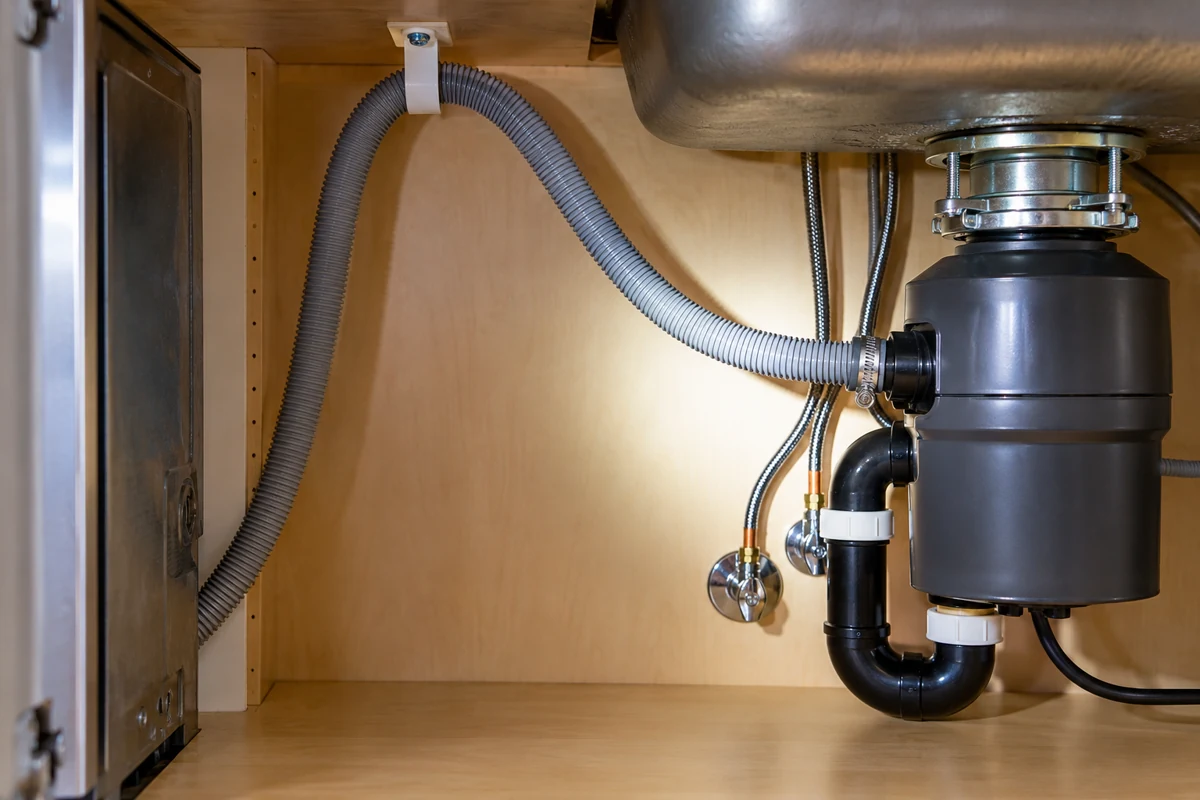
The hose also needs a high loop. Whirlpool’s drain line page explains why: the loop stops water siphoning and flowing back into the dishwasher. The hose has to rise up and be secured to the underside of the counter, or connect to an air gap, as your local code requires.
Did the hose slip down off its clip? Then dirty sink water can run back into the tub. If you’re seeing that, our guide to water backing up into a dishwasher covers it in detail.
While you’re under there, check the clamp at the disposer or sink end. Whirlpool says the hose must be securely clamped to the sink drain or disposer inlet.
New disposer? Knock out the plug
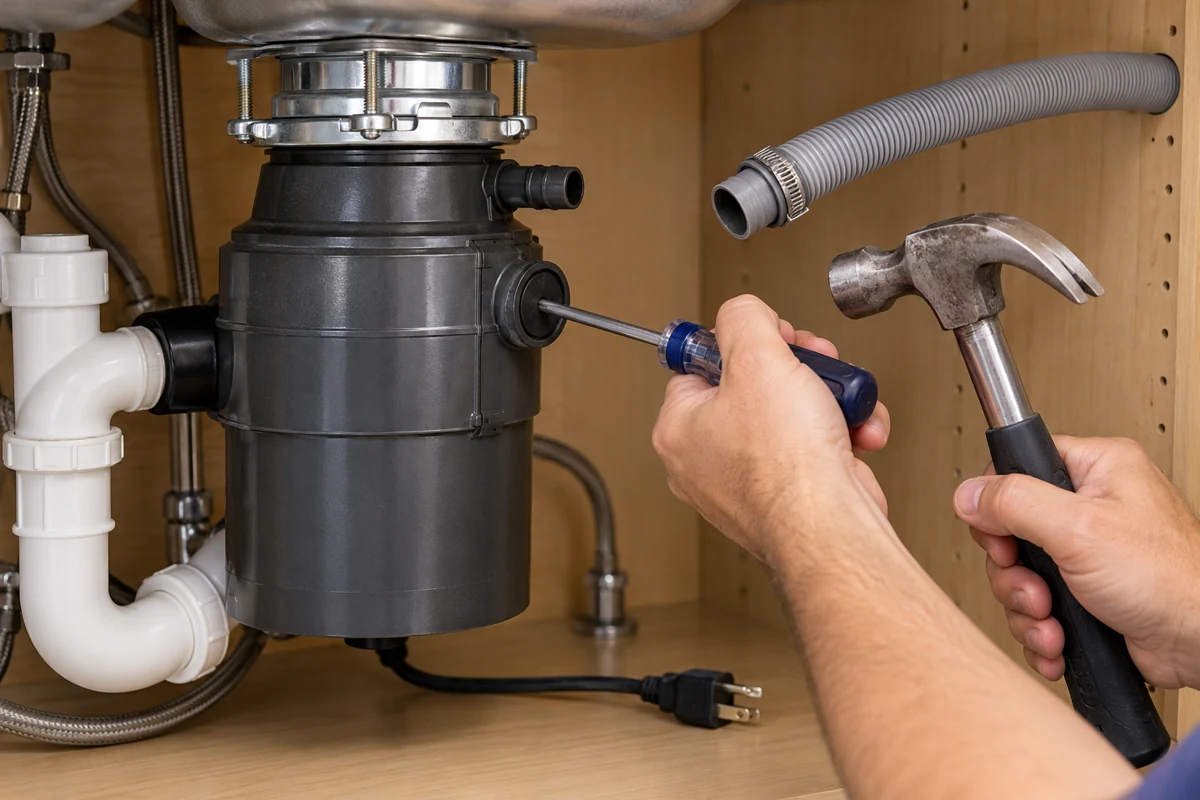
This is the one that catches new installs. A new garbage disposer comes with a knockout plug sealing its dishwasher inlet. Whirlpool says leaving it in blocks drainage completely.
It’s easy to miss when someone else did the install. On r/appliancerepair, a tech told one owner how to clear it:
“Take something and put it in there then take a hammer and lightly tap it until the plug breaks free, they are made to be removed that way. I usually use a screwdriver and a hammer.”
– r/appliancerepair (13 upvotes)
Did your dishwasher stop draining right after you had a disposer installed or replaced? That’s almost certainly it. Whirlpool calls removing the plug critical. Knock it out, fish it out of the disposer, then run a drain cycle.
An older disposer can block the drain too. Whirlpool says to check it for food or debris and run it to clear the blockage before you start a drain cycle. If water won’t leave the sink either, the clog is further down the sink trap or tailpiece.
Clear the air gap
Some kitchens have a small chrome cap on the sink deck or countertop. That’s the air gap. It does the same job as your high loop.
When it clogs, water can flow back into the dishwasher. Whirlpool says to keep it clean inside and under the cap, and to take the cap off now and then to clear debris.
Reading the F9 E1 code
Whirlpool flashes codes on the Clean light instead of a screen. Its error code page explains how to read them. Count the first set of fast flashes for the F number. After a pause of a second or two, count the second set for the E number. The pattern repeats about every 5 seconds.
Nine flashes, a pause, then one flash is F9 E1. Whirlpool’s error code page lists it as long drain, not draining. The checks it gives are the ones above: the filter, the hose, the disposer and its knockout plug, and the air gap.
For every other code, see our Whirlpool dishwasher error codes list. To make the machine show its code history, there’s a Whirlpool dishwasher diagnostic mode guide too.
Get the standing water out safely
You can’t clean a filter under three inches of water. Whirlpool’s page gives you a safe way to empty the tub:
- Turn the power off at the circuit breaker and shut off the water supply.
- Lay towels in front of the dishwasher.
- Bail the water out with a cup, or use a turkey baster or a hand pump on the sump.
- Pour it down a sink or toilet.
Whirlpool also says not to use drain-opening chemicals inside the dishwasher. They don’t belong in the tub or the pump.
When it’s the drain pump
Say you’ve cleaned the filter, the hose is clear and looped, and the disposer and air gap are open. If it still won’t drain, the problem is inside the machine. That’s the drain pump or the wiring and controls that run it.
On service calls, I always ran the disposer and pulled the filter before I touched the pump. More often than not, the dishwasher drained before I got that far.
Stop and call for service if the fix means pulling the dishwasher out from under the counter or opening its electrical box.
Whirlpool dishwasher not draining: short answers
Why is there water in the bottom of my Whirlpool dishwasher?
Water just above the filter screen usually means a partial restriction. Clean your filter and sump, then check the hose for a kink. More water than that? You’ve got a full blockage.
Can I pour drain cleaner into a dishwasher?
No. Whirlpool says not to use drain-opening chemicals inside the dishwasher. Bail the water out and clean the filter by hand instead.
Why won’t my new Whirlpool dishwasher drain?
On a new install, check the disposer knockout plug first, then the hose’s high loop or air gap. Whirlpool’s page for newly installed dishwashers lists those before anything else.