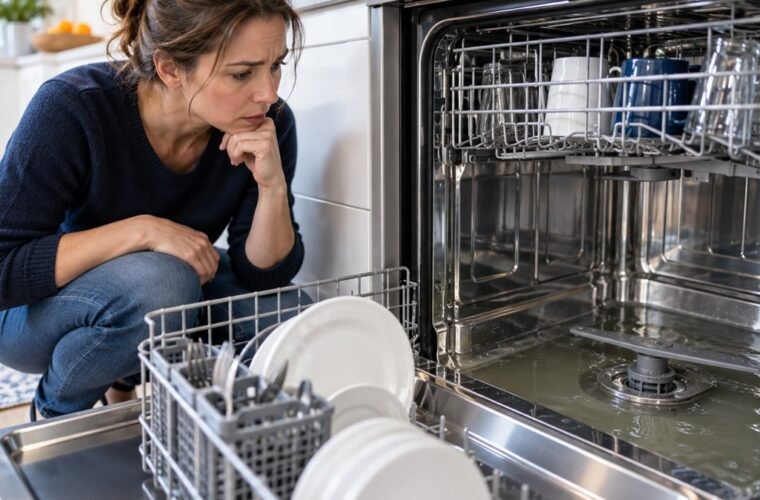
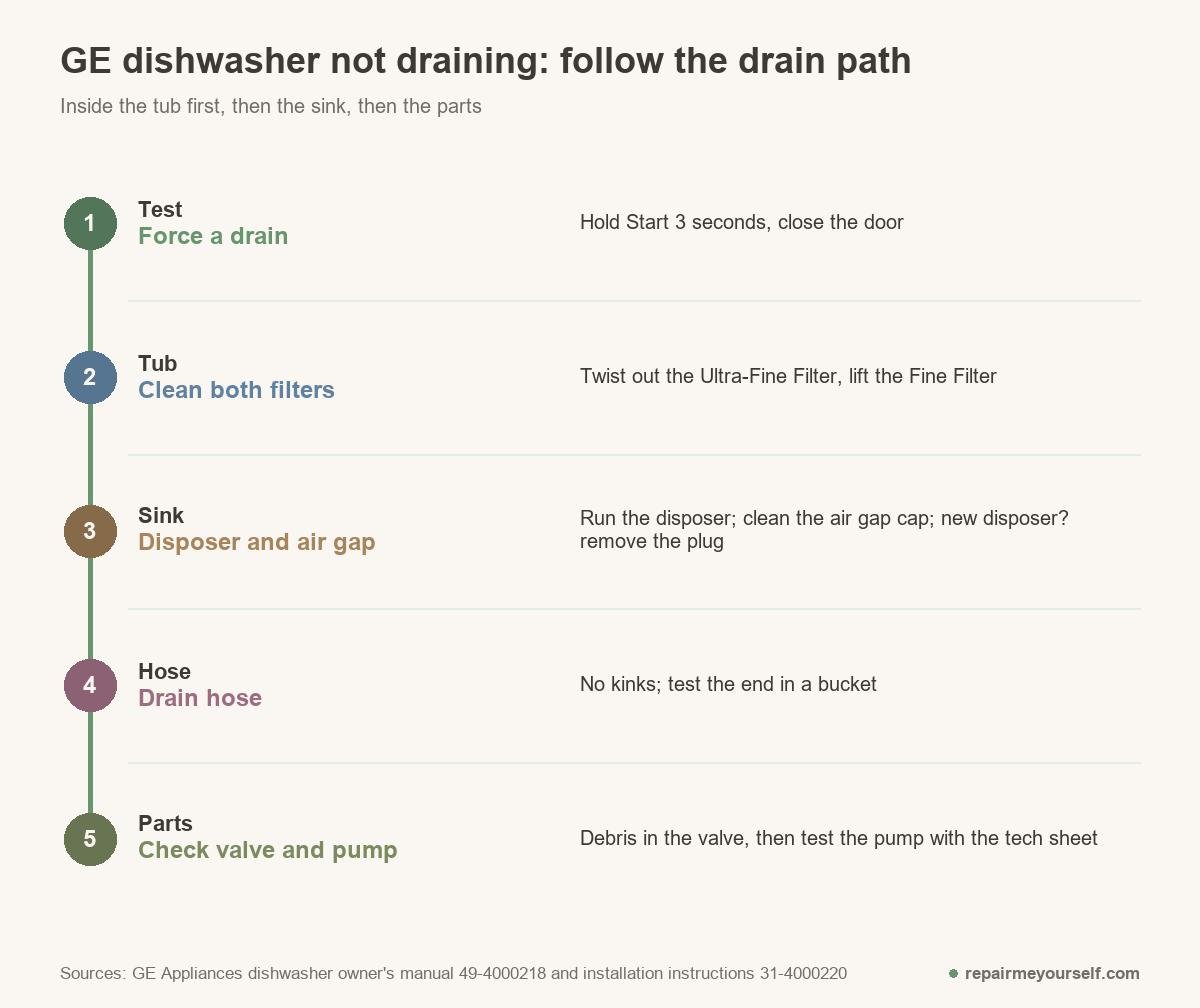
A GE dishwasher not draining usually has a blockage somewhere between the filters in your tub and the drain under your sink.
GE’s own troubleshooting table blames a clogged air gap, a clogged drain, or a drain line that wasn’t installed with a high loop or air gap.
You can clear most of those yourself. Here’s the order I’d work in.
Force a drain first
Before you bail water out, try GE’s cancel. You press and hold the Start pad for 3 seconds, then close the door.
GE’s owner’s manual says the dishwasher will drain, beep, and turn off the wash cycle light.
Watch what happens. Does the pump run and the water go down? Then the pump works, and you’re probably dealing with a partial clog. If nothing drains even then, start with the filters and work toward the pump.
That test can tell you a lot. One r/appliancerepair poster had already replaced the drain pump on their GE, and the water still sat in the tub after a cycle. But holding Start for 3 seconds drained it fine.
Here’s GE’s troubleshooting row for standing water, and what it says to do:
| Possible cause (GE) | What GE says to do |
|---|---|
| Air gap is clogged | Clean the air gap |
| High drain loop or air gap not installed | Check the installation instructions for the drain line |
| Drain is clogged | If it drains into a disposer, run the disposer clear. If the sink drains slowly too, you may need a plumber. |
Clean the filters in the bottom of the tub
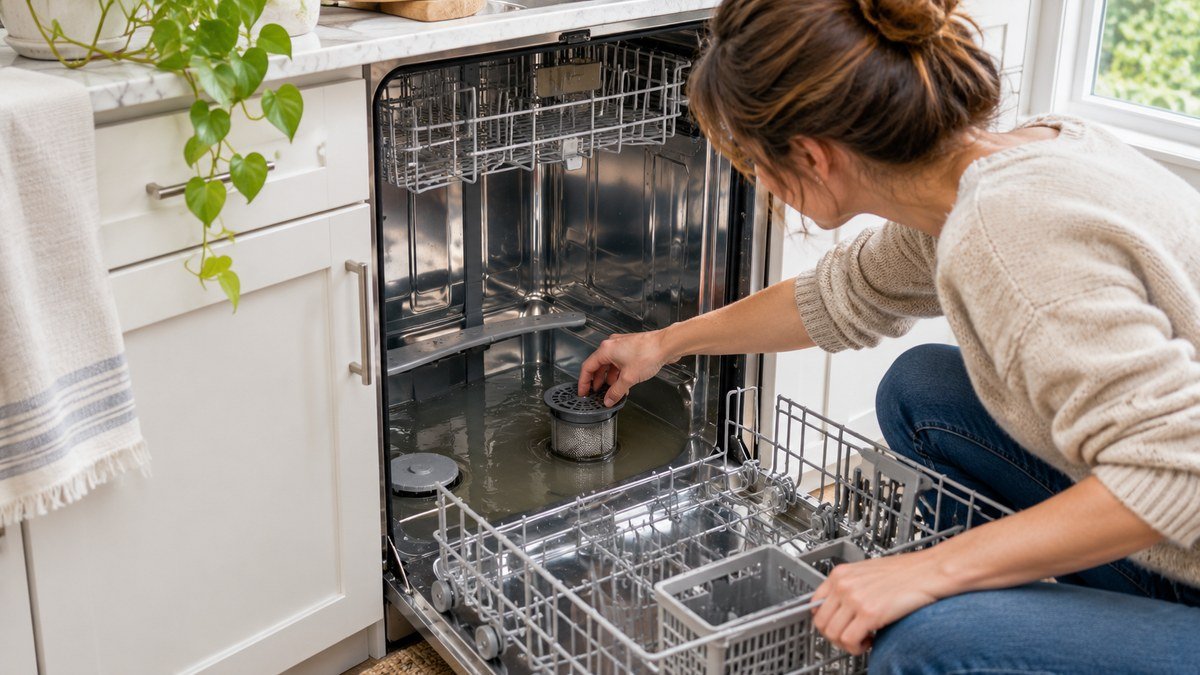
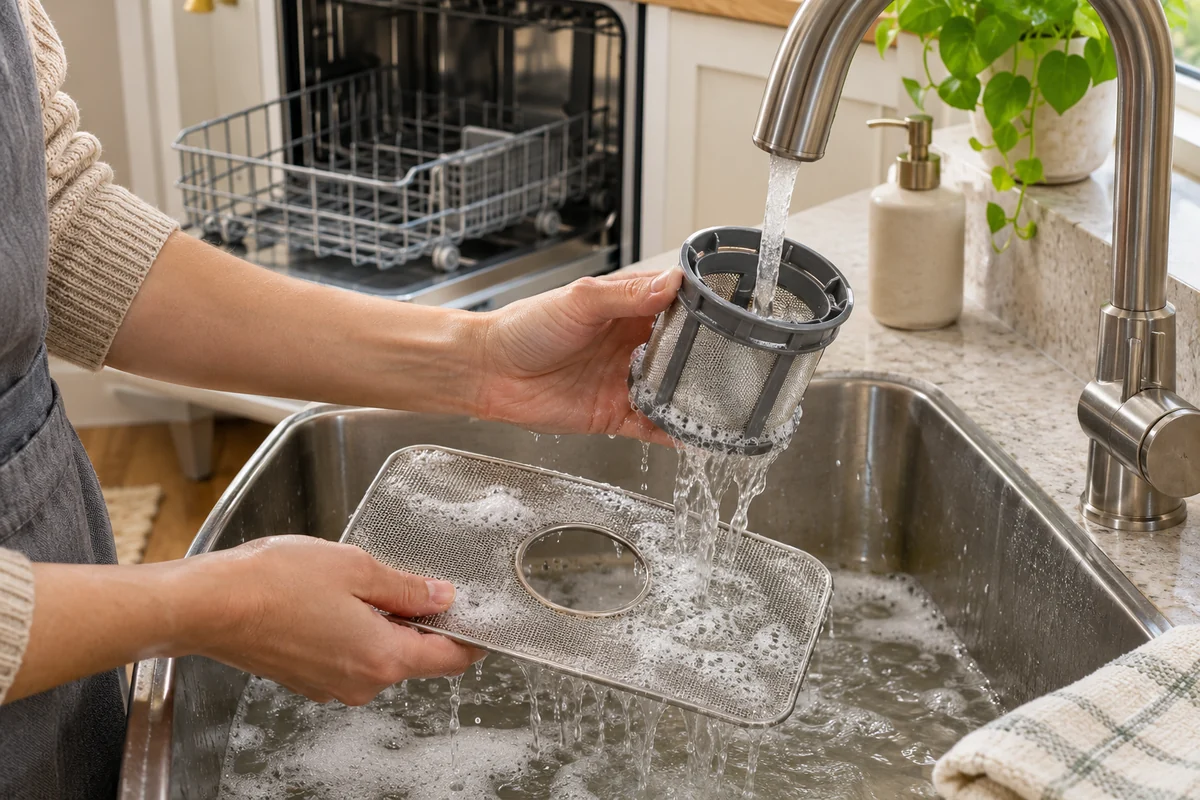
Start inside, because it’s the easiest part for you to reach. GE’s manual for its current models shows two filters under the bottom rack. GE says to clean them every other month, or more often with heavy use.
- Pull the bottom rack out.
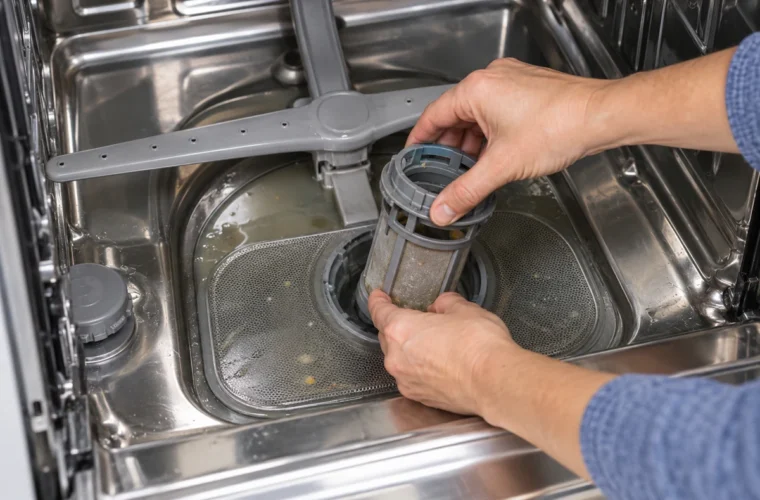
- Twist the Ultra-Fine Filter counterclockwise and lift it out. Rinse it with warm, soapy water and use a sponge on stubborn bits. Some models have a separate filter basket that twists off it.
- Lift out the Fine Filter, the mesh plate underneath. Rinse it the same way. GE warns that scouring pads or brushes can scratch it, so use a soft brush or sponge.
- Put the Fine Filter back first, then the Ultra-Fine Filter, twisted until it locks.
While the filters are out, look into the opening for anything solid.
GE’s manual says to scrape off bones, toothpicks, skins and seeds before loading, and to remove leafy vegetables. Those are exactly the things that end up stuck down there.
Check the disposer and the air gap
If your filters were clean, move to the sink.
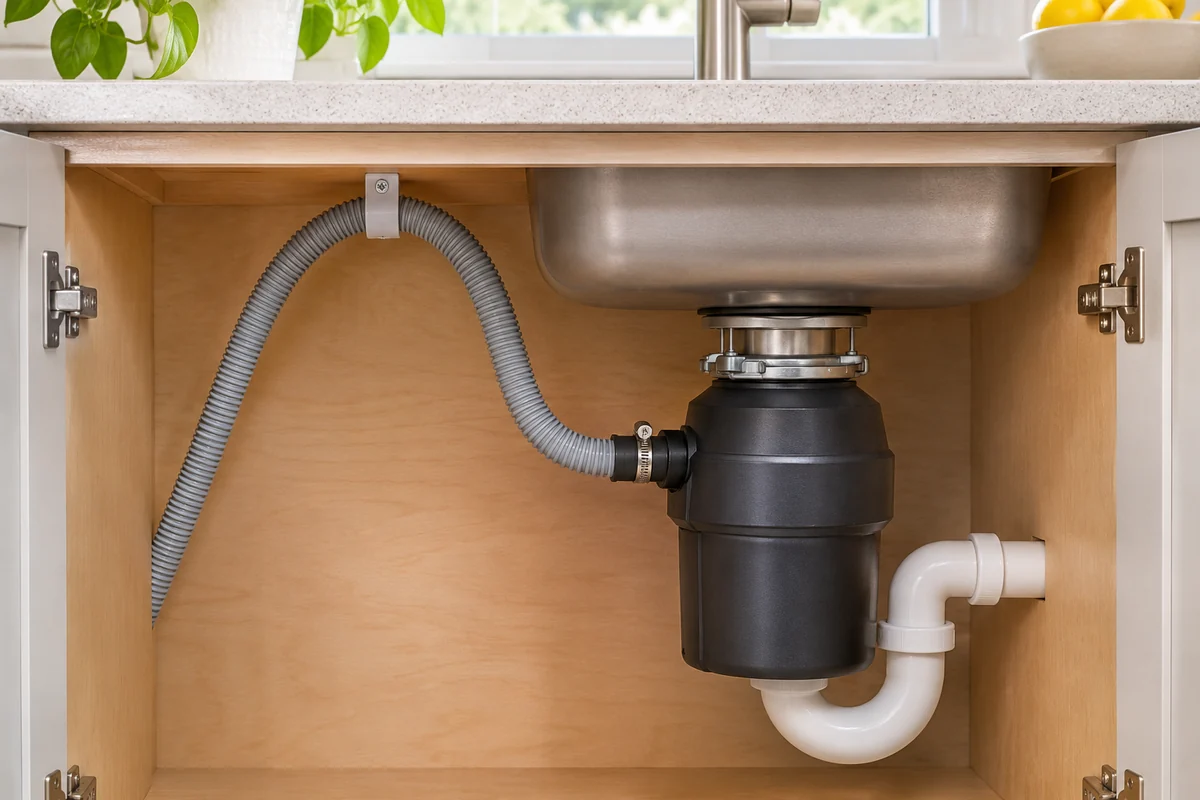
Your dishwasher drains into either the garbage disposer or a waste tee on the sink drain, and sometimes through an air gap on the counter first.
- Run the disposer. GE says to run the disposer clear if the dishwasher drains into it.
- Clean the air gap. It’s the small cap on the countertop next to the faucet, if you have one. GE says to lift off the cover, remove the plastic cap under it, and clean it with a toothpick.
- Check the sink itself. If the sink drains slowly, the clog is in the house drain, and GE says you may need a plumber.
Did your dishwasher or the disposer go in recently? Then check the disposer’s drain plug.
GE’s installation guide says it in capitals: the dishwasher will not drain if the plug is left in place. It has to come out before the hose goes on.
GE’s guide also requires an air gap where local code calls for one, or when the waste tee or disposer connection is less than 18 inches above the floor. Otherwise the hose needs a high loop under the counter.
If your hose just runs straight across, that can be your problem.
Check the drain hose
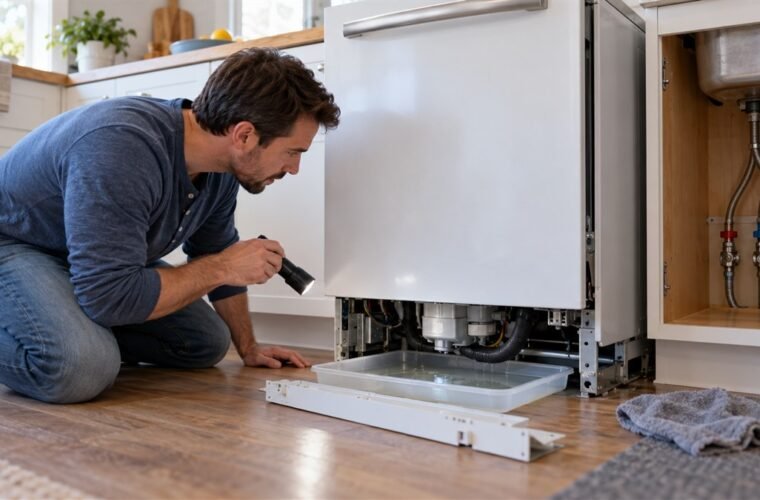
A hose can clog or kink even when everything else is clean. GE’s installation guide says to make sure the drain hose isn’t kinked under or behind the dishwasher.
Turn off the dishwasher’s power at the breaker and put a towel down first.
Then you disconnect the hose at the disposer or waste tee. One commenter on r/Appliances suggested putting that end in a bucket and running a drain: if it empties into the bucket, the blockage is where the hose connects.
Sometimes the clog is in the hose itself. A GE owner on r/HomeImprovement found exactly that:
“I had a clogged drain hose. It was just the hose external to the dishwasher. I had to remove the hose and flex it to clear the block using the garden hose.” u/FreakyRiver on Reddit
They’d had the dishwasher about 12 years. If the water’s backing up from the sink into the tub instead, our guide to water backing up into a dishwasher covers that.
If it still won’t drain: the check valve and the pump
Past the hose, there are two parts left: the check valve that stops dirty water flowing back, and the drain pump. Here’s a quick test you can do, from a repair tech in that same GE thread:
“Open the washer door IMMEDIATELY after the drain pump stops, and see if the water level suddenly rises.., if it does, then you have something fouling your backflow preventer valve.” u/MeNahBangWahComeHeah on Reddit
The culprit, they said, is often a strand of celery, string or dental floss. That fits GE’s advice to scrape off skins and leafy vegetables.
If the water doesn’t flow back and the pump doesn’t move water even on a forced drain, the pump is next.
Pull the tech sheet before you order one. It has the test values for your model, and I wouldn’t buy a pump without checking it first.
Seeing a code on the display? Look it up in our GE dishwasher error codes guide before you take anything apart.
Don’t overlook the detergent
The top reply in that GE thread was three words long: “Use less soap.” GE’s manual says you should never use liquid hand dish soap in a dishwasher.
It also says detergent not made for dishwashers will fill the tub with suds. Use just enough dishwasher detergent to get the dishes clean.
GE dishwasher not draining: questions
How do I make my GE dishwasher drain?
Press and hold the Start pad for 3 seconds, then close the door. GE’s manual says the dishwasher will drain, beep and turn off the wash cycle light. If it won’t drain that way, clean the filters and check the disposer and air gap.
Is there a reset button on a GE dishwasher?
GE’s manual doesn’t list one. To stop a cycle and drain, hold Start for 3 seconds. If it won’t run at all, GE says to check the fuse or breaker, and on some installs a wall switch next to the disposer switch.
Where’s the model number on a GE dishwasher?
GE’s manual says it’s on a label on the tub wall, just inside the door. You’ll need it to order a pump or find the tech sheet for your model.
Why won’t it drain after a new disposer went in?
The drain plug in the disposer’s dishwasher inlet was probably left in. GE’s installation guide says the dishwasher won’t drain if that plug is still there. Remove it, then reconnect the hose. The symbol lights on your panel are explained in our GE dishwasher symbols guide.