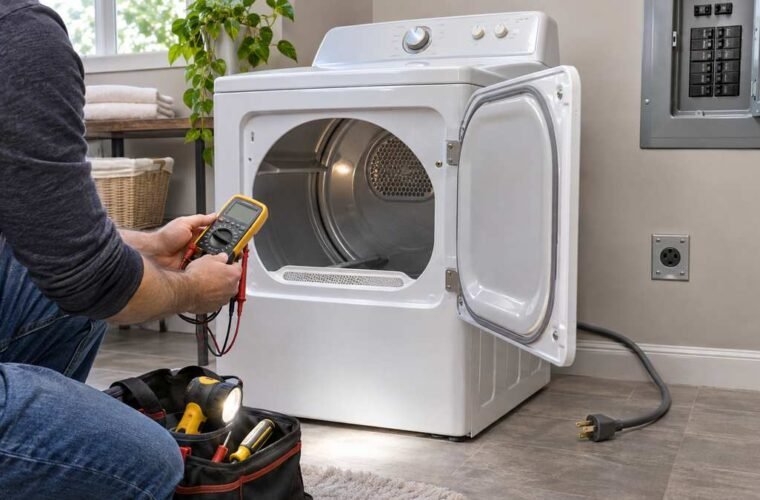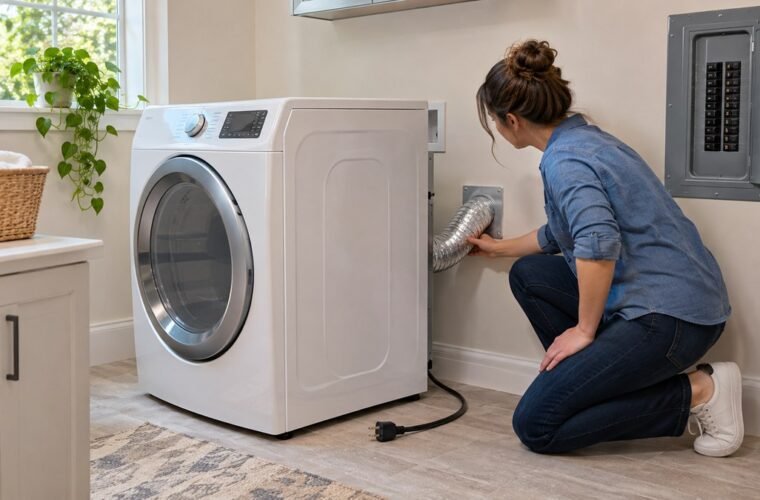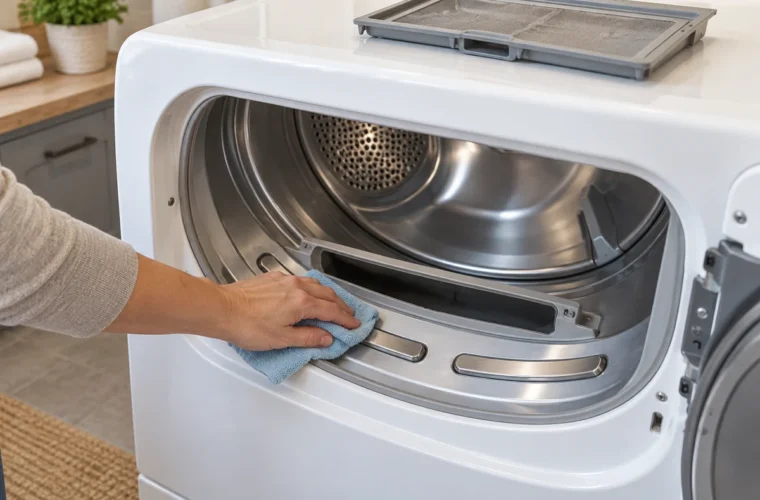
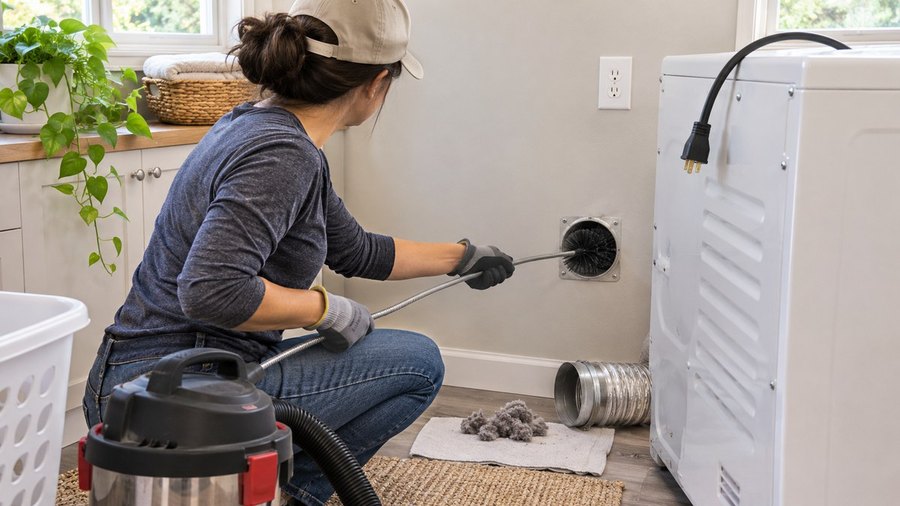
Here’s how to clean dryer vent ducts: unplug the dryer, pull it out and disconnect the duct. Vacuum the dryer’s outlet and the duct, brush the wall run from inside and from the outdoor hood, then reconnect it and test the airflow outside.
How often? GE’s owner’s manual says to inspect and clean the exhaust duct at least once a year.
Whirlpool gives a wider window: every one to two years, or sooner when drying slows down. It depends on how often you dry, what you dry and how much pet hair goes through.
Before you pull anything out, make sure the vent is the problem. Your dryer may already be telling you.
Signs your dryer vent is clogged
Long dry times are the most common sign. Whirlpool’s page on a blocked or restricted dryer vent lists the others:
- Damp clothes after a full cycle, or one load that takes you two or three cycles.
- A cabinet that feels hot when you touch it, mostly on the sides and near the bottom. The heat can’t get out.
- Steam inside the dryer. You’ll see it on a glass door, or on a display that fogs over.
- Water on the floor behind the dryer. The moisture stays inside, so you might think the washer’s leaking.
- Hardly any lint on your lint screen, and only at the bottom. There isn’t enough air moving to carry it there.
If your lint screen sits on top of the dryer, Whirlpool has a quick test. Pull the screen out, set the dryer to Air Dry or Air Fluff, and start it. Put your hand in the screen slot.
Strong air means the house vent is probably clear. Little or none means it’s probably restricted.
When the dryer warns you itself
Some dryers check their own airflow and put the answer on the display:
- Whirlpool and Maytag: a Check Vent light or an AF code. On certain models it comes on during the sensing phase at the start of an automatic cycle. Whirlpool says the dryer keeps running, but dry times suffer.
- LG Flow Sense: d80, d90 or d95. LG reads these as 80%, 90% and 95% blockage, with d95 the severe one. It calls them safety alerts, not dryer faults, and says fixing the airflow usually clears them.
If an LG keeps showing the code after the vent is clear, the page on LG dryer d90 with no blockage covers what’s left. Slow drying with no warning at all has other causes too, and they’re on the dryer taking longer than normal page.
What you need
Most of what you need is a vacuum. GE’s manual only asks for a vacuum with a hose attachment for the duct, plus a mirror to check the outdoor hood. For a longer run, add:
- A dryer vent brush kit with screw-together rods.
- A screwdriver or nut driver for the duct clamps.
- A new transition duct, if the one behind your dryer is foil or plastic. More on that below.
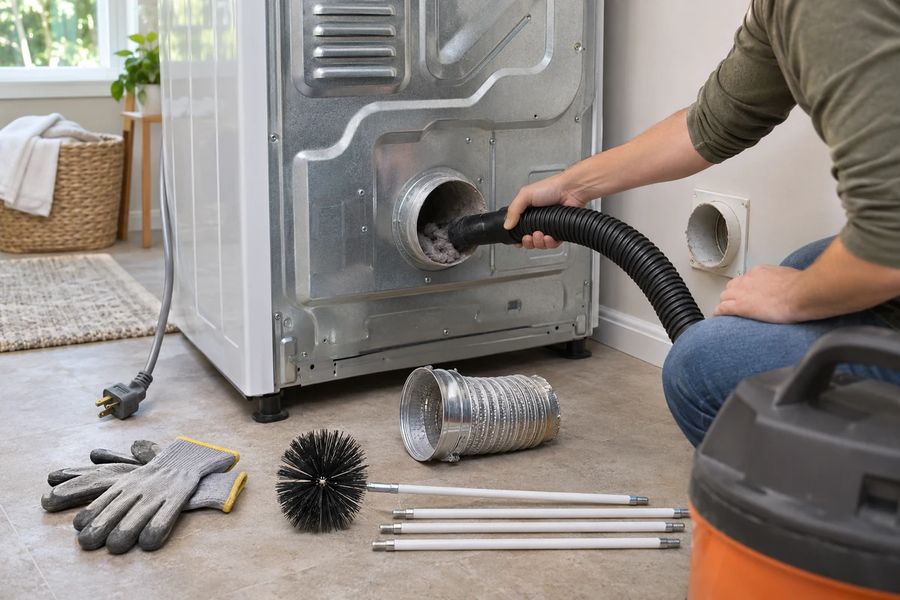
How to clean dryer vent ducts in eight steps
- Cut the power. Unplug the dryer or switch off its breaker. GE’s manual warns that pressing Power or Start/Pause doesn’t disconnect the power. I unplug before I touch a duct, every time.
- Leave the gas line alone. On a gas dryer, pull it out only as far as the gas connector allows without strain. GE limits that flexible connector to 4 feet and says never to reuse an old one. So unhooking it isn’t part of a vent cleaning. I don’t do gas-line work, and if the connector has to come off, call a licensed pro.
- Disconnect the duct. Loosen the clamp at the dryer’s exhaust outlet and slide the duct off. Take the other end off the wall pipe too.
- Vacuum the outlet and the short duct. Run your vacuum hose into the outlet on the back of the dryer, then through the duct. That’s GE’s whole routine: unplug, disconnect, vacuum, reconnect.
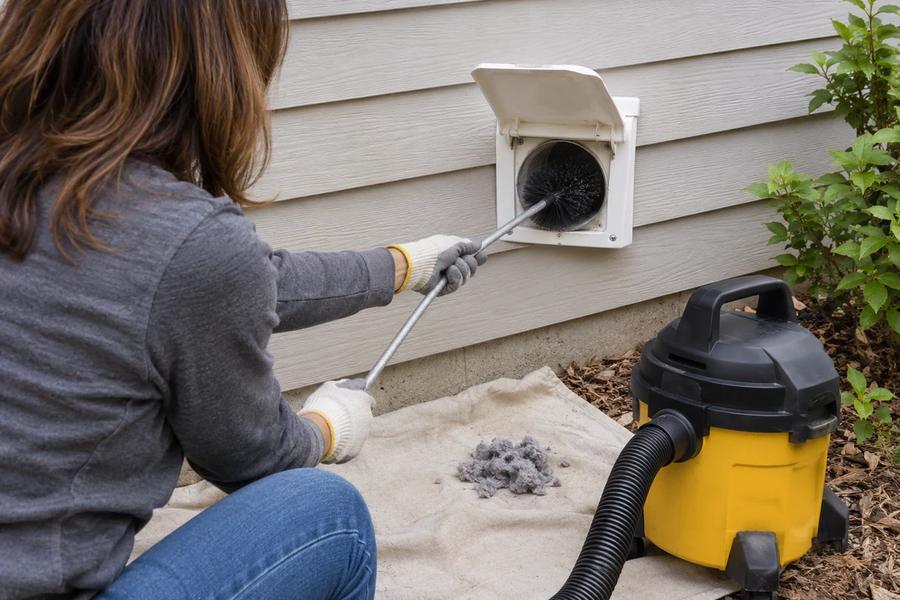
- Brush the wall run. Push the brush into the wall pipe and work it toward the outside. Pull it back slowly and vacuum the opening as the lint comes out. Repeat from the outdoor hood if you can reach it.
- Clear the outdoor hood. Pull out lint, leaves and nests. GE says to use a mirror to check that the flaps inside the hood move freely, and that nothing is nesting in the hood or the duct. Whirlpool wants the hood at least 12 inches from the ground, plants, rocks and snow.
- Reconnect without crushing it. Slide the duct back on and tighten the clamps. Whirlpool says to leave at least 4 inches between the dryer and the wall when you push it back.
- Test it from outside. Run the dryer for 5 to 10 minutes and hold your hand under the outdoor hood. Whirlpool’s rule is simple: if the air feels weaker than a hair dryer on high, clean the full length of the vent and the hood again.
On a dryer with a Check Vent light, Whirlpool says to start a heated Timed Dry cycle once you’re done. If the light still comes on, have the whole house vent run cleaned.
Expect more lint than you’d guess. One homeowner cleaned theirs for the first time after a few years in the house:
“First time cleaning it since we moved in in 2019, and I suspect it hadn’t been done for several years before that. Weighed about 7-8 pounds in the garbage bag.” u/MarginallyClever on Reddit
How long the vent can be before cleaning stops helping
If your vent clogs again within months, it’s often too long or has too many turns. GE’s installation chart puts a number on it.
With 4-inch rigid metal duct and GE’s recommended hood, the vent can run up to 120 feet with no elbows. That’s down to 60 feet with four 90° elbows.
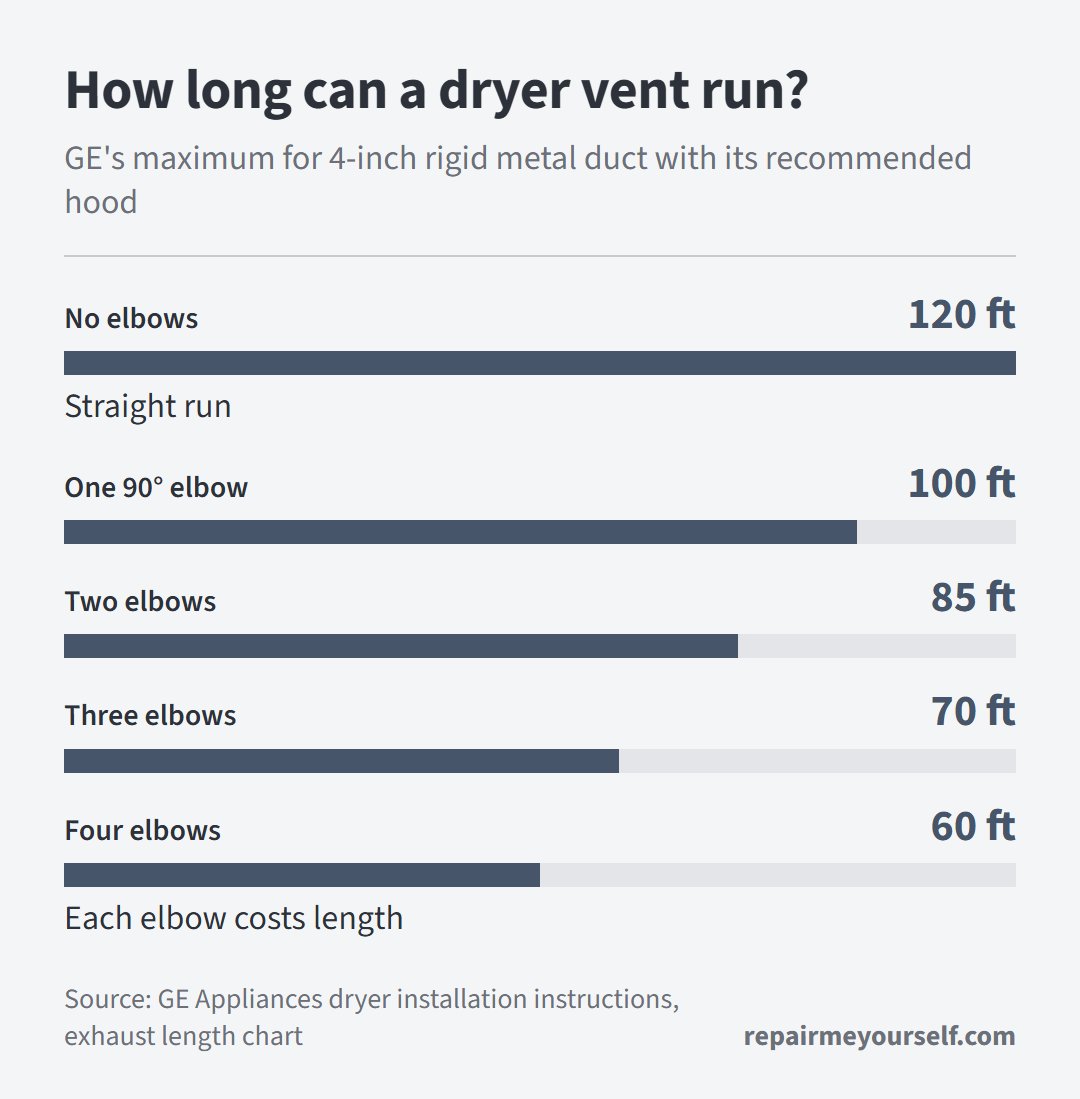
GE counts any elbow over 45° as a 90°, and two 45° elbows as one 90°. The transition duct behind the dryer counts toward the total length.
A longer run, GE says, means longer drying, a shorter dryer life and lint buildup that’s a fire hazard.
The duct itself matters as much as the length. Check it while you have it off:
- Metal, not foil or plastic. Whirlpool recommends rigid or flexible metal and says foil or plastic can collapse or get crushed. GE wants 4-inch rigid metal for the house duct, rigid metal or a UL-listed transition duct behind the dryer, and never a plastic vent.
- 4 inches across. Whirlpool says a larger or smaller duct cuts airflow and lengthens drying.
- Nothing in the way. GE says not to put a screen in or over the duct, and not to add a booster fan.
How often to clean a dryer vent
Clean your dryer vent at least once a year. That’s GE’s minimum, and it’s the safe answer if you aren’t sure how fast yours clogs. Whirlpool and LG set different limits, and the table shows all three:
| Source | How often | What it adds |
|---|---|---|
| GE owner’s manual | At least once a year | A partly clogged exhaust lengthens drying |
| Whirlpool Product Help | Every 1 to 2 years, or when drying slows | Depends on use, what you dry and pet hair |
| LG Flow Sense guide | Deep clean every 6 to 12 months | Clean the lint filter every load |
Your lint screen is a separate, everyday job. The U.S. Fire Administration says to clean it before and after each cycle and never run the dryer without it.
Its flyer also says to clean behind the dryer, where lint builds up, and check that the outdoor vent cover opens while the dryer runs.
When to hand it to a vent cleaner
You can handle the duct behind the dryer and a short, straight wall run yourself. Whirlpool says cleaning the house venting may need a vent cleaning service, depending on how it’s installed.
It adds that the job isn’t covered by warranty, and an appliance service tech won’t do it.
Stop and call a pro if:
- You smell gas. Leave the dryer off and follow the steps on the dryer smells like gas page.
- The duct goes through walls, a ceiling or the roof, and you can’t reach both ends.
- The Check Vent light or a Flow Sense code comes back after a full cleaning. LG says that if the warning shows up after the duct was cleaned or replaced, the blower fan may be defective, and to contact LG service.
If you rent, the answer is shorter. A tenant on a third floor asked how to clean a vent that starts on the far side of the apartment and had never been cleaned.
The top reply:
“You don’t. You contact your landlord.” u/Gardenadventures on Reddit
Dryer vent cleaning questions
Can I clean the dryer vent without moving the dryer?
Only part of it. You can brush in from the outdoor hood and clear the hood itself. But GE’s routine starts at the dryer’s outlet and the short duct behind it, and you can’t reach those with the dryer against the wall.
Can I use a leaf blower to clean a dryer vent?
The GE, Whirlpool and LG pages cited here don’t mention one. They vacuum and brush.
Some homeowners use one anyway: a Reddit commenter takes the hose off the back of the dryer, puts a leaf blower in that end, and holds a shop vac at the hood outside.
Why is my dryer still slow after I cleaned the vent?
Look at the lint screen. GE says dryer sheets can leave a waxy film on it, and to wash the screen in warm, soapy water. Whirlpool adds that fabric softener residue is usually invisible.
Is your screen clean and the dryer cold? Then it’s a heating fault, so go to GE dryer not heating or LG dryer not heating.
The real proof the job worked is outside the house: air at the hood that’s as strong as a hair dryer on high.