You walk past the laundry room and catch a faint, unmistakable whiff of gas near the dryer. Your first instinct is probably right: this isn’t something to wait out. You wonder, “why does my dryer smell like gas?”
A dryer that smells like gas usually points to a loose fitting, aging connector, or dirty burner, but any persistent smell needs immediate safety action, not a DIY fix.
Before we get into causes, here’s what matters most: knowing the difference between a smell you can safely investigate and one that means you need to leave the house right now.
If You Smell Gas Right Now, Do This First
A strong or continuous gas odor is a genuine emergency, not a troubleshooting opportunity. Take these steps immediately:
- Don’t flip light switches, unplug anything, or use your phone inside the house.
- Leave the doors open on your way out and get everyone, including pets, outside.
- Call your gas utility’s emergency line or 911 from outside the house, not from inside.
- Don’t go back in or restart the dryer until the gas company or a licensed technician confirms it’s safe.
A faint, brief smell that clears up on its own is a different situation, and the causes below explain when that’s genuinely normal versus when it still deserves a professional look.
Quick-Reference When a Dryer Smells Like Gas
| Cause | Severity | Needs a Professional? |
|---|---|---|
| Brand-new dryer break-in smell | Harmless | No |
| Brief whiff during ignition | Usually normal | No, unless persistent |
| Loose or aging gas connector | Serious | Yes |
| Dirty burner or clogged tubes | Moderate | Often |
| Gas valve not fully open | Moderate | Sometimes |
| Lint burning near the burner | Moderate | Sometimes |
| Cracked flexible gas line | Serious | Yes |
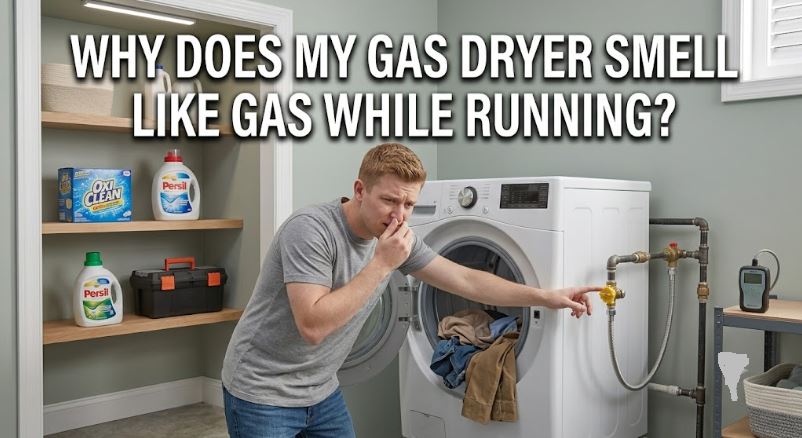
Why Does My Gas Dryer Smell Like Gas While Running?
Consider these reasons when your dryer smells like gas while running:
1. A Brand-New Gas Dryer’s Break-In Smell
New gas dryers often carry a faint chemical or metallic odor for the first several cycles as protective coatings on internal components burn off. This is a normal manufacturing byproduct, not a leak, and it typically fades within three or four loads.
Run the first few cycles with the laundry room well ventilated, and the smell should disappear completely on its own.
2. A Brief Whiff of Gas During Ignition
Every time a gas dryer’s burner ignites, a small amount of gas purges through the line before combustion starts. A faint, fleeting smell right at the start of a cycle, one that vanishes within a few seconds, is generally normal operation rather than a leak.
The distinction that matters is duration. A smell that clears in a few seconds is expected; one that lingers, gets stronger, or returns throughout the cycle is not.
3. A Loose or Aging Gas Connector
The flexible connector linking your dryer to the gas line can loosen slightly over time, especially if the dryer has been moved, pulled out for vent cleaning, or bumped during other repairs. Even a small gap at the fitting lets gas escape continuously.
This is one of the more common sources of a persistent smell, and it’s also one you shouldn’t tighten yourself if there’s any active odor present. If the smell is faint and you want to confirm the connector before calling anyone, a compact combustible gas leak detector (View on Amazon) held near the fitting can help pinpoint the source, but any confirmed leak still needs a licensed technician or your gas utility to correct.
4. A Dirty Burner or Clogged Burner Tubes
Lint and dust can work their way into the burner assembly over years of use, disrupting the flame pattern and causing incomplete combustion. Incomplete combustion produces a distinct odor along with a flame that burns yellow or orange instead of a clean blue.
This isn’t a leak in the traditional sense, but incomplete combustion also produces carbon monoxide, which is colorless and odorless on its own, making the accompanying gas smell an important early warning sign rather than something to dismiss.
If your dryer’s flame looks anything other than mostly blue, that’s worth a professional inspection alongside the odor. A carbon monoxide meter (View on Amazon) near the laundry room can confirm whether CO levels are rising while the dryer runs.
5. A Gas Valve That Isn’t Fully Open
After a dryer installation, a move, or any nearby plumbing work, the gas shutoff valve can end up in a partially open position. This sometimes produces a faint odor without delivering enough gas for the burner to ignite properly, leaving you with both a smell and a dryer that won’t heat.
Confirming valve position is something a technician can verify quickly and safely, since valves that don’t seat correctly need proper adjustment rather than being forced.
6. Lint Burning Near the Burner Housing
Lint that accumulates directly against a hot burner housing can singe or smolder without an open flame, producing a smell that people commonly mistake for a gas leak. This is more of an overheating and fire-risk issue than a gas-line problem, but it deserves the same urgency.
Our guide to Maytag gas dryer troubleshooting covers how to safely inspect and clean the burner area on a gas model, including the ignition sequence and the components involved.
7. A Cracked or Degraded Flexible Gas Line
Flexible gas connectors have a service life, and older lines can develop small cracks or brittleness, particularly if they’ve been kinked, stretched, or exposed to years of vibration from the dryer. A degraded line can leak small amounts of gas continuously, even without an obvious point of damage.
Gas connectors are inexpensive to replace, but this is line-pressure work that belongs with a licensed technician rather than a weekend project, regardless of how simple it looks.
When to Call a Professional Instead
Anything beyond a brief ignition whiff or a fading new-dryer smell warrants a professional. Gas fittings, valves, and connector lines carry real explosion and carbon monoxide risk, and the cost of a technician visit is minor compared to the alternative. If your gas dryer is old enough that this is one of several recent issues, our gas vs. electric dryer guide can help you weigh repair against replacement.
FAQs
Why does my dryer smell like gas only when it starts?
A brief smell right at ignition is usually just residual gas purging from the line before the burner lights, and it should clear within a few seconds. If it lingers past the start of the cycle, treat it as a possible leak.
Is it normal for a brand-new gas dryer to smell like gas?
A mild, non-gas chemical odor from protective coatings burning off is normal for the first few loads. A distinct gas smell on a new unit still deserves a check, since it could indicate an installation issue with the connector.
Can a gas dryer leak carbon monoxide without smelling like gas?
Yes. Carbon monoxide itself is odorless, but the incomplete combustion that produces it often comes with a noticeable gas or burning smell, which is why any odor from a gas dryer is worth taking seriously.
Should I keep using my dryer if it smells like gas?
No. Stop using it until the smell is fully explained, whether that’s a confirmed harmless cause or a repair completed by a professional. Continuing to run it risks both fire and gas exposure.
How do I tell a real gas leak from burning lint?
A gas leak typically smells like sulfur or rotten eggs and doesn’t change with the dryer’s cycle. A lint or dust smell is usually more like burning paper or dust and tends to fade once the dryer cools and the debris is cleared.
Staying Safe When Your Dryer Smells Like Gas
A gas smell from your dryer is never something to ignore, but it isn’t always a full-blown emergency either. Brief whiffs during ignition and new-appliance break-in odors are normal and resolve on their own within a few cycles.
Anything that lingers, returns, or comes with a yellow flame or overheating signs deserves a professional’s attention before you run the dryer again. When in doubt, treat the smell as real and get it checked. That single habit is the best protection against both fire and carbon monoxide risk in a home with a gas dryer.