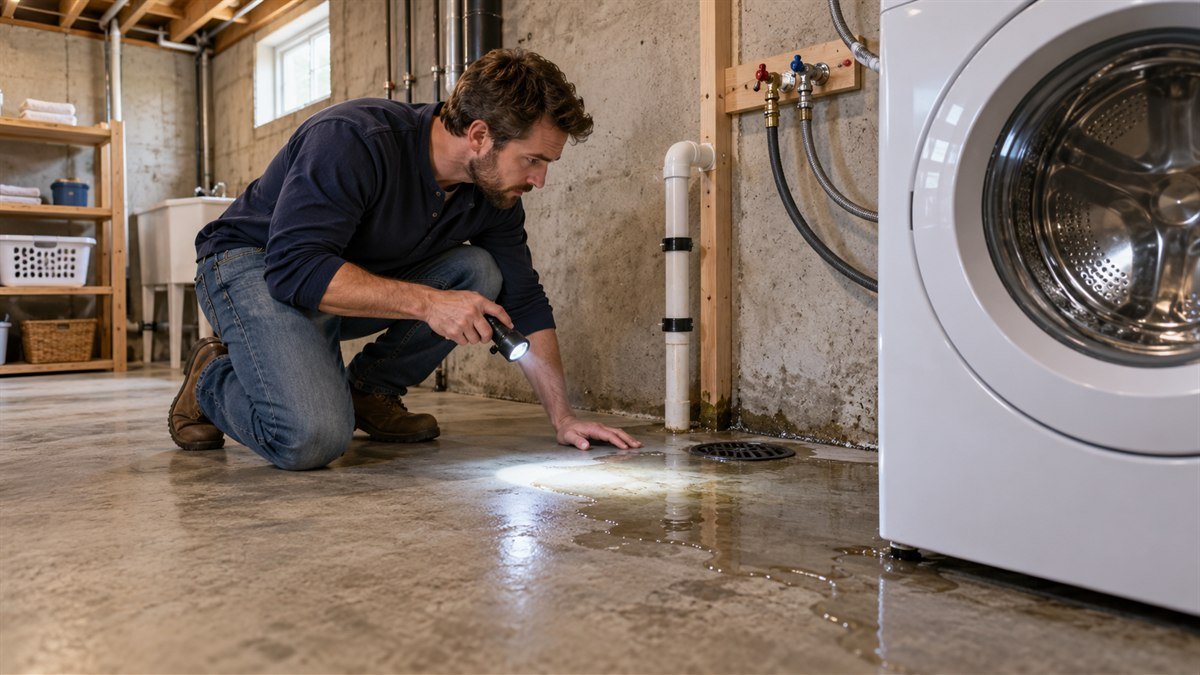
When your washer seems to be leaking into the basement, the water on the floor doesn’t always come from the washer. Dry the floor and watch when the water comes back.
If it shows up only while the machine runs, your washer or its drain is the cause. If it returns with the washer off, after rain or on a muggy day, a new hose won’t fix it. That water is coming from the house.
Basement laundry rooms hide leaks well. Concrete soaks water up, boxes sit right on the floor, and you rarely look behind the machine until the carpet in the next room feels damp. Here’s how to find the source before you spend money on the wrong fix.
Shut Off the Water and Power First
Turn off both supply valves behind the washer, clockwise until they stop. Then look at where the water is before you reach for anything.
If the puddle touches an outlet, the power cord or the electrical panel, stay out of it. Switch off the laundry circuit at the breaker, but only if you can reach the panel from dry floor. Can’t reach it dry? Call an electrician or your utility.
When the floor around the plug is dry, unplug the washer. Mop up the standing water and move anything stored on the floor. Don’t drag a loaded washer across wet concrete by yourself. It’s heavy. Wet concrete is slick.
Is Your Washer Leaking Into the Basement? Run the Washer-Off Test
This one test saves you the most money. Dry the floor completely. Lay paper towels around the base of the washer and along the nearest wall, then leave the washer off and the valves closed for a day.
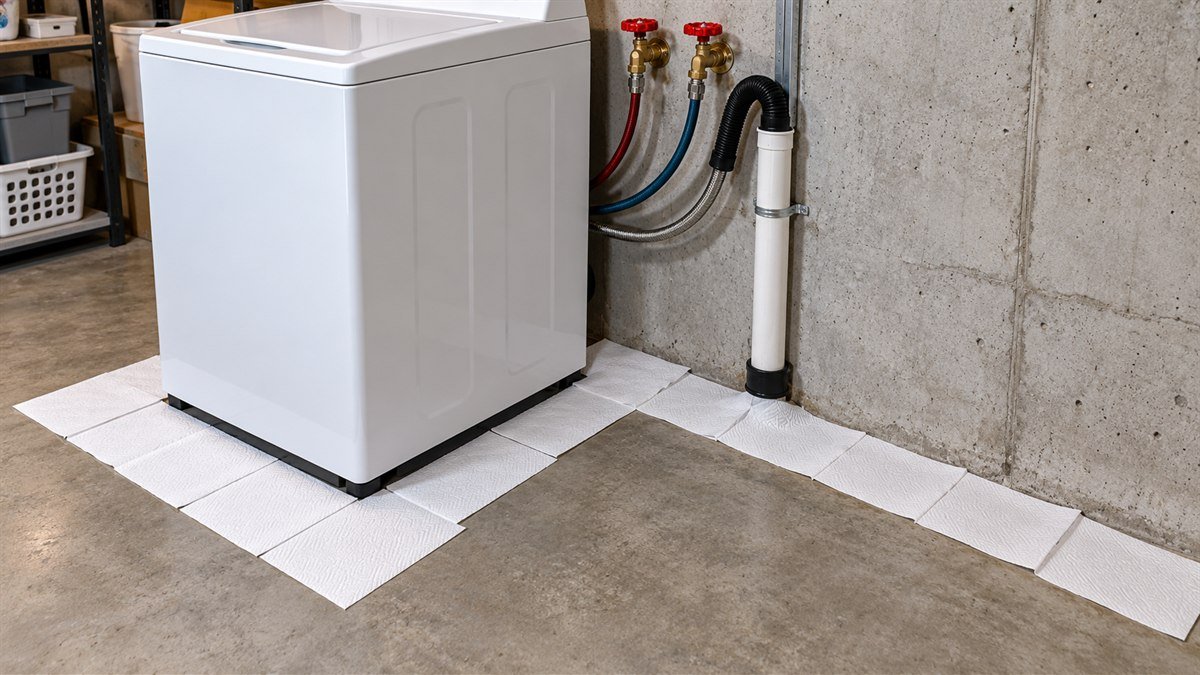
Dry towels the next morning point to the washer or its plumbing. Wet towels with the washer off mean the water has another source. Match what you see to the table.
| When the water shows up | Most likely source | Where to look |
|---|---|---|
| Only while the washer fills | Supply hoses, hose washers, inlet valve, detergent drawer | Back of the machine, top of the cabinet |
| During the wash or agitate stage | Door boot (front-loaders) or oversudsing | Front of the cabinet, under the door |
| During drain or spin | Drain hose, standpipe overflow, drain pump | Standpipe, laundry sink, under the machine |
| Up through the floor drain when the washer pumps out | A partly clogged house drain line | The floor drain, not the washer |
| Washer off, on humid days, beads on pipes or walls | Condensation | Cold water pipes, the lower wall |
| Washer off, after rain, along the wall-floor joint | Water coming in through the foundation | Cracks, the cove joint, window wells |
| Washer off, near the water heater or softener | Another appliance | Tank base, relief valve pipe, softener drain line |
If the Washer Is the Source, Check It in This Order
These are the checks I run on a basement call, cheapest and quickest first. Most washer leaks turn out to be a connection, not a broken part.
Supply hoses
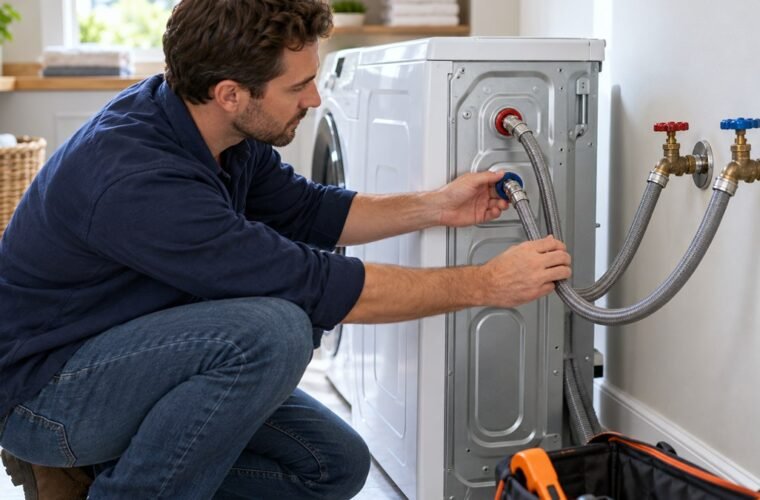
Run your hand along both hoses from the valve to the machine. You’re feeling for drips at each end and looking for bulges, cracks or rust on the fittings.
A slightly loose fitting can take a snug turn by hand. Don’t crank on it. A bulging hose is close to bursting, so replace it today.
Whirlpool’s hose listings say to replace washer inlet hoses after five years of use. Write the install date on the new ones so you know when your five years are up.
Drain hose and standpipe
Your drain hose should sit loosely in the standpipe, not jammed down into it. Whirlpool’s front-load drain guide says the hose shouldn’t go more than 4.5 inches into the drainpipe, and the pipe shouldn’t be taped over.
The same guide lists a 30-inch minimum standpipe height for those models. Check your own manual, since other models and brands differ.
In basements, I ran into an overflowing standpipe more than once. The washer was fine. The drain line behind the wall just couldn’t keep up with how fast the pump pushed water out, so it spilled over the top.
See water running down the outside of the standpipe during the drain? That line needs a plumber. If the water comes over the tub instead, our guide to a washer overflowing during the wash covers the causes inside the machine.
Detergent drawer and door seal
Too much detergent, or the wrong kind, makes suds that push water out around the drawer or the door. Use the amount your manual lists and clean the dispenser. On a front-loader, pull back the door boot. You’re looking for a tear, or a sock stuck in the fold.
Leaks from inside the cabinet
Water that only drips during the spin cycle usually points to the pump, an internal hose or the tub seal. Stop the cycle as soon as you see water, because running it again just to watch puts more water on your floor.
Our guide to a washer leaking from underneath walks through all seven internal causes in order.
If the Water Comes Back With the Washer Off
Then the washer is off the hook. The question becomes whether the water is condensing out of the air or coming in through the foundation, and those two need very different fixes.
Condensation forms on cold surfaces in humid air. In summer you’ll see beads on the cold water line and dark patches low on the concrete.
The EPA’s guide to mold and moisture recommends insulating cold water pipes and keeping indoor humidity below 60 percent, ideally 30 to 50 percent. A dehumidifier usually handles it.
To tell the two apart, try a foil test. Tape a square of aluminum foil to a dry patch of wall, seal all four edges, and check it after a day or two. Moisture on the room side means condensation. Moisture under the foil, against the concrete, means water is moving through the wall.
Water after rain points the same way. So does a damp line where the wall meets the floor, or wet spots far from the laundry.
Start outside. The same EPA guide says the ground should slope away from the foundation so water doesn’t pool against it, so clear your gutters and make sure the downspouts empty well away from the house.
A single washer leak doesn’t mean your basement needs waterproofing. Water that keeps coming in after rain, once you’ve ruled out the washer and the plumbing, does need a proper look from a foundation specialist, not an appliance tech.
In New Jersey, for example, Blue Umbrella Waterproofing inspects basements to find where water is getting in through the foundation, walls or floor.
Check your other water appliances too. A water heater that drips from the base of the tank is usually finished, and our water heater age calculator tells you how old yours is from the serial number. A softener drain line that slips out of the drain can leave a puddle that looks just like a washer leak.
Dry It Out Within 48 Hours
The clock starts when the floor gets wet. The EPA says to dry water-damaged areas and items within 24 to 48 hours to prevent mold growth.
Run fans and a dehumidifier. Get the boxes off the floor, and pull up wet carpet pads, since they stay soaked long after the surface feels dry to your hand.
Don’t lay flooring or restack storage until you know the leak has stopped. Otherwise the next cycle or the next storm soaks it again.
Stop and Call for Help If
- The water touches an outlet, the cord or the panel, or your washer keeps tripping the breaker. Call an electrician before anyone touches it.
- The leak comes from inside the cabinet and you’d have to pull panels you’re not comfortable with. Call an appliance technician.
- Water rises through the floor drain when the washer drains. Call a plumber.
- Water keeps coming through the walls or floor with the washer off. Call a basement waterproofing contractor.
Most basement washer leaks end with a new hose or a reseated drain hose. The towel test takes one day, and it tells you whether that’s your fix or whether the problem is the basement itself.