
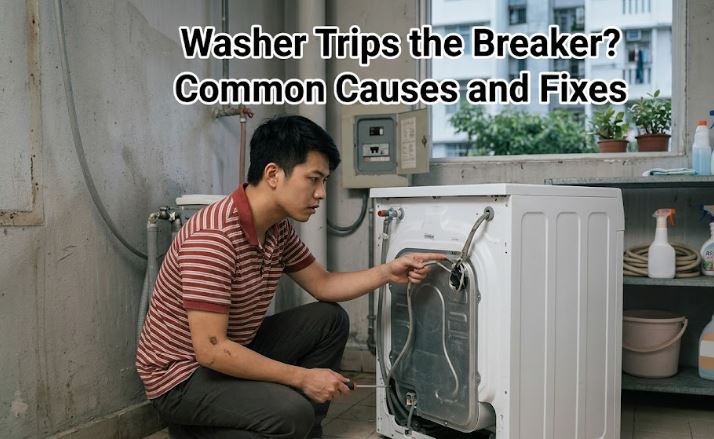
You reset the breaker, start the washer, and walk away. Ten minutes later the laundry room is dark again, the machine dead mid-fill, and you’re back at the panel flipping the same switch for the second or third time this week.
A washer trips the breaker from an overloaded shared circuit, a water leak causing a ground fault, a failing pump or motor drawing excess current, or damaged internal wiring.
Some of these are a quick fix. Others mean stopping use of the washer entirely until a professional takes a look, so it’s worth knowing which is which before you reset that breaker again.
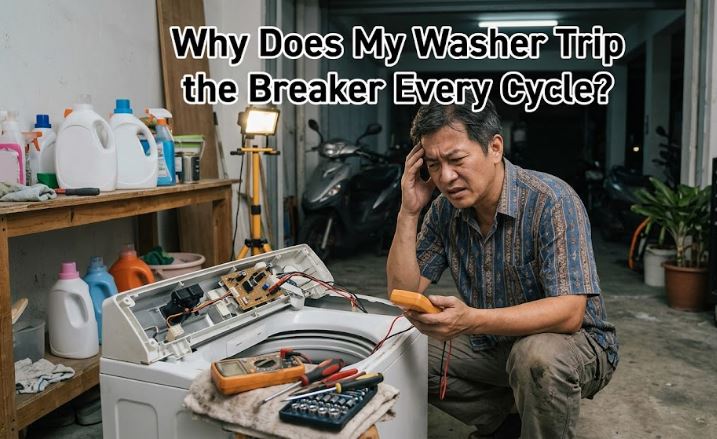
Match the Breaker Trip Pattern to the Likely Cause
When the breaker trips, and what else is running at the time, narrows this down faster than resetting it and hoping.
| What You Notice | Most Likely Cause | Typical Fix |
|---|---|---|
| Trips only when other appliances run at the same time | Overloaded shared circuit | Move appliances to separate circuits |
| Trips right as the machine starts spinning | Failing motor or pump drawing excess current | Test and replace the motor or pump |
| Trips along with a visible water leak | Ground fault from water reaching wiring | Stop use, call a technician immediately |
| Trips specifically when the lid closes or locks | Shorted lid switch | Replace the lid switch |
| Trips randomly, no clear pattern | Chafed or pinched internal wiring | Professional wiring inspection |
| Trips every single time, immediately on reset | Direct short circuit | Stop use, call an electrician |
| Trips only during startup, never mid-cycle | Motor surge on a marginal circuit | Have the circuit and breaker rating checked |
Why a Washer Pulls Enough Power to Trip a Breaker
A washer draws the most current at motor startup and during spin, so most trips cluster around those two moments rather than happening at random.
1. An Overloaded Circuit Shared With Other Appliances
Washers typically run on a dedicated 15 or 20-amp circuit, but not every laundry room is wired that way. If the washer shares a circuit with a space heater or another appliance running at the same time, the combined draw can exceed what the breaker allows.
This is especially common in stacked laundry setups, where a washer and dryer sometimes share a single circuit through a splitter. Our Maytag stackable washer and dryer troubleshooting guide covers how shared circuits contribute to this exact problem.
2. A Water Leak Reaching Internal Wiring
Water and electricity finding each other inside a washer is exactly what a breaker is designed to protect against. A leaking hose, a failing door seal, or water pooling near the control board can create a ground fault, tripping the breaker to cut power before it becomes dangerous.
If you see or suspect water near the washer’s electrical components, stop using the machine and unplug it rather than resetting the breaker repeatedly. This one is worth a technician visit, not a DIY fix.
3. A Failing Drain Pump or Motor Drawing Excess Current
A pump or motor with worn bearings has to work harder to turn, and that added resistance shows up as higher current draw, sometimes enough to trip a breaker that would otherwise handle the washer’s normal load fine.
If the trip happens consistently right as the pump or motor kicks in, a failing part is a reasonable suspect. A direct-fit replacement drain pump (View on Amazon) addresses this when the pump itself is the source.
4. A Shorted Lid Switch
The lid switch carries a live circuit every time the lid closes. If moisture, corrosion, or worn insulation creates a short inside the switch, that short can trip the breaker the moment the lid locks, well before the wash cycle starts.
A trip that happens right as the lid closes, rather than during the wash itself, points fairly directly at this part. A replacement lid switch (View on Amazon) resolves this on most Whirlpool and Kenmore top-load models.
5. Chafed or Pinched Internal Wiring
Wiring inside the cabinet can rub against a sharp edge or vibrate against a metal panel over years of use, eventually wearing through the insulation enough to create an intermittent short. This kind of fault often trips the breaker with no consistent pattern, making it one of the harder causes to pin down without opening the machine.
This is a job for a qualified appliance technician rather than a DIY repair, since diagnosing a hidden short safely means testing a live circuit inside the cabinet.
6. A Motor Startup Surge on a Marginal Circuit
Every washer motor draws a brief surge of current at startup, higher than its running current. On a circuit already close to its rated capacity, from long wire runs, an older breaker, or other loads nearby, that surge alone can trip it even though the washer runs fine once going.
If trips happen only at the very start of a cycle and never mid-wash, the circuit itself is worth checking before assuming the washer has failed. Our Kenmore Model 110 troubleshooting guide covers testing outlet voltage and cord condition, both useful first checks here.
7. A Weak or Aging Circuit Breaker
Breakers wear out over time and can begin tripping below their rated amperage, especially after a decade or more of use. If the washer’s actual draw tests normal but the breaker still trips, the breaker itself may be the failing part.
Replacing a breaker means working inside the electrical panel, which is a licensed electrician’s job rather than a homeowner repair.
Narrowing Down the Actual Cause
Work through these before assuming a part inside the washer has failed.
- Note exactly when the trip happens, at startup, at the lid lock, or during spin, since timing narrows the list significantly.
- Unplug other appliances on the same circuit and run the washer alone to rule out overload.
- Check for any sign of water near the back panel, hoses, or control area before resetting anything.
- Test outlet voltage with a multimeter (View on Amazon) if trips seem tied to the circuit rather than the washer.
- Stop resetting the breaker repeatedly if it trips immediately every time, since that pattern points to a direct short.
DIY Fix or Call a Professional?
| Factor | Safe to Check Yourself | Needs a Professional |
|---|---|---|
| Circuit overload | Yes, unplug other devices and retest | — |
| Lid switch short | Yes, straightforward part swap | — |
| Water near wiring | No | Yes, immediately |
| Chafed internal wiring | No | Yes |
| Weak breaker itself | No, requires panel access | Yes, licensed electrician |
| Immediate trip on every reset | No | Yes, stop use and call for service |
When to Stop Resetting the Breaker Entirely
A breaker that trips once, tied to an obvious cause like another appliance running at the same time, isn’t an emergency. A breaker that trips immediately on every reset, trips alongside any sign of water, or trips with a burning smell anywhere near the washer is different, and it’s worth unplugging the machine and calling a professional rather than continuing to flip the switch.
Frequently Asked Questions
Is it safe to keep resetting a breaker that keeps tripping?
Occasionally, if the cause is an obvious overload you’ve already corrected. Repeatedly resetting a breaker that trips immediately or without explanation risks masking a real electrical fault.
Can an old washer motor cause a breaker to trip?
Yes. A motor with worn bearings or windings draws more current than a healthy one, enough to trip a breaker the washer used to run on without issue.
Why does my washer only trip the breaker during the spin cycle?
Spin is when the motor draws the most current, so a marginal circuit, a failing motor, or a worn pump are all more likely to show up at that point rather than during fill or wash.
Should I upgrade my breaker if my washer keeps tripping it?
Only after an electrician confirms the washer’s actual draw is within normal range and the circuit is simply undersized. Upgrading a breaker without addressing a washer fault can mask a real problem.
Does a GFCI outlet trip differently than a circuit breaker?
Yes. A GFCI trips specifically in response to a ground fault, often from moisture, while a standard breaker trips from overcurrent. Check both separately if your laundry room has a GFCI outlet.
Restoring Steady Power to Your Washer
A washer that trips the breaker is telling you either it’s drawing more current than it should, or the circuit feeding it can’t quite keep up. Note exactly when the trip happens, rule out shared circuits and obvious overload first, and treat any water near the wiring as a reason to stop and call a professional rather than reset and hope. Once the actual cause is identified, most washers go back to running a full cycle without ever touching the panel again.