The most reliable washing machine brand in the latest public service data is LG for front-loaders and GE Profile for top-loaders. In Yale Appliance’s 2026 numbers, LG front-loaders needed first-year service 2.7% of the time and GE Profile top-loaders 3.4%.
But the badge alone won’t protect you. GE Profile’s front-loaders came in at 10.5%.
So pick the brand for the type of washer you want. Then check who repairs that brand where you live, because even a washer that rarely breaks still has to be fixed when yours does.
The most reliable washing machine brand depends on the type
Yale Appliance sells and services washers in Massachusetts and New Hampshire, and it publishes how many of the machines it sold needed a repair in their first year. Its 2026 post draws on 33,190 service calls, and it’s the best public look you’ll get at real repair rates by brand.
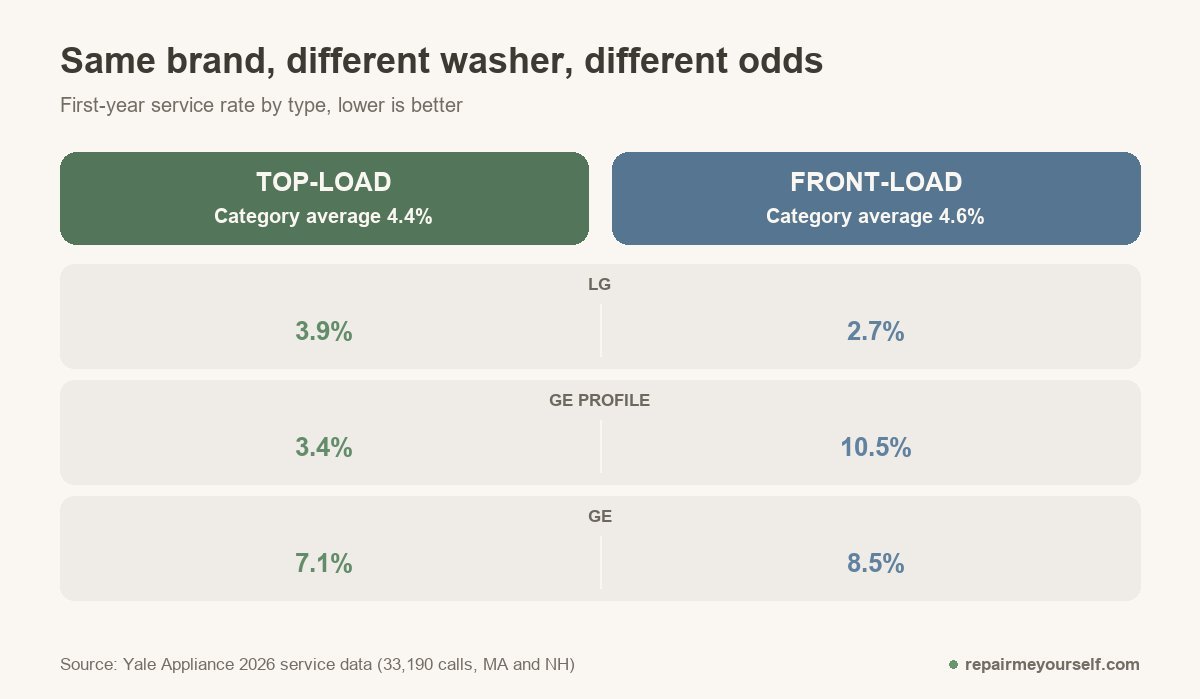
Look at how close the two types are overall. Yale’s top-load average is 4.4% and its front-load average is 4.6%.
The gap between brands is far bigger than the gap between designs, so the type you pick matters less than which brand you pair it with.
LG is the one brand near the top on both sides, at 3.9% top-load and 2.7% front-load.
Speed Queen top-loaders ran 4.6%, right at the average, and Yale had no front-load figure for it. Plain GE ran 7.1% top-load and 8.5% front-load.
If you only remember one thing, make it the GE Profile split. “Buy GE Profile” is good advice for a top-loader and poor advice for a front-loader, using the same retailer’s numbers.
Two data sets, two different questions
You’ll see two sources quoted on every reliability page, and they don’t measure the same thing.
Yale’s data divides the washers it serviced by the washers it sold, in the first year only. It’s a clean read on defects and installation problems.
Yale says tracking after the first year gets messy because people move and call other servicers, so it can’t tell you how your washer holds up at year seven. It also only covers brands Yale sells in volume, in two states.
Consumer Reports works the other way. It surveys its members, covering more than 108,600 washers in its latest update, and predicts how likely a brand’s new models are to break or develop problems within five years. The full brand rankings are for members only.
Which one should you trust? Use Yale for “will this one need a repair soon” and CR for “will it still be going in five years.” Neither answers both, so I read them together.
What goes wrong depends on the type too
CR’s public findings show each design fails in its own way. Across all washers, members most often reported tangled clothes (10%), odor (8%) and mold or mildew (7%).
Tangling hit top-loaders hardest, at 14% for high-efficiency top-loaders and 11% for agitator models. Odor and mold were the front-loader complaint, at 13% each.
Mold is where the brand matters most in CR’s data. Front-loaders from Kenmore (21%), Maytag (19%), Electrolux (18%) and Whirlpool (16%) were more likely to report it. Speed Queen front-loaders came in at 3%. If you’re set on a front-loader, it’s a number you’ll want to weigh as heavily as the service rate.
Among compact washers, CR says Whirlpool had the highest problem rates, including leaking, drainage and noise. If you need a compact, don’t assume a brand’s full-size record carries over.
Can someone fix it near you?
Reliability isn’t only how often your washer breaks. It’s also how long you’re without it when it does, and that depends on whether anyone near you services the brand you bought.
Yale says this outright about Samsung: its washers were reliable, but service was always the sticking point, so check how quickly Samsung can reach your area before you buy. The same post credits GE with the largest service network in the country.
Service also changes from town to town. One owner on r/Appliances pushed back on LG’s service reputation:
“where I live zero issues with LG service in fact I’ve seen them go out same day in a few occasions”
– r/Appliances, September 2026
Before you buy, call one or two local repair shops and ask which brands they’ll work on and how fast they can get parts.
It’s a five-minute call, and it’s the part no national ranking can answer for you.
What my service calls can and can’t tell you
Most of the washers I worked on were Whirlpool-family machines, then Samsung, LG, GE and Frigidaire. Don’t read that as a failure ranking. It mostly reflects what people in my area owned.
The problems themselves were rarely exotic. Yale lists draining, spinning, noise and door locks as its most common washer calls, and it traces many drain calls to socks, baby clothes or pet hair in the pump, which no brand can prevent. Code pages like the LG washer OE code and the Samsung washer 4C code cover the fixes that save a service call.
What I did learn is to check two things before recommending a washer: that a local shop services it, and that the tech sheet and parts are easy to get for that model.
Other washer reliability questions
Which washing machine brand lasts the longest?
No public data set tracks washer lifespan by brand. CR’s five-year problem prediction is the closest, and its full rankings are member-only. Warranty length is a useful clue: Yale notes Speed Queen’s TR7003WN comes with a 7-year parts and labor warranty. For typical lifespans and the repair-or-replace math, see how long washing machines last.
Which washing machine brands should you avoid?
Avoid a brand-and-type pairing, not a whole brand. In Yale’s data, GE Profile front-loaders (10.5%) and plain GE front-loaders (8.5%) had the highest first-year service rates. In CR’s data, Kenmore, Maytag, Electrolux and Whirlpool front-loaders reported the most mold.
For a front-loader, the public numbers point to LG. For a top-loader, GE Profile or LG. Either way, find out who will fix it in your area before the washer comes off the truck.