
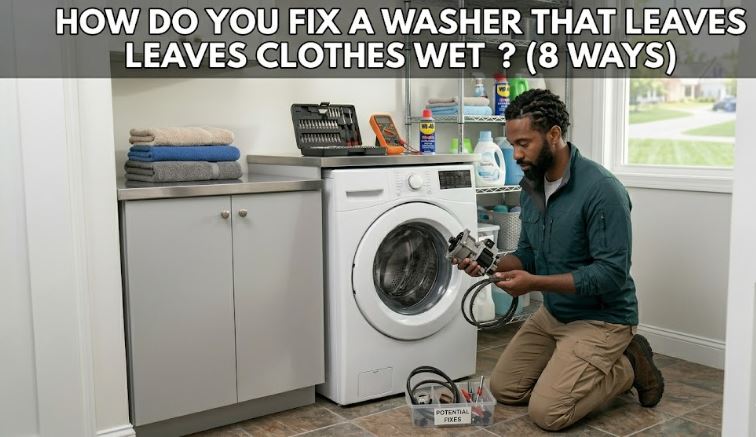
You transfer your laundry to the dryer and immediately realize everything is soaking wet, not just damp, but dripping. The spin cycle ran, the machine beeped, but somehow the water never left the clothes.
This is one of the most frustrating washer problems because the machine appears to have done its job. In reality, something interrupted the spin cycle or reduced its effectiveness enough that water extraction never happened properly.
The good news is that most causes are DIY-friendly and start with the simplest checks. Let’s go through them one by one.
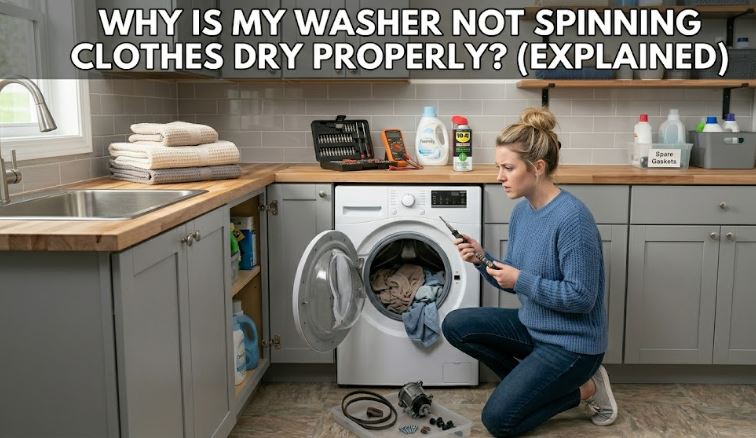
Quick Diagnosis for a Washer That Doesn’t Spin Clothes Dry
| What You Notice | Most Likely Cause |
|---|---|
| Clothes soaking wet, some water in drum | Drainage problem or clogged pump filter |
| Clothes wet but drum is empty of water | Spin speed too low or wrong cycle selected |
| Wet clothes only on one side of drum | Unbalanced load cutting spin short |
| Wet clothes after every single cycle | Lid switch fault or worn drive belt |
| Clothes wetter than usual, gradually worsening | Worn motor coupler or failing motor |
| Machine spins briefly then stops | Overloaded drum triggering safety stop |
What Causes a Washer to Stop Spinning Clothes Dry?
Your clothes may remain soaking wet after a spin cycle due to different reasons. Below are possible explanations for a washer not spinning clothes dry:
1. The Load Is Unbalanced or Overloaded
This is the most common reason clothes come out soaking wet, and it is entirely free to fix.
When clothes bunch together on one side of the drum, the machine detects excessive vibration and automatically reduces spin speed or stops the spin cycle entirely to protect itself. At a reduced spin speed, water extraction drops dramatically and clothes end up saturated.
Overloading creates the same result. A drum packed beyond its capacity triggers the machine’s imbalance sensors because the load cannot distribute evenly, and the spin cycle either never reaches full speed or cuts out early.
How to Fix an Unbalanced or Overloaded Drum
Open the lid or door and physically redistribute the clothes evenly around the drum. Pay attention to heavy items like towels, jeans, and bedding since these are the most frequent culprits.
Remove some items if the drum is packed tightly. Fill it to around 75 to 80 percent of capacity and make sure clothes can move freely rather than sitting in a compressed mass. Then run a drain and spin cycle to finish extracting water from the current load.
2. The Wrong Cycle or Spin Speed Is Selected
This one catches people off guard more often than you would expect, and it requires zero repair work to fix.
Delicate, hand-wash, and wool cycles are intentionally designed to spin at very low speeds to protect fragile fabrics. If one of these cycles was selected by mistake, clothes will come out noticeably wetter than usual because the spin speed was never high enough for proper water extraction.
How to Choose the Right Cycle
Check the cycle selector and confirm it matches the type of laundry you are washing. For everyday loads of cotton and mixed fabrics, use a normal or cotton cycle which spins at full speed.
If clothes are already wet from a completed low-spin cycle, select a dedicated spin-only or drain-and-spin cycle to run at full speed without adding more water. Most modern machines include this option specifically for situations like this.
3. The Drain Hose or Pump Filter Is Blocked
A washer cannot spin clothes dry if it cannot first remove the water from the drum. Poor drainage means the machine is trying to spin clothes while they are still partially submerged, and water simply gets redistributed rather than extracted.
This is exactly why a blocked drain hose or clogged pump filter often shows up as wet clothes rather than obvious standing water in the drum.
How to Clear a Drainage Blockage
Start with the pump filter since it is the most common source of drainage problems. Find the small access panel at the front base of the machine. Place towels underneath, unscrew the filter cap slowly, and clean out any lint, coins, or debris with an old toothbrush.
Next, pull the machine away from the wall and inspect the drain hose for kinks or blockages. Disconnect both ends and flush water through it to confirm it is clear. Also check that the hose sits no deeper than 6 to 8 inches into the standpipe, since inserting it too far causes siphoning that prevents proper drainage.
For a complete drainage troubleshooting walkthrough, our post on washer drains slowly covers every drainage-related cause in detail.
4. The Lid Switch or Door Lock Is Faulty
The lid switch on a top-loader and the door lock on a front-loader both signal to the control board that it is safe to begin spinning. When either develops a fault, the machine may skip the spin cycle entirely or reduce spin speed to a crawl, leaving clothes completely saturated.
A partially failing switch is particularly deceptive because the machine still appears to complete the cycle normally.
How to Test and Replace the Lid Switch
Close the lid firmly and listen for a solid click. No click on a top-loader almost always means the switch is not engaging properly. Use a multimeter to test the switch for continuity in the closed position. A reading that shows no continuity means the switch is not sending a reliable signal.
Find a suitable replacement lid switch for your washing machine on Amazon.
5. The Drive Belt Is Worn or Broken
The drive belt connects the motor to the drum and powers the spinning motion. When it wears thin, stretches, or snaps, the motor runs but the drum either spins weakly or does not spin at all.
A worn belt often causes inconsistent spin performance before it fails completely. Clothes come out wetter than usual for weeks or months, and the problem gradually worsens until the belt gives out entirely.
How to Inspect and Replace the Drive Belt
Unplug the machine and remove the rear access panel. Locate the belt running between the motor pulley and the drum pulley. Look for cracks, fraying, glazing, or excessive looseness. A belt that slides off the pulley easily by hand has already stretched past its working tension. Thus, it needs a reliable replacement (View on Amazon)
6. The Motor Coupler Has Failed (Direct-Drive Top-Loaders)
This one applies specifically to direct-drive top-loading washers, which are common in Whirlpool, Kenmore, and Maytag machines made from the 1990s onward.
The motor coupler is a small three-piece plastic and rubber component that connects the motor directly to the transmission. It is designed to break under extreme stress to protect the motor from damage. When it fails, the motor runs but spin function stops entirely.
A sure sign of a failed coupler is a machine that agitates normally but completely refuses to spin.
How to Replace a Failed Motor Coupler
Unplug the machine and lay it on its back or side to access the motor from underneath. The coupler sits between the motor shaft and the transmission input shaft. Inspect it for cracked or missing plastic sections.
You can find a compatible motor coupling kit for your washing machine on Amazon.
7. The Clutch Assembly Is Worn (Top-Loaders)
The clutch assembly allows the drum to gradually ramp up to full spin speed rather than engaging abruptly. When it wears out, the drum never reaches the RPM needed for effective water extraction, even though the machine appears to complete the spin cycle normally.
Clothes consistently coming out wetter than they used to be, with no other obvious cause, is a strong indicator that the clutch is wearing down.
How to Address a Worn Clutch
Listen carefully during the spin cycle. A failing clutch often produces a grinding or scraping noise during the spin ramp-up phase before the drum reaches full speed. Confirming this alongside consistently wet clothes points clearly to clutch wear.
The clutch is not repairable and needs full replacement. Search your model number alongside “clutch assembly” on Amazon to find the correct part. For Whirlpool and Kenmore machines this is a well-documented repair with plenty of step-by-step guides available. Also check our related post on washer making loud banging noise during spin cycle since a failing clutch often accompanies both symptoms.
8. The Control Board Is Not Completing the Spin Cycle
When all mechanical components check out but clothes still come out wet, the control board is the next suspect.
The board governs every phase of the wash cycle, including when and how fast the drum spins. A faulty board may cut the spin phase short, reduce spin speed mid-cycle, or skip it entirely while still reporting a completed cycle.
Random or inconsistent wet clothes alongside unusual display behavior or unexpected error codes are the strongest signs of a board issue.
How to Diagnose a Control Board Problem
Start with a hard reset. Unplug the machine for two full minutes, plug it back in, and run a spin-only cycle to see if full spin speed returns. This clears temporary errors and sometimes resolves the issue without any parts.
If the problem keeps occurring, run the machine’s built-in diagnostic mode to check for stored error codes. Search your model number alongside “diagnostic mode sequence” to find the right steps for your brand.
Also Read: Why Your Dryer Takes More Than One Cycle to Dry Clothes (Fixed)
Frequently Asked Questions
Why do my clothes feel wetter after some cycles but not others?
Inconsistent wetness almost always points to an intermittent mechanical issue rather than a settings problem. A worn drive belt, a partially failing lid switch, or a clutch that is beginning to slip all produce this kind of unpredictable spin performance that gradually gets worse over time.
Can too much detergent cause clothes to come out wet?
Yes, indirectly. Excess suds create resistance inside the drum that makes water extraction less efficient during the spin cycle. Clothes absorb the foam and hold onto more moisture than they would in a clean rinse. Always measure detergent carefully and use HE formula if your machine requires it.
My washer spins but clothes are still soaked. Is it a drainage problem?
Very likely yes. If the drum is spinning but clothes come out saturated, the machine is probably spinning with residual water still present in the drum. Start by cleaning the pump filter and checking the drain hose, since partial drainage blockages cause exactly this symptom without producing obvious standing water.
How do I know if my motor coupler is broken?
The clearest sign is a machine that agitates the clothes during the wash phase but then completely fails to spin at the end. The motor will hum normally during agitation, but when the spin phase begins, nothing happens. This specific combination almost always points to a broken motor coupler on direct-drive top-loaders.
Is it worth repairing a washer that never spins clothes fully dry?
In most cases, yes. Lid switches, drive belts, and motor couplers are all under $50 in parts and are among the most affordable washer repairs available. Only when the motor or control board has failed does the repair cost start to approach the value of an older machine.
Fix Your Washing Machine Today to Start Spin-Drying
A washer not spinning clothes dry is almost always fixable without calling a technician. Start by balancing the load and confirming the right cycle is selected, since those two checks alone resolve a large portion of complaints. Then move to the drain system before touching any internal components. The above washing machine troubleshooting guide should be able to help you do it like a pro.


