
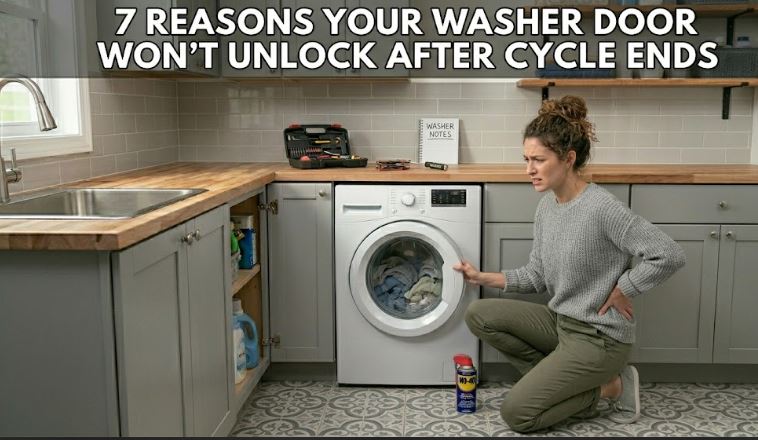
The cycle finished. The machine beeped. But the door is sealed shut and nothing you press makes it budge. Your laundry is trapped and you have no idea why.
A washer door that won’t unlock after a cycle is one of those problems that feels urgent immediately, especially when you are on a tight schedule. The good news is that most causes have a straightforward fix, and several require no tools or parts at all.
One important rule before anything else: never force the door open by yanking the handle. That almost always breaks the latch mechanism and turns a simple fix into a costly one. Work through the causes below instead.
Quick Diagnosis for a Washer Door That Won’t Unlock After Cycle Ends
| What You Notice | Most Likely Cause |
|---|---|
| Door locked, cycle just finished | Normal safety delay, wait 2 to 5 minutes |
| Door locked with water visible in drum | Drainage problem preventing door release |
| Door locked, error code on display | Control board fault or door lock error |
| Door handle gives slightly but won’t open | Door latch assembly has failed |
| Door locked after power cut mid-cycle | Control board needs reset |
| Door locks and unlocks repeatedly | Faulty door lock actuator |
What Causes a Washer Door to Stay Locked After Washing?
The washing machine’s door may stay locked after the wash cycle ends due to any of the reasons below:
1. The Safety Delay Has Not Expired Yet
Before assuming anything is wrong, consider this first.
Modern front-loading washers have a built-in safety delay of two to five minutes after the cycle ends. During this time the machine confirms that the drum has stopped spinning, the water temperature has dropped, and any residual water has drained. The door stays locked throughout this process even though the display shows the cycle as complete.
What to Do
Simply wait. Give the machine three to five minutes after the cycle finishes before pulling on the door handle. You will hear a distinct click when the lock disengages and the door is ready to open.
If you are still waiting after five minutes and nothing has happened, that is when you move on to the causes below.
2. Water Is Still in the Drum
This is the most common mechanical reason a washer door refuses to unlock, and it is a deliberate safety feature rather than a fault.
Your machine uses a water level sensor to monitor drum conditions at all times. If any water remains in the drum when the cycle ends, the door lock stays engaged automatically. Opening the door with water inside would flood the floor immediately, so the machine simply will not allow it.
How to Drain the Drum and Unlock the Door
Select a drain-and-spin cycle and let it run to completion. This clears any residual water and triggers the door to unlock afterward.
If the machine will not drain at all, manually drain the drum using the pump filter access panel at the front base of the machine. Place towels underneath, unscrew the filter cap slowly, and let the water run into a shallow dish. Once the drum is empty, try the door again.
Our post on washer drains slowly and our guide on washer leaves water in drum cover the underlying drainage causes in full detail.
3. The Control Board Needs a Reset
A power interruption mid-cycle, a voltage spike, or a temporary electronic glitch can cause the control board to get stuck in a locked state. The machine thinks the cycle is still running even though it has actually finished, and the door lock stays engaged because the board never received the signal to release it.
This is more common than most people expect, and a reset fixes it the majority of the time.
How to Reset the Control Board
Unplug the machine completely from the wall outlet. Do not just press the power button. Wait a full two minutes to allow the board’s capacitors to discharge completely, then plug it back in.
Press the power button and wait another 30 seconds before trying the door. Many machines release the door lock automatically as part of the restart sequence. If the door stays locked after the reset, run a short drain-and-spin cycle to trigger the unlock mechanism properly.
4. The Door Lock Assembly Has Failed
The door lock assembly is the component that physically engages and releases the door latch. It contains a solenoid or thermal actuator that receives a signal from the control board and releases the lock mechanism at the end of a cycle.
When this component fails, the board sends the unlock signal but the mechanical release never happens. The cycle completes normally, the display shows the machine is done, but the door stays firmly shut.
How to Test and Replace the Door Lock Assembly
Check the display for error codes. On Whirlpool and Maytag machines, codes like dL, F5 E1, or F5 E2 point directly to the door lock assembly. On LG machines, look for a dE or LE error code.
Unplug the machine and access the door lock assembly from inside the door frame. Test the solenoid with a multimeter for continuity and resistance. A solenoid reading outside its specified range means the actuator has failed and the assembly needs a replacement (View on Amazon).
5. The Pressure Switch Is Faulty or Blocked
The pressure switch monitors the water level inside the drum and communicates that information to the control board. When it malfunctions or its air hose gets clogged, the board receives an inaccurate reading suggesting water is still present in the drum, even when the drum is completely empty.
The result is a door that stays locked indefinitely because the machine believes it is unsafe to open.
How to Diagnose a Pressure Switch Problem
Locate the pressure switch, typically a small round component near the top of the machine connected by a thin rubber hose. Inspect the hose for cracks, kinks, or blockages first, since a blocked hose is often the real cause rather than the switch itself.
Disconnect the hose and blow gently through it. A clear hose should produce a faint click from the switch. No click means the switch or hose needs attention. In fact, you should replace it, and you can find compatible options on Amazon.
6. The Door Gasket Is Obstructing the Latch
This cause is specific to front-loading washers and is more common than most people realize.
The rubber door gasket can shift, bunch up, or develop buildup along its inner edge. When this happens, the gasket physically obstructs the door latch mechanism and prevents it from disengaging properly, even when the electronic lock has released.
A door that gives slightly when pulled but will not open fully, without any error codes, is a strong indicator that the gasket is the obstruction.
How to Clear a Gasket Obstruction
Unplug the machine and inspect the entire circumference of the rubber door gasket. Look for sections that have pulled away from the retaining groove, visible debris or buildup along the edge near the latch, or areas where the gasket has folded inward.
Clean the gasket thoroughly with a warm damp cloth, paying extra attention to the area directly around the latch point. Press any sections that have shifted back into their retaining groove firmly by hand. If the gasket is torn or severely deteriorated, replace it (View on Amazon).
7. How to Use the Emergency Door Release
If you have worked through the steps above and the door still will not open, most front-loading washers include a manual emergency release cord for exactly this situation.
This is a last resort for getting laundry out while you wait for a part or a technician. It bypasses the electronic lock mechanically and should only be used after confirming the drum is empty of water.
How to Find and Use the Emergency Release
Unplug the machine first. Then open the pump filter access panel at the front base of the machine. Look for a small plastic loop or cord, usually orange or red, hanging near the pump filter housing.
Pull the cord downward firmly and hold it while pulling the door open with your other hand. The door should release immediately. If there is no cord visible, check your user manual for the emergency release location specific to your model since placement varies between brands.
Frequently Asked Questions
Is it safe to force a washing machine door open?
No, and it is worth being firm about this. Forcing the door handle damages the latch mechanism and often the door gasket too, turning a straightforward repair into a more expensive one. Always work through the drainage and reset steps first before considering the emergency release cord.
Why does my front-loader door unlock sometimes but not others?
Intermittent door lock failure almost always points to a door lock assembly that is wearing out rather than fully failed. The solenoid or actuator works inconsistently, releasing the door on some cycles but not others. It will fail completely over time, so replacing it sooner rather than later avoids getting laundry trapped again.
Can a power outage cause the washer door to stay locked?
Yes, very commonly. A mid-cycle power cut leaves the control board in an uncertain state, and the door lock stays engaged as a default safety position. Unplugging the machine for two full minutes and then restarting almost always clears this and releases the door.
My washer shows a door lock error code. What does that mean?
Door lock error codes like dL, F5 E1, F5 E2 on Whirlpool and Maytag machines, or dE on LG machines, indicate the control board cannot confirm the door lock is operating correctly. Start with a reset. If the code returns, the door lock assembly itself needs testing and likely replacement.
How long should a washing machine door lock last?
A door lock assembly typically lasts ten to fifteen years under normal use. Overloading the machine, forcing the door closed, and allowing detergent residue to build up around the latch all accelerate wear significantly.
Patience First, Tools Second
A washer door that won’t unlock after a cycle almost always starts with a simple fix. Wait out the safety delay, check for standing water, and do a hard reset before reaching for any tools. Those three steps alone resolve the majority of locked door complaints without spending a cent.
If the door is still stuck after working through this list, our post on washer leaves water in drum covers the drainage side of this problem in more detail, and our complete washing machine troubleshooting guide is your go-to resource for error code lookups and advanced component diagnostics across all major brands.