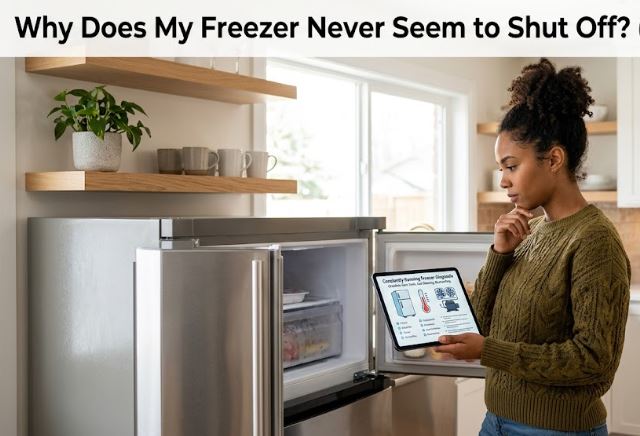
There is a steady hum that becomes the background soundtrack of your kitchen. The compressor runs through the morning, through the afternoon, and into the evening without ever taking a break. Your energy bill is climbing and the freezer either cannot reach the right temperature, or it is somehow running too cold while still never shutting off.
A freezer that runs constantly without cycling off is never doing this by choice. Something specific is preventing it from reaching the set temperature, or preventing the thermostat from recognizing that it has. Either way the compressor keeps running in an attempt to solve a problem it cannot overcome on its own.
Normal freezer operation involves the compressor cycling on for roughly 30 to 45 minutes, reaching the set temperature, shutting off for 10 to 20 minutes, then cycling back on. Anything that disrupts that pattern, keeping temperatures too high to satisfy the thermostat or keeping the thermostat from accurately reading a temperature that has been reached, produces continuous running. Understanding which category your problem falls into is the fastest path to the right fix.
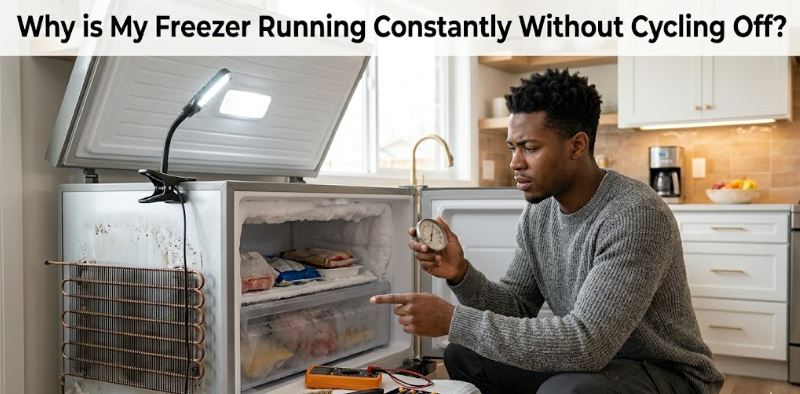
What Is Keeping Your Freezer Running Constantly Without Cycling?
Here’s an overview:
| What You Notice | Most Likely Cause |
|---|---|
| Runs constantly, temperature correct | Thermostat or thermistor not signaling shutoff |
| Runs constantly, freezer not cold enough | Dirty condenser coils, door gasket leak, or defrost failure |
| Runs constantly with heavy frost on back wall | Defrost system failure blocking airflow to evaporator |
| Runs constantly, warm ambient environment | Normal behavior in hot room or garage placement |
| Runs constantly after recent large load of food | Normal recovery period, not a fault |
| Runs constantly, fridge section too warm | Air damper fault trapping cold air in freezer |
| Runs constantly with unusual noise | Evaporator fan or condenser fan issue |
What Causes a Freezer to Run Nonstop for Days?
These are the causes behind every freezer that will not cycle off:
1. The Condenser Coils Are Dirty
Dirty condenser coils are the most common cause of a freezer running continuously and also the most straightforward to fix. This single maintenance step resolves more constant-running complaints than any other.
The condenser coils are where your freezer releases the heat it extracts from the compartment into the surrounding room air. When these coils get coated with a layer of dust, pet hair, and debris, they cannot release heat efficiently. The refrigerant returns to the evaporator coil still carrying heat it could not shed, and the compressor runs continuously trying to compensate for the reduced heat rejection. The freezer works harder and harder while achieving less and less, never satisfying the thermostat enough to cycle off.
Here Is How to Fix It
- Unplug the freezer and pull it away from the wall or locate the coils beneath the unit behind the kick plate at the front base
- Vacuum the coils using a narrow brush attachment, working carefully between the coil fins to remove accumulated dust without bending the fins
- The Refrigerator Coil Cleaning Brush (View on Amazon) reaches deep between coil fins and removes debris that a standard vacuum attachment cannot access, costing under $15 and lasting for years
- After cleaning, plug the freezer back in and allow two to three hours for the temperature to stabilize before checking whether normal cycling has resumed
- Clean condenser coils every six to twelve months, or every three to four months in homes with pets that shed heavily
2. The Door Gasket Is Leaking
A leaking door gasket is the second most common cause of continuous freezer operation and connects directly to the frost buildup issue covered in our post on freezer frosting over excessively.
When the gasket fails to seal completely, warm room air enters the freezer continuously. The compressor works to replace the cold air being displaced by that warm infiltration and to cool the warm air that replaces it. Since the source of warm air is constant rather than intermittent, the compressor never gets a chance to satisfy the thermostat and cycle off.
Here Is How to Check and Fix It
- Close the freezer door on a dollar bill and pull. A healthy gasket holds firmly with noticeable resistance. A leaking gasket lets the bill slide free easily
- Run your hand around the perimeter of the closed door feeling for any cold air draft
- Inspect the gasket for cracks, tears, stiff sections, or areas that have separated from the door frame
- Clean the gasket with warm soapy water and dry thoroughly first since grease and food debris often cause perfectly intact gaskets to seal poorly
- If cleaning does not restore the seal, you should replace it (View on Amazon).
3. The Defrost System Has Failed
Safety level: Accessing the evaporator coil is a moderate DIY task after unplugging the unit.
This is the cause that surprises most homeowners because it seems counterintuitive. A failed defrost system causes the compressor to run constantly, not because the freezer is warm, but because ice has blocked the evaporator coil and the compressor is fighting to push cold air through a physical blockage it cannot overcome.
Here is what actually happens. The automatic defrost heater melts frost from the evaporator coil every 8 to 12 hours. When the heater, the defrost thermostat, or the defrost timer fails, that melting never occurs. Frost builds progressively on the coil over days and weeks until a thick ice block surrounds the entire coil assembly.
The evaporator fan cannot push air through the ice, the freezer temperature rises, the thermostat senses the warmth and commands the compressor to keep running. The compressor runs continuously but achieves nothing because the real problem is an ice-blocked coil that no amount of compressor running can fix.
Here Is How to Diagnose and Fix It
- Unplug the freezer and remove the back panel inside the freezer compartment, usually secured by two to four screws, to expose the evaporator coil
- If you find a solid block of ice surrounding the coil rather than a light frost layer, the defrost system has failed and the coil is blocked
- Manually defrost the coil by leaving the freezer unplugged with the door open for 24 to 48 hours. Place towels inside to catch the melt water
- Once the coil is clear, test the defrost heater with a multimeter for continuity. No continuity means the heater has burned out
- Test the defrost thermostat for continuity while cold. It should show continuity at freezing temperatures
- Advance the defrost timer manually with a flat-head screwdriver to confirm the timer is advancing correctly through the defrost cycle
- If it doesn’t, you may need to replace it
4. The Temperature Is Set Too Low
A freezer set significantly below the correct temperature essentially gives the compressor an impossible target. Room air constantly entering through normal door openings is warm relative to an extreme temperature target, and the compressor must run almost continuously to maintain a temperature that is unnecessarily cold.
This cause is particularly common after someone adjusts the temperature control accidentally during cleaning, or after a power outage resets the settings to a default that is lower than the previous setting.
Here Is How to Check and Fix It
- Position a freezer/refrigerator thermometer (View on Amazon) at the center of your freezer for a few hours to check its accurate temperature reading
- The correct freezer temperature should be 0°F (-18°C). A setting significantly below -5°F forces the compressor to work much harder than necessary
- Adjust the temperature control one setting toward warmer and allow 24 hours before checking whether the compressor begins cycling off normally
- If the control is already at the correct setting but the actual temperature reads significantly warmer, the compressor is running because it genuinely cannot reach the set point, which points toward a different cause
5. The Thermistor Is Sending Inaccurate Readings
The thermistor is a small temperature sensor that continuously monitors the freezer compartment temperature and reports that reading to the control board. The board uses this data to decide when to run the compressor and, critically, when to shut it off.
When the thermistor fails and sends readings that are warmer than the actual compartment temperature, the control board believes the freezer has not reached the set point regardless of how cold it actually is. The compressor keeps running in response to a phantom warmth that does not exist, and no amount of additional cooling satisfies the board because the faulty sensor never reports that the target temperature has been achieved.
Here Is How to Test and Replace It
- Unplug the freezer and locate the thermistor, usually a small probe clipped to the evaporator coil or mounted on the interior wall near the evaporator cover
- Test it with a multimeter set to resistance at room temperature. Most freezer thermistors read between 5,000 and 20,000 ohms at room temperature depending on the brand. Check your model’s service documentation for the specific expected range
- A reading significantly outside the expected range confirms the thermistor is sending inaccurate data to the control board, and as a result, requires a replacement (View on Amazon).
6. The Temperature Control Thermostat Has Failed
The temperature control thermostat is the component that directly controls when the compressor turns on and off. In older mechanical thermostats, a bimetallic coil or a refrigerant-filled sensing bulb expands and contracts with temperature changes, physically opening and closing the compressor circuit at the appropriate temperatures. When the thermostat fails in the closed position, it keeps the compressor circuit permanently closed and the compressor runs without interruption regardless of the actual freezer temperature.
Here Is How to Test and Replace It
- With the freezer plugged in, slowly rotate the temperature control dial from the coldest setting to the warmest setting while listening carefully. A healthy thermostat produces an audible click at some point during this rotation as the compressor circuit opens. No click at any setting indicates the thermostat contacts are not opening
- Unplug the freezer and test the thermostat with a multimeter. At the warmest dial setting it should show no continuity as the contacts open. Continuity at the warmest setting confirms the contacts are stuck closed
- Search your model number alongside “temperature control thermostat” on Amazon to find the correct replacement. Thermostat replacement on most freezers involves removing the control knob, unscrewing the thermostat housing, and disconnecting and reconnecting the wiring harness
7. The Ambient Temperature Is Too High
This is one cause that requires no parts and no repair because the freezer is working exactly as it should. The environment around it is simply too warm for the appliance to maintain its cycling schedule.
Freezers placed in garages, outdoor sheds, or uninsulated utility rooms in summer experience significantly warmer ambient temperatures than those placed in climate-controlled kitchen spaces. A freezer rated for indoor use operating in a 90°F garage in July is fighting a far larger heat load than it was designed for and may run continuously during the hottest part of the day without any mechanical fault at all. Additionally, a freezer placed directly next to the oven, dishwasher, or in direct sunlight experiences a localized heat load that produces the same continuous running pattern.
Here Is How to Address It
- Note whether the constant running correlates with the hottest parts of the day or with specific seasons rather than occurring at all times
- Move the freezer away from direct heat sources, direct sunlight, and appliances that generate significant ambient heat
- Ensure at least two to three inches of clearance on all sides and at the back of the unit to allow heat from the condenser coils to dissipate freely
- If the freezer is in a garage, consider whether a garage-ready model rated for wider ambient temperature ranges is a better long-term fit for the location
8. There Is a Refrigerant Leak in the Sealed System
Safety level: Observation only. Refrigerant work requires EPA Section 608 certification.
A refrigerant leak is the most serious cause of continuous running on this list and the one that is least likely to be resolved without professional involvement. When refrigerant leaks from the sealed system, the remaining refrigerant cannot absorb and transport heat effectively. The compressor runs continuously trying to achieve a cooling capacity the depleted refrigerant charge can no longer deliver, and the freezer temperature never reaches the set point regardless of how long the compressor runs.
Signs of a refrigerant leak include the freezer running continuously without ever reaching the correct temperature despite a clean condenser coil and intact door gasket, oil staining near connections in the sealed system, and a hissing sound during operation.
Here Is What to Observe and Do
- Place an independent thermometer inside the freezer. A unit running constantly but unable to get below 10°F to 15°F despite a clean coil and sealed door points strongly toward refrigerant loss
- Listen for any hissing near the back of the appliance during operation
- If a refrigerant leak is suspected, contact a licensed appliance technician. Refrigerant handling requires EPA certification and specialized equipment
- On freezers over ten years old, compare the cost of sealed system repair against replacement since sealed system work is one of the more expensive appliance repairs and the remaining lifespan of an older unit may not justify the investment.
Freezer Constant Running Fix Cost Overview
| Cause | DIY Safe | Fix Cost | Pro Service Cost |
|---|---|---|---|
| Clean condenser coils | Yes | Free – $15 | $80 – $150 |
| Adjust temperature setting | Yes | Free | N/A |
| Clean or replace door gasket | Yes | Free – $30 | $100 – $200 |
| Manual defrost to assess defrost system | Yes | Free | N/A |
| Replace defrost heater | Moderate DIY | $20 – $40 | $150 – $300 |
| Replace defrost thermostat | Moderate DIY | $10 – $20 | $100 – $180 |
| Replace defrost timer | Moderate DIY | $15 – $25 | $100 – $200 |
| Replace thermistor | Moderate DIY | $10 – $25 | $100 – $180 |
| Replace temperature control thermostat | Moderate DIY | $20 – $40 | $100 – $200 |
| Refrigerant leak repair | No | N/A | $300 – $600 |
Frequently Asked Questions
How long is it normal for a freezer to run without cycling off?
A freezer typically runs for 30 to 45 minutes per cycle and rests for 10 to 20 minutes before the next cycle. Extended running is normal after a large load of food is added, after the door has been opened frequently, or during unusually hot weather. If the compressor has been running for more than two to three hours without cycling off and none of those circumstances apply, the cause is worth investigating.
Does a constantly running freezer use a lot more electricity?
Yes, significantly. A compressor that runs continuously rather than cycling normally draws full power for every additional hour of operation. Depending on the freezer size and the underlying cause, a constantly running freezer can add $15 to $40 per month to the electricity bill compared to a properly cycling unit. Addressing the cause promptly pays for most DIY repairs within one to two billing cycles in energy savings alone.
My freezer just started running constantly after I loaded a large amount of grocery into it. Is that normal?
Yes, for a period of time. Adding a large volume of room-temperature food raises the internal temperature of the freezer significantly. The compressor runs continuously until the new food is fully frozen and the compartment temperature returns to the set point, which can take several hours depending on the volume of food added. If the compressor is still running continuously 12 hours after loading, the recovery period has extended beyond normal and one of the causes above is worth investigating.
Can I ignore a freezer that runs constantly if the food stays frozen?
Not long-term. Even if the food remains frozen, a compressor running continuously is under sustained stress it was not designed for. The compressor motor windings generate heat during operation and continuous running without rest periods prevents the heat from dissipating normally. This accelerates wear on the motor insulation and bearing surfaces, reducing the compressor’s remaining lifespan significantly. Addressing the cause while the compressor is still functional is always more economical than replacing a burned-out compressor later.
I cleaned the condenser coils and checked the gasket but the freezer still runs constantly. What next?
The defrost system is the most logical next step. Remove the back panel inside the freezer compartment and inspect the evaporator coil for ice buildup. A coil encased in ice despite clean condenser coils and a sealed door confirms the defrost heater, thermostat, or timer has failed. Manually defrost the coil first, then test each defrost component with a multimeter to identify which one has failed.
Clean the Coils First, Then Work Through the System
A freezer running constantly without cycling off is almost always fighting a heat rejection problem, an airflow blockage, or a faulty sensor that prevents the cycle from completing correctly. The condenser coil cleaning resolves the most cases in the shortest time and costs almost nothing. Do that first, confirm the door gasket seals correctly, and check the temperature setting before concluding anything mechanical has failed.
From there, the defrost system components and the thermistor are the next most likely causes and both are accessible DIY repairs with inexpensive parts. For other freezer-related issues, learn how to troubleshoot them using our complete freezer troubleshooting guide!