
Summer heat does not wait for a convenient moment. Whether you rent, you live somewhere window units are not allowed, or you just need to cool one room fast without a permanent installation, a portable air conditioner is one of the most practical solutions available.
The problem is the market is full of units that look similar on paper but perform very differently in real life. After digging through independent lab tests, verified buyer feedback, and real-world performance data, here are the five best portable ACs under $500 you can buy on Amazon right now — with honest assessments of what each one actually delivers.
Before diving in, one important note on BTU numbers: the large figure on the box follows the older ASHRAE standard and overstates real cooling output. The number you want is the SACC rating (Seasonally Adjusted Cooling Capacity), which reflects actual performance under realistic conditions. All specs below use SACC.

Affordable Comfort: Best Portable AC Units Under $500
Below are five top air conditioners you can get from Amazon with a budget under $500 or slightly more:
1. Whynter ARC-14S – Best Overall Cooling Performance
Specs at a Glance
| Feature | Detail |
|---|---|
| Cooling Capacity (SACC) | 9,500 BTU |
| Hose Design | Dual hose |
| Coverage | Up to 500 sq. ft. |
| Noise Level | Under 56 dB |
| Modes | Cool, dehumidify, fan |
| Auto Drain | Yes |
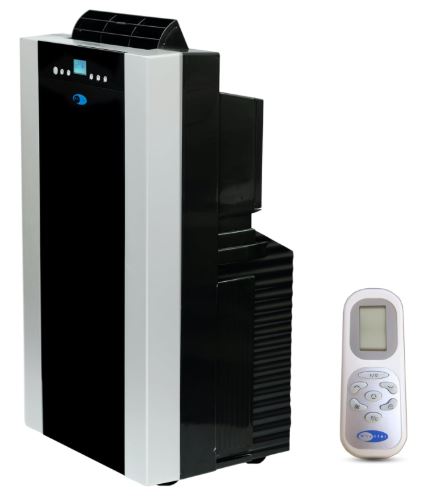
If you ask most appliance professionals what is the best portable AC under $500, the Whynter ARC-14S comes up consistently. Good Housekeeping named it Best Overall for two straight years, and independent lab testing backs that up.
The defining feature is its dual-hose design. Most portable ACs use a single hose that exhausts indoor air to cool the condenser — creating negative pressure that pulls warm outside air back in through every gap and crack. The ARC-14S uses separate intake and exhaust hoses, so the condenser is cooled by outside air and your room’s air is never touched. The result is significantly faster temperature drop and better sustained cooling.
In TechGearLab’s controlled testing, the ARC-14S dropped room temperature by more than eight degrees Fahrenheit in a single hour — one of the best results in the category. The activated carbon filter adds genuine air quality improvement, and the auto-drain system recycles condensate so you rarely need to manually empty a tank.
The trade-off is weight. At around 74 pounds, this is not the unit you carry between floors every day. On flat surfaces it rolls easily, but the handles are shallow and lifting it is uncomfortable. For a permanent spot in a living room or bedroom, though, it is hard to beat.
Best for: Anyone who wants the strongest real-world cooling in a single room up to 500 sq. ft.
2. Midea Duo 12,000 BTU (MAP12S1TBL) – Quietest and Most Energy Efficient
Specs at a Glance
| Feature | Detail |
|---|---|
| Cooling Capacity (SACC) | 10,000 BTU |
| Hose Design | Dual hose-in-hose |
| Coverage | Up to 450 sq. ft. |
| Noise Level | As low as 42 dB |
| Smart Control | Wi-Fi, Alexa, Google Assistant |
| Inverter Compressor | Yes |
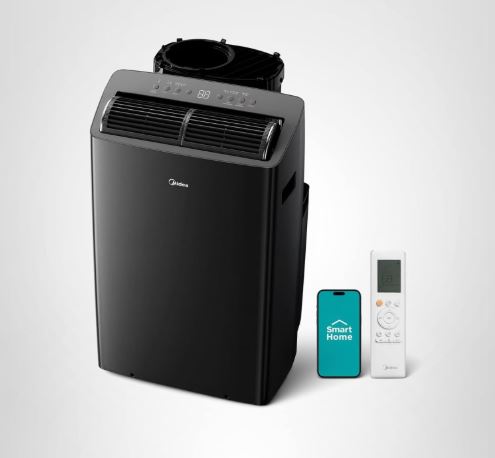
The Midea Duo takes a different approach from the Whynter. Where the ARC-14S prioritises raw cooling speed, the Duo prioritises efficiency and quiet operation — and it delivers on both in ways that genuinely matter in daily use.
At 42 dB on its lowest setting, this is extraordinarily quiet for a portable AC. Most comparable units run at 56 to 60 dB. In a bedroom or home office, the difference is immediately noticeable. You can hold a conversation, sleep, or work without the unit competing for attention.
The inverter compressor is the other major differentiator. Standard portable AC compressors cycle on and off aggressively, creating temperature swings and energy spikes with every cycle. An inverter compressor runs continuously at variable speed — slower when the room is close to the target temperature, faster when demand rises. Midea claims 40 percent energy savings over the federal minimum standard, and independent testing broadly confirms the advantage.
The hose-in-hose design keeps both intake and exhaust channels within a single housing. It achieves the same efficiency benefit as a traditional dual-hose system while making installation cleaner and the window footprint smaller. With a SACC of 10,000 BTU — actually the highest true cooling output on this list — it also has serious cooling credentials to go with its efficiency claims.
Best for: Bedrooms, home offices, or anyone running the AC for long hours where energy costs and noise matter.
3. BLACK+DECKER BPACT14WT – Easiest to Install, Strong Raw Cooling
Specs at a Glance
| Feature | Detail |
|---|---|
| Cooling Capacity (SACC) | 7,700 BTU |
| Hose Design | Single hose |
| Coverage | Up to 350-400 sq. ft. realistic |
| Noise Level | ~59 dB |
| Modes | Cool, dehumidify, fan |
| Follow Me Remote | Yes |
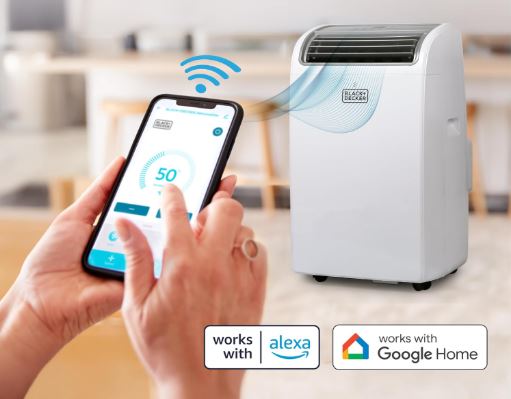
The BLACK+DECKER BPACT14WT is the most straightforward unit on this list. It is a single-hose portable AC with strong raw cooling output, fast setup, and one of the highest review counts of any portable unit on Amazon. If you need something that works without fuss, this is worth serious consideration.
In TechGearLab’s testing, the BPACT14WT dropped room temperature by 8.3 degrees Fahrenheit in a single hour — one of the strongest raw results across the entire category. The window kit installs in five to ten minutes on the first attempt, faster than almost any competitor. The hose assembly clips together without tools, and breakdown for storage or seasonal removal is just as clean.
Two things to be honest about. First, the SACC of 7,700 BTU is the lowest on this list. The 14,000 BTU figure on the box is the inflated ASHRAE number. The real-world coverage of 350 to 400 square feet is realistic; the marketed 700-square-foot claim is not for a hot summer day.
Second, as a single-hose design, it creates negative pressure in the room, which draws in warm outside air through gaps. It is less efficient than the dual-hose alternatives. For renters, students, or anyone who needs a capable unit at a lower price point without complex setup, it is a solid, popular choice — just size it appropriately.
Best for: Smaller rooms up to 400 sq. ft., renters, and anyone who prioritizes fast installation and ease of use.
4. GE Profile PPHV10WWF – Best Smart Features and Auto Evaporation
Specs at a Glance
| Feature | Detail |
|---|---|
| Cooling Capacity (SACC) | 9,850 BTU |
| Hose Design | Dual hose |
| Coverage | Up to 450-550 sq. ft. |
| Smart Control | Wi-Fi, SmartHQ app, geolocation |
| Inverter Compressor | Yes |
| Auto Evaporation | Yes — no manual draining |
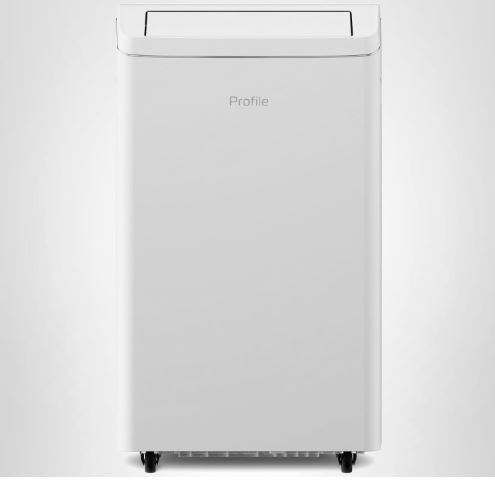
The GE Profile PPHV10WWF launched in late 2024 and brings a combination of features that would have cost considerably more just a couple of years ago — dual-hose efficiency, inverter compressor, auto evaporation, and full smart home integration under $500.
Auto evaporation is genuinely useful. Rather than collecting condensate in a tank that needs manual emptying every few days, the PPHV10WWF exhausts most moisture as vapour through the exhaust hose. In high-humidity climates this is a real convenience advantage. The GE models with this feature rarely require manual draining under normal operating conditions.
The SmartHQ app offers something none of the other models here do: geolocation automation. It detects when you are approaching home and starts cooling the room before you arrive. When you leave, it switches to an energy-saving Away mode automatically. For tech-oriented households already using smart appliances, this level of integration feels natural.
As a newer model it has fewer long-term reviews than the Whynter or BLACK+DECKER. Early buyer feedback is positive and aligns with GE’s quiet-operation claims. Its 9,850 BTU SACC is among the strongest on this list and is an honest, DOE-compliant figure.
Best for: Tech-forward households wanting smart home integration, auto evaporation convenience, and dual-hose efficiency in one package.
5. Midea Duo 14,000 BTU with Heat (MAP14HS1TBL) – Best for Large Rooms and Year-Round Use
Specs at a Glance
| Feature | Detail |
|---|---|
| Cooling Capacity (SACC) | 12,000 BTU |
| Heating Mode | Yes (reverse cycle) |
| Hose Design | Dual hose-in-hose |
| Coverage | Up to 550 sq. ft. |
| Noise Level | As low as 42 dB |
| Smart Control | Wi-Fi, Alexa, Google Assistant |
| Inverter Compressor | Yes |
This is the large-room version of Pick 2, and it earns its place for two specific reasons: the highest SACC output on this entire list at 12,000 BTU, and a heating function that turns it into a four-seasons appliance rather than a summer-only purchase.
For genuinely large rooms — open-plan living areas, converted garages, or any space pushing 500 to 550 square feet — the 12,000 BTU SACC is the number that matters. Where most portable ACs at this price lose a significant fraction of their rated output to single-hose inefficiency, the Duo’s dual hose-in-hose system and inverter compressor preserve more of that capacity for actual room cooling.
The heating function operates through reverse-cycle refrigeration — the same principle as a heat pump. It handles shoulder-season temperature maintenance well. This is not a primary heating system for a cold winter, but for spring and autumn comfort it means you own one appliance instead of two.
Everything from Pick 2 carries over: 42 dB quiet operation, inverter efficiency, smart control through the Midea Air app, and Alexa and Google Assistant voice control. At the top end of the $500 budget, this is the unit that delivers the most capacity and the widest year-round utility.
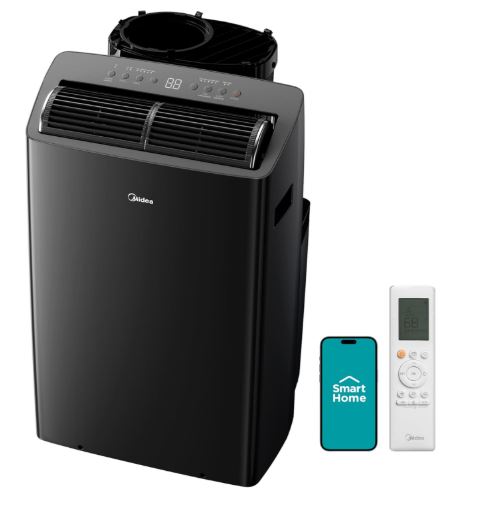
Best for: Medium-to-large rooms up to 550 sq. ft., year-round climate control, anyone who wants the strongest cooling output in this price bracket.
Quick Comparison of the Above Budget Portable Air Conditioner
| Model | SACC BTU | Hose | Inverter | Noise | Smart | Coverage |
|---|---|---|---|---|---|---|
| Whynter ARC-14S | 9,500 | Dual | No | Under 56 dB | No | 500 sq. ft. |
| Midea Duo 12K | 10,000 | Dual | Yes | 42 dB | Yes | 450 sq. ft. |
| BLACK+DECKER BPACT14WT | 7,700 | Single | No | about 59 dB | No | 350-400 sq. ft. |
| GE Profile PPHV10WWF | 9,850 | Dual | Yes | Quiet | Yes | 450-550 sq. ft. |
| Midea Duo 14K + Heat | 12,000 | Dual | Yes | 42 dB | Yes | 550 sq. ft. |
What to Know Before You Buy
SACC is the number that matters. Ignore the large BTU figure on the front of the box unless you know which standard it uses. Always compare SACC figures. A unit marketed at 14,000 BTU (ASHRAE) may deliver only 7,700 BTU under real-world SACC conditions.
Single-hose designs have a real efficiency penalty. A single-hose unit exhausts indoor air and creates negative pressure that pulls warm outside air back in through gaps around doors and windows. On a hot day, this cycle undermines the cooling you are trying to achieve. Four of the five picks above use dual-hose designs to avoid this.
Match the SACC to your actual room size. Manufacturer coverage claims assume ideal conditions. For rooms with high ceilings, poor insulation, or significant sun exposure, subtract 20 to 30 percent from the rated coverage figure. A 9,500 SACC unit will comfortably cool a well-insulated 400-square-foot room but may struggle in an equally large room with three south-facing windows on a 95-degree day.
Also Read:
- How to Troubleshoot Common Air Conditioner Problems
- Best Budget Air Conditioner Units Under $300 Reviewed
Frequently Asked Questions
What does SACC mean on a portable AC?
SACC stands for Seasonally Adjusted Cooling Capacity. It is the U.S. Department of Energy’s current standard for rating portable air conditioners and reflects real-world performance better than the older ASHRAE number. When comparing units, always use SACC.
Is a dual-hose portable AC worth the extra money?
For most people, yes. Single-hose units exhaust indoor air and draw in unconditioned replacement air through gaps in your walls, windows, and doors. This reduces effective cooling and raises running costs over time. Dual-hose units avoid this entirely and cool faster in hot conditions.
Do I need to drain a portable air conditioner?
Most models collect condensate and require manual draining every few days during heavy use. The GE Profile PPHV10WWF and Whynter ARC-14S both include auto-evaporation or auto-drain technology that significantly reduces how often you need to do this.
What room size can a portable AC under $500 realistically cool?
With a dual-hose unit rated at 9,000 to 12,000 BTU SACC, expect reliable cooling in a room of 350 to 550 square feet in moderate conditions. Very large open-plan spaces or rooms with poor insulation will need a higher SACC rating to stay comfortable on the hottest days.
Can a portable AC replace a window unit?
In most cases, a quality portable AC will cool a room effectively but uses slightly more energy than an equivalent window unit because of the heat the unit itself adds to the room. For rooms where a window unit is not possible — landlord restrictions, incompatible windows, or rented spaces — a portable AC is a practical and effective alternative.

Hi, I’m Barlgan! I created Repair Me Yourself to empower homeowners to tackle appliance repairs with confidence. From decoding error codes to fixing cooling issues, I break down complex repairs into simple, actionable steps that save you time and money.