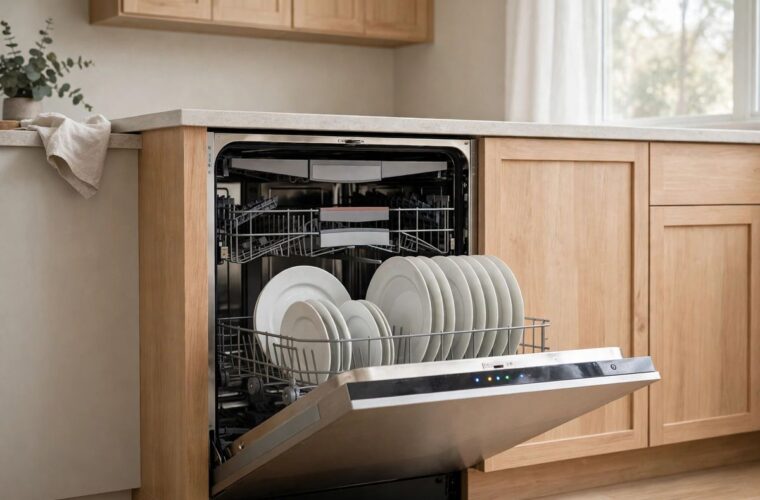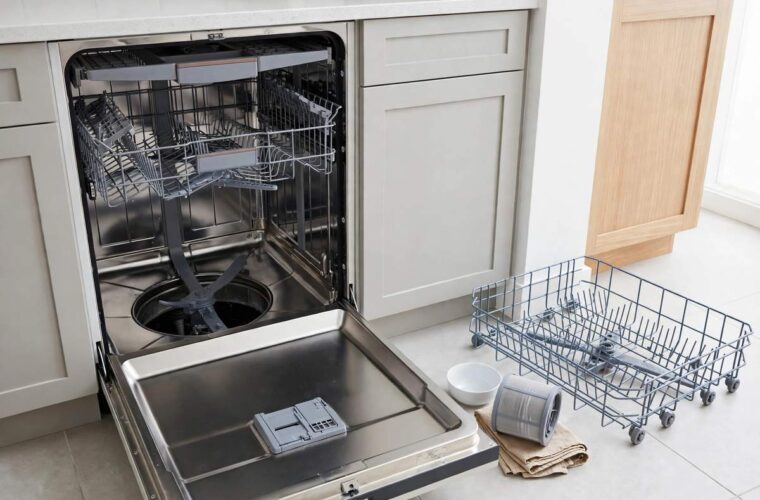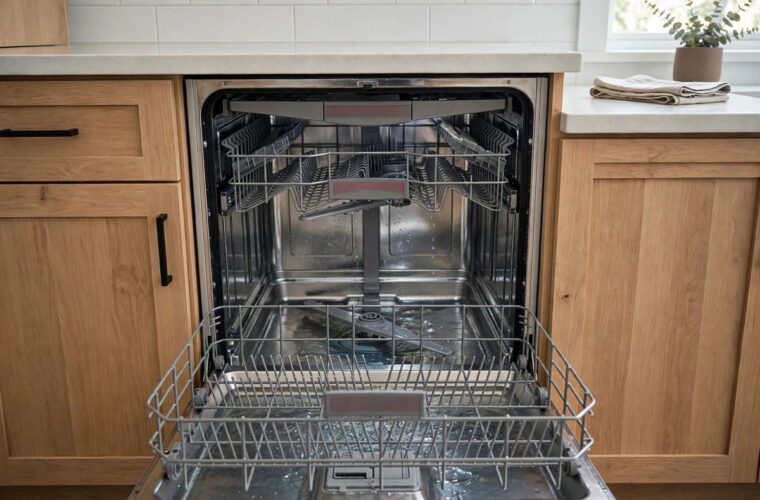
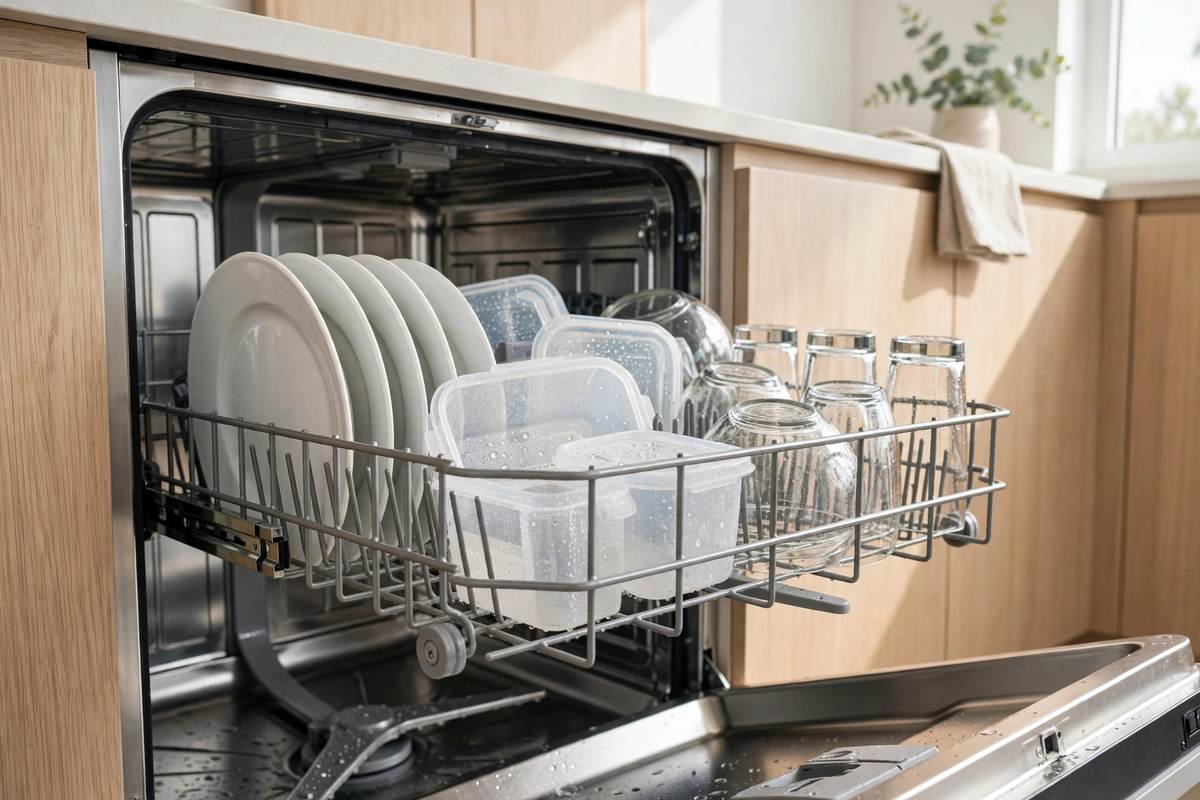
Bosch dishwashers dry by condensation, not by a fan blowing hot air. That’s why plastic comes out wetter than glass or ceramic. Bosch’s own list starts with rinse aid, loading space and the Sanitize or Extra Dry option, plus about 30 minutes before you unload.
A Bosch dishwasher not drying properly is usually working as designed, just on a wetter cycle than you expect. The machine has no exposed heating coil, so every fix below is about keeping heat in the load or helping water slide off. It isn’t broken in most of the cases I see.
Why Bosch Dishes Stay Wet
Condensation drying has two jobs. The final rinse has to heat the load, and the stainless tub has to stay cooler than the dishes so moisture condenses there instead of on them. Anything that holds heat dries. Anything that doesn’t stays beaded.
Plastic is the usual culprit because it has low thermal mass and sheds heat fast. Glasses and knives come out dry while lids, containers and kids’ cups stay wet. That pattern is the tell.
“Rinse aid doesnt work well on plastic. Which seems to be the biggest culprit. Yet plastic does not retain heat well so again wont dry…”
– r/Appliances (20 upvotes)
| What’s wet | What it usually means | Check first |
|---|---|---|
| Everything, glasses included | Rinse aid empty or set too low | Rinse aid level and setting |
| Plastic only | Plastic holds less heat than ceramic | Rinse aid, then a hotter cycle |
| Cups with water in the base | They sit level, so water can’t run off | Loading angle |
| Dishes and tub cold at the end | The wash water didn’t heat | Hot supply, then a technician |
- Drying method: condensation on a stainless tub, no exposed element
- Rinse aid setting: 4 or 5 in Bosch’s manual
- Wait before unloading: about 30 minutes
- Best drying option: Sanitize or Extra Dry, where fitted
None of that is a fault. The checks below follow the order I’d use on a call: rinse aid, loading, cycle, patience, then the machine itself.
Rinse Aid: Set It to 4 or 5
Bosch’s support page puts rinse aid second on its list, after loading space. The manual is more specific: a setting of 4 or 5 keeps enough sheeting action for most homes.
Rinse aid doesn’t dry dishes by itself. It lowers the surface tension so water runs off in a sheet instead of hanging in drops, and drops are what stay behind as spots and puddles.
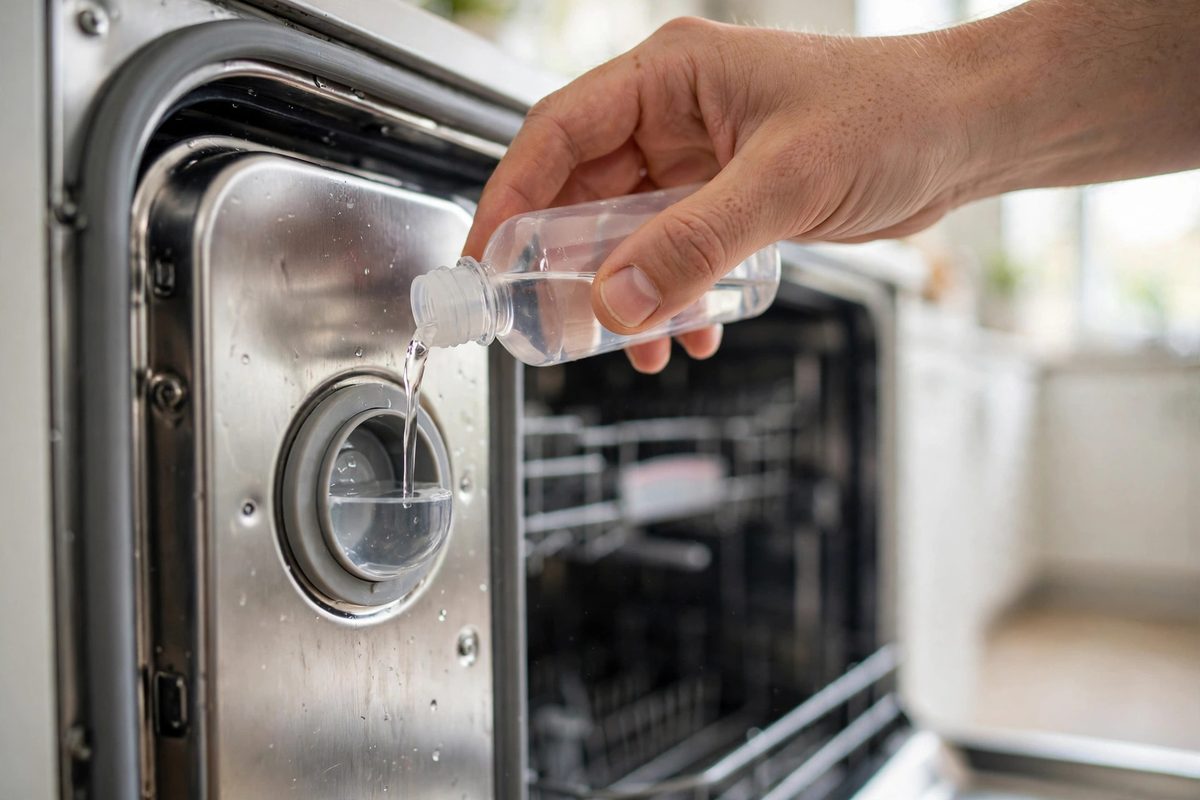
You’ll find the dispenser on the inner door. Fill it to the max line and close the flap until it clicks. The reservoir usually lasts a few weeks, so the light on the panel is a reminder, not a fault code.
Bosch’s dial goes higher than 5, but most homes don’t need it. Go up a step if your glasses still show spots, and down one if they look streaky.
All-in-one pods don’t change the advice. The support page asks for rinse aid without exempting them, and the liquid in the dispenser does more than the pellet inside a tablet. Check the dial before you buy a new bottle, because a dispenser set to 1 behaves like an empty one.
If the dial confuses you, how to fill and set the rinse aid walks through the dosage.
Load It So Water Can Leave
Bosch’s first tip is space. Dishes need a gap between them so water can drain off instead of pooling in a hollow.
You want cups and bowls face down, tilted slightly, so the base isn’t level. Don’t nest them, and don’t let a sheet pan sit across the front of a rack and block the spray.
Cutlery belongs in the basket with the handles mixed, not spooned together. I’ve seen a single serving spoon bridge two baskets and keep water in both.
The spray arms have to spin. Turn them by hand before you close the door. I check this first on a call, because a tall pan that stops an arm leaves a wet-dry pattern on one side of the load. Bowls need the most care. Four nested bowls keep water in the bottom one no matter how good the cycle is.
Choose a Hotter, Longer Cycle
Bosch’s support page says to select Sanitize or Extra Dry if the model has them. Both add time and heat at the end, which is exactly what condensation drying needs.
Eco and one-hour cycles save energy, and they often finish with more water on the load. That’s a trade, not a fault, and it’s the first thing to change before you buy anything.
Your panel may hide the option behind a button rather than a printed key. The Bosch dishwasher symbols guide maps the icons on the common US panels.
Wait About 30 Minutes Before Unloading
The end-of-cycle beep means the wash is done, not that the drying is finished. Bosch’s manual asks for roughly 30 minutes with the door closed before you pull the racks out.
Crack the door an inch if you’re in a hurry. That lets the humid air escape without dropping the load’s temperature all at once.
Pull the bottom rack first. Water pools on the door lip, and it drips onto whatever sits below. In a household that unloads at the beep, this change fixes more wet-dish complaints than any part.
CrystalDry Models: What’s Different
CrystalDry adds a mineral compartment that releases heat during drying. Bosch says it reaches up to 176°F and describes the result as 60% drier than its standard condensation cycle.
That’s Bosch’s figure, not an independent test. Real loads still vary with incoming water temperature and how full the racks are.
Even a CrystalDry machine leaves some plastic damp, because the plastic never gets hot enough to shed water. If glasses come out dry and only the lids and containers stay wet, the machine is doing its job.
The badge matters when you’re comparing models. A standard Bosch without CrystalDry can still dry a mixed load well; it just leans harder on rinse aid and the Extra Dry option.
Bosch Dishwasher Not Drying: When It’s a Fault
Touch the tub and a dinner plate right after a full cycle. If both are cold, the wash water never heated, and no rinse aid setting will fix that.
Run the kitchen tap until it’s hot before your next load starts. Every dishwasher plumbed to the hot supply loses heat in the line overnight, and the machine can’t always make it up.
If the water is hot at the tap and the tub still feels cold at the end, the heating circuit is the suspect.
That’s where I stop walking people through it. The element and its controls sit behind line voltage, and a tech with the tech sheet and a meter should take over.
A machine that won’t cancel or restart is a different problem. Reset the Bosch dishwasher first, then read the code if one shows on the display.
Bosch Dishwasher Not Drying: FAQ
Why does my Bosch dishwasher stay wet inside?
Most Bosch machines dry by condensation. Moisture collects on the cooler tub and runs down, so plastic and light cups stay wet because they hold little heat. Rinse aid, a hotter cycle and about 30 minutes of patience handle the rest.
Is there a reset button for a Bosch dishwasher?
There’s no dedicated reset key on most Bosch panels. Press and hold Start or Cancel for about three seconds to clear a cycle, or switch the breaker off for a minute.
What rinse aid setting should I use?
Bosch’s manual points to 4 or 5. Start at 4, then raise it one step if your glasses still show spots or the load feels damp at the end.
What is CrystalDry?
CrystalDry is Bosch’s mineral-based drying system. A zeolite compartment stores moisture and releases heat, and Bosch says it pushes the final temperature to 176°F and dries 60% better than the standard cycle.
Is it a heater fault?
Only if the tub and dishes are cold at the end of a hot cycle. Warm dishes that still hold water point to rinse aid, loading or the cycle choice. If the tub is cold, the heating circuit needs a technician.
Do all-in-one tablets replace rinse aid?
No. Bosch’s support page asks for rinse aid in the dispenser whether or not your tablets include it, and the dispenser dose is what coats the load during the final rinse.
Why are my dishes still wet after the cycle ends?
Usually because the door was opened early or the load was unloaded at the beep. Wait about 30 minutes, then check rinse aid and the cycle chosen. If the tub is cold, the machine isn’t heating.