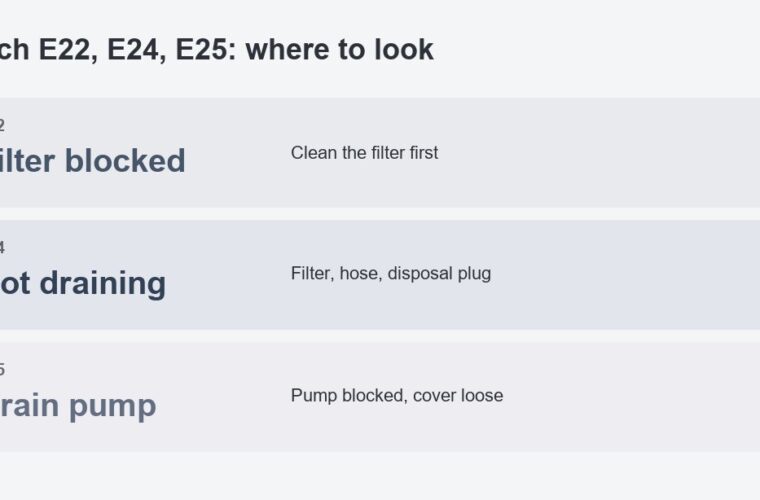
An LG dishwasher not draining usually shows OE on the panel, and the code means the machine gave up waiting for the tub to empty.
Force a drain first, then clean your filter, then check the hose height. Nine times out of ten your fault is in one of those three.
I listen to the pump before I pull a single part. On the LG machines I see, the sound splits your diagnosis in half faster than any meter reading, and it costs you nothing to try.
LG dishwasher not draining: what the OE code means
OE is LG’s drain error. The control board runs the drain pump for a set time, watches for your water level to drop, and throws the code when the level stays put.
So what is the board watching? The level sensor, not the pump.
Some panels show dE for the same family of fault, so don’t read the letters as a different problem; both mean the water didn’t leave. LG dishwasher symbols carry the rest of the display vocabulary if a second light comes on.
That’s the useful part: your board and the level sensor are alive. A board that couldn’t see the water level wouldn’t know to complain about it.
Force a drain before you open anything
Press and hold Cancel for about 3 seconds. On most LG models that starts your drain cycle and pumps the tub out, which buys you a dry workspace and one clean test of the pump.
If your model has no Cancel & Drain pad, there’s a trick in the manual: start any cycle, let it run for 45 seconds, then power the unit off.
The first 45 seconds of every LG cycle is drain only, so you get the pump run without a wash.
Listen while it runs. That half-minute tells you more about your machine than the code does.
Clean the filter and the sump
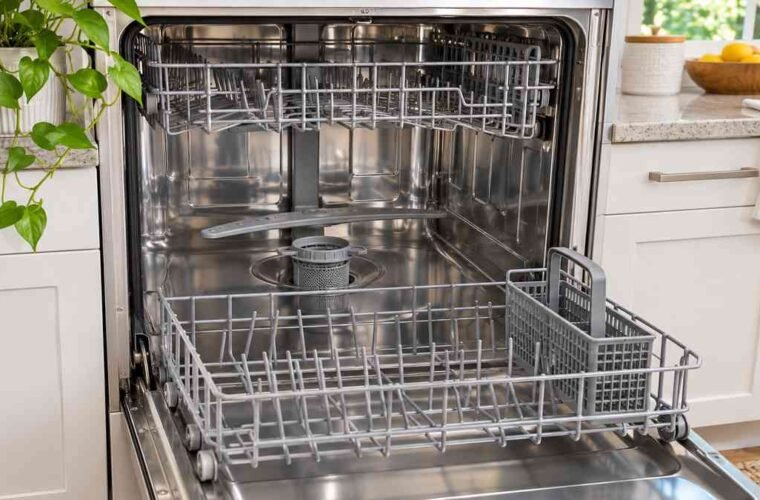
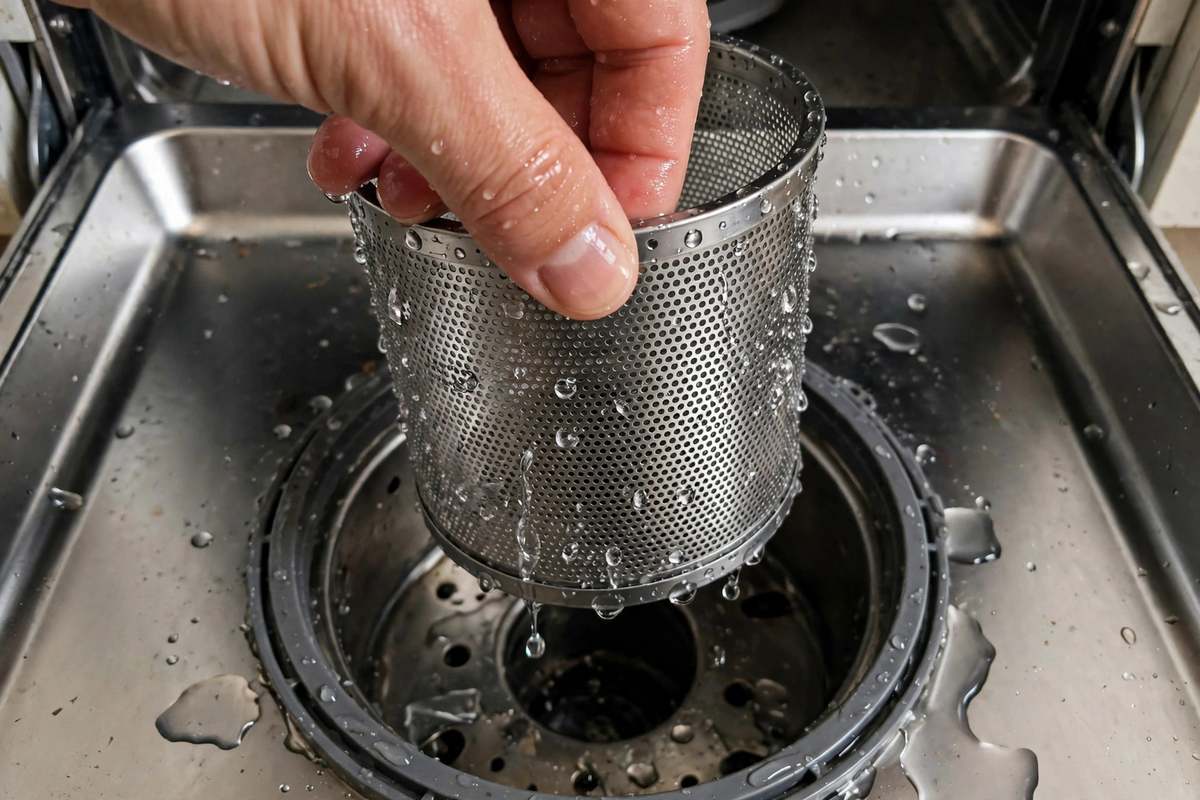
Pull your bottom rack, twist the cylindrical mesh filter out of the base, and rinse it under warm water. Food film and grease close the mesh, and a closed filter starves the pump.
Look into the sump with a flashlight. Glass, a bone or a bottle cap sits there and blocks the impeller without ever reaching the filter, which is why your filter looked clean and your tub still filled.
A little clean water below the filter grate is normal, and a tub holding an inch of dirty water with the cycle stopped is not.
The drain path outside the machine
Three things outside the cabinet stop an LG dishwasher, and your new install can hit all three in the same week. The sibling guides for GE and Samsung trace the same path with their own hose limits.
- Air gap: the small cylinder beside the sink faucet. Pull the cap, lift the inner cover, and clear the grit. A blocked air gap backs water into the tub.
- Disposal knockout: on a new install into a garbage disposal, the plug has to be punched out of the disposal’s dishwasher inlet. Leave it in and the drain has nowhere to go.
- Hose routing: LG limits the drain hose to 12 feet with no extension, and the hose end has to sit between 12 and 40 inches above the base of the appliance. Below that window, the tub siphons; above it, the pump can’t lift.
Those two numbers explain most of the “new dishwasher won’t drain” calls I get. Your machine is fine; the plumbing is a foot too low.
A kinked hose behind the cabinet does the same thing. Pull your unit out and look at the whole run rather than trusting the loop you can see.
Slow drain versus no drain
A tub that empties in 40 seconds and one that never empties are different faults. Slow means the path is partly open: hair and grease in the hose, a half-blocked air gap, or a filter you cleaned but didn’t twist back fully.
No drain at all means the pump isn’t moving water or the path is shut. If your water creeps down overnight, you have a partial blockage, and the pump is fine.
What the pump is telling you
Run the forced drain and put a hand on your lower front panel. The vibration and the sound sort your fault into three groups, and you don’t need a meter for any of them. Start with the sound.
| What you hear | What it means | Next move |
|---|---|---|
| Hum, no water movement | Impeller blocked or hose blocked | Clear the sump, then the hose |
| Nothing at all | Pump not getting power | Check the harness and the board |
| Grinding or rattle | Debris in the impeller | Pull the pump, clear it |
| Normal pump noise, water stays | Blockage downstream | Air gap, disposal plug, hose |
A humming pump that moves no water is usually jammed, not dead. Silence points the other way, at the wiring or the board, and that’s a different repair with a different price. The pump-sound read works the same way on most brands.
On the LG ThinQ models I’ve opened, the pump sits behind the lower kick panel and comes out with two screws and a twist.
Test yours on the bench before you buy a replacement, because a pump that spins dry is a pump that works.
A new LG that won’t drain
A dishwasher installed this week that won’t drain is almost never a machine fault. Check your knockout plug, then measure the hose end against the floor.
If that end sits under 12 inches above the base, your tub is siphoning and no part will fix it.
Brand-new units also ship with shipping bolts and foam where you wouldn’t look, and a drain hose folded double inside the cabinet is common enough that I check yours before I check anything electrical.
If your unit is older and the filter, air gap and hose all check out, the pump or the pressure switch is the next suspect. That’s the point where your repair stops being a cleaning job.
FAQ
Why is my LG dishwasher not draining after cleaning the filter?
The drain path is still partly shut. The filter is one gate; the air gap, the disposal knockout and the hose height sit after it.
Why is there water standing in the bottom of my LG dishwasher?
Standing water means the drain cycle failed or the tub is siphoning back. A small amount below the filter grate is normal; an inch of dirty water after a stopped cycle is the OE fault.
How do I force my LG dishwasher to drain?
Hold Cancel for 3 seconds. Without a Cancel & Drain pad, start a cycle, let the first 45 seconds run, then switch the unit off; that opening window is drain only.
How do I test the LG dishwasher drain pump?
Run the forced drain and listen. A hum with no water means a blockage; silence means no power; grinding means debris. Pull the pump only after that test.
Does resetting clear the OE code?
It clears the display, not the water. Cut power at the breaker for a minute to reset the board, then run a drain; if the tub still holds water, the code will come back.