

You pull fresh laundry out of a machine that just cleaned it, bring it to your nose, and catch something that smells closer to a damp basement than sunshine. The irony of clean clothes that smell worse than they went in is one of the most frustrating experiences in home laundry, and it is overwhelmingly a front-loader problem.
Front-load washers are genuinely more efficient than top-loaders. They use less water, less energy, and are gentler on fabrics. But that efficiency comes with a structural tradeoff: the tight horizontal door seal, the reduced water volume, and the enclosed drum create an environment where moisture, detergent residue, and biological growth accumulate faster and more persistently than they ever could in a top-loader with its open vertical design.
Understanding precisely where the smell lives in your machine is the key to eliminating it permanently rather than temporarily masking it with cleaning products. The causes below cover every location where odor-causing buildup takes hold, along with the specific steps to clear each one.
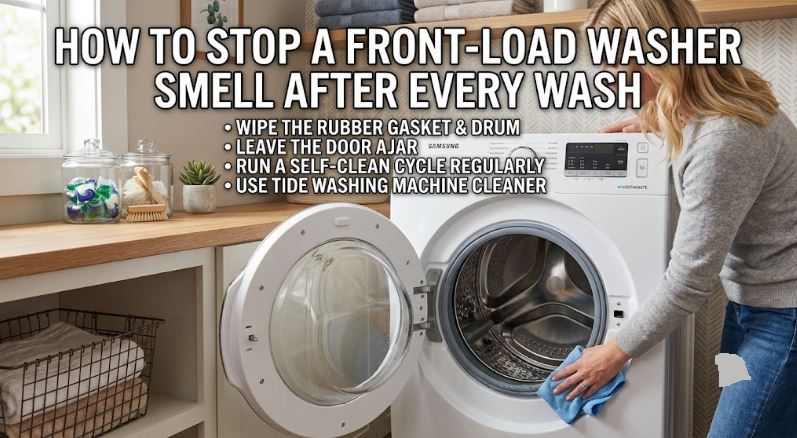
Where Is the Smell Coming From in Your Front-Load Washing Machine?
Use this table to identify the most likely source based on the type and timing of the odor.
| Smell Type and Timing | Most Likely Source |
|---|---|
| Musty or mildewy smell when door is opened | Mold or mildew in the door gasket folds |
| Sour smell on clothes after washing | Biofilm buildup inside the drum or detergent drawer |
| Sewage-like odor from the machine | Clogged drain pump filter or plumbing P-trap issue |
| Musty smell that worsens in warm weather | Stagnant moisture trapped in drum with door closed |
| Chemical or soapy smell despite clean clothes | Excess detergent residue in drum and hoses |
| Smell returns days after a deep clean | Door left closed between washes trapping humidity |
| Smell only on cold wash cycles | Bacteria not killed at low temperatures, biofilm growing |
7 Reasons Your Front-Load Washer Smells After Wash and How to Eliminate Each One
These are the causes behind virtually every persistent front-loader odor complaint, starting with the one that contributes to the majority of cases.
1. The Door Gasket Is Harboring Mold and Mildew
The rubber door gasket is ground zero for front-loader smells, and cleaning it is the single most impactful action you can take when your machine smells bad after every wash.
The gasket forms a tight watertight seal during every cycle, which is exactly what makes it so effective at trapping moisture, detergent residue, lint, hair, and soil particles in its deep folds. That warm, dark, perpetually damp environment is ideal for mold and mildew growth. Once established, mold colonies in the gasket folds release musty volatile compounds on every subsequent cycle, and those compounds transfer to your clean clothes.
Here Is How to Deep Clean the Gasket
- Open the washer door and pull back the rubber gasket folds gently all the way around the perimeter. The inner folds are where the worst buildup accumulates and where most homeowners never look
- Remove any physical debris trapped in the folds: coins, hair, lint, small clothing items, and pet hair
- Mix a solution of one part white vinegar to one part warm water in a spray bottle. Spray it generously on all gasket surfaces including the deep inner folds
- Scrub the gasket thoroughly with an old toothbrush, paying extra attention to the bottom of the gasket where water pools and biological growth is most concentrated
- For visible black mold spots, apply a solution of one part bleach to ten parts water directly to the affected areas, wait five minutes, then scrub and rinse thoroughly
- Dry the entire gasket surface completely with a clean cloth after cleaning
- After every wash going forward, take 15 seconds to wipe the gasket with a dry cloth before closing the door. This one habit prevents the majority of future mold growth
2. Too Much Detergent or the Wrong Type Is Creating Biofilm
This is the cause that surprises most front-loader owners because using more soap feels like it should produce cleaner, fresher results. The opposite is true in a high-efficiency washer.
Front-load washers are HE machines that use significantly less water than top-loaders. When regular detergent or excess HE detergent is used, the reduced water volume cannot fully rinse it away. Detergent residue builds up on the drum walls, in the door seal, inside the detergent drawer, and along the hoses. Over time this residue creates a sticky biofilm layer that traps bacteria, body soils, and moisture. That biofilm produces the persistent sour or musty smell that transfers to every load washed in the machine.
Here Is How to Fix It
- Switch to a dedicated HE detergent immediately if you are using regular detergent in an HE front-loader
- Reduce the amount of HE detergent to two thirds of the recommended amount as a starting point, since most manufacturers overstate the required quantity on packaging
- The Tide HE Turbo Clean Liquid Detergent (View on Amazon) is specifically formulated to rinse completely in low-water HE cycles without leaving residue, making it a reliable choice for preventing biofilm buildup
- Stop using liquid fabric softener entirely since it leaves a waxy coating inside the drum and hoses that is one of the primary contributors to biofilm formation. Switch to Downy Rinse and Refresh (View on Amazon) as an alternative since it conditions without leaving the waxy residue that standard softener deposits
3. The Detergent Drawer Is Clogged With Residue
The detergent dispenser drawer receives detergent, fabric softener, and bleach on every cycle. A portion of each product never fully flushes through during the cycle and accumulates in the drawer compartments, the drawer housing, and the internal channels that feed the drum.
This accumulated residue turns into a dark, sticky, foul-smelling sludge over weeks and months. Every subsequent cycle passes water through this contaminated housing before it reaches the drum, picking up odor along the way and distributing it through the wash.
Here Is How to Clean the Detergent Drawer
- Pull the detergent drawer out completely. Most front-loader drawers release fully by pressing a small release tab inside the softener compartment while pulling the drawer out
- Soak the entire drawer in warm soapy water for 20 to 30 minutes to loosen the accumulated residue
- Scrub every compartment and corner with a stiff brush or old toothbrush. The dividers and corners accumulate the most concentrated buildup
- Also reach into the drawer housing inside the machine with a cloth and wipe the internal channels and ceiling of the housing, which are frequently the worst-contaminated areas
- Rinse the drawer thoroughly and dry before reinserting
- Leave the drawer slightly open between washes to allow the housing to dry and prevent fresh residue from sitting in moisture
4. The Drum Interior Has Accumulated Biofilm
Even without visible mold, the inner drum surface develops a thin layer of biofilm from accumulated body soils, detergent residue, and hard water minerals. This layer is invisible to the naked eye but is a continuous source of odor that transfers to every load. Cold wash cycles accelerate biofilm formation since low temperatures do not kill bacteria or dissolve detergent completely.
Here Is How to Deep Clean the Drum
- Run an empty drum cleaning cycle on the hottest available setting. Most modern front-loaders have a dedicated Drum Clean, Tub Clean, or Self Clean cycle specifically for this purpose
- For machines without a dedicated cleaning cycle, set the hottest temperature and longest cycle available and add either two cups of white vinegar to the detergent drawer or a dedicated washer cleaning tablet
- The Affresh Washing Machine Cleaner Tablets (View on Amazon) are specifically formulated to dissolve biofilm and mineral deposits inside front-loader drums. Drop one tablet directly into the empty drum before running the cleaning cycle. Use one tablet monthly for ongoing maintenance
- After the cleaning cycle, wipe the drum interior with a dry cloth to remove any loosened residue that the cycle did not drain away
- Introduce at least one hot wash cycle per week into your laundry routine going forward, even for lightly soiled loads, since heat breaks down residue and kills bacteria that cold cycles allow to accumulate
5. The Drain Pump Filter Is Clogged
The drain pump filter at the front base of the machine catches lint, hair, coins, and fabric debris before they reach the pump impeller. When it goes unclean for weeks or months, the trapped debris becomes waterlogged and begins to decompose in a warm, enclosed space. The resulting odor is distinctly sewage-like or strongly musty and emanates from the lower front of the machine.
This is one of the most overlooked maintenance tasks on front-loaders, and many owners do not know the filter exists until they trace a persistent smell to the base of the machine.
Here Is How to Clean the Filter
- Locate the small access panel at the front lower corner of the machine. It may be a door that flips open or a removable panel
- Place old towels and a shallow dish underneath the access point before opening since water will drain out
- Unscrew the filter cap slowly counterclockwise, allowing water to drain into the dish in a controlled flow
- Remove the filter completely and rinse it under running water. Use a stiff brush to scrub away all trapped debris, hair, and slime from the filter mesh
- Also wipe inside the filter housing with a damp cloth to remove any debris remaining in the cavity
- Reinstall the filter firmly, confirming it is fully seated before closing the access panel
- Clean this filter every one to three months as ongoing maintenance
6. The Door Is Being Left Closed Between Washes
This is the most common contributing habit that turns an occasional smell into a permanent one, and it is entirely free to change.
After every wash cycle, the interior of the drum is warm and wet. The drum walls, gasket, and door glass all carry residual moisture. When the door is closed immediately after removing laundry, all of that moisture is sealed inside a dark, warm, enclosed space with no airflow. Within hours, the conditions are ideal for mold and mildew to resume growing on any surface that retained biological material from the previous wash.
Here Is How to Fix It
- Leave the washer door open after every single load without exception. Even a four to five inch gap provides enough airflow to dry the drum and gasket before mold can establish
- Leave the detergent drawer open simultaneously since the drawer housing traps moisture in the same way
- If leaving the door open is not practical due to space constraints, run the machine’s Drum Dry or Air Dry function if your model has one. This circulates air through the drum after the cycle to accelerate drying
- For households with young children, a door prop clip keeps the door open safely without creating an access hazard
7. Laundry Is Being Left in the Drum After the Cycle Ends
Wet laundry sitting in a sealed drum is one of the fastest ways to generate both machine odor and cloth odor simultaneously. The warm, wet environment of a completed wash cycle with clothes still inside is essentially a controlled environment for bacterial growth. After 30 to 60 minutes, the smell develops in the clothes and transfers back to the drum interior.
Removing clothes promptly after every cycle costs nothing and resolves this cause permanently.
Here Is How to Prevent It
- Set a phone timer for the duration of your wash cycle and transfer clothes immediately when it goes off
- If your machine has a delay notification feature, activate it so the machine signals you audibly when the cycle completes
- For households where immediate transfer is not always possible, run a short rinse and spin cycle before transferring clothes if they have been sitting for more than an hour after the main wash completed
- Never leave wet laundry in the machine overnight
The Complete Monthly Maintenance Routine That Prevents Odors Permanently
Building a monthly maintenance routine is the only permanent solution to front-loader odor. Spot cleaning after the smell appears is reactive. Monthly maintenance prevents it from developing in the first place.
The complete monthly routine includes:
- Run one empty Drum Clean cycle on the hottest setting with one Affresh tablet or two cups of white vinegar
- Remove, soak, scrub, and dry the detergent drawer completely
- Pull back the door gasket folds and scrub with the vinegar solution described above
- Clean the drain pump filter at the base of the machine
- Wipe the drum interior dry after the cleaning cycle
The entire routine takes under 30 minutes and costs almost nothing when done consistently.
Front-Load Washer Smell Fix Overview
| Cause | Fix Cost | Time Required | Frequency |
|---|---|---|---|
| Clean door gasket | Free | 10 minutes | Weekly wipe, monthly scrub |
| Switch to correct HE detergent amount | Free – $15 | Immediate | Every load |
| Clean detergent drawer | Free | 15 minutes | Monthly |
| Run drum cleaning cycle | Free – $8 (tablets) | 1 hour cycle | Monthly |
| Clean drain pump filter | Free | 10 minutes | Every 1 to 3 months |
| Leave door open after each wash | Free | Zero | After every load |
| Transfer laundry promptly | Free | Zero | After every load |
Frequently Asked Questions
Why does my front-load washer smell even though I clean it regularly?
Regular cleaning that leaves the gasket folds unaddressed is the most common reason a clean-looking machine still smells. The inner folds of the rubber door gasket hold the most concentrated biological growth and are the area most often missed during quick cleanings. Pull the gasket back completely and scrub the deep inner folds with a toothbrush. That single overlooked area is responsible for the majority of persistent front-loader odors even in otherwise well-maintained machines.
Can I use bleach to clean my front-load washer?
Yes, carefully and infrequently. Bleach is effective for killing established mold and mildew on the gasket and inside the drum. Use a diluted solution of one part bleach to ten parts water on the gasket, and never exceed two cups of bleach in the drum for a cleaning cycle. Avoid mixing bleach with vinegar since this combination produces harmful chlorine gas. Use bleach cleaning no more than once a month and rinse the machine thoroughly afterward.
Why does my laundry smell musty when it comes out of a clean-looking machine?
A clean-looking drum can still harbor biofilm on its interior surface that is invisible to the naked eye. Additionally, the detergent drawer housing and the drain pump filter are frequently sources of odor that bypass the drum entirely but contaminate the wash water. Run a hot drum cleaning cycle and clean the drawer and filter before concluding the machine is truly clean rather than just visually clean.
Does fabric softener make front-loader smells worse?
Yes, significantly. Liquid fabric softener leaves a waxy coating on the drum surface, the gasket, and the internal hoses with every use. That coating is a primary contributor to biofilm formation since it provides a sticky surface for bacteria, body soils, and detergent residue to adhere to. Eliminating liquid fabric softener and switching to an alternative conditioning method is one of the most effective single habit changes for reducing front-loader odor long term.
My front-loader is brand new and already smells. Is that normal?
Biofilm can begin forming within the first few cycles on a new machine if washing habits encourage it. Using too much detergent, running only cold cycles, and leaving the door closed between washes creates the conditions for odor development regardless of how new the appliance is. Establishing the correct habits from the first cycle prevents the smell from ever developing rather than requiring corrective cleaning later.
Change the Habits and the Smell Disappears for Good
A front-load washer that smells after every wash is not a broken machine. It is a machine responding predictably to the conditions it operates in. Moisture, detergent residue, and closed-door storage create the smell. Gasket cleaning, correct detergent use, an open door between washes, and monthly maintenance eliminate it permanently.
The most impactful first step is always the gasket scrub with the door wiped dry afterward, followed by a hot drum cleaning cycle. Those two actions together resolve the majority of front-loader odor complaints immediately and keep the machine fresh when combined with the preventive habits above. For related reading, our complete washing machine troubleshooting guide is your go-to resource across all leading washer brands.