
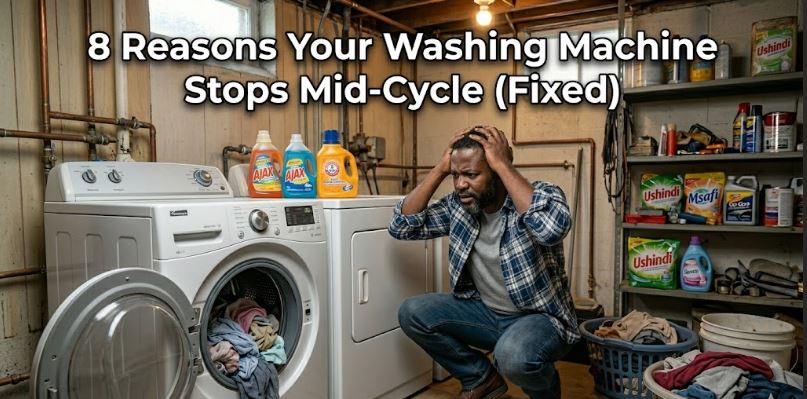
You walk back into the laundry room expecting clean clothes, and instead you find a drum full of soggy laundry sitting in water. Your washing machine stopped mid-cycle, and now you have no idea why.
The frustrating part is that mid-cycle stops can happen for several different reasons, and the fix depends entirely on the cause. So rather than guessing, let’s work through each one systematically.
Quick Diagnosis for a Washing Machine That Stops Mid Cycle
| What You Notice | Likely Cause |
|---|---|
| Machine stops during spin, clothes on one side | Unbalanced load |
| Stops during rinse, water still in drum | Drainage blockage |
| Stops and door won’t open | Door lock failure |
| Stops after running for 30+ minutes | Motor overheating |
| Random stops with no pattern | Control board or timer fault |
| Stops during fill cycle | Water inlet valve issue |
What Makes a Washer Quit Before the Cycle Ends?
Below are eight reasons a washing machine is likely to stop washing before the cycle ends:
1. The Load Is Unbalanced
This is the most common reason your washing machine stops mid-cycle, and it is also the easiest to fix.
When clothes clump together on one side of the drum, the machine detects excessive vibration during the spin phase. Rather than damage its own bearings or drum, it stops itself as a precaution.
How to Fix an Unbalanced Load
Open the lid or door and manually redistribute the clothes evenly around the drum. Pay special attention to heavy items like jeans, towels, or bedding, since these are almost always the culprit.
Also, try mixing heavy and light items together rather than washing one large item alone. A single duvet in a drum is a recipe for a mid-cycle stop every time.
2. The Drain Hose or Pump Is Blocked
Your washer cannot advance to the spin cycle if it cannot drain the wash water first. A blocked drain hose, clogged pump filter, or kinked hose will cause the machine to pause and wait, sometimes indefinitely.
This is one of those issues that catches people off guard because the machine technically has no error, it is simply stuck waiting.
How to Clear a Drainage Blockage
Start by checking the drain hose at the back of the machine for kinks or bends. Straighten it out and make sure it sits no deeper than 6 to 8 inches into the standpipe, since inserting it too far can cause siphoning.
Next, locate the pump filter (usually behind a small door at the front base of the machine) and clean it out. The Supplying Demand Washing Machine Drain Pump (View on Amazon) is a reliable replacement if your pump is damaged beyond cleaning. It fits most front-loaders and comes with basic hardware for a straightforward swap.
3. The Door or Lid Switch Is Failing
The lid switch on a top-loader and the door lock on a front-loader serve the same purpose: confirming the machine is safely closed before it runs.
If this switch develops a fault mid-cycle, the machine interprets it as the door opening and shuts off immediately as a safety response.
How to Test and Replace the Switch
Listen for a click when you close the lid or door. If there is no click, the switch is likely the problem.
Unplug the machine, access the switch, and test it with a multimeter for continuity. No continuity means you need a replacement. The Supplying Demand 4-Pack Lid Switch Assembly (View on Amazon) is compatible with most top-load washer models.
4. The Motor Is Overheating
Washing machines have a thermal overload protector built into the motor. When the motor runs too hot, this protector trips and cuts power to prevent permanent damage.
This tends to happen during long or back-to-back cycles, or in machines that are overloaded regularly.
How to Handle an Overheating Motor
If your machine stops after 20 to 40 minutes of running, overheating is a strong candidate. Unplug the machine and let it rest for at least an hour before trying again.
Going forward, avoid overloading the drum beyond 80 percent capacity, and give the machine a short rest between back-to-back cycles. If overheating becomes a recurring problem, the motor itself may be wearing out and approaching the end of its lifespan.
5. The Water Inlet Valve Is Faulty or Blocked
During the rinse phase, the water inlet valve opens to refill the drum. If this valve is blocked by mineral deposits or has failed electrically, the machine waits for water that never comes, and eventually times out and stops.
This one is especially common in areas with hard water.
How to Fix the Inlet Valve
First, turn off the water supply and disconnect the inlet hoses. Check the mesh screens inside the hose connections for sediment buildup and clean them with a brush.
If the screens look clear but the problem persists, test the solenoids on the valve with a multimeter. A reading outside the 500 to 1500 ohm range usually means the valve is faulty. The Beaquicy Washing Machine Water Inlet Valve (View on Amazon) is an affordable, widely compatible replacement that many DIYers find easy to install without any special tools.
6. The Timer or Control Board Has a Fault
Think of the timer and control board as the machine’s conductor and brain. The timer signals each phase of the cycle, and the control board executes those signals. When either fails, the machine can get stuck at any point and refuse to move forward.
This is less common than the issues above, but it does happen, particularly in older machines or those that have experienced a power surge.
How to Diagnose a Timer or Board Issue
Start with a hard reset. Unplug the machine from the wall for two full minutes, then plug it back in and try a fresh cycle.
If the problem keeps happening at the same point in every cycle, the timer is more likely the issue. If stops are random, the control board is the better suspect. Test the timer with a multimeter and search your model number on Amazon to find the right replacement part.
7. The Machine Is Set to Rinse Hold Mode
This is a feature that many people do not even know exists, yet it causes a lot of confusion.
Rinse hold keeps the machine paused with the drum full of water at the end of the wash phase, intended to prevent creasing in fabrics. If this mode is activated accidentally, the machine will stop and appear stuck every single time.
How to Disable Rinse Hold
Check your control panel for a “Rinse Hold,” “No Spin,” or “Pause” indicator light. If it is lit, hold or press the appropriate button to cancel the mode. Then press start again to resume the cycle.
Check your user manual if you are unsure which button controls this, since it varies between brands.
8. There Is a Power Supply Interruption
A brief dip in voltage, a tripped breaker, or a loose plug can all cause your washer to stop mid-cycle. What makes this tricky is that the power may return quickly, so the machine looks like it has power when you check on it, but the cycle already stopped.
How to Check for a Power Issue
Go to your breaker box and confirm the washer’s breaker is fully in the “on” position. Also unplug the machine and plug it back in firmly, since vibration can slowly loosen the plug from the outlet.
If breaker trips keep happening, avoid running other high-draw appliances on the same circuit as the washer.
DIY Repair Cost Breakdown
| Part | DIY Cost | Pro Service Cost |
|---|---|---|
| Pump filter cleaning | Free | $80 – $150 |
| Drain pump replacement | $25 – $60 | $150 – $250 |
| Lid/door switch | $15 – $40 | $100 – $200 |
| Water inlet valve | $20 – $50 | $100 – $200 |
| Timer replacement | $30 – $80 | $150 – $300 |
| Control board | $80 – $200 | $200 – $400 |
Frequently Asked Questions
Why does my washing machine keep stopping mid-cycle with no error code?
An unbalanced load or a drainage blockage is usually responsible when there is no error code displayed. These are both safety stops triggered by sensors, and neither requires a part replacement in most cases.
Can I open the door when the washing machine stops mid-cycle?
On front-loaders, the door lock may stay engaged for a few minutes after stopping. Wait 2 to 3 minutes, then try the door. Never force it open, as this can break the latch mechanism.
Why does my washer stop specifically during the spin cycle?
The spin phase is where load imbalance causes the most problems. The machine detects vibration exceeding a safe threshold and stops to protect the drum and bearings. Redistributing clothes almost always solves this.
How do I reset a washing machine that stopped mid-cycle?
Unplug the machine from the wall for two full minutes, then plug it back in. This clears the control board memory and lets you start a fresh cycle from the beginning.
Should I call a technician if my washer keeps stopping every cycle?
If the stops happen consistently after trying all the fixes above, a faulty control board or motor is likely involved. At that point, a technician or part replacement is the next logical step.
Don’t Let Mid-Cycle Stops Ruin Your Laundry Day
Most of the time, a washing machine that stops mid-cycle is trying to tell you something fixable, an unbalanced load, a clogged filter, or a switch that needs replacing. Work through the causes above from top to bottom, since the simpler fixes resolve the majority of cases.
If you have already gone through this guide and the problem persists, our full washing machine troubleshooting resource covers advanced diagnostics, error codes, and when a replacement makes more financial sense than a repair. You can also explore our related guide on washer won’t start but has power if the machine refuses to run at all.