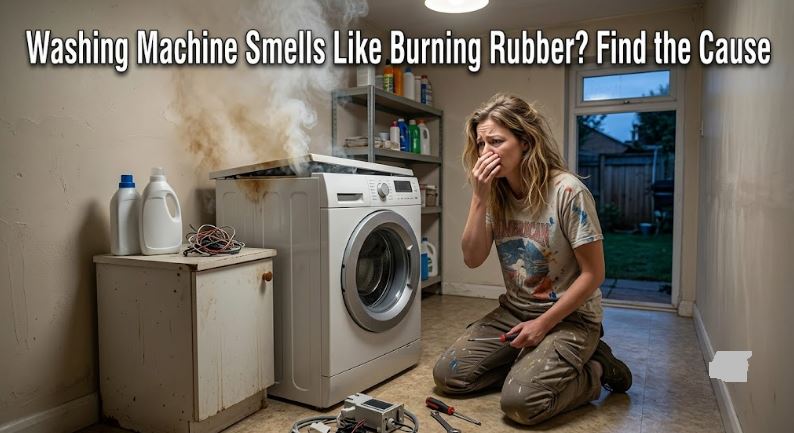
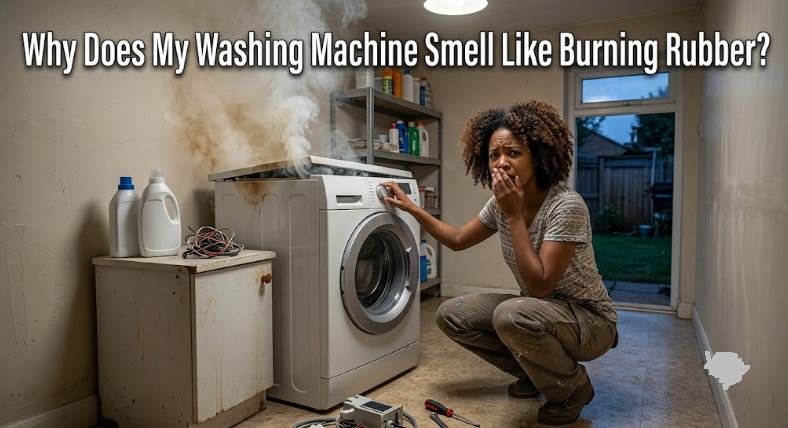
You are loading the next batch of laundry and a sharp, unmistakable burning rubber smell stops you mid-fold. It is not the detergent. It is not the fabric softener. Something inside the washing machine is generating heat it should not be generating, and that smell is the warning you cannot afford to ignore.
Unlike a musty or sour odor that develops from neglected cleaning, a burning rubber smell from a washing machine almost always means friction. Something is slipping, dragging, overheating, or burning through in the mechanical system that drives the drum, the pump, or both. The good news is that identifying the specific cause is often straightforward, and several fixes are genuinely within DIY reach.
Stop the machine, unplug it, and let it cool for at least 20 minutes before investigating. Then work through the causes below from the top.
In Summary: Why Your Washing Machine Smells Like Burning Rubber
| When and Where the Smell Occurs | Most Likely Cause |
|---|---|
| Burning smell on a brand new machine, only during fill | New rubber inlet hoses off-gassing, not a fault |
| Burning smell during spin cycle, tub barely moves | Worn or slipping drive belt |
| Burning smell during drain phase | Seized or clogged drain pump |
| Burning smell throughout entire cycle | Overloaded drum stressing motor and belt |
| Sharp burning smell from rear of machine | Motor overheating or failing start capacitor |
| Burning rubber smell with grinding or squealing | Worn drum bearings or seized idler pulley |
| Intermittent smell with no other symptoms | Motor coupler wearing out on direct-drive models |
7 Reasons Your Washing Machine Smells Like Burning Rubber and How to Fix Each One
These are the causes behind most burning rubber complaints by most washing machine users:
1. It Is a New Machine With New Rubber Inlet Hoses
If the burning rubber smell appeared specifically on a brand new washing machine during the very first few cycles, this cause resolves itself without any repair at all.
New rubber inlet hoses and new motor insulation both release a strong rubber odor during initial heating. The smell is most noticeable during the fill phase before the motor even starts running. It is completely harmless and fades on its own within 10 to 20 cycles as the rubber settles and the manufacturing odors dissipate.
Here Is How to Confirm It
- Start the washer and allow it to fill with hot water without beginning the agitation cycle
- If the burning rubber smell appears during the fill phase before the motor or pump activates, the inlet hoses are the source
- Open windows to ventilate the laundry room during the first several uses
- The smell will fade progressively with each cycle. No parts need replacing and no action is required beyond patience and ventilation
2. The Drive Belt Is Worn or Slipping
This is the most common mechanical cause of a burning rubber smell in belt-driven washing machines, and the smell is the most useful early warning sign that the belt is failing.
The drive belt connects the motor to the drum pulley, enabling the spinning and agitation cycles. Over years of use, the belt stretches, glazes over from heat and friction, or develops cracks in the rubber surface. A stretched or glazed belt slips on the pulleys rather than gripping them cleanly. That slipping generates heat and releases the characteristic burning rubber smell that intensifies during the spin cycle when the belt is under maximum load.
Here Is How to Inspect and Replace It
- Unplug the machine and turn off the water supply before opening any panels
- Access the belt through the rear panel on front-loaders or the cabinet on top-loaders
- Inspect the belt along its full length for glazing (shiny hardened surface), cracking, fraying, or visible stretching
- A belt that slides off the pulley by hand without resistance has already stretched beyond its working tension, and thus needs a replacement (View on Amazon)
- Also check our detailed post on washer not spinning clothes dry since a slipping belt almost always affects spin performance alongside the smell
3. The Drain Pump Is Seized or Clogged
A burning rubber smell that is strongest during the drain phase of the cycle, or that comes from the lower front area of the machine, almost always points to the drain pump.
The drain pump removes water from the drum after each cycle. When a small object like a coin, button, or piece of wire gets lodged against the pump impeller, the pump motor strains continuously against the obstruction. On belt-driven pump models, the belt slips against the seized pump pulley and burns. On electric drain pump models, the motor itself overheats and produces a sharper, more electrical burning smell.
Here Is How to Check and Fix It
- Unplug the machine and locate the pump filter access panel at the front base of the machine
- Place towels underneath and unscrew the filter cap slowly to drain any residual water
- Remove the filter completely and check the impeller inside the housing for any foreign objects. Remove anything you find using needle-nose pliers
- Spin the impeller by hand after clearing it. It should rotate freely without resistance or grinding
- If the impeller spins freely but the burning smell persists during the drain phase, test the pump motor with a multimeter for continuity. A failed motor needs full replacement
- The Upgraded W10876600 Washer Drain Pump (View on Amazon) is compatible with most top-loaders.
4. The Machine Is Overloaded
An overloaded drum is one of the most common causes of burning rubber smells and one of the easiest to prevent permanently with a single habit change.
When the drum is packed beyond its designed capacity, the motor must work significantly harder to turn the load through each agitation and spin cycle. That extra load stress heats the motor, strains the belt, and puts excessive pressure on the drum bearings. Heavy items like waterlogged comforters, dense bath towels, and multiple pairs of jeans together create a load that generates friction and heat at every point in the drive system simultaneously.
Here Is How to Fix and Prevent It
- Stop the cycle and remove roughly a quarter of the load. Redistribute the remaining clothes evenly around the drum
- Run the cycle again and monitor whether the burning smell returns with the reduced load
- Going forward, fill the drum to no more than 75 to 80 percent capacity. Clothes should move freely rather than sitting in a compressed mass
- Wash heavy single items like comforters and blankets separately from other laundry, and always balance them with a few lighter items to prevent the load shifting to one side and stressing the drum bearings
5. The Idler Pulley or Motor Pulley Is Seized
The idler pulley maintains tension on the drive belt throughout the cycle. The motor pulley transfers rotational power from the motor to the belt. When either pulley loses its lubrication, develops a bearing fault, or seizes on its shaft, the belt cannot move freely across it. Instead it drags and scrapes, heating up rapidly and producing a burning rubber smell that is often accompanied by a squealing sound as the belt heats under friction.
Here Is How to Diagnose and Address It
- Unplug the machine and access the belt and pulley system
- Spin each pulley by hand and feel for resistance, grinding, or wobbling on the shaft
- A pulley that requires significant force to spin by hand or that produces a grinding sensation has a bearing fault
- Apply a small amount of WD-40 Specialist White Lithium Grease (View on Amazon) to a dry but otherwise undamaged pulley shaft. This grease is formulated for plastic and metal components under load and lasts significantly longer than standard spray lubricant
- If the pulley is visibly cracked, completely seized, or wobbles significantly on its shaft, it needs full replacement. Search your model number alongside “idler pulley” or “motor pulley” on Amazon for the correct replacement
6. The Motor Coupler Is Wearing Out (Direct-Drive Models)
This cause applies specifically to direct-drive top-loading washers from Whirlpool, Kenmore, and Maytag, which use a motor coupler rather than a drive belt to connect the motor to the transmission.
The motor coupler consists of two plastic drive forks with a rubber cushion between them. As the coupler wears, the rubber center begins to slip and generate heat between the plastic forks under the load of the agitation and spin cycles. That rubber-on-plastic friction produces a burning rubber smell that comes in waves aligned with the agitation rhythm rather than being continuous throughout the cycle.
Here Is How to Replace a Worn Motor Coupler
- Unplug the machine and lay it on its back to access the motor from underneath
- The coupler sits directly between the motor shaft and the transmission. Inspect it for visible cracking, rubber shredding, or missing sections
- Even partial damage to the rubber center causes the smell and slippage that eventually accelerates to full failure, and thus the need for a replacement.
7. The Drive Motor Is Overheating or Failing
Safety level: Stop using the machine immediately if this is the suspected cause. Motor diagnosis requires a professional.
When the burning smell has a sharper, more electrical quality alongside the rubber note, or when the machine hums loudly but the drum barely moves, the drive motor itself is likely overheating or developing an internal fault.
A motor that is failing draws excess current, generates significant heat in the windings, and that heat burns both the winding insulation and any rubber components in contact with the motor housing. A start capacitor that is failing produces a similar smell since it develops internal arcing as it deteriorates.
Here Is What to Observe and Do
- Note whether the smell is accompanied by a loud hum from the motor area without corresponding drum movement, which points to the motor struggling to start
- Check whether the machine shuts itself off mid-cycle, which indicates the motor’s thermal overload protector is tripping from overheating
- Visually inspect the start capacitor if accessible. A bulging, cracked, or leaking capacitor has failed and is a fire risk that requires immediate replacement before running the machine again
- Do not attempt to run the machine if the motor is suspected. Contact a licensed appliance technician for motor testing with a clamp meter and multimeter
- On machines over ten years old, a failed motor often makes replacement more financially sensible than repair.
Burning Rubber Smell Fix Cost Overview
| Cause | DIY Safe | Fix Cost | Pro Repair Cost |
|---|---|---|---|
| New inlet hose off-gassing | Yes | Free | N/A |
| Reduce overloaded drum | Yes | Free | N/A |
| Clear clogged drain pump | Yes | Free | N/A |
| Lubricate dry pulley shaft | Yes | $8 – $12 | N/A |
| Replace drive belt | Moderate DIY | $10 – $25 | $100 – $200 |
| Replace motor coupler | Moderate DIY | $10 – $20 | $100 – $180 |
| Replace idler or motor pulley | Moderate DIY | $15 – $35 | $100 – $200 |
| Replace drain pump motor | Moderate DIY | $25 – $65 | $150 – $300 |
| Motor or capacitor diagnosis | No | N/A | $150 – $400 |
Frequently Asked Questions
Is it safe to keep using a washing machine that smells like burning rubber?
Not without identifying the cause first. Stop the machine, unplug it, and let it cool before investigating. If the smell was a one-time event from an overloaded drum and does not return at normal load sizes, running the machine again is fine. If the smell is recurring, comes with unusual sounds, or has a sharp electrical quality, do not use the machine again until the cause is identified and fixed. Continued use accelerates the damage significantly.
How do I tell whether the burning smell is from the belt or the motor?
Timing is the most useful diagnostic clue. A burning rubber smell that appears specifically during the spin cycle and coincides with a squealing sound almost always points to the drive belt slipping. A burning smell that is present throughout the entire cycle, comes with a hum but no drum movement, or has a sharper electrical quality points toward the motor or motor coupler. Accessing the belt first is the logical starting point since it is more accessible and more commonly the cause.
Why does my washing machine only smell like burning rubber on heavy loads?
Heavy loads force the motor, belt, and pulleys to work significantly harder than they do on lighter loads. A belt that is just beginning to wear or slip may function adequately on small to medium loads but generates heat and burning rubber smell only when the heavier load pushes the system beyond its degraded capacity. This intermittent pattern is an early warning that the belt needs replacing before it fails completely on a normal load.
Can I use my washing machine if the smell goes away on its own?
If the smell was clearly from an overloaded drum or a new machine’s hoses, and it does not return on subsequent cycles at the correct load size, the machine is safe to use. If the smell disappeared mid-cycle and you are not sure why, do not restart without investigating. A belt or coupler that slipped severely enough to burn may have temporarily recovered as temperatures dropped, but it will reach the same failure point again quickly.
Identify the Phase, Then Find the Component
A washing machine smelling like burning rubber is the mechanical system telling you precisely where to look. Match the smell’s timing to the wash phase, identify the component responsible for that phase, and you have the diagnosis in hand before opening a single panel. Start with the drain pump filter since it is the most accessible and requires no tools. Then check the drive belt and idler pulley before considering the motor.