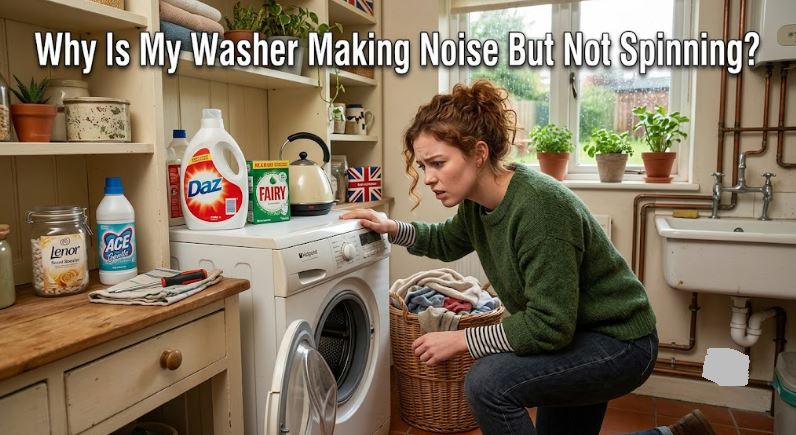
There is something distinctly alarming about a washing machine that hums, whirs, and clunks away through a full cycle but delivers a drum full of soaking wet clothes at the end. The noise confirms the motor is running and the machine has power. But somewhere between the motor turning and the drum spinning, something is breaking that mechanical chain.
The noise itself is actually your most useful diagnostic tool here. A humming motor with a stationary drum points to different causes than a grinding drum that barely moves, or a thumping machine that spins erratically. Pay attention to what the noise sounds like and when it occurs in the cycle, then match it to the causes below.
Unplug the machine before opening any panels, and turn off the water supply valves before disconnecting any hoses.
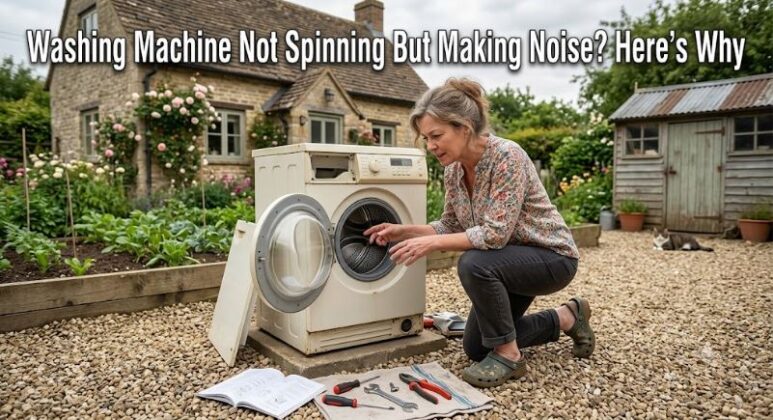
What Does the Noise Tell You About The Washing Machine?
| Noise Type and Timing | Most Likely Cause |
|---|---|
| Humming motor, drum completely still | Broken drive belt or failed motor coupler |
| Loud thumping with partial or no spin | Unbalanced load or worn suspension rods |
| Grinding or scraping during spin attempt | Worn drum bearings or foreign object in drum |
| Humming during drain phase, no spin follows | Clogged drain pump preventing spin from starting |
| Clicking or buzzing, spin never engages | Faulty lid switch or door lock not confirming closure |
| Squealing during spin, drum barely moves | Worn idler pulley or slipping drive belt |
| Motor runs throughout wash but not spin | Control lock active or wrong cycle selected |
8 Reasons Your Washing Machine is Making Noise But Not Spinning
These are the likely causes of why a washing machine would make some noise yet fail to spin:.
1. The Load Is Unbalanced or Overloaded
When a single heavy item like a comforter, a pair of jeans, or a bath towel bundles to one side of the drum, the machine’s vibration sensors detect the imbalance and reduce or cut the spin cycle entirely to protect the drum and bearings. The motor keeps running and the machine makes noise throughout, but without the drum reaching spin speed.
Overloading produces the same result by a different route. A drum packed beyond capacity cannot distribute weight evenly regardless of how the load is arranged, and the sensors cut the spin before it causes mechanical damage.
Here Is How to Fix It
- Open the door or lid and physically spread the clothes evenly around the drum by hand
- Remove two or three heavy items if the drum is packed tightly and run a drain-and-spin cycle to try completing the current load
- For large single items like comforters, add two or three towels to create a balanced weight distribution rather than washing the large item alone
- Fill the drum to no more than 75 to 80 percent capacity on future loads, leaving visible space at the top for clothes to tumble freely
2. The Drive Belt Is Broken or Has Slipped Off
If the motor hums persistently but the drum sits completely still during the spin cycle, a broken or slipped drive belt is the most common mechanical cause in belt-driven machines.
The belt wraps around the drum and the motor pulley, transferring rotation from the motor to the drum. When it snaps or slips off the pulley, the motor runs freely with no load resistance, producing a steady hum or whir while the drum goes nowhere. A squealing sound instead of a hum often indicates a belt that is slipping rather than broken, which generates friction noise before it finally comes off the pulley entirely.
Here Is How to Inspect and Replace It
- Unplug the machine and access the belt through the rear panel on front-loaders or the machine cabinet on top-loaders
- Spin the drum by hand with the machine unplugged. If it spins with almost no resistance and the belt hangs loose inside the cabinet, the belt has failed
- Inspect the belt along its full length for cracking, glazing, fraying, or visible breaks
- The W11239857 Washer Drive Belt (View on Amazon) fits most Whirlpool, Amana and Maytag top-loaders at under $15.
- Route the new belt around the motor pulley and drum pulley following the diagram in your user manual or a model-specific installation guide
3. The Motor Coupler Has Failed (Direct-Drive Models)
On direct-drive Whirlpool, Kenmore, and Maytag top-loaders, there is no drive belt. Instead, a motor coupler connects the motor directly to the transmission. This small three-piece component consists of two plastic drive forks with a rubber center cushion.
When the coupler fails, the motor runs normally, filling the laundry room with its usual sound, but zero rotational force reaches the transmission or drum. The machine fills, agitates weakly or not at all, and then hums through the spin phase without the drum turning. This is one of the most common and most affordable washing machine repairs available.
Here Is How to Diagnose and Replace It
- Unplug the machine and lay it on its side to access the motor from underneath
- Locate the coupler between the motor shaft and transmission input shaft. Look for cracked or missing plastic sections and deteriorated or shredded rubber in the center
- Even partial coupler damage causes the described symptoms and warrants full replacement
4. The Drain System Is Blocked and Preventing Spin
This connection surprises most homeowners: a blocked drain is one of the most common reasons a washing machine will not spin, and the noise clue is a distinct humming specifically during the drain phase.
Most washing machines will not enter the spin cycle until the drum has successfully drained. If the pump filter is clogged, the drain hose is kinked, or the pump motor has seized, the machine cannot drain water from the drum. It hums through the drain phase without moving water, and the spin cycle never starts because the water level sensor confirms conditions are not safe for spinning.
Here Is How to Clear the Drain System
- Locate the pump filter access panel at the front base of the machine. Lay towels underneath and unscrew the filter cap slowly to drain any water
- Remove the filter completely and clear any lint, coins, hairpins, or debris from both the filter and the housing behind it
- Spin the pump impeller by hand inside the housing. It should rotate freely without grinding or resistance
- Also pull the machine away from the wall and inspect the drain hose for any sharp kinks along its length. Straighten any kinks and confirm the hose sits no deeper than 6 to 8 inches inside the standpipe
- For a complete drain system walkthrough, our post on Kenmore Elite washer not draining but spinning covers every drainage-related cause in detail
5. The Lid Switch or Door Lock Is Faulty
The lid switch on a top-loader and the door lock on a front-loader serve the same safety function: they confirm to the control board that the door is fully closed before allowing the spin cycle to begin. When either fails, the motor runs through the wash phase, the machine makes all its usual sounds, but the spin cycle never engages.
A partially failing switch is particularly tricky because it may work intermittently, allowing spin on some cycles but not others, which makes the diagnosis feel inconsistent and confusing.
Here Is How to Test and Fix It
- On a top-loader, close the lid firmly and listen for a definite click from the switch. Press the switch manually through the lid opening and check whether the machine responds by attempting to spin
- Test the switch with a multimeter set to continuity while the lid is in the closed position. A working switch shows continuity when closed and breaks it when open. A switch with no continuity at all in either position has failed
- The Idelen Lid Switch Assembly (View on Amazon) fits most Whirlpool, Amana, Maytag, and Kenmore top-loaders and includes the wiring harness for a direct plug-and-play installation at under $20
- For front-loaders, check the door lock assembly for error codes and test the lock solenoid with a multimeter as described in our post on washer door won’t unlock after cycle
6. The Suspension Rods or Shock Absorbers Are Worn
The suspension system supports the drum during the spin cycle, absorbing vibration and preventing the drum from slamming against the cabinet at high speed. On top-loaders, four suspension rods hang the outer tub from the cabinet corners. On front-loaders, two or four shock absorbers connect the tub to the base frame.
When these components wear out or fail, the drum shifts dramatically during spin attempts. The sensors detect the excessive movement, cut the spin speed immediately, and the machine thumps and bangs through repeated speed-reduction attempts without ever reaching useful spin speed. The noise is characteristic: a loud, repetitive thumping that worsens as the machine tries to accelerate.
Here Is How to Test and Replace Them
- Open the cabinet and manually push down on the drum. On a top-loader, a healthy suspension allows the tub to push down and return slowly with resistance. If it springs back immediately or bounces multiple times, the rods have lost their dampening
- Check each rod or shock absorber for visible leakage, a collapsed dampening section, or detached mounting points
- The MVWC565FW1 Washer Suspension Rod Kit (View on Amazon) fits most Whirlpool, Kenmore and Maytag top-loaders and comes as a complete four-piece set. Replace all rods simultaneously since they wear at similar rates
- For front-loaders, search your model number alongside “shock absorber kit” on Amazon for the correct replacement pair
7. The Drum Bearings Are Failing
Worn drum bearings produce one of the most recognizable sounds in washing machine diagnosis: a deep, rolling grind or rumble that intensifies noticeably as spin speed increases. The drum itself moves, but it wobbles on its shaft rather than spinning cleanly, which generates the grinding noise and prevents the machine from reaching full spin speed.
Additional signs include rust-colored streaks on the back wall of the drum interior, water leaking from the rear of the machine, and a grinding sensation when spinning the empty drum by hand.
Here Is What to Check and Do
- Unplug the machine, open the door, and spin the empty drum slowly by hand. A grinding or rough sensation even at slow, hand-powered rotation confirms worn bearings
- Look for rust-colored streaks on the back interior wall of the drum, which appear when the worn bearing seal allows water to reach the bearing housing
- Bearing replacement requires significant disassembly of the drum and outer tub. On machines over eight to ten years old, compare the repair cost of $200 to $400 against the machine’s age before committing to this repair
8. The Machine Is Not Level
A washing machine that is not sitting level experiences uneven weight distribution on the drum support system with every rotation. During spin, that imbalance becomes amplified at high RPM and the vibration sensors cut the spin speed repeatedly to protect the machine. The result is a cycle of partial spin, sensor detection, speed reduction, and reattempt that produces significant noise without ever completing a full spin.
The noise is typically a loud rhythmic thumping or rocking sound that is clearly audible from another room.
Here Is How to Level the Machine and Stop the Noise
- Place a spirit level on top of the machine and check it both side to side and front to back
- Adjust the leveling feet by turning them clockwise to raise or counterclockwise to lower each corner until the bubble sits centered in both directions
- Tighten the locking nut above each foot firmly after adjustment to hold the position against vibration
- Place Anti-Vibration Washing Machine Pads (View on Amazon) under all four feet after leveling. These rubber pads grip the floor surface, prevent the machine from shifting out of level during heavy spin cycles, and noticeably reduce vibration noise transfer through the floor and walls
Washing Machine Making Noise But Not Spinning: Fix Cost Overview
| Cause | DIY Safe | Fix Cost | Pro Repair Cost |
|---|---|---|---|
| Redistribute unbalanced load | Yes | Free | N/A |
| Level machine and add anti-vibration pads | Yes | Free – $20 | N/A |
| Clear drain pump filter and hose | Yes | Free | N/A |
| Replace motor coupler | Moderate DIY | $10 – $20 | $100 – $180 |
| Replace lid switch | Moderate DIY | $15 – $25 | $100 – $200 |
| Replace drive belt | Moderate DIY | $10 – $25 | $100 – $200 |
| Replace suspension rod kit | Moderate DIY | $20 – $45 | $150 – $250 |
| Drum bearing replacement | No | N/A | $200 – $400 |
Frequently Asked Questions
Why does my washing machine make noise but the drum does not turn at all?
A drum that makes no movement whatsoever while the motor sounds active almost always points to a broken drive belt on belt-driven models or a failed motor coupler on direct-drive models. Both disconnect the motor from the drum mechanically, allowing the motor to run freely while producing no drum rotation. The drive belt costs under $15 and the motor coupler costs under $20, making these two of the most affordable appliance repairs available.
My washing machine spins during the wash cycle but not the spin cycle. What is different?
Agitation and spin are mechanically different functions. On top-loaders specifically, the lid switch, clutch assembly, and transmission all play roles in the transition from agitation to spin. A machine that agitates but refuses to spin most commonly has a failed lid switch preventing the spin signal, a worn clutch that cannot ramp the drum to spin speed, or a drain blockage stopping the transition since the machine must drain before spinning.
Can excess detergent cause a washing machine to make noise but not spin?
Yes, in two ways. Excess suds create a foam load inside the drum that behaves differently from a water load, confusing the water level sensors. Additionally, a thick suds layer resists the drain pump during the drain phase, which can prevent the machine from successfully draining and therefore from entering the spin cycle. Switching to the correct amount of HE detergent and running a rinse-only cycle clears this immediately.
Is it safe to run the washing machine if it makes noise but will not spin?
Not repeatedly. A machine running through its noise phase but failing to spin on every cycle is under sustained mechanical stress from whatever component is failing. A worn coupler, a slipping belt, or a seized pump all accumulate more damage with every cycle that runs. Identifying and addressing the cause before the next use prevents a relatively affordable repair from becoming a more expensive one.
The Noise Guides You Directly to the Problem
A washing machine making noise but not spinning is telling you something specific with every sound it makes. A hum with a still drum says belt or coupler. A grind that worsens with speed says bearings. A thump during spin attempts says imbalance or suspension. A drone during the drain phase says pump. Follow the sound to the right component, start with the free checks, and work toward the mechanical fixes in the order listed.