
You can hear the motor humming. The machine fills with water, the timer ticks along, and everything sounds normal. But the agitator just sits there doing absolutely nothing. Your clothes are soaking but not getting cleaned.
A washer agitator that refuses to move while the motor keeps running is a very specific problem, and that specificity is actually helpful. It means the motor is fine and the issue sits somewhere in the mechanical chain between the motor and the agitator itself.
Most of these causes are affordable to fix, and several cost under $20 in parts. Let’s work through them from the most common to the most involved.
Quick Diagnosis for a Washer Agitator That Won’t Move But Motor Runs
| What You Notice | Most Likely Cause |
|---|---|
| Motor hums, agitator completely still | Broken motor coupler or worn drive belt |
| Agitator moves slightly then stops | Stripped agitator dogs or worn drive block |
| Grinding noise, agitator barely moves | Worn transmission or stripped agitator base |
| Motor runs during spin but not agitation | Faulty lid switch or selector switch |
| Agitator jerks once then stops | Broken agitator dogs or coupler |
| Motor runs, no agitation, no spin either | Failed motor coupler or control board |
What Causes a Washer Agitator to Stop Working While the Motor is Running?
Below are issues that could stop the agitator from moving all of a sudden while the motor runs just fine:
1. The Motor Coupler Has Broken
This is the single most common cause of a running motor with no agitator movement, especially on direct-drive top-loading washers from Whirlpool, Kenmore, and Maytag.
The motor coupler is a small three-piece component made of two plastic drive forks with a rubber cushion between them. It sits directly between the motor shaft and the transmission input shaft. When the machine is overloaded or the coupler simply wears out from normal use, it breaks apart to protect the motor and transmission from damage.
When it fails, the motor runs freely but the transmission receives no power at all. The result is a machine that sounds completely normal but does zero mechanical work inside the drum.
How to Replace a Broken Motor Coupler
Unplug the machine and lay it on its side or back to access the motor from underneath. The coupler sits right between the motor shaft and the transmission. Pull it out and inspect it for cracked plastic forks or a deteriorated rubber center.
The Primeswift Motor Coupling Kit (View on Amazon) is compatible with most direct-drive Whirlpool and Kenmore top-loaders and comes with all three coupler pieces for a complete replacement. At under $15 and about 30 minutes of work, this is one of the most satisfying DIY washer fixes available.
2. The Agitator Dogs Are Worn Out
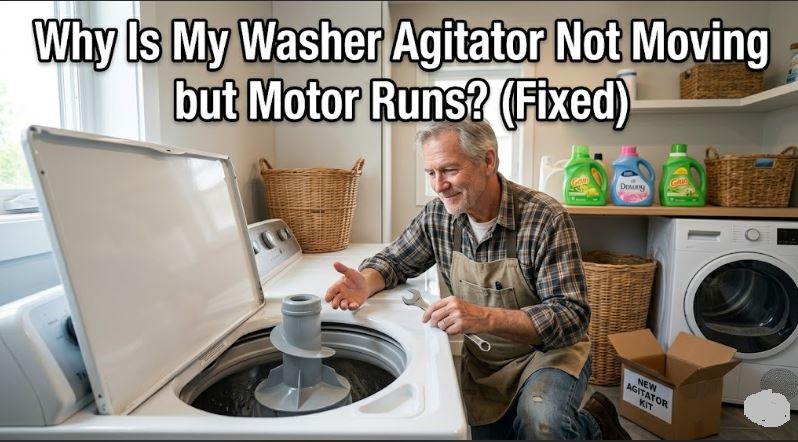
This cause is specific to washers with a two-piece agitator, which is common on most older and mid-range top-loaders.
The agitator dogs, also called directional cogs or dog ears, are small plastic ratcheting pieces that sit inside the top half of the agitator. They allow the upper agitator to rotate in one direction during agitation while the lower half stays stationary. When they wear down, the upper agitator spins freely in both directions with no resistance and no cleaning action.
A classic sign of worn agitator dogs is an agitator that spins easily by hand in both directions. A healthy agitator should only spin freely in one direction and resist firmly in the other.
How to Replace Agitator Dogs
Remove the agitator cap at the top of the agitator and lift the upper agitator section straight off. The agitator dogs sit in a plastic carrier underneath. Inspect them for rounding, cracking, or missing teeth.
The Primeswift Agitator Repair Kit (View on Amazon) includes the dogs, carrier, and cap hardware for most Whirlpool and Maytag two-piece agitator models. This is one of the cheapest fixes on this list at around $8 to $12, and the repair takes under 20 minutes without any special tools.
3. The Drive Block Is Stripped
The drive block is a small plastic or composite component that connects the transmission output shaft directly to the agitator. It sits at the very base of the agitator assembly.
When the drive block wears out or strips internally, the transmission shaft still oscillates back and forth as it should, but that motion never transfers to the agitator above it. The result looks identical to a motor coupler failure from the outside, which is why checking the drive block is the natural next step after ruling out the coupler.
How to Inspect and Replace the Drive Block
Remove the agitator completely by lifting it straight up or unscrewing the center bolt depending on your model. With the agitator out, watch the transmission shaft during the wash cycle to confirm it is actually moving. If the shaft oscillates but the agitator was not following, the drive block is your culprit.
Inspect the drive block for visible wear, cracking, or a stripped center hole that no longer grips the shaft. Search your model number alongside “agitator drive block” on Amazon to find the correct replacement. Installation is straightforward and requires only a wrench and a few minutes.
4. The Drive Belt Is Worn or Broken
Not all top-loaders are direct-drive machines. Many older models use a rubber drive belt to transfer power from the motor to the transmission, which then drives the agitator.
When this belt wears thin, glazes over, or snaps entirely, the motor spins freely but no power reaches the transmission or the agitator. You might also notice that neither agitation nor spinning works when the belt has broken completely, since both functions share the same belt on many models.
How to Check and Replace the Drive Belt
Unplug the machine and remove the rear access panel. Locate the belt running between the motor pulley and the transmission pulley. Look for cracking, fraying, glazing, or a belt that has slipped off the pulley entirely.
A belt that slides off easily by hand has already stretched past its working tension. The Supplying Demand Washer Drive Belt (View on Amazon) is an OEM-compatible option for several major brands at under $20. Always search your model number alongside “drive belt” to confirm compatibility before ordering.
Also check our post on washer not spinning clothes dry since a worn belt almost always affects both agitation and spin performance together.
5. The Lid Switch Is Faulty
Your top-loading washer will not agitate if it cannot confirm the lid is properly closed. The lid switch sits just inside the lid frame and signals the motor circuit to operate when the lid closes.
When this switch develops a fault, the motor circuit stays open and the agitator receives no power, even though the motor itself hums normally because it draws power through a separate circuit path.
This is a particularly deceptive cause because everything sounds normal, the fill works, the timer runs, but the agitator never engages.
How to Test and Replace the Lid Switch
Open and close the lid firmly and listen for a solid click from the switch. No click is an immediate red flag. Then use a multimeter to test the switch for continuity with the lid in the closed position. No continuity confirms the switch is not completing the motor circuit. Thus, it needs a replacement (View on Amazon).
6. The Transmission Has Failed
The transmission converts the motor’s rotational movement into the back-and-forth oscillation that drives the agitator. When internal transmission gears wear out or strip, the motor runs and the input shaft turns, but that motion never becomes agitation at the output shaft.
This is less common than the causes above, but it does happen, particularly on machines that have been regularly overloaded or are more than fifteen years old.
How to Diagnose a Transmission Problem
With the agitator removed, plug the machine in carefully and run a wash cycle while watching the transmission output shaft directly. If the shaft does not oscillate at all while the motor runs, the transmission has failed internally.
Transmission replacement is one of the more involved and expensive washer repairs. On older machines, it is worth comparing the transmission cost against the machine’s age before committing to the repair. A new transmission typically runs $80 to $150 in parts, and installation requires significant disassembly.
7. The Control Board Is Not Sending the Agitation Signal
When all mechanical components check out but the agitator still refuses to move, the control board becomes the final suspect.
The board governs every phase of the wash cycle and sends specific voltage signals to the motor at each stage. If the board fails to send the agitation signal correctly, the motor may still run in a standby state but never receive the instruction to power the transmission and agitator.
Random or worsening agitation failures alongside unusual display behavior or error codes are the clearest signs of a board issue.
How to Address a Control Board Fault
Start with a hard reset. Unplug the machine for two full minutes, plug it back in, and run a fresh cycle to see if normal agitation returns. This clears temporary errors and resolves glitches in many cases.
If the problem persists, run the machine’s built-in diagnostic mode to check for stored error codes. Search your model number alongside “diagnostic mode sequence” to find the correct steps for your brand. If diagnostics confirm a board fault, replacement is the path forward. Search your model number on Amazon to find the correct board for your specific machine.
Agitator Fix Cost and Difficulty Overview
| Cause | DIY Difficulty | Part Cost | Pro Repair Cost |
|---|---|---|---|
| Agitator dogs replacement | Very easy | $8 – $15 | $80 – $150 |
| Motor coupler replacement | Easy | $10 – $20 | $100 – $180 |
| Drive block replacement | Easy | $10 – $20 | $80 – $150 |
| Lid switch replacement | Easy | $15 – $40 | $100 – $200 |
| Drive belt replacement | Moderate | $10 – $25 | $100 – $200 |
| Transmission replacement | Advanced | $80 – $150 | $200 – $400 |
| Control board replacement | Advanced | $80 – $200 | $200 – $400 |
Frequently Asked Questions
How do I know if it is the agitator dogs or the motor coupler causing the problem?
Spin the agitator by hand with the machine unplugged. If it spins freely in both directions with zero resistance, the agitator dogs are worn. If it resists in both directions but still does not move during the cycle, the motor coupler or drive belt is the more likely cause.
Can overloading the washer cause the agitator to stop working?
Yes, directly. The motor coupler is specifically designed to break under extreme overload stress in order to protect the motor and transmission from damage. Repeated overloading is one of the fastest ways to wear out a motor coupler, which then stops agitation entirely.
My agitator moves slightly but very weakly. What does that mean?
Weak or minimal agitation almost always points to worn agitator dogs, a deteriorating drive block, or a slipping drive belt. The mechanical connection between the motor and agitator is still partially intact but no longer transmitting full power. All three are inexpensive fixes worth checking before moving to more serious components.
Does a washer agitate and spin using the same motor?
Yes, on most top-loaders a single motor powers both agitation and spin. The transmission and clutch assembly determine which function runs at each phase of the cycle. This is why a broken motor coupler usually stops both agitation and spinning simultaneously, since both depend on power reaching the transmission.
Is it worth fixing an agitator problem on an older washer?
In most cases, yes. Agitator dogs and motor couplers are among the most affordable washer repairs available, often costing under $20 in parts. Even a drive belt or lid switch replacement stays well under $50. Only when the transmission or control board has failed does the repair cost start approaching the point where replacement makes more financial sense.
Start at the Coupler and Work Your Way Up
A washer agitator not moving while the motor runs is almost always a mechanical disconnect somewhere between the motor and the agitator shaft. Start with the motor coupler and agitator dogs since these two causes account for the vast majority of agitation failures and cost almost nothing to fix.
Work your way through the drive block, belt, and lid switch before considering the transmission or control board. For related reading and many other washing machine problems, our ultimate washing machine troubleshooting guide is your go-to resource for deeper diagnostics across all major washer brands.