
Miele dishwashers are built to last. The brand engineers its machines to a 20-year service life standard — and most owners who maintain them properly hit that target. But even a premium appliance throws error codes from time to time, and when yours does, understanding exactly what the code means is the fastest route from problem to solution.
This Miele dishwasher troubleshooting guide covers every significant Miele dishwasher error code, what’s actually causing it, what you can fix yourself, and when to call a technician. It’s written for real Miele owners — not technicians — so the language stays practical throughout.
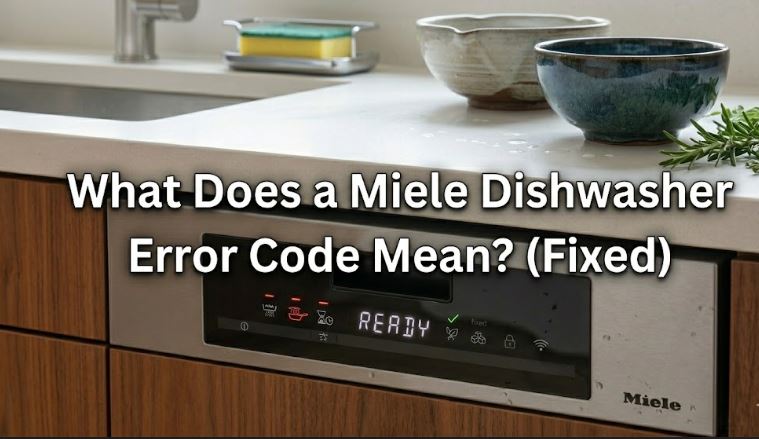
How Miele Dishwashers Display Error Codes
Miele communicates faults in two ways, depending on the model you own.
Newer models with digital displays show the fault code directly on the screen — for example, “F11” or “Fault: Water Intake.” Older models without displays use flashing LED sequences on the “Intake/Drain” indicator light to communicate the fault.
On older models, count the number of flashes in each sequence. Each group of flashes corresponds to a fault number. If you’re unsure how to read your specific model’s indicator sequence, the manual on Miele USA’s support page covers this for each series.
How to Reset a Miele Dishwasher Error Code
Before diving into individual codes, it’s worth knowing the universal reset process. Many Miele error codes will reappear after a reset if the underlying problem hasn’t been addressed — but resetting first confirms whether the code was a one-off glitch or a persistent fault.
To reset:
- Press and hold the Start/Stop button for approximately 3–5 seconds
- The program will cancel and the machine will drain
- Open the door and leave it ajar for 60 seconds
- Close the door and restart a new program
If the error code returns immediately or within one cycle, the fault is genuine and needs diagnosis.
Complete Miele Dishwasher Error Code Reference
The table below covers the full range of Miele dishwasher symbols and fault codes in numerical order. Use it as a quick reference before diving into the detailed explanations below.
All Miele Dishwasher Fault Codes at a Glance
| Code | System Affected | Fault Description | DIY Possible? |
|---|---|---|---|
| F01 | Temperature sensor | Water/heating NTC short-circuited | No |
| F02 | Temperature sensor | Water/heating NTC open-circuited | No |
| F11 | Drainage | Drainage fault — water not draining | Often yes |
| F12 | Water intake | Water intake fault at start of step | Often yes |
| F13 | Water intake | Water intake fault at end of step | Often yes |
| F14 | Pressure switch | Water intake / heater pressure switch | Sometimes |
| F15 | Hot water intake | Hot water intake fault | Sometimes |
| F18 | Flow meter | Flow meter stationary state fault | No |
| F19 | Flow meter | Flow meter stiff and not turning freely | No |
| F24 | Heater relay | Heater relay contact fault | No |
| F25 | Temperature | Target temperature not reached | No |
| F26 | Boiling protection | Boiling protection fault | No |
| F32 | Door lock | Door lock does not close | Sometimes |
| F33 | Door lock | Door lock does not open | Sometimes |
| F36 | Door lock | Door lock switch defective | No |
| F40 | Electronics | Electronic control fault | No |
| F42 | Electronics | Line frequency registration fault | No |
| F47 | Electronics | Faulty electronic interface | No |
| F51 | Heater pressure switch | Heater pressure switch fault | No |
| F52 | Heater pressure switch | Heater pressure switch reset during heating | No |
| F53 | Circulation pump | Speed sensor fault | No |
| F63 | Circulation pump | Slide shutter / pump failure | No |
| F67 | Circulation pump | Circulation pump speed too low | No |
| F68 | Circulation pump | Pump operating after switch-off | No |
| F69 | Circulation pump | Circulation pump blocked | Sometimes |
| F70 | Float switch | Waterproof system / float switch fault | Sometimes |
| F78 | Circulation pump | Circulation pump error | No |
| F88 | Turbidity sensor | Turbidity (soil) sensor fault | No |
Drainage Fault Codes
Drainage faults are among the most common Miele error codes — and also among the most fixable without a technician visit.
F11 — Drainage Fault
What it means: Water is not draining from the tub within the expected time.
Common causes:
- Blocked or dirty filter assembly at the base of the tub
- Kinked or obstructed drain hose behind the machine
- Blocked non-return valve in the sump
- Failed or blocked drain pump
- Foreign object lodged in the heater pressure switch
What to check first:
- Remove and rinse the filter assembly under running water — this resolves the issue more often than any other step
- Check the drain hose behind the unit for kinks or blockages
- Inspect the sump area for any debris (broken glass, food debris, labels from jars)
- If the above don’t resolve it, the drain pump may need replacement — this is a technician job
Most F11 codes in machines that are regularly maintained are caused by a clogged filter. Clean it monthly to prevent recurrence.
Water Intake Fault Codes
Water intake errors are the second most common category. They share several root causes and are worth diagnosing together.
F12, F13, F14, and F15 — Water Intake Faults
These four codes all relate to problems getting water into the dishwasher at the right rate and temperature. The specific code tells you which stage of the intake process is failing.
| Code | Specific Fault | Most Likely Cause |
|---|---|---|
| F12 | Intake fault at start of step | Closed inlet valve, low water pressure, kinked inlet hose |
| F13 | Intake fault at end of step | Partially blocked inlet valve strainer |
| F14 | Circulation pressure fault | Heater pressure switch obstruction or pump issue |
| F15 | Hot water intake fault | Cold water supply only; heating element or sensor fault |
What to check for F12 and F13:
- Confirm the water supply tap behind the machine is fully open
- Inspect the inlet hose for kinks
- Clean the inlet valve strainer — a mesh filter where the hose connects to the machine
- Check your home water pressure (should be 10–145 psi)
F14 and F15 involve internal pressure monitoring and the heating system. If the above checks don’t apply, these typically require a technician.
Flow Meter Fault Codes
Flow meter codes are less common but worth understanding. They indicate the machine can’t accurately measure how much water it’s receiving.
F18 and F19 — Flow Meter Faults
F18 means the flow meter is stationary when it should be spinning — usually because water isn’t flowing at all, or the meter is jammed. F19 means the meter is turning but sluggishly, suggesting debris partially blocking it.
Both codes often trace back to an underlying water supply or inlet valve problem. Check those first before assuming the flow meter itself has failed.
Replacing a flow meter is a component-level repair. It’s within the skill range of a confident DIYer with the right part, but most owners will prefer to have a technician handle it.
Heating System Fault Codes
Heating faults are where Miele’s diagnostic system earns its reputation for precision. The codes narrow down the problem to specific components.
F24 — Heater Relay Contact Fault
The heater relay activates the heating element during wash cycles. An F24 code means the relay’s contacts are not operating correctly — either fused shut or failing to close.
This is not a DIY repair. The control board or relay module needs professional assessment.
F25 — Target Temperature Not Reached
The machine is heating but cannot reach the programmed temperature within the expected timeframe. This can indicate a failing heating element, a faulty NTC temperature sensor, or low water pressure reducing the water volume available for heating.
F26 — Boiling Protection Fault
This code fires when the machine detects water temperature exceeding safe limits. It’s a protective mechanism. Causes include a failed thermostat, an overloaded detergent dispenser creating excessive foam (which traps heat), or a faulty NTC sensor.
Check detergent dosing first — overfilling the dispenser is a common trigger. If dosing is correct, this needs a technician.
F51 and F52 — Heater Pressure Switch Faults
The heater pressure switch monitors water pressure in the heating circuit. F51 means the switch failed to activate. F52 means it activated at the wrong time or reset unexpectedly during a heating phase.
Both codes require professional diagnosis. Do not attempt to bypass the heater pressure switch — it is a safety component.
Circulation Pump Fault Codes
Circulation pump codes represent the largest single group of Miele fault codes. They all indicate problems with the pump that circulates water through the spray arms during washing.
F53, F63, F67, F68, and F69 — Circulation Pump Faults
These codes pinpoint different aspects of pump behavior.
| Code | Specific Pump Fault | DIY Option |
|---|---|---|
| F53 | Speed sensor not detecting pump rotation | No — sensor or pump replacement |
| F63 | Slide shutter fault / pump failure | No — technician required |
| F67 | Pump speed too low — insufficient pressure | Sometimes — check for blockage |
| F68 | Pump running after program ends | No — control module issue |
| F69 | Pump physically blocked by foreign object | Yes — inspect and clear obstruction |
For F67 and F69, start by removing the spray arms and inspecting the pump area for debris — a broken piece of cutlery, a small bone, or a label that’s come off a jar are the most common culprits. Use a flashlight and a pair of long-nose pliers to clear any visible obstruction.
If clearing the obstruction doesn’t resolve F67 or F69, the pump impeller may be damaged and will need replacement.
Door Lock Fault Codes
Door lock faults are straightforward in their causes but variable in their DIY resolution.
F32 and F33 — Door Lock Faults
F32 means the door lock mechanism is not closing and latching as the program expects. F33 means the lock is not releasing at the end of a cycle.
Check for obvious obstructions first — a dish or pan handle protruding through the door seal, or debris caught in the door latch area. If the lock mechanism is physically intact and unobstructed, the door latch assembly may need replacement.
F36 — Door Lock Switch Defective
This code indicates the switch that confirms the door is locked is itself faulty. The door may be locking physically, but the machine isn’t receiving confirmation. This requires a technician.
Float Switch and Waterproof System
F70 — Float Switch Fault / Waterproof System Activated
F70 is one of the more serious Miele dishwasher error codes. It means the anti-flood system has been triggered.
Miele’s waterproof system includes a float switch in the base pan of the machine. If water leaks internally and collects in the base, the float rises and triggers F70 — stopping all operation to prevent a flood. This is the machine protecting your kitchen, not malfunctioning.
What to do:
- Do not restart the machine
- Pull the dishwasher out from under the counter
- Tilt it gently forward — this allows water to drain from the base pan through the front
- Check all hose connections at the back for leaks
- Inspect the door seal for damage
If the float switch itself has failed — triggering F70 without any actual leak — the switch needs replacement. A technician can confirm which scenario applies.
Miele-Recommended Products to Keep Your Machine Running
Preventing error codes is significantly easier than resolving them. These three Miele original products address the most common causes of recurring faults — limescale buildup, poor drying, and detergent residue — and are all available on Amazon.
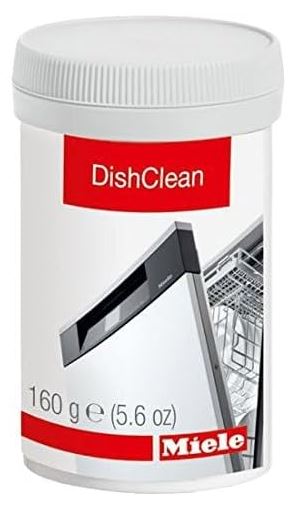
1. Miele DishClean Dishwasher Cleaner — 5.6 oz
DishClean is Miele’s own formulated dishwasher maintenance cleaner. It targets limescale deposits, odors, grease residue, and detergent buildup — all of which contribute to recurring fault codes including F14, F51, and F67 when left unchecked.
Miele recommends using it four to five times per year. It also maintains the elasticity of door seals, which extends the life of the seal and reduces the risk of water leakage triggering F70.
- Formulated specifically for Miele dishwashers — compatible with all models
- Removes limescale, food deposits, and odors in a single cycle
- Protects door seals and internal components
- Provides 4–5 applications per bottle (5.6 oz)
- Reduces the frequency of fault codes related to heating and circulation
- Suitable for use in any brand of dishwasher
Check current price and reviews on Amazon
2. Miele Original Dishwasher Rinse Aid — 17 oz
Rinse aid does more than help dishes dry — it actively reduces water spot formation on internal components, which over time contributes to sensor and pressure switch contamination. Using the correct rinse aid consistently is one of the most effective ways to prevent the conditions that trigger F14, F25, and F51 codes.
Miele’s formula includes glass protection chemistry that is calibrated to work with the brand’s AutoSensor technology. Third-party rinse aids can cause overfoaming, which contributes to F26 boiling protection triggers.
- Specifically formulated for Miele dishwashers with glass protection
- Prevents water spots and reduces mineral deposit buildup on internal sensors
- Works with Miele’s AutoSensor drying system for optimal drying performance
- 17 oz bottle — approximately 30+ fill cycles depending on dosing setting
- Compatible with all Miele dishwasher models
- Helps prevent overfoaming that can trigger F26 and F51 codes
Check current price and reviews on Amazon
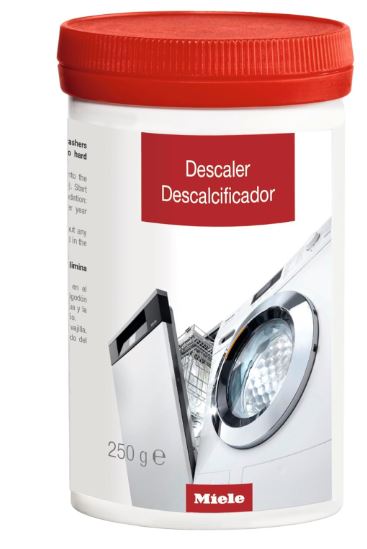
3. Miele Original Descaling Powder — 9.6 oz (GP DC WG 0252 P)
In hard water areas, limescale is the single most common underlying cause of heating and pressure-related fault codes in Miele dishwashers. This is Miele’s own descaling powder — safe for both dishwashers and washing machines, and formulated to dissolve calcium deposits from the heating element, heater pressure switch, flow meter, and circulation pump without damaging internal components.
Using descaling powder one to three times per year in hard water households directly addresses the root cause behind F14, F24, F25, F51, F52, and F67 fault codes.
- Miele original formulation — safe for all internal components including seals and sensors
- Dissolves limescale from the heating element, pump, flow meter, and pressure switch
- 9.6 oz bottle — 1–3 applications per year depending on water hardness
- For use in dishwashers and Miele washing machines
- Most effective when used on a hot/intensive program with the machine empty
- Particularly important in areas with hard water (above 200 ppm hardness)
Check current price and reviews on Amazon
DIY vs Professional Repair: Quick Reference
One of the most useful things to know about Miele dishwasher error codes is which ones you can safely address yourself. This table gives a clear at-a-glance guide.
| Fault Code | First DIY Step | Call a Technician If |
|---|---|---|
| F11 | Clean filter and drain hose | Standing water remains after cleaning |
| F12 / F13 | Check water supply tap and inlet strainer | Inlet valve or hose is intact but code persists |
| F14 | Run DishClean cycle; check for foam | Code persists after cleaning |
| F18 / F19 | Check water supply pressure | Code persists with good supply pressure |
| F24 | Check detergent dosing | Any result — relay replacement needed |
| F26 | Reduce detergent dose; run empty hot cycle | Code persists with correct dosing |
| F32 / F33 | Check for obstructions in door latch | Latch physically clear but code persists |
| F51 / F52 | None — technician required | Immediately |
| F67 / F69 | Inspect and clear pump area of debris | Pump area clear but code persists |
| F70 | Tilt machine to drain base; inspect hoses | Any leak visible or code persists |
Miele Dishwasher Maintenance Schedule to Prevent Error Codes
Most recurring Miele dishwasher error codes are preventable. The following schedule addresses the root causes behind the most common faults.
Monthly:
- Remove and clean the filter assembly under running water
- Wipe the door gasket with a damp cloth
- Check spray arm holes for blockages — use a toothpick to clear clogged jets
Every 3 months:
- Run a DishClean cycle with the machine empty on the hottest program
- Inspect the door seal for cracks or stiffness
- Check that the salt reservoir is adequately filled (for models with water softeners)
Every 6–12 months (hard water areas):
- Run a descaling cycle using Miele descaling powder
- Inspect the inlet hose strainer and clean if mineral deposits are visible
- Check rinse aid dispenser and refill as needed
Annually:
- Inspect door hinges and latch mechanism for wear
- Check all hose connections at the back of the machine for signs of weeping or corrosion
Frequently Asked Questions
What does F11 mean on a Miele dishwasher?
F11 is a drainage fault — it means the dishwasher cannot drain water from the tub within the expected time window. The most common cause is a blocked filter or a kinked drain hose. Start by removing and thoroughly cleaning the filter assembly at the base of the tub. If cleaning the filter and hose doesn’t resolve it, the drain pump may be blocked or faulty and will need professional attention.
Can I fix a Miele dishwasher error code myself?
Some codes — particularly F11, F12, F13, F32, F33, and F69 — often have DIY-accessible root causes like blocked filters, kinked hoses, or debris in the pump area. Others, including F24, F40, F51, F52, F53, and F63, involve internal components like the heater relay, control board, or circulation pump motor. These require a licensed Miele technician with the right diagnostic tools and parts access.
How do I enter service mode on a Miele dishwasher?
Service mode varies by model series. On most Miele dishwashers, you access it by pressing and holding the Program button while switching the machine on, then releasing and pressing again in a specific sequence. Miele USA’s support page at mieleusa.com lists the exact procedure for each series. Service mode is most useful for reading stored fault codes and running individual component tests.
What causes recurring Miele dishwasher error codes?
Recurring codes most commonly trace back to limescale buildup in hard water areas, detergent overdosing causing excessive foam, a neglected filter creating back-pressure in the drainage system, or a partially failed component that registers a fault under certain conditions but not others. Regular maintenance with DishClean and descaling powder — paired with monthly filter cleaning — eliminates the root cause of the majority of recurring codes.
When should I call a Miele technician vs trying to fix it myself?
If the fault code involves the heater relay (F24), electronics (F40, F42, F47), heater pressure switch (F51, F52), circulation pump motor (F53, F63, F67, F68), or float switch (F70) and doesn’t resolve after the basic DIY steps listed above, contact a Miele-authorized technician. Attempting to bypass or force-restart these components risks compounding the fault or causing a safety hazard. Miele’s service line can confirm what’s covered under any remaining warranty.
Is it worth repairing an older Miele dishwasher with a fault code?
Generally yes — up to a point. Miele builds its machines to a 20-year service life, and replacement parts remain available for models well beyond 10 years. A good rule of thumb is that a repair costing less than 50% of the machine’s current replacement value is worth considering, particularly for components like pumps and relays that, once replaced, are unlikely to fail again soon. For machines over 15 years old with multiple simultaneous fault codes, replacement becomes more compelling.
The Bottom Line
A Miele dishwasher error code is the machine telling you something specific — not just flashing lights and frustration. With a clear understanding of what each code means, you can triage quickly: identify the DIY-accessible issues, address them with the right maintenance products, and know precisely when the diagnosis warrants a professional call rather than another reset.
The codes covered here account for the vast majority of faults Miele owners encounter in the real world. Bookmark this guide, keep your filter clean, use genuine Miele care products, and most codes will either resolve themselves or point you directly to the one component that needs attention.

Hi, I’m Barlgan! I created Repair Me Yourself to empower homeowners to tackle appliance repairs with confidence. From decoding error codes to fixing cooling issues, I break down complex repairs into simple, actionable steps that save you time and money.