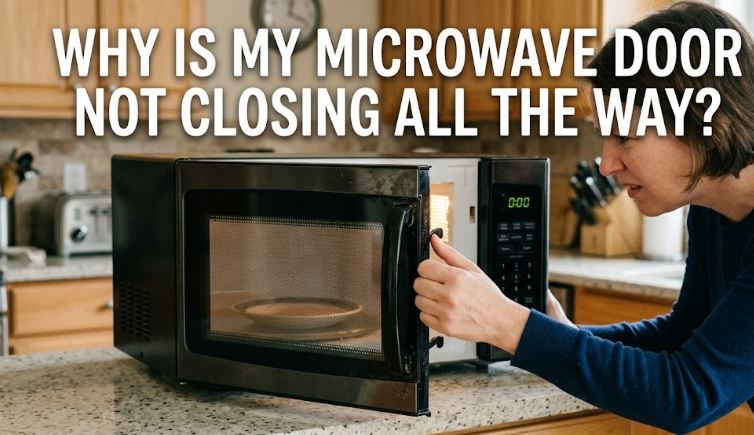
A microwave door that does not close properly is not just an inconvenience. It is a genuine safety issue that needs resolving before another cycle runs. Every microwave is designed with a safety interlock system that prevents operation unless the door is fully and correctly closed. That system exists to prevent microwave radiation from escaping into the kitchen during use.
If your door is not closing, the machine will not start and that is the safety system doing its job correctly. If your door appears to close but the microwave still runs without proper contact, that is a more serious situation that requires immediate attention.
Work through the causes below in order. Most are visible from the outside and several require no tools or parts at all.
Critical Safety Reminder
Do not operate a microwave with a door that does not close and seal properly. Microwave radiation leakage from an improperly sealed door poses a genuine health risk. Also never open the microwave cabinet for any internal repair. The capacitor retains a lethal charge even after unplugging. Every cause below is clearly marked as either a safe external check or a professional repair.
Quick Reference for a Microwave Door That Won’t Close Properly
| What You Notice | Most Likely Cause |
|---|---|
| Door bounces back instead of latching | Broken or worn door latch hooks |
| Door closes but feels loose or wobbly | Loose or damaged door hinges |
| Door misaligned, gaps visible on one side | Sagging hinge or bent door frame |
| Door closes fine but microwave won’t start | Door interlock switches not engaging |
| Door handle feels different, door resists | Broken torsion spring or damaged handle |
| Debris preventing full closure | Food buildup in latch cavity or door frame |
Why the Microwave Door Won’t Close Properly
Check out these issues if your microwave door won’t shut properly and learn to fix them:
1. Food Debris Is Blocking the Latch or Frame
This is always the first thing to check because it costs nothing, takes two minutes, and resolves more door closure complaints than most people expect.
Food splatter, grease buildup, and dried debris accumulate in the latch receptacle, the latch hooks, and along the door frame gasket over time. Even a thin layer of hardened grease inside the latch cavity can prevent the door hooks from seating fully, making the door feel like it bounces back or does not click into place with the usual firmness.
This is especially common in heavily used microwaves that are not cleaned regularly around the door frame and latch area.
How to Clean the Latch and Frame
Unplug the microwave before cleaning. Dampen a soft cloth with warm water and a small amount of mild dish soap. Wipe the entire door frame, the latch receptacle openings on the microwave body, and the latch hooks along the door edge. Use a soft toothbrush to reach inside the latch cavities where a flat cloth cannot access.
Dry everything thoroughly before plugging back in and testing. Never spray cleaning products directly into the latch opening since liquid reaching the door interlock switches creates a safety hazard. If the door closes firmly after cleaning, debris was the entire cause.
2. The Door Latch Hooks Are Worn or Broken
This is the most common mechanical cause of a microwave door that will not close properly, and it is visible from the outside of the door without opening anything.
Most microwave doors have two plastic latch hooks along the leading edge of the door that engage small receptacle openings on the microwave body when the door closes. These hooks activate the door interlock switches and confirm to the control board that the door is fully closed.
Over years of daily use, the plastic hooks wear down at their tips, crack, or break entirely. A worn hook no longer reaches deep enough into the receptacle to engage the switch, and the door either does not stay closed or stays closed without the microwave recognizing it as properly latched.
How to Inspect the Door Latch Hooks
Open the door and examine the latch hooks along the door edge under good lighting. Look for visible cracking, chipping, a rounded or flattened tip where the hook should be sharply defined, or a hook that is missing entirely. Compare both hooks to confirm whether wear is even or confined to one.
Also check the receptacle openings on the microwave frame for cracks or deformation that would prevent the hooks from seating properly even if the hooks themselves are intact.
Latch hook replacement is a model-specific repair that accesses the inner door panel. On most countertop microwaves, the inner door panel is accessible by removing screws from the door perimeter. Search your model number alongside “door latch” or “door hook” on Amazon to find the correct part.
3. The Door Hinges Are Loose or Damaged
Door hinges bear the full weight of the microwave door every time it is opened and closed. On over-the-range microwaves, the door is particularly heavy and the hinges take significant daily stress. Over time, hinge mounting screws loosen, hinge pins wear, or the hinge bracket itself bends, causing the door to sag and misalign with the latch receptacles on the frame.
A sagging or misaligned door produces a specific symptom: the door closes easily on one side but shows a visible gap or requires extra pressure on the other side. You may also notice the door handle sits lower than it used to relative to the microwave body.
How to Inspect the Hinges
Open the door fully and look at the hinge points where the door connects to the microwave body, typically at the bottom and sometimes the top of the door on countertop models, or along the side on over-the-range models. Check for loose screws at the hinge mounting points and tighten any that have worked loose with a screwdriver.
If tightening the hinge screws does not restore proper door alignment, the hinge itself has worn or bent and needs replacement. Hinge replacement on over-the-range microwaves is more involved due to the door weight and mounting position. On machines where hinge damage has caused the door to sag enough to create a visible gap along the seal, professional assessment is the recommended approach since radiation leakage testing should be performed after any door alignment repair.
4. The Door Torsion Spring Is Broken
DIY safety level: Symptom identification is safe. Spring replacement accesses the door interior.
Torsion springs are used on downward-opening microwave doors to provide the tension that keeps the door closed when latched and controls the door’s movement when opening. Most models that use torsion springs have one on each side of the door at the bottom hinge area.
When a torsion spring breaks, the door loses its tension and either falls open immediately after being released, does not stay closed reliably, or requires noticeably more effort to close than usual. On some models a broken spring also causes the door to hang at a slight angle rather than sitting flush against the frame.
How to Identify a Broken Torsion Spring
Open the door and notice whether it stays in position when released or drops immediately without support. Also notice whether closing the door requires more force than it used to and whether the door springs back slightly rather than staying latched.
Torsion spring replacement requires accessing the inner door panel, which on most models involves removing screws from the door perimeter. The springs sit at the bottom of the door frame and are visible once the inner panel is removed. Search your model number alongside “door torsion spring” or “door spring” on Amazon to find the correct replacement set. Replace both springs simultaneously since they wear together and a single replacement leaves the remaining spring at risk of imminent failure.
5. The Door Seal or Gasket Is Damaged
The door seal, sometimes called the choke seal or door gasket, runs around the inner perimeter of the door and creates a microwave-tight seal against the frame when the door closes. This seal does not need to be airtight since microwaves are not pressure vessels, but it does need to be intact and correctly positioned to prevent microwave radiation from escaping around the door edges during operation.
A damaged, compressed, or displaced seal can prevent the door from closing flush against the frame, creating a visible gap and preventing the latch hooks from reaching their full engagement depth.
How to Inspect the Door Seal
Open the door and examine the seal running around the inner door perimeter. Look for sections that have flattened, torn, pulled away from the door frame, or hardened from heat exposure. Press the seal gently along its entire length and confirm it springs back rather than staying compressed.
A seal that has pulled away from its groove can sometimes be pressed firmly back into position if the underlying groove is undamaged. A seal that is cracked, torn, or has lost all elasticity needs replacement. Search your model number alongside “door seal” or “door gasket” on Amazon to find the correct replacement. Installing a new seal involves pressing it firmly into the retaining channel around the door perimeter, which is a straightforward process on most models.
Note that after any door seal replacement, radiation leakage testing by a professional is recommended to confirm the new seal creates a proper barrier during operation.
6. The Door Frame Is Bent or Warped
Physical impact, dropping a heavy item against the door, closing the door forcefully against an obstruction, or simply years of thermal cycling from heat exposure can warp or bend the door frame itself. Even a few millimeters of deformation along the door frame prevents the door from sitting flush against the microwave body and creates gaps where the frame should contact the seal.
This cause is usually visible by looking at the microwave from the front with the door closed and checking whether the door sits evenly against the body on all sides.
How to Assess Frame Damage
Close the door and look at the gap between the door edge and the microwave frame from the front. A consistent, even gap all the way around is normal. A gap that is noticeably larger on one side, wider at the top or bottom, or absent on one side and wide on the other points to frame deformation.
Minor door frame deformation on inexpensive countertop microwaves is often not economically repairable since straightening the frame requires specialized equipment. For machines where the door frame is warped enough to create visible gaps, replacement of the machine is usually more cost-effective than repair.
For over-the-range microwaves where the replacement cost is higher, a professional assessment determines whether the frame can be corrected or whether the unit needs replacing. Check out new microwave models on Amazon!
7. The Door Interlock Switches Have Failed
DIY safety level: External symptom observation only. Switch replacement is a professional repair.
This cause produces a specific and important variation of the door closure problem. The door closes and latches normally from the outside, the latch hooks engage, the door feels secure, but the microwave still will not start because the internal door interlock switches are not registering the door as properly closed.
Microwave door interlock switches are small electrical switches positioned behind the latch receptacles. When the door hooks push into the receptacles and engage, they physically press these switches to complete the circuit that allows the magnetron and other components to receive power. When a switch fails or its actuator wears down, the door can be physically closed while the switch reports it as open, and the safety system prevents the microwave from starting.
A secondary and more serious failure mode is a switch that remains closed when the door is open, which bypasses the safety system. This is why a microwave that starts running immediately when the door is opened should be unplugged immediately and taken to a technician without further use.
What to Observe and What to Do
If the door closes firmly and the latch feels secure but the microwave displays a door error, shows a light that stays on with the door closed, or simply refuses to start, a failed interlock switch is the likely cause.
Do not attempt to access or replace the interlock switches yourself. They sit inside the microwave cabinet directly adjacent to the high-voltage components. A technician with equipment to safely discharge the capacitor handles this repair. The switches themselves cost very little, typically $5 to $15 each, making the professional labor cost the primary expense at $80 to $150 for the repair.
Microwave Door Closure Fix Cost and Safety Level Overview
| Cause | Safe DIY | Part Cost | Pro Repair Cost |
|---|---|---|---|
| Clean latch and frame | Yes | Free | N/A |
| Tighten loose hinge screws | Yes | Free | N/A |
| Reseat displaced door seal | Yes | Free | N/A |
| Door latch hook replacement | Partial DIY | $10 – $30 | $80 – $150 |
| Door torsion spring | Partial DIY | $8 – $20 | $80 – $150 |
| Door seal replacement | Partial DIY | $10 – $25 | $80 – $150 |
| Door hinge replacement | Moderate DIY | $15 – $35 | $100 – $180 |
| Door interlock switches | Professional only | $5 – $15 parts | $80 – $150 |
| Bent door frame assessment | Professional only | N/A | $80 – $200 |
Frequently Asked Questions
Is it safe to use my microwave if the door does not close completely?
No, and this is not an area where caution is optional. A microwave door that does not close and seal properly allows microwave radiation to escape during operation. Microwave radiation at close range causes tissue heating and can damage eyes particularly quickly since the lens has no cooling blood supply. Do not use the microwave until the door closes and seals correctly.
My microwave door closes but the machine still will not start. What causes that?
A door that closes physically but fails to start the microwave points to a failed door interlock switch rather than a mechanical closure problem. The latch hooks are engaging the receptacles but not pressing the interlock switches far enough to complete the circuit. This is a professional repair since the switches sit adjacent to the high-voltage components inside the cabinet.
Can I fix a microwave door latch myself?
On many countertop microwave models, yes. The door latch hooks are accessed by removing screws from the door perimeter and lifting the inner door panel. This area does not involve the high-voltage components and is safe for a careful DIYer following model-specific guides. However, anything that requires opening the main microwave body rather than the door panel itself should be left to a professional due to the capacitor risk.
How long do microwave door latches typically last?
Plastic door latch hooks typically last eight to twelve years under normal daily use. Opening the door roughly, allowing children to hang on the door, or consistently slamming the door rather than closing it gently all accelerate latch wear significantly. Replacing worn latch hooks proactively when they first show visible rounding is far less disruptive than waiting for a complete failure.
My microwave door suddenly started feeling different when closing. Should I be concerned?
Yes. A door that closes differently than it used to is telling you something has changed in the latch, spring, or hinge system. A door that feels looser, requires more force, bounces back more than usual, or makes a different sound when latching should be inspected immediately. Meanwhile, a door closure system that is partially compromised typically continues deteriorating until it fails completely, at which point the microwave becomes unusable until repaired.
Fix Your Microwave Door Today!
A microwave door that will not close properly almost always starts with something visible and accessible. Clean the latch area first, check the hooks, inspect the hinges, and examine the seal before drawing any conclusions about internal components.
Most door closure problems are resolved at the latch hook or debris level without touching anything inside the machine. For related reading, check out our post on microwave sparks when running for related safety and operational faults and our complete microwave troubleshooting guide for other common microwave problems worth troubleshooting.