
Your Maytag dishwasher was running a normal cycle, and then it stopped. A code appeared on the display — something like F9E1 or F3E1 — and now the machine will not budge. Or maybe your Clean light is flashing in a repeating pattern that looks like a secret message you were never given the key to decode.
Here is the thing: those codes are not cryptic. They are your dishwasher telling you exactly what is wrong. Maytag’s diagnostic system is designed to pinpoint the problem down to a specific component, which means that with the right information, many of these errors are fixable without a service call. This guide covers every major Maytag dishwasher error code, what causes each one, and what you can do about it today.
How Maytag Dishwasher Error Codes Work
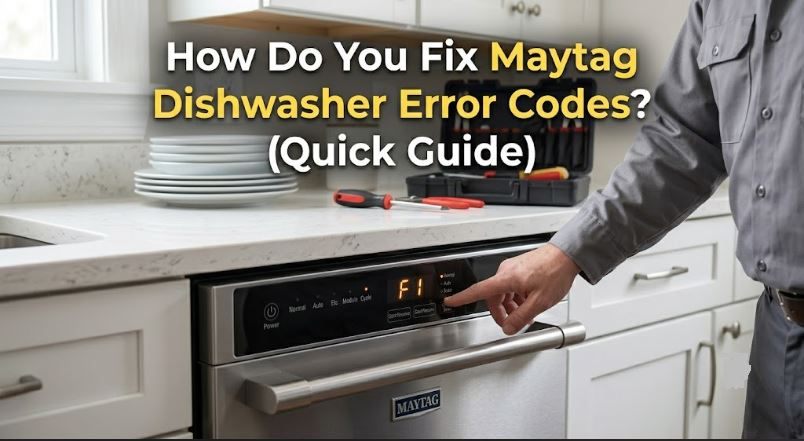
Maytag dishwashers communicate faults in two ways depending on the model. Newer models with digital displays show alphanumeric codes in an F# E# format. Older models without displays use flashing light sequences and display symbols on the control panel instead.
Understanding which system your dishwasher uses is the first step to reading it correctly.
F# E# Codes on Digital Display Models
Modern Maytag dishwashers use a two-part code structure. The F number identifies the system or category where the fault occurred. The E number narrows it down to the specific component or condition within that system. F9E1, for example, means Function 9 (drainage) and Error 1 (slow or no drain detected).
When a code appears, the dishwasher typically stops the cycle and waits. It does not always mean something is broken — sometimes a code clears with a simple reset or a quick maintenance step.
Flashing Light Sequences on Older Models
Older Maytag models without a digital display communicate errors through the Clean light or other panel lights flashing in a specific repeating pattern. The number of flashes before a pause indicates the fault category. Seven flashes, for example, typically point to a heating element issue on older HE-series models.
Count the blinks carefully, note any pause between groups, and match the pattern to the code list below.
Complete Maytag Dishwasher Error Code Reference
The table below covers the most common Maytag dishwasher error codes across both digital and older models.
| Error Code | System | Fault | DIY Fixable? |
|---|---|---|---|
| F0E1 | Communication | Control panel lost contact with main board | Often yes — reset first |
| F1E1 | Control board | Main control board failure | Possibly — reset, then replace |
| F2E1 | Keypad | Stuck or shorted key on control panel | Partially — dry out first |
| F3E1 | Temperature sensor | Water temperature sensor (thermistor) fault | Yes — check wiring first |
| F5E1 | Door | Door switch not detecting latch | Yes — check latch alignment |
| F5E2 | Door | Door stuck closed — control cannot release | Yes — check door spring |
| F6E1 | Water supply | No water entering dishwasher | Yes — check inlet valve |
| F6E2 | Water supply | Inlet valve electrical fault | Partially — check wiring |
| F6E4 | Float switch | Float stuck or overfill detected | Yes — check and free float |
| F7E1 | Heating | No heat detected during cycle | Yes — check element and wiring |
| F7E2 | Heating | Heater relay stuck on | No — replace control board |
| F8E4 | Water level | Overfill — too much water in tub | Yes — check float switch |
| F9E1 | Drainage | Slow drain or no drain | Yes — most common DIY fix |
| F9E2 | Drainage | Drain pump electrical fault | Partially — check wiring |
F-Code Breakdown: Causes and Fixes by Category
Each category of codes shares a common root cause. Understanding the category helps you narrow down the fix before pulling out a screwdriver.
F0 and F1 Codes: Communication and Control Board
These codes indicate the dishwasher’s two main electronic brains have lost contact with each other or one has failed.
The first step for any F0E1 or F1E1 code is a hard reset. Turn off the circuit breaker for at least one full minute, then restore power. This clears the dishwasher’s memory and resets the communication pathway. If the code returns immediately after power is restored, the control board or user interface board has a persistent fault.
F0E1 specifically means the user interface (control panel) and the main control board can no longer communicate. This is sometimes caused by a loose ribbon cable connection between the two boards — particularly common on older models where heat cycling has loosened the connector over years of use. If you are comfortable with basic appliance disassembly, inspect and reseat the ribbon cable before ordering a replacement board.
F1E1 points directly to the main control board. In some cases, a stuck relay or failed capacitor on the board is the culprit. A hard reset fixes it occasionally. If it persists, board replacement is the path forward. Our GE Profile dishwasher control panel troubleshooting guide explains the diagnostic principles behind control board and ribbon cable faults that apply across most dishwasher brands including Maytag.
F2 Codes: Keypad and Control Panel
F2E1 means a key on the control panel is registering as continuously pressed. This is more common than it sounds.
The most frequent cause is moisture behind the panel. Steam from the wash cycle, cleaning spray applied directly to the panel, or a spilled beverage can leave moisture trapped between the membrane and the circuit board. That moisture creates a conductive path that mimics a pressed button.
The fix: power off the dishwasher, leave the door open for 12 to 24 hours, then restore power and test. If the key is physically stuck or damaged, the user interface board needs replacement.
F3 Codes: Temperature Sensor
F3E1 indicates the thermistor — the temperature sensor that monitors water heat during the wash — is sending a reading outside the expected range.
First, check that your home water heater is set to at least 120 degrees Fahrenheit. Run the kitchen hot tap for 30 seconds before starting a cycle to ensure hot water has reached the supply line. If water temperature is adequate and F3E1 persists, the thermistor itself has likely failed and needs replacement. This is a low-cost part and a straightforward replacement on most Maytag models.
F5 Codes: Door Latch and Switch
F5E1 means the door switch is not detecting that the door is properly latched. The dishwasher will not run without a confirmed door closure — this is a safety interlock.
Start by checking the door latch for physical damage or misalignment. A lower rack loaded backwards or overloaded can prevent the door from closing fully, which triggers this code without any mechanical fault. Remove the lower rack and reinstall it correctly, then close the door firmly and listen for the latch click.
If the latch mechanism itself is damaged or the switch has failed, both parts are available and replaceable without professional tools on most Maytag models.
F6 Codes: Water Supply
These codes indicate a problem with water entering the dishwasher. F6E1 means no water was detected filling the tub. F6E2 points to an electrical fault at the inlet valve. F6E4 means the float switch — the safety mechanism that prevents overfilling — has detected an open circuit or an overfill condition.
For F6E1, start at the supply valve under the sink. Confirm it is fully open. Check the inlet hose for kinks. Then inspect the inlet valve screen — a fine mesh filter at the valve itself that can clog with sediment over time. Turn off the water supply, disconnect the inlet hose, and clean the screen with an old toothbrush.
For F6E4, open the dishwasher and locate the float — a small dome or cylinder at the front base of the tub. Wiggle it gently to ensure it is not stuck in the up position, which would trigger the overfill sensor continuously. If it moves freely and the code persists, the float switch itself needs testing and potentially replacement.
F7 Codes: Heating System
F7E1 means the dishwasher completed a cycle without detecting any heat from the heating element. The most common causes are a burned-out heating element, a failed high-limit thermostat, or a wiring connection that has come loose at the element terminals.
A multimeter test of the heating element for continuity is the definitive diagnostic step. A reading of OL (open loop) confirms the element has failed. Replacement heating elements for common Maytag models are available on Amazon and are accessible from inside the tub by removing the lower spray arm and filter assembly.
F7E2 is more serious — it means the heater relay on the control board is stuck in the on position, continuously powering the element. This code requires control board replacement and is not a safe DIY repair to leave operating.
F8 and F9 Codes: The Most Common Maytag Dishwasher Errors
These are the two codes most Maytag owners will encounter at some point, and both are frequently resolved without replacing any parts.
F8E4: Overfill Detected
This code means water entered the tub beyond the safe level. The most common cause is a stuck float switch — either physically stuck in the down position (allowing overfill) or sending incorrect readings to the control board. Check the float, clean around it, and ensure it moves freely.
A faulty water inlet valve that does not close fully when powered off can also cause slow overfilling between cycles. If the float is moving freely and F8E4 continues appearing at the start of cycles, the inlet valve is the likely culprit.
F9E1: Slow or No Drain
F9E1 is the most common Maytag dishwasher error code and the one most often resolved with maintenance rather than parts. It means the dishwasher attempted to drain but did not empty within the expected time window.
Work through these steps in order before assuming a component failure:
- Clean the dishwasher filter. Remove the lower rack, twist out the cylindrical filter at the base of the tub, and rinse it thoroughly under warm running water.
- Check the drain hose under the sink for kinks or blockages. The hose should loop upward to at least 18 inches above the floor before connecting to the drain.
- Run the garbage disposal for 30 seconds. Dishwashers share the same drain line, and a blocked disposal is one of the most common causes of F9E1.
- Inspect the air gap if your installation has one. The chrome cylinder on the countertop or sink can collect debris that restricts drainage.
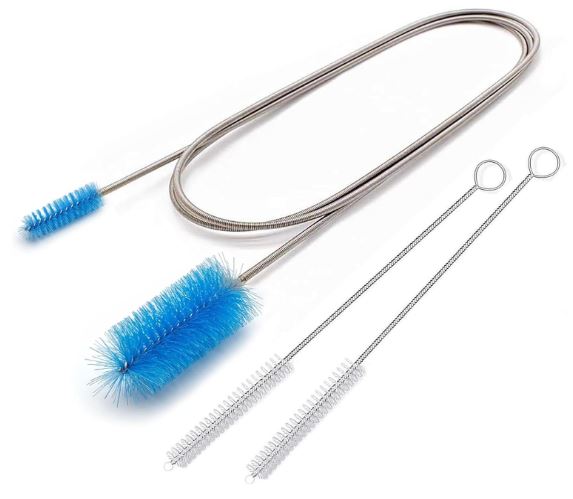
For drain hose cleaning, a 67-inch flexible drain brush (View on Amazon) threads through the hose and removes accumulated grease and debris without disassembly.
If F9E1 persists after all of the above, the drain pump itself may be blocked or failing.
The Clean Light Flash Code System (Older Maytag Dishwasher Models)
Maytag models without a digital display use repeating Clean light flash sequences to indicate faults. Count the flashes before each pause — the number indicates the fault category.
| Flash Count | Fault Indicated | First Step |
|---|---|---|
| 1 flash | Stuck relay or software error | Hard reset — cut power 1 minute |
| 3 flashes | Water temperature too low | Check water heater setting |
| 4 flashes | Open or shorted temperature sensor | Inspect thermistor wiring |
| 6 flashes | Water supply issue | Check inlet valve and supply |
| 7 flashes | Heating element fault | Test element for continuity |
| 8 flashes | Slow drain | Clean filter, check drain hose |
| 9 flashes | Diverter motor problem | Check diverter valve and motor |
A steady Clean light after a cycle is normal confirmation. A flashing Clean light at the start of a cycle or mid-cycle is the diagnostic signal to count.
How to Reset a Maytag Dishwasher After an Error Code
Many Maytag dishwasher error codes clear on their own once the underlying problem is resolved. For codes that persist, a control reset is the correct first response before attempting any repair.
Press Cancel/Drain and allow the pump to complete its drain cycle — this takes one to two minutes. Then disconnect the dishwasher from power by turning off the circuit breaker for at least one full minute. Restore power, close the door firmly, select a cycle, and press Start.
If the same code returns immediately, the fault is confirmed as persistent and the relevant component needs inspection. If the code does not return, monitor the machine through two or three full cycles before concluding it was a transient error.
Preventing Error Codes with Regular Maintenance
Most Maytag dishwasher error codes — particularly F9E1 drain faults and F7 heating codes — are preventable with consistent maintenance.
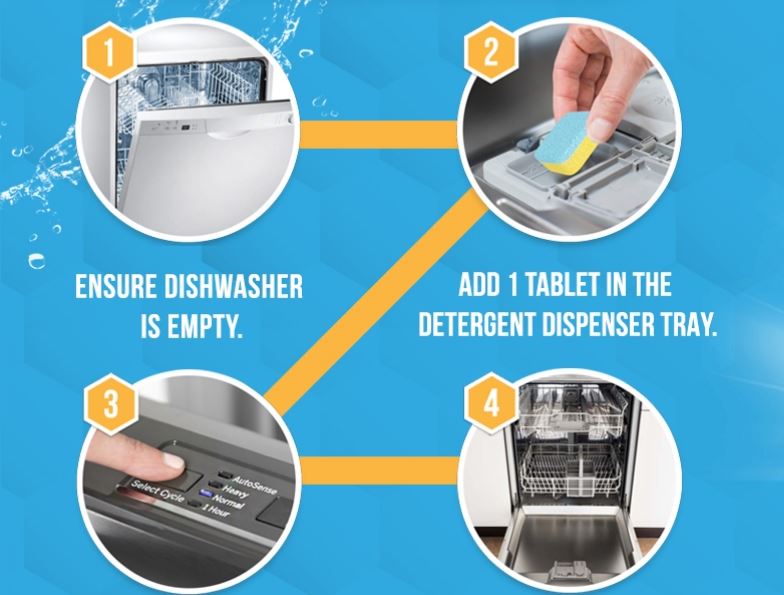
Clean the filter monthly. Run a dishwasher cleaning cycle every four to six weeks using a machine cleaner that removes limescale, grease buildup, and mineral deposits from the pump, spray arms, and internal hoses. Affresh Dishwasher Cleaner Tablets (View on Amazon) are specifically formulated for Whirlpool-platform appliances (which includes Maytag) and are one of the most consistently effective options available.
For households in hard water areas where limescale accumulates rapidly, a descaling cleaner with citric acid removes mineral deposits more aggressively. The ACTIVE Dishwasher Cleaner Tablets 24-pack, one-year supply (View on Amazon) explicitly lists Maytag compatibility and tackles limescale, grease, and odor in a single cycle.
Run the kitchen hot tap for 30 seconds before starting any cycle. This ensures the dishwasher fills with hot water from the start rather than drawing cold water from a supply line that has cooled between uses — the most common trigger for F3 and F7 heating-related codes.
If your dishwasher develops cleaning problems alongside error codes — dishes coming out with residue or spotting — our dishwasher not cleaning dishes guide covers spray arm blockages, water pressure issues, and detergent dispenser faults that often accompany diagnostic codes.
When to Call a Technician
Most Maytag dishwasher error codes have at least one DIY step worth trying before booking a service call. The ones that generally require professional diagnosis are:
- F7E2 — heater relay stuck on (control board replacement, involves electrical risk)
- F1E1 that persists after multiple resets and ribbon cable inspection (board replacement)
- F9E2 drain pump electrical fault that persists after wiring checks (pump motor replacement)
- Any code that returns immediately after a new part is installed (may indicate a secondary component failure or a wiring harness issue)
For everything else, the steps above give you a realistic chance of resolving the problem yourself. A standard Maytag dishwasher service call runs $150 to $300 before parts. Knowing which codes have simple fixes is the difference between spending an afternoon on a maintenance task and spending a week waiting for a technician appointment.
Frequently Asked Questions
What does F9E1 mean on a Maytag dishwasher?
F9E1 means the dishwasher detected a slow or absent drain during the cycle. Clean the filter, check the drain hose for kinks, run the garbage disposal, and inspect the air gap. Most F9E1 codes clear after filter and drain hose maintenance without any parts replacement.
How do I reset a Maytag dishwasher error code?
Press Cancel/Drain and let the pump drain for one to two minutes. Then turn off the circuit breaker for at least one minute before restoring power. If the code returns immediately, the fault is confirmed as persistent and the relevant component needs inspection.
What does the Clean light flashing 7 times mean on a Maytag dishwasher?
Seven flashes on older Maytag models without a digital display typically indicate a heating element fault. The element may have failed, or the high-limit thermostat or wiring connection at the element terminals may be the cause. Test the element with a multimeter for continuity.
Can I run my Maytag dishwasher with an error code showing?
It depends on the code. Codes related to drainage (F9E1) or temperature sensing (F3E1) may allow a cycle to complete with compromised performance. Codes related to door latching (F5E1) or control board communication (F0E1) will typically prevent the cycle from running at all. Running a cycle through an active F7E2 heater-stuck-on code is not safe and should not be attempted.
How often should I clean my Maytag dishwasher filter to prevent error codes?
Maytag recommends cleaning the filter monthly under normal household use. Households with hard water, households with young children, or households that run the dishwasher daily should clean it every two to three weeks. A clogged filter is the single most preventable cause of F9E1 drain errors.

Hi, I’m Barlgan! I created Repair Me Yourself to empower homeowners to tackle appliance repairs with confidence. From decoding error codes to fixing cooling issues, I break down complex repairs into simple, actionable steps that save you time and money.