Reach into the freezer for a scoop of ice cream and chip your spoon on something approaching concrete. Pull out a bag of vegetables and find everything welded together in a solid block. Check the walls and find a thick frost layer building up where there should not be one. These are all signs that your freezer has crossed the line from doing its job into overdoing it.
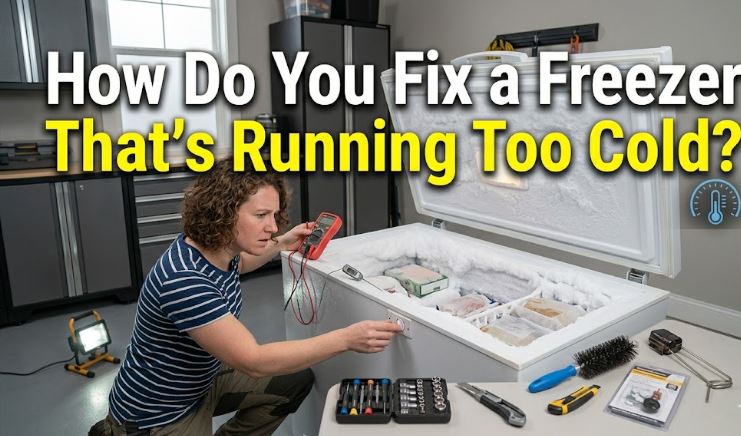
People rarely think to question a freezer that is too cold. More cold feels like more protection. But a freezer running significantly below the correct temperature wastes energy, causes freezer burn on food that would otherwise be fine, and almost always signals an underlying issue that will worsen if ignored. The ideal freezer temperature is 0°F (-18°C). Anything significantly below that is unnecessary for food preservation and is telling you something specific about the appliance.
The good news is that most causes of a freezer running too cold are accessible and fixable without a technician. Let’s work through each one.
What Is Keeping Your Freezer Too Cold?
Here’s an overview of why your freezer freezes more than it should:
| What You Notice | Most Likely Cause |
|---|---|
| Freezer significantly below 0°F with no changes made | Temperature control set too high or faulty thermostat |
| Thick frost or ice buildup on walls | Defrost system failure or door seal leak |
| Food freezer burned despite proper wrapping | Temperature fluctuating or running too low |
| Freezer too cold, fridge section too warm | Air damper stuck open or blocked vents |
| Temperature drops after ice maker was turned on | Ice maker running without a water supply connection |
| Temperature correct at dial but wrong in practice | Faulty thermistor sending wrong readings |
| Everything frozen solid including items near the door | Overfilled freezer blocking airflow to thermostat |
7 Reasons Your Freezer Is Too Cold and How to Fix Each One
These are the causes behind virtually every freezer running colder than it should.
1. The Temperature Control Is Set Too Low
Before opening any panels or considering any component, spend thirty seconds at the temperature dial or digital panel. This resolves more freezer-too-cold complaints than any other single cause.
Someone may have bumped the dial during a deep clean, a child may have adjusted the settings, or the control may have shifted during reorganization. Freezer temperature dials on older models are often unlabeled with clear degree markings and use a 1 through 9 or Min through Max scale instead, which makes it easy to accidentally dial past the correct setting without realizing it.
Here Is How to Check and Fix It
- Place a Freezer Thermometer (View on Amazon) in the center of the freezer and leave it for four hours before reading the temperature
- The correct freezer temperature is 0°F (-18°C). Anything below -5°F is unnecessarily cold and wastes energy
- Adjust the temperature control one setting at a time toward warmer, then wait 24 hours before checking again since freezers take time to stabilize after any adjustment
- For digital control panels, confirm the displayed set point matches the manufacturer’s recommendation in the user manual, since some panels show the set point while others show the actual measured temperature
- If the control is already set correctly but temperature is still too low, the control itself or the thermostat may be faulty
2. The Air Vents Are Blocked Inside the Freezer
Proper airflow inside the freezer is what keeps temperature consistent and prevents any single area from becoming significantly colder than the rest. Air circulates from the evaporator through internal vents to all parts of the compartment. When food packaging blocks those vents, cold air concentrates in one area, the thermostat sensor gets an artificially warm reading from another area, and the compressor keeps running to compensate, pushing temperatures lower than they should be throughout the compartment.
This is one of the most common causes of a freezer that gradually gets colder over weeks as items are added without attention to placement.
Here Is How to Fix It
- Check the interior walls and back panel for small vent openings and confirm no food packaging, bags, or containers are pressed directly against them
- Reorganize the freezer so all items sit at least an inch away from the walls and the back panel
- Avoid packing the freezer so tightly that air cannot circulate between items. Aim for about 75 to 80 percent full as the maximum
- Confirm the evaporator fan cover at the back of the freezer compartment is not blocked by ice buildup, which would point to a separate defrost system issue addressed below
3. The Defrost System Has Failed
This is one of the more counterintuitive causes on the list because a defrost system failure seems like it should make a freezer warmer, not colder. Here is why the opposite happens.
When the automatic defrost heater fails to melt frost from the evaporator coil periodically, ice builds up progressively on the coil. That ice insulates the cold coil surface and blocks airflow through the evaporator. The compressor runs harder and more frequently trying to compensate for the reduced efficiency, pushing temperatures lower in the process. Meanwhile, ice builds up on the freezer walls and blocks the internal vents.
A thick frost layer on the walls, particularly on the back wall near the evaporator, is the clearest sign of a defrost system problem.
Here Is How to Diagnose and Address It
- Unplug the freezer and manually defrost it by leaving the door open and placing towels inside to catch the melt water. Allow 24 to 48 hours for complete defrost
- Plug it back in and monitor whether frost returns to the walls within a week. Normal frost is minimal. Returning wall frost within a week confirms the automatic defrost system is not running correctly
- The defrost system has three components: the defrost heater, the defrost thermostat, and the defrost timer or control board. Each can be tested with a multimeter for continuity
- The WR51X10055 Defrost Heater Assembly (View on Amazon) is the most commonly replaced defrost component on GE and related models. Search your specific model number alongside “defrost heater” on Amazon to find the correct part for your appliance
4. The Door Gasket Is Leaking
A leaking door gasket seems like it should make a freezer warmer by letting cold air out. In practice, a compromised gasket allows warm, humid air from outside the freezer to seep in continuously. That warm air deposits moisture on the evaporator coil and walls, frost accumulates rapidly, and the compressor runs almost constantly to maintain temperature against the continuous infiltration. The result is a freezer that runs colder than the set point because the compressor never gets to rest.
Additionally, the rapid frost buildup that results from a leaking gasket blocks internal vents and contributes to the too-cold condition described in cause three above.
Here Is How to Inspect and Fix the Gasket
- Run your hand slowly around the entire perimeter of the closed freezer door feeling for cold air escaping. Any detectable draft confirms a seal failure at that location
- Use the dollar bill test: close the freezer door on a dollar bill and try to pull it out. A healthy gasket holds the bill firmly with noticeable resistance. A leaking gasket lets the bill slide out easily
- Inspect the gasket visually for visible cracks, tears, compression deformation, or sections that have hardened and lost their flexibility
- Clean the gasket with warm water and mild dish soap first since built-up grease and debris can prevent it from sealing correctly even when undamaged
- If cleaning does not restore the seal, a replacement freezer door gasket (View on Amazon) is necessary.
5. The Air Damper Is Stuck Open
This cause applies specifically to combination refrigerator-freezer units rather than standalone freezers. The air damper, sometimes called the diffuser or freezer control, is a small flap that regulates how much cold air flows from the freezer compartment into the refrigerator section. When it fails in the open position, too much cold air stays in the freezer rather than being shared with the refrigerator. The freezer runs below its correct temperature while the refrigerator section simultaneously runs too warm.
If your freezer is too cold and your refrigerator section is also warmer than it should be, the air damper is the first component to investigate.
Here Is How to Check and Fix It
- Locate the air damper on your model. It is typically found at the top of the refrigerator section or along the partition between the two compartments. Your user manual shows the exact location
- Unplug the appliance and inspect the damper for visible damage, debris blocking its movement, or a flap that is stuck in the fully open position
- With the unit unplugged, the damper flap should move freely between open and closed positions when pushed gently. A damper that is physically stuck needs cleaning or replacement
- If the damper moves freely but does not regulate automatically during operation, the temperature sensor attached to it has failed and the damper assembly needs replacement.
6. The Thermistor Is Sending Inaccurate Readings
Safety level: Testing is safe with a multimeter. Replacement is accessible DIY.
The thermistor is a small temperature sensor inside the freezer that continuously monitors the compartment temperature and sends that reading to the control board. The board uses that data to decide when to run the compressor and for how long. When the thermistor fails and sends readings that are warmer than the actual temperature, the control board thinks the freezer needs more cooling than it actually does and runs the compressor continuously, driving the actual temperature well below the set point.
This cause can be difficult to identify without testing since the thermistor looks physically intact even when it has failed electrically.
Here Is How to Test and Replace It
- Unplug the freezer and locate the thermistor, usually a small probe attached to the evaporator coil or clipped to the internal wall near the evaporator cover
- Test the thermistor with a multimeter set to resistance. At room temperature, most freezer thermistors should read between 5,000 and 20,000 ohms depending on the brand and model. Your user manual or a model-specific guide provides the correct range
- A reading significantly outside the expected range confirms the thermistor is faulty and sending incorrect temperature data to the control board. Hence, it requires a replacement (View on Amazon).
7. The Ice Maker Is Running Without a Water Supply
This is a specific cause that affects combination refrigerator-freezers with built-in ice makers and surprises many homeowners when they first learn about it.
When the ice maker is switched on but the water supply line is not connected or the supply valve is turned off, the ice maker motor attempts to run its harvest cycle repeatedly without producing any ice. Those repeated motor cycles generate heat inside the ice maker compartment, which the freezer’s thermostat interprets as a temperature rise. The compressor runs more frequently and longer than it should to compensate for the perceived heat, driving the freezer temperature below its correct set point.
Here Is How to Identify and Fix It
- Check whether the ice maker is switched on by locating the ice maker power switch or arm inside the freezer compartment
- Check whether the water supply line connected to the back of the refrigerator is properly attached and whether the supply valve behind the unit is open
- If the ice maker is on but no water supply is connected, either connect a supply line or switch the ice maker off until a supply line can be installed
- After switching the ice maker off, allow 24 hours for the freezer temperature to stabilize and confirm it returns to 0°F before concluding the issue is resolved
Freezer Too Cold Fix Cost Overview
| Cause | DIY Safe | Fix Cost | Pro Service Cost |
|---|---|---|---|
| Adjust temperature control | Yes | Free | N/A |
| Reorganize to unblock air vents | Yes | Free | N/A |
| Switch off unconnected ice maker | Yes | Free | N/A |
| Manual defrost to assess defrost system | Yes | Free | N/A |
| Clean or replace door gasket | Yes | Free – $30 | $100 – $200 |
| Defrost heater replacement | Moderate DIY | $15 – $40 | $150 – $300 |
| Thermistor replacement | Moderate DIY | $10 – $25 | $100 – $200 |
| Air damper replacement | Moderate DIY | $20 – $50 | $100 – $200 |
Frequently Asked Questions
What is the correct temperature for a freezer?
The correct freezer temperature is 0°F (-18°C). This temperature keeps food safely frozen, preserves food quality, and operates the compressor at an efficient duty cycle. Anything significantly below -5°F is unnecessarily cold, does not improve food preservation, and increases energy consumption without benefit.
Can a freezer that is too cold damage my food?
Yes, in two specific ways. Extreme cold accelerates freezer burn by drawing moisture from food surfaces more aggressively than normal freezing temperatures do. It also causes ice crystals to form more rapidly inside food cells, which degrades the texture of items like fruit, bread, and cooked proteins when they are thawed. Food safety is not the concern at overly cold temperatures. Food quality is.
How long does it take for a freezer to stabilize after a temperature adjustment?
Allow at least 24 hours after any temperature adjustment before checking the thermometer again. Large adjustments or a freezer that was significantly overfull may take up to 48 hours to reach a new stable temperature. Checking too soon and making additional adjustments before the freezer stabilizes leads to overcorrecting in the opposite direction.
Why is my freezer too cold at the back but normal at the front?
Temperature variation between the back and front of the freezer almost always points to a blocked internal air vent at the back of the compartment. Cold air from the evaporator exits through these vents and if they are obstructed by food packaging or ice buildup, the back of the freezer gets significantly colder than the set point while the front remains at a normal temperature. Clear the vents and reorganize items away from the back wall.
Should I call a technician if my freezer is too cold?
Not immediately. The temperature control setting, vent blockage, ice maker status, and door gasket condition together resolve the majority of freezer-too-cold complaints without any professional involvement. If the freezer continues running too cold after addressing those causes and after a manual defrost, a thermistor or defrost system component has likely failed and professional diagnosis confirms which one needs replacement.
A Thermometer in the Freezer Is Worth More Than a Thousand Guesses
Addressing a freezer that runs too cold starts with knowing exactly how cold too cold actually is. Place an independent thermometer inside, give it four hours, and read the actual temperature before adjusting anything. That reading tells you whether you are dealing with a minor calibration issue or something more significant.
From there, work through the free checks in order: temperature setting, vent blockage, ice maker status, and door gasket. Those four steps resolve the vast majority of freezer-too-cold complaints before any tools come out. For related reading across the freezer category, our complete freezer troubleshooting guide covers every major freezer symptom, component failure, and brand-specific issue across all leading appliance brands.