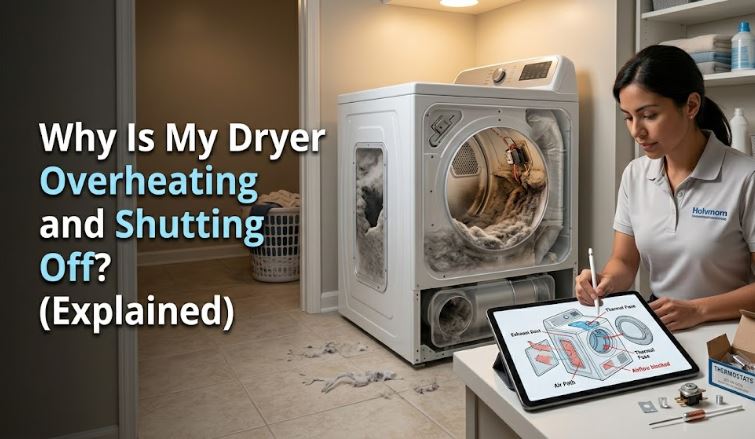
Your dryer stops mid-cycle. The clothes are still damp. You press start again and it runs for a few minutes before shutting off again. Or maybe you notice the outside of the machine feels dangerously hot, or clothes come out scorching rather than just warm.
A dryer overheating and shutting off is never something to keep pushing through. The shutoff is the machine’s built-in safety system doing its job. Something is causing internal temperatures to climb beyond safe limits, and the dryer cuts power to prevent a fire. That underlying cause needs to be found and fixed before another cycle runs.
The good news is that most causes are accessible and fixable. Let’s work through them from the most common to the most serious.
Safety Rule Before Anything Else
When a dryer shuts off from overheating, let it cool completely for at least 30 minutes before inspecting it or attempting a restart. Opening a hot dryer and immediately handling internal components creates a burn risk. Cooling first also allows any thermal safety devices to reset if they are the resettable type.
Quick Reference for Dryer Overheating and Shutting Off
| When It Shuts Off | Most Likely Cause |
|---|---|
| Shuts off after 5 to 10 minutes every cycle | Severe vent blockage or failed high-limit thermostat |
| Shuts off mid-cycle, restarts fine after cooling | Thermal overload protection triggering from restricted airflow |
| Clothes feel scorching hot at end of cycle | Cycling thermostat stuck in closed position |
| Dryer cabinet hot to the touch outside | Severely blocked exhaust vent trapping heat inside |
| Shuts off, burning lint smell present | Lint near heating element or severely clogged vent |
| Shuts off randomly with no pattern | Failing cycling thermostat or loose wiring connection |
What Causes a Dryer to Overheat and Turn Off Suddenly?
Your dryer may start to overheat and turn off due to any of these reasons:
1. The Exhaust Vent Is Blocked
This is the cause behind the overwhelming majority of dryer overheating shutoffs, and every technician starts here before touching any component.
Your dryer generates heat and relies entirely on continuous airflow to carry that heat and moisture out through the exhaust vent. When lint accumulates in the vent system and restricts that airflow, hot air has nowhere to go. It recirculates inside the cabinet, temperatures rise rapidly, and the safety system trips and shuts the machine off.
A severely blocked vent can bring a dryer to shutoff temperature within five to ten minutes of starting a cycle. And because lint is highly flammable, a blocked vent is not just an appliance problem. It is a fire hazard that needs immediate attention.
How to Clear a Blocked Exhaust Vent
Unplug the dryer and pull it away from the wall. Check the flex duct immediately behind the machine for kinks, compression, or sharp bends and straighten anything you find. Confirm the dryer sits at least eight inches from the wall.
Disconnect the vent hose and vacuum out both the hose and wall duct. For longer vent runs, the Holikme Dryer Vent Cleaning Brush Kit (View on Amazon) attaches to a standard drill and reaches deep into runs that a vacuum cannot clear. Then go outside and confirm the exterior vent flap opens fully and freely. A stuck or partially blocked exterior flap is one of the most overlooked causes of dryer overheating and takes two minutes to check.
Also check for birds’ nests, debris, leaves, or even snow blocking the exterior hood, particularly if the shutoff problem appeared suddenly rather than gradually.
2. The Lint Trap Is Clogged and Overdue for a Deep Clean
A fully loaded lint trap restricts airflow right at the entry point of the entire ventilation system. Every load adds more lint, and a trap that is not cleaned after every single use gradually chokes the airflow that keeps the machine from overheating.
Beyond the visible lint layer, a waxy coating from fabric softener and dryer sheet residue builds up on the mesh screen over time. This coating persists even after removing the visible lint and restricts airflow just as effectively as packed lint.
How to Deep Clean the Lint Trap
Remove and clean the screen before every load without exception. Then once a month, wash the screen under warm running water with a soft brush to dissolve the waxy residue layer. Hold it up to a light source after washing. Light should pass through the mesh evenly across the entire screen. Any dark patches where light is blocked mean more scrubbing is needed.
Also vacuum inside the lint trap housing slot monthly using a narrow vacuum attachment. Lint that bypasses the screen accumulates in the slot and around the blower housing below it, restricting airflow from inside the machine regardless of how clean the screen itself looks.
3. The Cycling Thermostat Has Failed
The cycling thermostat is the component responsible for turning the heating element on and off throughout the cycle to maintain a safe, consistent drum temperature. A working thermostat cycles the element off when the temperature reaches the set point and back on when it drops.
When the cycling thermostat fails in the closed position, it never signals the heating element to turn off. The element runs continuously at full power rather than cycling on and off, and temperatures inside the drum climb steadily until the high-limit thermostat or thermal fuse trips the shutoff.
This is one of the more common component causes of overheating and produces a very recognizable pattern: clothes come out scorching hot rather than just warm, and the dryer eventually shuts off before the cycle completes.
How to Test and Replace the Cycling Thermostat
Unplug the dryer and locate the cycling thermostat on the exhaust duct or blower housing. Test it with a multimeter for continuity at room temperature. A working thermostat shows continuity when cold. A thermostat stuck in the closed position also shows continuity at room temperature, but the key diagnostic is whether it opens and breaks continuity as temperature rises, which requires a more involved thermal test.
If you have already confirmed the vent is clear but the dryer still overheats, replacing the cycling thermostat is the most practical next step.
4. The High-Limit Thermostat Has Failed
The high-limit thermostat is the last line of thermal defense before the thermal fuse. It sits near the heating element and cuts power to the element if temperatures exceed a safe upper threshold.
When the high-limit thermostat itself fails in the closed position, it loses its ability to perform that cutoff. The element runs unchecked, temperatures rise beyond safe limits, and the thermal fuse eventually blows to shut the machine down completely.
A dryer that overheats repeatedly and has already blown through more than one thermal fuse is almost certainly dealing with a failed high-limit thermostat that was never replaced alongside the fuse.
How to Test and Replace the High-Limit Thermostat
Unplug the dryer and locate the high-limit thermostat on the heating element housing. Test it with a multimeter for continuity. Unlike the cycling thermostat, a working high-limit thermostat shows continuity at room temperature and should open and break continuity only above its rated temperature. A thermostat that shows no continuity at all at room temperature has failed open and needs replacing.
5. The Heating Element Is Shorted or Faulty
A heating element that has developed an internal short does not always stop producing heat. Sometimes it produces significantly more heat than it should because part of the element is bypassing normal resistance limits and running at a higher wattage.
This creates a dryer that overheats even with proper airflow, clear vents, and functional thermostats, because the heat source itself is generating more energy than the safety components are designed to handle at that output level.
How to Test a Shorted Heating Element
Unplug the dryer and remove the rear panel to access the heating element housing. Inspect the element coil visually for any sections that have sagged and are touching the element housing rather than sitting freely in their mounts. A coil touching the housing creates a ground short that causes excess heat output.
Test the element with a multimeter. Check for continuity between the element terminals and the element housing itself. Continuity between the element and the housing confirms a short to ground, and the element needs immediate replacement (View on Amazon).
6. The Blower Wheel Is Clogged or Damaged
The blower wheel is the internal fan that drives airflow through the drum and out the exhaust system. When lint bypasses the trap and accumulates between the blower wheel blades, or when a small object gets sucked into the blower housing and jams the fan, airflow drops dramatically even when the exhaust vent is clean.
A clogged blower wheel is deceptive because the vent looks clear and the lint trap looks clean, yet the machine still overheats and shuts off because the fan generating the airflow cannot operate at full capacity.
How to Inspect and Clear the Blower Wheel
Unplug the dryer and access the blower wheel from the rear panel or front panel depending on your model. Spin the wheel by hand and feel for resistance, grinding, or wobbling on its shaft. Look for lint packed between the blades or any foreign object lodged in the housing.
Clear any lint buildup by hand or with a vacuum. If an object has damaged the blades or the wheel wobbles from a bent shaft, replacement is necessary. Search your model number alongside “blower wheel” on Amazon since this component is model-specific in its dimensions.
7. The Load Is Too Large or Too Dense
Overloading is one of the most overlooked causes of dryer overheating and one that requires zero parts or tools to address.
When the drum is packed beyond its capacity, clothes cannot tumble freely and hot air cannot circulate through the load properly. Heat builds up inside the dense mass of fabric, the drum interior temperature climbs, and the safety system eventually shuts the machine off to prevent damage.
Bulky items like rubber-backed rugs, thick comforters, and heavy workwear are the most frequent offenders because they trap heat within their mass rather than allowing it to flow through.
How to Prevent Overload Shutoffs
Fill the drum to no more than two-thirds capacity and make sure clothes tumble freely when you close the door rather than sitting compressed against the glass. For bulky or dense items, split the load into two smaller cycles or use the appropriate heat setting, since lower heat settings produce less heat buildup for each rotation.
Also confirm that clothes arriving from the washer have been properly spun. Excessively wet clothes increase the load weight and extend drying time significantly, putting extra thermal stress on the machine throughout a longer cycle. Our post on washer not spinning clothes dry covers every spin-related washer issue that contributes to this problem.
Overheating Fix Priority and Cost Overview
| Cause | Safety Priority | DIY Difficulty | Part Cost | Pro Cost |
|---|---|---|---|---|
| Clean lint trap | Immediate | Very easy | Free | N/A |
| Clear exhaust vent | Immediate | Easy | Free – $20 | $80 – $150 |
| Reduce load size | Immediate | Very easy | Free | N/A |
| Clear blower wheel | High | Moderate | Free | $100 – $180 |
| Cycling thermostat kit | High | Easy | $10 – $25 | $100 – $180 |
| High-limit thermostat | High | Easy | $10 – $20 | $100 – $180 |
| Heating element | High | Moderate | $20 – $50 | $150 – $300 |
Frequently Asked Questions
Why does my dryer shut off after just a few minutes every time?
A dryer that shuts off within five to ten minutes of starting almost always has a severely blocked exhaust vent. The machine reaches unsafe temperatures so quickly because hot air has nowhere to escape from the very start of the cycle. Clean the vent thoroughly and confirm the exterior flap opens freely before running another cycle.
Can I restart the dryer immediately after it shuts off from overheating?
No, and it is important to wait. Let the machine cool for at least 30 minutes before restarting. Restarting immediately puts the already hot components under immediate thermal stress again and risks tripping the thermal fuse, which is a one-time device that cannot be reset and must be replaced once blown.
My dryer keeps blowing the thermal fuse. What is the real problem?
A thermal fuse that blows repeatedly almost always means the underlying overheating cause has never been properly addressed. The fuse is a symptom, not the root problem. A failed cycling thermostat, a shorted heating element, or a persistently blocked vent will blow through replacement fuses indefinitely until the actual cause is fixed.
How do I know if my dryer is overheating versus just running hot normally?
A properly functioning dryer produces warm to hot air inside the drum but should not be painful to touch through the door seal after a cycle. Clothes should come out warm, not scalding. The cabinet exterior should feel warm but not hot to the touch. If clothes feel scorching, the cabinet exterior burns your hand, or the machine shuts off before completing a cycle, overheating is confirmed.
Does overloading really cause the dryer to overheat and shut off?
Yes, genuinely. A packed drum prevents airflow circulation inside the load and forces the heating element to work continuously without the airflow needed to dissipate the heat. Over time that causes temperatures to rise beyond what the thermostat can manage efficiently. Splitting large loads into two smaller ones is one of the most effective overheating prevention habits available.
Address the Overheating Before the Next Cycle
A dryer overheating and shutting off is the machine doing exactly what it was designed to do when something goes wrong. The shutoff protects you from a fire. The cause of that shutoff is what needs your attention before running another load.
Start with the vent and lint trap since those two causes account for the vast majority of overheating shutoffs. Work through the thermostat and heating element checks if the vent is clear. And for more related diagnostics, check out our up-to-date dryer troubleshooting guide.

Hi, I’m Barlgan! I created Repair Me Yourself to empower homeowners to tackle appliance repairs with confidence. From decoding error codes to fixing cooling issues, I break down complex repairs into simple, actionable steps that save you time and money.