
Airflow is to a dryer what water is to a washing machine. Without it, nothing works properly. A dryer with weak airflow cannot remove moisture from clothes efficiently, runs hotter than it should, takes multiple cycles to finish a load, and gradually works its way toward a complete breakdown or worse, a lint fire.
The frustrating part is that weak airflow develops slowly. The dryer does not stop working overnight. It just gets slightly less effective week by week until one day you realize you have been running two cycles per load for months.
Here is a simple test before we start. Go outside while the dryer is running and hold your hand near the exterior vent. You should feel strong, warm airflow, similar to a hair dryer at full power. If it feels weak, cool, or barely detectable, you have an airflow problem that needs fixing today.
Weak Airflow From Dryer Quick Reference
| What You Notice | Most Likely Cause |
|---|---|
| Weak airflow at exterior vent, vent looks clear | Clogged lint trap housing or blower wheel |
| No airflow at exterior vent | Severe vent blockage or exterior flap stuck closed |
| Airflow fine at first, weakens over time | Progressive lint accumulation in vent system |
| Airflow weak since a recent move or installation | Vent hose kinked or incorrectly installed |
| Airflow weak with new plastic smell | Wrong vent hose material trapping lint |
| Airflow weak alongside overheating shutoffs | Combined vent and blower wheel blockage |
What Causes Weak Airflow Coming From a Dryer Vent?
Your airdryer may produce weak airflow due to these reasons:
1. The Lint Trap and Housing Are Clogged
The lint trap is the entry point of the entire dryer airflow system. When it is partially or fully blocked, every cubic foot of air that needs to move through the dryer first has to push through that restriction. The result is weakened airflow throughout the entire system from front to back.
Beyond the visible lint layer on the screen, fabric softener residue and dryer sheet wax coat the mesh over time and create an invisible film that blocks airflow just as effectively as packed lint. A simple test confirms this: run water over the lint screen. If water pools on the surface rather than flowing straight through, the screen has a wax coating that a standard lint removal does not address.
Additionally, lint that bypasses the screen accumulates inside the trap housing slot itself, restricting the airflow channel below the screen regardless of how clean the screen looks. Note that this could also be the reason behind a dryer smelling like burning lint.
How to Deep Clean the Lint Trap and Housing
Remove the lint screen and clean it under warm running water with a soft brush and a small amount of dish soap. Scrub until water flows freely and evenly through the entire mesh surface. Let it dry completely before reinserting.
Then use a narrow vacuum attachment to clean inside the lint trap housing slot. Reach as far down as the attachment allows and remove any accumulated lint from the channel below the screen. Do this monthly as part of routine maintenance. Clean the screen itself after every single load without exception.
2. The Exhaust Vent Is Blocked or Kinked
This is the most common cause of weak dryer airflow and the one that has the most direct impact on drying performance, overheating risk, and fire safety.
Lint accumulates in the exhaust vent system with every load. Over months and years it builds up on the interior walls of the duct, narrowing the passage that air must travel through. Each bend and elbow in the vent run is a collection point where lint accumulates faster than in straight sections. Eventually the restriction becomes severe enough that airflow at the exterior vent drops to a fraction of what it should be.
A kinked or compressed flex duct behind the machine causes an equally dramatic airflow drop without any lint involvement at all. Pushing the dryer too close to the wall compresses the flexible hose into a sharp bend that can reduce airflow by 50 percent or more.
How to Clear and Optimize the Exhaust Vent
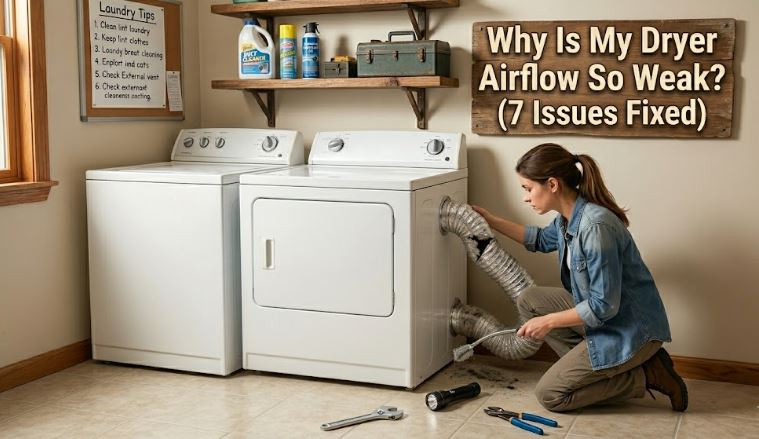
Pull the dryer away from the wall and inspect the flex duct along its full length. Straighten any kinks and make sure the machine sits at least eight inches from the wall to give the hose room to curve smoothly rather than bend sharply.
Disconnect the hose and vacuum out both the hose and wall duct. For longer runs, the Holikme Dryer Vent Cleaning Brush Kit (View on Amazon) attaches to a standard drill and reaches deep into duct runs that a vacuum cannot clear. It comes with flexible rod extensions for runs up to 60 feet and beyond. After cleaning, go outside and run the dryer to confirm airflow at the exterior vent feels strong and warm before calling the job done.
3. The Exterior Vent Flap Is Stuck or Blocked
This cause sits right at the end of the vent system and is one of the most overlooked sources of weak dryer airflow because nobody thinks to check the outside of their house when the dryer stops performing well.
The exterior vent hood has a flap or set of louvers that open when the dryer runs and close when it stops to prevent cold air, pests, and debris from entering. When this flap sticks closed or only partially opens from lint buildup, pest nesting material, warping, or physical damage, airflow is restricted right at the exit point. The entire vent system backs up and the dryer effectively tries to exhale against a closed door.
How to Inspect and Fix the Exterior Vent Flap
Go outside and locate the exterior vent hood while the dryer is running. The flap should open fully and you should feel strong airflow. If the flap barely moves or stays nearly closed, press it gently by hand to confirm it is not stuck mechanically.
Clean any lint, debris, or bird nesting material from the flap and its surrounding hood. Lubricate stiff hinge points with a small amount of silicone spray. If the flap is warped, corroded, or broken and does not seal properly when closed, replace the entire vent hood (View on Amazon).
4. The Vent Hose Material Is Wrong
This cause catches many homeowners off guard because the vent hose looks perfectly fine from the outside. The material it is made from is the problem.
Flexible white vinyl or thin plastic accordion-style duct hoses are still widely sold but should never be used for dryer venting. Their ribbed interior surface catches and holds lint at every ridge rather than allowing it to pass through freely. Over time these hoses accumulate thick rings of lint inside every accordion fold, reducing the effective internal diameter dramatically and creating a serious fire risk at the same time.
Building codes in most regions now require semi-rigid metal or rigid metal ducting for dryer vent runs precisely because of this problem.
How to Replace Wrong Vent Hose Material
Measure the distance from the dryer exhaust port to where the duct enters the wall. Replace any vinyl or thin plastic accordion hose with semi-rigid aluminum duct for flexible sections and rigid metal duct for any straight runs inside walls or through cabinets.
The Home Sun 4 Inch 8FT Semi Rigid Dryer Vent (View on Amazon) is a flexible yet smooth-interior option that dramatically reduces lint accumulation compared to plastic accordion hose while still bending to navigate around obstacles behind the machine. Use proper foil duct tape rather than regular duct tape at all connection points since standard tape degrades from heat over time.
5. The Blower Wheel Is Clogged or Damaged
The blower wheel is the internal fan that generates all the airflow moving through the dryer. Everything downstream, the vent hose, the wall duct, the exterior flap, depends entirely on the blower wheel generating enough pressure to push air through the entire system.
When lint bypasses the trap and packs between the blower wheel blades, airflow drops significantly even when the entire vent system is completely clear. A dryer sheet sucked into the blower housing makes this worse by catching additional lint and forming a dense plug around the wheel blades.
A damaged blower wheel with bent or broken blades generates even less airflow since each damaged blade moves less air per revolution than an intact one.
How to Clean or Replace the Blower Wheel
Unplug the dryer and access the blower wheel from the rear panel or cabinet interior depending on your model. Spin the wheel by hand and look for lint packed between the blades or any foreign object lodged in the housing. Clear any buildup by hand or with a vacuum.
Also check the blower wheel for blade damage. A wheel that wobbles on its shaft or has visibly bent or missing blades needs full replacement. Search your model number alongside “blower wheel” on Amazon since dimensions vary between models. Replacing a damaged blower wheel restores full airflow immediately and is one of the most impactful single-component fixes for a dryer with chronically weak airflow.
6. The Vent Run Is Too Long or Has Too Many Bends
Sometimes the dryer airflow problem is not a blockage at all. The vent system was simply designed or installed in a way that restricts airflow structurally.
Most dryer manufacturers specify a maximum vent run of 25 feet in a straight line. Every 90-degree elbow bend counts as the equivalent of five additional feet of straight run. A vent with three elbows and 15 feet of straight run is effectively a 30-foot run from the machine’s perspective, which already exceeds what the blower wheel was designed to overcome efficiently.
Dryers installed in interior rooms, basements, or apartments sometimes have vent runs that stretch 40 to 50 equivalent feet through walls, floors, and ceiling spaces. These installations require either a dryer booster fan or a more powerful machine to maintain adequate airflow.
How to Address an Excessively Long or Complex Vent Run
First, count every elbow in your current vent run and measure the straight sections. Multiply elbows by five and add to the straight measurement for total equivalent length. If the result exceeds 25 feet, the system is undersized for what the dryer needs.
Where possible, eliminate unnecessary elbows by rerouting sections of the duct. Replace 90-degree elbows with two 45-degree elbows, which reduces airflow restriction at each turn. For runs that cannot be shortened, the Tjernlund In-Line Dryer Duct Booster Fan (View on Amazon) installs inside the duct run and supplements the dryer’s built-in blower wheel, restoring adequate airflow through long or complex installations. It activates automatically when the dryer runs and requires no manual operation.
7. The Dryer Is Installed in a Poorly Ventilated Space
This is the least obvious cause and one that is easy to miss because it has nothing to do with the vent system itself.
A dryer needs a supply of fresh air to replace the warm, humid air it exhausts. When it is installed in a small, sealed utility closet or a room with no air supply, it creates a slight negative pressure inside the space as it pushes air out through the vent. That negative pressure effectively works against the blower wheel, reducing the net airflow the machine can generate through the duct.
This cause is most common in tight closet installations and becomes more pronounced as the room gets smaller and more sealed.
How to Improve Supply Air for the Dryer
Check whether your dryer is installed in a fully enclosed space with no fresh air supply. If the closet or utility room has louvered doors or an air gap below the door, supply air is likely adequate. If the space is completely sealed, this is contributing to weak airflow performance.
Install a louvered vent panel in the closet door or leave the door slightly open during cycles to allow replacement air to enter the space. For built-in closet installations, a small passive air inlet vent cut into the wall of the closet and covered with a louvered grille provides a permanent solution without any mechanical parts.
Dryer Weak Airflow Fix Cost and Difficulty Overview
| Cause | DIY Difficulty | Part Cost | Pro Cost |
|---|---|---|---|
| Clean lint trap and housing | Very easy | Free | N/A |
| Straighten kinked vent hose | Easy | Free | N/A |
| Clean exhaust vent | Easy | Free – $20 | $80 – $150 |
| Fix or replace exterior flap | Easy | $10 – $25 | $80 – $130 |
| Replace vinyl hose with metal duct | Easy | $15 – $40 | $100 – $180 |
| Clean or replace blower wheel | Moderate | Free – $35 | $100 – $200 |
| Install duct booster fan | Moderate | $50 – $100 | $150 – $250 |
| Reroute or shorten vent run | Advanced | $30 – $80 | $150 – $300 |
Frequently Asked Questions
How do I test my dryer’s airflow without any tools?
The simplest test is the hand test at the exterior vent. Go outside while the dryer runs and hold your hand near the vent opening. Airflow should feel strong and warm, similar to a hair dryer on full power. Weak, cool, or barely detectable airflow confirms a restriction in the system that needs addressing before the next cycle.
Can weak airflow damage my dryer over time?
Yes, significantly. Weak airflow forces the motor and blower wheel to work harder against resistance, accelerates wear on the heating element and thermostats from excess heat, and shortens the overall lifespan of the machine. Dryers with chronically weak airflow typically fail years earlier than machines with properly maintained vent systems.
Is flexible accordion-style duct hose acceptable for dryer venting?
Only semi-rigid aluminum or rigid metal duct is appropriate for dryer venting. Flexible white vinyl and thin plastic accordion hoses trap lint in every ridge, degrade from heat over time, and are a fire hazard. Many building codes now prohibit them for dryer vent installation entirely. If you currently have plastic accordion hose, replacing it with semi-rigid aluminum duct is one of the single most impactful improvements you can make to dryer airflow and safety.
How many bends are too many in a dryer vent run?
Each 90-degree elbow reduces effective vent length capacity by five feet. Most dryer manufacturers specify a maximum total equivalent length of 25 feet. More than four 90-degree elbows in a standard installation typically exceeds that limit and requires either rerouting or a duct booster fan to maintain adequate airflow.
How often should the full dryer vent system be professionally cleaned?
Once a year for average households, and every six months for households doing four or more loads per day. Professional cleaning uses rotating brush systems that reach the full length of the duct run and extract compacted lint from bends and transitions that consumer brush kits cannot fully access.
Fix the Airflow and the Dryer Fixes Itself
A dryer with weak airflow is not a broken dryer. It is a dryer being choked by a problem in the pathway it needs to do its job. Fix the airflow and drying performance, cycle times, and overheating risk all improve immediately.
Start with the lint trap and exterior vent flap since those two checks cost nothing and take under fifteen minutes. Then move to the vent hose and blower wheel if airflow is still weak after those checks. But in case of other dryer problems, this dryer troubleshooting guide should come in handy.

Hi, I’m Barlgan! I created Repair Me Yourself to empower homeowners to tackle appliance repairs with confidence. From decoding error codes to fixing cooling issues, I break down complex repairs into simple, actionable steps that save you time and money.