
Walk into almost any American kitchen and you’ll find a microwave. But where it lives — sitting on the counter or mounted above the stove — makes a bigger difference than most people realize. The countertop vs over-the-range microwave choice shapes how much prep space you have, how well your kitchen vents cooking fumes, how easy the microwave is to reach, and how much you’ll spend before the first bag of popcorn.
Neither type is universally better. They serve different kitchens, different households, and different priorities. This guide breaks down every meaningful difference between the two — cooking performance, ventilation, installation, cost, safety, and more — so you can land on the right choice with confidence.

Countertop vs Over-the-Range Microwave Placement and Purpose
A countertop microwave is exactly what it sounds like — a freestanding unit that sits on your kitchen counter, plugs into a standard wall outlet, and requires no installation beyond clearing some space. You can put it anywhere in the kitchen with access to a power socket, and you can move it whenever you like. For renters, first-time buyers, and anyone who wants maximum flexibility at minimum cost, the countertop model has been the default choice for decades.
An over-the-range microwave — often an OTR — mounts directly above your stove or cooktop, filling the space that a range hood would otherwise occupy. It’s hardwired into your kitchen’s electrical system, anchored to the wall and the cabinetry above it, and serves a dual purpose: it works as a full-featured microwave while also providing ventilation over your cooktop through a built-in exhaust fan and filter system.
It is not portable, not easy to replace on a whim, and requires professional installation in most cases — but it frees up the counter and integrates into the kitchen in a way that countertop models simply cannot.
Countertop vs Over-the-Range Microwave Cooking Performance
Both types heat food using the same microwave technology, and at comparable wattage levels, their core cooking performance is essentially identical. A 1,000-watt countertop microwave and a 1,000-watt OTR model will reheat your leftovers in the same amount of time and defrost your chicken with the same efficiency.
Where the difference emerges is in wattage access and interior capacity. Because countertop microwaves connect to a standard household outlet on a shared circuit, most models operate at 700–1,200 watts. OTR microwaves typically run on a dedicated 120-volt, 20-amp circuit and commonly operate at 1,000–1,100 watts — a similar range, but with more consistent power delivery because the circuit isn’t shared with other appliances. In everyday use, this distinction is minimal. You’re unlikely to notice a difference in heating time between a well-specified countertop model and a similarly specified OTR.
Interior capacity is worth examining more carefully. While OTR models tend to be wide — typically 30 inches to match standard stovetop widths — their interior volume is often more constrained than comparably priced countertop models due to the fixed form factor. Countertop microwaves range from 0.5 cubic feet for compact models up to 2.2 cubic feet for large family units, giving you more choice in matching the machine to the volume of food you actually cook. OTR models typically run 1.5–2.1 cubic feet, which is adequate for most households but doesn’t offer the same range of options.
Sensor cooking — where the microwave detects steam and humidity levels during cooking and automatically adjusts time and power — is now available in both types at mid-range price points. This is worth prioritizing regardless of which type you choose, as it produces noticeably better results on reheating and defrosting compared to manual time-setting.
Countertop vs Over-the-Range Microwave Ventilation
This is where OTR microwaves have a clear, unique advantage that countertop models simply cannot replicate.
Every over-the-range microwave includes a built-in exhaust system — an exhaust fan, a grease filter, and usually a charcoal filter to reduce odors — positioned directly above your cooktop. When you’re sautéing onions, searing a steak, or boiling a pot of pasta, the OTR microwave pulls steam, grease particles, and cooking odors upward through the filters and either vents them outside through ductwork or recirculates the air back into the kitchen after filtering.
The ventilation power of an OTR microwave is measured in CFM — cubic feet per minute. Most OTR models move air at 200–400 CFM, with higher-end models reaching 400 CFM. This is adequate for typical home cooking: everyday stovetop use, sautéing, and light frying. However, it falls short of what a dedicated range hood can deliver. High-performance range hoods can move 600–1,200 CFM, which is why serious home cooks who frequently do high-heat cooking, frying, or stir-frying often prefer a countertop microwave paired with a proper range hood rather than relying on an OTR’s built-in ventilation.
Important Distinction
An important distinction exists between ducted and ductless OTR configurations. A ducted OTR vents air outside the home through ductwork — the most effective setup for clearing smoke and steam. A ductless or recirculating OTR filters the air through charcoal and grease filters and pushes it back into the kitchen — better than nothing, but notably less effective, especially for heavy cooking. If you’re installing an OTR where no ductwork exists, you’ll either need to run new ductwork (adding cost and complexity) or accept the performance limitations of a recirculating setup.
Countertop microwaves offer no stovetop ventilation at all. If you choose one, you need a separate range hood or vent to manage cooking fumes — either an existing one above the stove, an under-cabinet hood, or a recirculating range hood that sits on the counter or mounts to the wall.
Counter Space vs Kitchen Openness
This is the tension at the heart of the countertop vs over-the-range microwave decision for most households.
A countertop microwave occupies a meaningful footprint. A standard mid-size model measures roughly 21–24 inches wide, 16–20 inches deep, and 12–14 inches tall — equivalent to a large food processor or stand mixer in terms of counter real estate. In a small kitchen with limited counter space, that footprint can genuinely constrain your prep area and force other small appliances off the counter entirely.
An OTR microwave uses zero counter space. By occupying the above-range zone that would otherwise be a range hood or blank wall, it clears the entire counter surface for prep work, small appliances, and storage. In a galley kitchen, a small apartment kitchen, or any space where counter square footage is genuinely scarce, this is not a minor convenience — it meaningfully changes how the kitchen functions day to day.
The flip side is that OTR microwaves are mounted at head height or above. For shorter adults, for children, and for anyone with limited reach or arm strength, pulling a hot dish out of a microwave mounted above a stove — while leaning over a hot burner — is an ergonomic and safety concern worth taking seriously. If the primary microwave users in your household are below average height, elderly, or include young children, the accessibility of a countertop model is a genuine advantage.
Installation and Cost
This is one of the sharpest practical differences between the two types.
A countertop microwave requires no installation at all. Unbox it, place it on the counter, plug it into a standard outlet, and it works. If it breaks or you want to upgrade, unplug it and replace it. No professional needed, no permits, no ductwork considerations.
An over-the-range microwave requires professional installation in most cases. The unit must be mounted to the wall with a bracket and to the cabinetry above the stove, connected to the ventilation system, and wired to a dedicated electrical circuit. A straightforward like-for-like OTR replacement costs $100–$300 in labor. Installing where no OTR previously existed — or where new ductwork needs to be run — pushes total installation costs to $250–$1,200 or more, depending on ductwork complexity, electrical work, and cabinet modifications required.
The unit costs are broadly comparable. Budget countertop microwaves start under $100, with mid-range models running $150–$400 and premium convection or air fryer combo units reaching $300–$500. OTR microwaves start around $200 for basic models and run $350–$600 for mid-range options with sensor cooking and stronger ventilation. Factor installation on top of the OTR unit price and the total cost is almost always higher — often meaningfully so.
That said, an OTR microwave can actually save money compared to buying a countertop microwave and a separate range hood, since it combines both functions in one appliance. If you need both, the OTR’s dual-purpose value is a legitimate economic argument.
Countertop vs Over-the-Range Microwave Head-to-Head Comparison
| Feature | Countertop Microwave | Over-the-Range Microwave |
|---|---|---|
| Installation required | None — plug and play | Yes — professional recommended |
| Installation cost | $0 | $100–$1,200+ depending on setup |
| Unit price range | $60–$500 | $200–$700 |
| Counter space used | Yes — significant footprint | None |
| Ventilation provided | None | Yes — 200–400 CFM built-in |
| Accessibility | Excellent — counter height | Variable — mounted high above stove |
| Portability | Yes — move or replace easily | No — permanent installation |
| Interior capacity | 0.5–2.2 cu ft (wide range) | 1.5–2.1 cu ft (narrower range) |
| Wattage range | 700–1,200W | 900–1,100W |
| Sensor cooking available | Yes (mid-range and up) | Yes (mid-range and up) |
| Cooktop lighting | No | Yes — built-in halogen or LED |
| Best for | Renters, flexible layouts, serious cooks | Homeowners, small kitchens, counter space savers |
| Replaces range hood | No | Yes — in most configurations |
Safety Considerations
One safety concern with OTR microwaves deserves direct attention: the combination of a hot stove below and a microwave above creates a situation where someone — particularly a child or shorter adult — must reach over an active or recently used cooktop to retrieve hot food. Burns and spills in this configuration are a genuine, documented household hazard. If the primary microwave users in your home include children or elderly family members, a countertop microwave at a lower, easier height is a meaningfully safer choice.
For households with children specifically, a countertop microwave at counter height is also simply more accessible for supervised independent use — something that matters as kids start heating their own snacks and meals.
There is also a maintenance consideration with OTR models. The grease filters must be cleaned regularly — typically monthly — and the charcoal filters replaced every few months depending on cooking frequency. Neglecting this maintenance reduces ventilation performance and, in the case of heavy grease buildup, can become a fire risk over time. Countertop microwaves require nothing beyond wiping down the interior.
Who Should Choose a Countertop Microwave?
A countertop microwave is the right call if you rent and cannot or do not want to install a permanent appliance. It also makes sense if you already have an adequate range hood in place and don’t need the ventilation function of an OTR. Serious home cooks who do high-heat cooking, frying, or heavy stovetop work will find an OTR’s 300–400 CFM ventilation inadequate and are better served by a dedicated range hood paired with a countertop microwave.
Countertop models are also the clear choice for households where shorter adults, children, or elderly users are the primary microwave operators, where ease of replacement and low commitment cost are priorities, or where the kitchen layout simply doesn’t accommodate an above-stove installation.
Find the best-selling countertop microwave ovens on Amazon!
Who Should Choose an Over-the-Range Microwave?
An over-the-range microwave is the better option when counter space is genuinely limited and every inch of prep surface matters. It’s also the practical choice for homeowners replacing an existing OTR unit, where installation is straightforward and the mounting infrastructure already exists.
If your kitchen lacks a separate range hood and you need stovetop ventilation, an OTR handles both functions in one appliance — often at a lower combined cost than buying both separately. Households where kitchen aesthetics and a built-in, integrated look are priorities will also prefer the OTR’s seamless installation over a freestanding countertop unit.
Find the best-selling over-the-range microwave ovens on Amazon!
Top Picks Available on Amazon
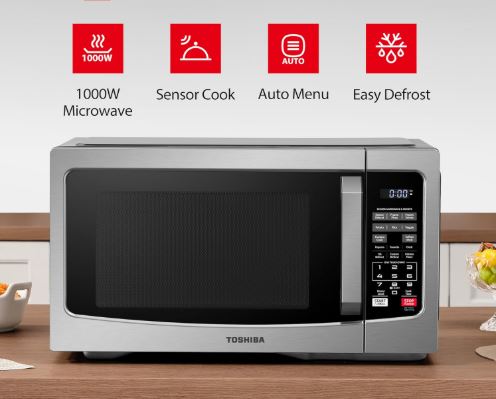
1. Toshiba EM131A5C-SS Countertop Microwave — 1.2 Cu Ft, 1,100W (Stainless Steel)
For buyers who want a reliable, well-featured countertop microwave at an accessible price, the Toshiba EM131A5C-SS is one of the most consistently reviewed models on Amazon and a frequent recommendation from consumer publications.
It strikes a strong balance between capacity, wattage, and usability — with a smart humidity sensor that removes the guesswork from reheating common foods and an ECO mode that cuts standby energy consumption. The mute function is a genuinely appreciated practical touch: no more microwave beeping at midnight.
- 1.2 cu ft interior — fits a 12.4-inch turntable and handles most everyday dishes and containers
- 1,100 watts — solid power output for fast, even heating on a standard outlet
- Smart humidity sensor — automatically detects moisture and adjusts cooking time for six popular food types
- 12 auto-cook menus including popcorn, potato, pizza, frozen vegetable, beverage, and dinner plate
- 10 power levels for precise control from defrost to full power
- Mute function — silences the end-of-cycle beep for late-night use
- ECO mode — reduces power consumption in standby by up to 50%
- Memory function — stores up to three personalized time and power combinations
- Easy-clean interior with stainless steel finish
- No installation required — plugs into standard 120V outlet
Check current price and reviews on Amazon
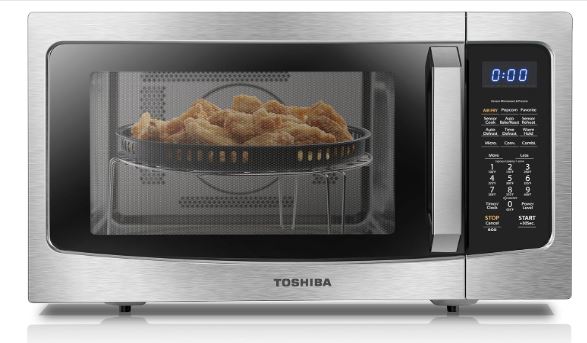
2. Toshiba ML-EC42P(SS) 4-in-1 Countertop Microwave with Air Fryer and Convection — 1.5 Cu Ft, 1,000W
For households that want a countertop microwave to do more than just reheat, the Toshiba ML-EC42P is a genuine multi-function appliance that consolidates microwave, convection oven, air fryer, and combination cooking into one countertop unit.
The air fryer function uses 360-degree rapid heat circulation — no added oil required — delivering crispy results on chicken, fries, and vegetables that a standard microwave simply cannot achieve. The convection mode with auto bake and auto roast menus also makes it a capable secondary oven for households without wall ovens or who want to avoid heating the main range for smaller meals.
- 1.5 cu ft interior with a 13.6-inch position-memory turntable — fits a 12-inch pizza or a whole rotisserie chicken
- 4-in-1 functionality: microwave, air fryer, convection oven, and combination microwave + convection modes
- Smart sensor with 13 auto menus — adjusts automatically for optimum results on popular foods
- Air fryer with 10 auto menus — crispy results without oil using 360° rapid air circulation
- Convection with 4 auto bake and 4 auto roast menus for oven-quality results
- 10 power levels including warm hold function — keeps food at serving temperature for up to 99 minutes
- Mute function, ECO mode, child lock, and delay start
- Easy-clean stainless steel interior — scratch and rust resistant
- Includes grill rack and grill tray for use with air fry and broil functions
- No installation required — plugs into standard 120V outlet
Check current price and reviews on Amazon
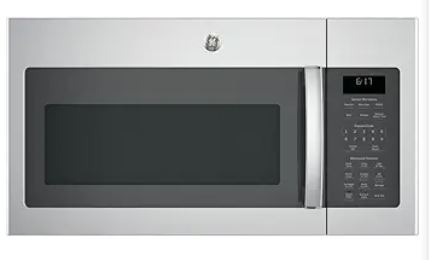
3. GE JVM6175SKSS Over-the-Range Microwave — 1.7 Cu Ft, 1,000W (Stainless Steel)
GE’s JVM6175SKSS is one of the most widely sold over-the-range microwaves in the US and one of the most straightforwardly recommended for buyers entering the OTR category. It hits the practical sweet spot: a 1.7 cu ft interior that handles family-sized dishes, sensor cooking that takes the guesswork out of reheating and defrosting, and a two-speed 300 CFM exhaust fan that handles everyday stovetop ventilation effectively.
The convertible venting design — which supports external ducted venting, vertical exhaust, or recirculating modes — means it can be installed in a wide range of kitchen configurations without requiring specific pre-existing ductwork. The recirculating charcoal filter kit is included in the box.
- 1.7 cu ft interior — wide enough to accommodate large dinner plates and casseroles
- 1,000 watts with 10 power levels for full cooking flexibility
- Sensor cooking controls — automatically adjusts time and power for reheating, defrosting, popcorn, potatoes, and more
- Two-speed, 300 CFM exhaust fan — adequate for everyday stovetop ventilation and light frying
- Convertible venting: supports external ducted (vertical or horizontal) or recirculating ductless installation
- Recirculating charcoal filter kit included — ready to install out of the box for ductless use
- Bright/night/off halogen cooktop lighting — two bulbs illuminate the cooking surface below
- Recessed 12.8-inch glass turntable — accommodates larger dishes than standard OTR turntables
- Express cook buttons for 1–5 minutes at full power
- Child lock, sound volume control, clock, and countdown timer
- Professional installation recommended; fits standard 30-inch above-range cabinet cutout
Check current price and reviews on Amazon
Tips for Getting the Most From Either Type
Whichever type you choose, a few habits make a measurable difference in how well the appliance performs and how long it lasts.
Use the sensor or auto cook function whenever possible. Manual time-setting is the most common cause of overcooked or unevenly heated food. The sensor function in mid-range and premium models reads steam output and adjusts automatically — use it instead of guessing.
Keep the interior clean and dry between uses. Food splatters absorb microwave energy during subsequent cycles and create hot spots that heat unevenly and can cause damage over time. A weekly wipe-down of the interior with a damp cloth prevents buildup from hardening and becoming more difficult to remove.
For OTR models, clean the grease filter monthly. Most OTR grease filters are dishwasher safe — check your manual. A clogged grease filter reduces ventilation performance significantly and is the single most common maintenance issue with OTR microwaves. Replace the charcoal filter every three to six months depending on how often you cook.
Don’t run the microwave empty. Running either type without food or water inside can damage the magnetron — the core component that generates the microwave energy — sometimes immediately and sometimes progressively. If you want to test the unit, place a cup of water inside.
Cover food during heating. A microwave-safe cover (View on Amazon) or a damp paper towel prevents food from splattering on the interior walls, reduces cleaning frequency dramatically, and also improves heating evenness by trapping steam.
Frequently Asked Questions
Can an over-the-range microwave replace a range hood entirely?
For most typical home cooking, yes. An OTR microwave’s 200–400 CFM exhaust capacity handles everyday stovetop use, steam, and light cooking odors adequately. However, if you regularly do high-heat cooking, frequent frying, stir-frying, or cook large quantities of food with significant smoke production, a dedicated range hood with 600–1,200 CFM will outperform any OTR setup meaningfully. For serious home cooks, the OTR is a compromise on ventilation — functional but not optimal.
Is it possible to install an over-the-range microwave without existing ductwork?
Yes. Most OTR microwaves — including the GE JVM6175SKSS reviewed above — offer a recirculating or ductless installation mode that uses a charcoal filter to clean and recirculate the air rather than venting it outside. The filter kit is often inclusive. This setup is straightforward to install without ductwork, but it’s meaningfully less effective at clearing smoke, grease, and steam than a ducted installation. If you have the option to run ductwork, it is worth doing.
Do countertop microwaves need their own dedicated outlet?
They don’t require a dedicated circuit the way OTR microwaves do, but they do draw enough power that sharing a circuit with other high-draw appliances — a toaster, coffee maker, or electric kettle — can trip a circuit breaker. Placing the countertop microwave on its own outlet, or at minimum a circuit that isn’t heavily loaded by other simultaneous users, is the practical approach.
How long do countertop and over-the-range microwaves typically last?
Both types have a similar expected service life of roughly five to ten years under regular use, with proper maintenance. OTR microwaves may have slightly lower longevity estimates in some studies because they are mounted in a position that exposes them to more heat and grease from the cooktop below, which can stress components over time. Regular filter cleaning significantly mitigates this. A well-maintained countertop microwave from a reliable brand can comfortably reach ten years of service.
What is the minimum clearance needed between a stove and an over-the-range microwave?
The minimum clearance between the cooktop surface and the bottom of the OTR microwave is typically 13–16 inches, with many manufacturers specifying 66 inches from the floor to the top of the unit. The exact requirement varies by manufacturer and local building codes. Always check the installation specifications of the specific unit you’re purchasing before buying, especially if your kitchen has non-standard cabinetry height or a commercial-style range.
Can I use a countertop microwave above my stove using a mounting kit?
Some countertop microwaves can be mounted under a cabinet using a compatible trim kit, which gives them a more built-in appearance and keeps them off the counter. However, this is different from a true OTR installation — countertop models mounted this way do not include the exhaust fan and vent system of an OTR microwave and should not be installed directly above a cooktop due to heat exposure and ventilation requirements. If you want a mounted microwave that also vents, you need a purpose-built OTR unit.
Also Read: Is Your Microwave Not Working But Has Power? How to Troubleshoot it Like a Pro!
The Bottom Line
The countertop vs over-the-range microwave question comes down to three things: how much counter space you have, whether you need stovetop ventilation, and how committed you are to a permanent installation.
If you’ve genuinely limited counter space and you want a cleaner, more integrated kitchen without a separate range hood, an over-the-range microwave is a smart, space-saving investment — particularly for homeowners replacing an existing OTR unit where installation is simple. The GE JVM6175SKSS is a proven, reliable choice that delivers on both cooking and ventilation without overcomplicating the decision.
If you rent, move frequently, already have adequate ventilation, do serious stovetop cooking that demands better than 400 CFM, or simply don’t want the cost and commitment of a permanent installation, a countertop microwave is the more practical and flexible choice. The Toshiba EM131A5C-SS delivers excellent everyday performance at a genuinely fair price, and the Toshiba ML-EC42P takes it further as a true multi-function appliance that earns its counter footprint.
Either way, the microwave that’s right for your kitchen is the one that fits how you actually cook — not the one that looks best in a specification sheet.

Hi, I’m Barlgan! I created Repair Me Yourself to empower homeowners to tackle appliance repairs with confidence. From decoding error codes to fixing cooling issues, I break down complex repairs into simple, actionable steps that save you time and money.