If you are standing in an appliance aisle trying to decide between a high efficiency washer and a standard model, the sticker price is probably the first thing you notice. High efficiency machines cost more upfront — sometimes significantly more.
What is not immediately obvious is how much of that premium comes back to you through lower water and electricity bills over the life of the machine, and whether the cleaning performance actually holds up against the traditional agitator design you might already know.
The answer is not the same for every household. This guide covers exactly how these two washer types differ, what the real numbers look like, and which models on Amazon.com make the strongest case for each category right now.
How High Efficiency and Standard Washers Actually Differ
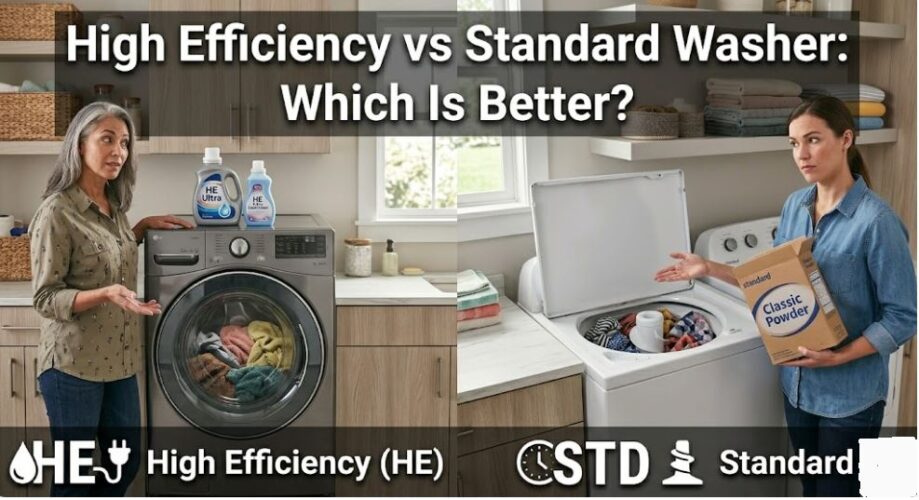
The distinction between these two washer types goes well beyond marketing language. The differences in engineering affect how much water and energy you use with every single load, how your clothes are cleaned, and how long your garments last.
What makes a washer high efficiency
A high efficiency washer — whether front-load or HE top-load — is engineered to use sensor technology to detect the weight of each load and add only as much water as that load requires. Instead of filling the drum entirely with water, HE machines saturate clothes more efficiently using precise water jets and tumbling or rotating drum action. The absence of a central agitator in most HE designs means there is no large post restricting drum space, which allows for larger capacity in the same exterior footprint.
According to the EPA’s ENERGY STAR program, certified front-load washers use around 45 percent less energy and 50 percent less water than a standard top-load agitator washer. On a practical level, ENERGY STAR data shows the average HE certified machine uses 14 gallons per load compared to 20 gallons for a standard machine — a savings of 6 gallons per cycle that compounds across thousands of loads over the machine’s lifetime.
What a standard washer offers
A standard top-load washer fills the drum with water to a level sufficient to submerge or surround the load, then uses a central agitator post to create mechanical friction against clothes. That friction is effective at loosening and lifting heavy soiling — which is why standard washers tend to be preferred for workwear, heavily soiled items, and households that regularly deal with ground-in dirt.
Cycle times are typically shorter. A standard normal wash cycle runs 35 to 50 minutes. An HE cycle optimized for the same load often runs 50 to 70 minutes, using less energy and water throughout but taking longer to achieve comparable results. For households doing several loads back-to-back, that difference is noticeable.
The Real Savings: What the Numbers Look Like
Understanding whether the upgrade is worth it requires honest math, not marketing claims.
An average US household does approximately 300 loads of laundry per year. At 6 gallons saved per load, switching from a standard to an HE washer saves around 1,800 gallons of water annually. The American Cleaning Institute estimates up to 6,000 gallons of annual savings for families with heavier laundry volumes — households doing five or more loads per week.
On electricity, water heating accounts for approximately 90 percent of the energy a washing machine uses per cycle. Because HE washers use significantly less hot water per load, the energy savings on water heating alone are meaningful.
ENERGY STAR certified front-load washers can reduce annual energy consumption to approximately 105 kWh per year, compared to 400 to 500 kWh for older standard machines. At the current US average electricity rate of around 16 cents per kWh, that gap translates to $45 to $65 per year in electricity savings alone.
Over a ten-year ownership period, a high efficiency washer can realistically save $450 to $700 in combined water and electricity costs for a typical household. That figure narrows or eliminates the price premium over a standard machine in most cases.
High Efficiency vs Standard Washer: Key Trade-Offs at a Glance
| Factor | High Efficiency (HE) | Standard |
|---|---|---|
| Water per load | 10 to 14 gallons typical | 20 to 40 gallons typical |
| Energy use | 45% less than standard agitator | Baseline |
| Cycle time | 50 to 70 minutes typical | 35 to 50 minutes typical |
| Cleaning heavy soiling | Good with pre-treatment | Stronger — mechanical agitation |
| Drum capacity | Larger — no central post | Reduced by agitator |
| Fabric care | Gentler — less abrasion | More wear on fabric over time |
| Upfront cost | Higher | Lower |
| Annual utility savings | $50 to $80 typically | Baseline |
| Detergent requirement | HE detergent required | Standard detergent |
| Maintenance | Door gasket cleaning needed (front-load) | Simpler — fewer failure points |
Three High Efficiency Washers on Amazon Worth Buying
All three models below are confirmed in stock on Amazon.com. Replace YOUR-TAG with your Amazon Associates tracking ID before publishing.
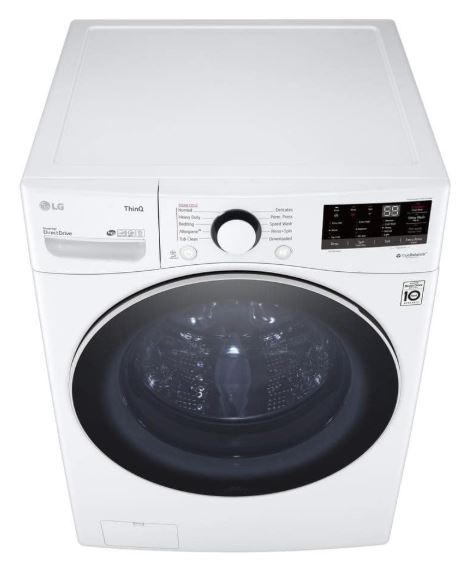
1. LG WM4200HBA — 5.0 Cu. Ft. Smart Front-Load HE Washer
The LG WM4200HBA is the high efficiency workhorse for large households. At 5.0 cubic feet it handles king-size comforters, bulky items, and large family loads without requiring multiple cycles. ENERGY STAR certified with an annual energy consumption of approximately 105 kWh per year, this is one of the most efficient full-size washers in its category.
TurboWash 360 uses five powerful jets to saturate clothes from multiple angles simultaneously, cleaning a full 10-pound load in under 30 minutes on the TurboWash setting. Built-in intelligence uses AI sensors to detect fabric texture and load size, then automatically selects optimal wash motions and temperature — taking the guesswork out of cycle selection for mixed loads. The Allergiene cycle uses steam to reduce common household allergens, which is a meaningful benefit for households with asthma or allergy sufferers.
The Direct Drive inverter motor connects the drum directly without belts or pulleys, reducing mechanical failure points and running significantly more quietly than conventional motor designs. LG backs it with a 10-year limited warranty. If you ever encounter an OE, UE, or LE error code during a cycle, our LG washer error codes guide walks through what each code means and the steps to resolve it.
Best for: Large households, families who run multiple loads weekly, anyone prioritizing long-term energy savings and drum capacity.
2. GE 5.0 Cu. Ft. UltraFresh Front Load Washer
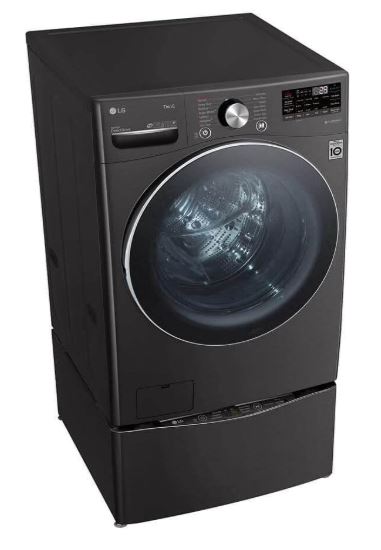
The GE UltraFresh front-load washer is a feature-packed high-efficiency machine designed for busy households that do a lot of laundry. Its large 5.0 cu. ft. drum easily handles bulky bedding, towels, and family-sized loads, while the SmartDispense system automatically adds the right amount of detergent for each cycle. The UltraFresh vent system and Microban protection are also big selling points because they help reduce the mildew smells many people associate with front-load washers.
In terms of cleaning performance, this washer does a very good job with everyday loads and heavily soiled clothes, and the fast spin speeds help shorten drying time. That said, some owners praise its convenience and smart features, while others report concerns about long-term reliability and electronic control boards. If you plan to keep it for many years, an extended warranty may be worth considering.
Key Features
- 5.0 cu. ft. high-efficiency capacity
- UltraFresh Vent System with OdorBlock
- SmartDispense detergent system
- Built-in Wi-Fi and app controls
- Steam cleaning and sanitize cycles
- Microban antimicrobial protection
- 1-Step Wash + Dry feature
- ENERGY STAR certified
3. LG WM3600HWA — 4.5 Cu. Ft. Smart Front-Load HE Washer with Steam
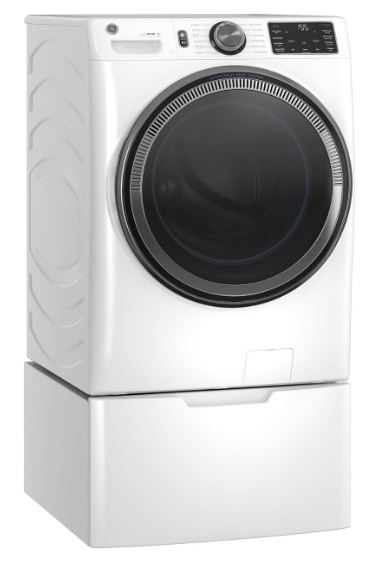
The LG WM3600HWA brings steam cleaning and smart features to the mid-range HE category. Steam penetrates fabric fibers before the main wash cycle begins, loosening stains and reducing the need for separate pre-treatment for most common soiling. The BuiltIn Intelligence feature uses sensors to detect load composition and automatically adjust wash settings, which is genuinely useful for mixed loads of varying fabric types and soil levels.
The TurboWash 39 feature cleans a standard load in 39 minutes — faster than most HE front-loaders at this price point — by combining high-speed drum rotation with optimized water jet pressure. The Direct Drive motor and 10-year warranty are consistent with LG’s broader front-load lineup. The LoDecibel quiet system keeps operating noise to a minimum, which matters for households where the laundry runs in the evening.
If this washer ever shows a drum or drain error, our washing machine not draining guide covers the diagnostic steps that apply across LG front-load models — from checking the drain pump filter to inspecting the hose for kinks.
Best for: Households wanting steam cleaning and fast cycle times in an HE design at a mid-range price.
Two Standard Washers on Amazon Worth Buying
Standard top-load washers remain a practical choice for heavy-duty laundry needs, budget-constrained buyers, and households that value simplicity and faster cycle times over long-term utility savings.
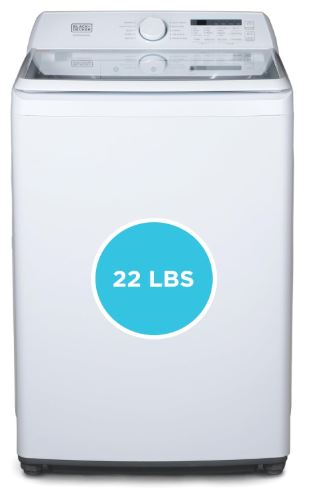
1. BLACK+DECKER BTLW41MW Top-Load Washer Review
The BLACK+DECKER BTLW41MW is a surprisingly solid option for anyone who wants a simple top-load washer without spending a fortune on a big-name brand. It keeps things straightforward with a traditional agitator, easy-to-use controls, and a roomy 4.1 cu. ft. drum that can comfortably handle family-sized laundry loads. The glass lid and LED display also give it a more modern look than you might expect at this price point.
What really stands out is how familiar the washing experience feels. Clothes get a deeper, more aggressive wash than many low-water HE machines, which is something a lot of buyers still prefer for towels, workwear, and heavily soiled laundry. Owners also tend to like how quiet it runs for an agitator washer. That said, because BLACK+DECKER is newer to full-size laundry appliances, long-term reliability is still a bit of an unknown compared to brands like Whirlpool or GE. Some users have also mentioned occasional balancing quirks and water-level frustrations when loads are uneven.
Key Features
- 4.1 cu. ft. capacity
- Traditional agitator wash system
- Stainless steel wash tub
- Glass lid design
- LED digital controls
- 10 wash cycles
- Multiple water level settings
- Delay start feature
- Quiet inverter motor
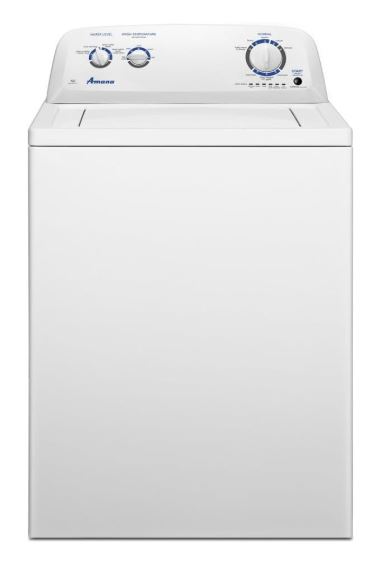
2. Amana NTW4516FW Top-Load Washer
The Amana NTW4516FW is the kind of washer people buy when they just want something simple that gets clothes clean without a bunch of extra technology. It sticks to the basics with old-school dial controls, a dual-action agitator, and a deep-water wash style that feels much closer to traditional washing machines from years ago. For smaller households or buyers on a tight budget, it’s one of the more affordable full-size washers still available.
Its biggest strength is simplicity. There are no touchscreens, apps, or complicated settings to deal with — just load your clothes, pick a cycle, and start washing. The agitator does a good job with dirty jeans, towels, and everyday laundry, especially if you prefer seeing more water in the tub during cycles. The tradeoff is that it’s louder, less water-efficient, and more basic than modern HE washers. Some owners also report that the washer can feel rougher on delicate fabrics over time compared to gentler impeller or front-load machines.
Key Features
- 3.5 cu. ft. capacity
- Dual-action agitator
- Deep Water Wash option
- Porcelain tub
- Multiple wash cycles
- Traditional top-load design
- Simple dial controls
- Extra rinse option
Is the High Efficiency Upgrade Worth It?
For most US households, yes — with one important condition. The payback period depends on how much laundry you do each week.
At five or more loads per week, an HE washer’s annual savings on water and electricity typically fall between $50 and $80. Over a ten-year ownership period, that accumulates to $500 to $800 — enough to fully recover the price premium of most HE models over their standard equivalents. The fabric care advantage adds another layer of value: clothes cleaned in HE machines show measurably less fiber wear over time, which extends the life of your wardrobe.
For households doing three or fewer loads per week, the annual savings are smaller and the payback period extends. In those cases, a well-chosen standard washer at a lower upfront cost can be the sensible financial decision — particularly if the household’s laundry regularly involves heavy soiling where an agitator’s mechanical action provides a genuine performance advantage.
The BLACK+DECKER BTLW41MW and Amana NTW4516FW are honest, capable machines that do what standard washers have always done well. The LG and Samsung HE models above them on this list are investments in long-term efficiency that reward households who use a washer heavily and plan to own it for a decade or more.
Frequently Asked Questions
Do I need special detergent in a high efficiency washer?
Yes. HE washers require detergent labeled HE on the packaging. Standard detergent produces excess suds in a low-water HE machine, which can leave residue on clothes, create odor problems in the drum, and in persistent cases cause drainage issues. HE detergent is formulated to clean effectively at lower water volumes and rinse completely without excessive sudsing.
Do high efficiency washers clean as well as standard washers?
For everyday lightly to moderately soiled laundry — shirts, sheets, casual wear — Consumer Reports testing shows modern HE front-load washers clean as well as or better than standard agitator machines. For heavily soiled workwear, muddy athletic gear, or consistently filthy loads, a standard agitator has a mechanical cleaning edge that HE machines compensate for with pre-treatment or extended cycle options.
Why do HE washers have longer cycle times?
HE washers use less water, which means clothes are not suspended in a large water volume throughout the cycle. To achieve thorough cleaning with less water, the machine runs longer tumbling cycles that repeatedly move clothes through a smaller, more concentrated wash solution. The trade-off is lower energy and water consumption throughout that longer cycle.
Can I use an HE washer without a dryer vent?
A washing machine does not require a vent. The dryer associated with a front-load HE washer may require venting depending on the model. Ventless dryer options — condensing and heat pump dryers — are available and compatible with HE front-load washers for spaces where duct installation is not practical.
What is the biggest maintenance difference between HE and standard washers?
Front-load HE washers require regular cleaning of the door gasket and periodic drum cleaning cycles to prevent odor buildup, which occurs because lower water usage can leave moisture in the seal area. Leaving the door slightly ajar between washes allows the interior to dry and prevents mold and mildew. Standard top-load washers are generally simpler to maintain and less prone to seal-related odor problems.

Hi, I’m Barlgan! I created Repair Me Yourself to empower homeowners to tackle appliance repairs with confidence. From decoding error codes to fixing cooling issues, I break down complex repairs into simple, actionable steps that save you time and money.