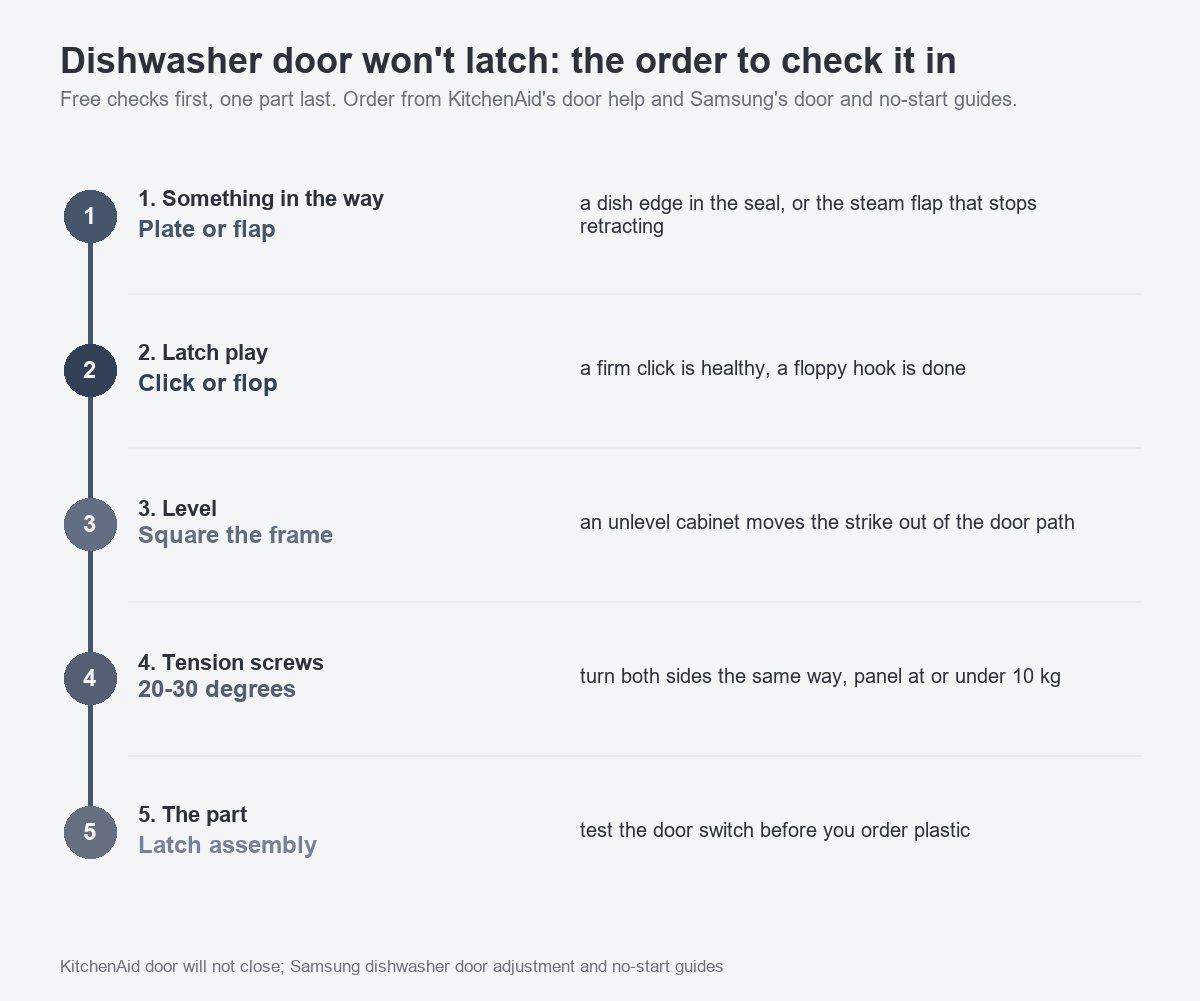
A dishwasher door that won’t latch closed is usually blocked or out of line, and only sometimes broken.
The latch closes a switch, and until that switch closes your machine won’t start.
Samsung lists a damaged door or latch among the reasons a dishwasher won’t start at all.
KitchenAid’s own door help puts the tension, the level, the seal and then the latch in that order.
Work through those first. They cost nothing but your time.
What the latch actually does
The hook on your door grabs a strike on the tub frame, and that same motion closes a small switch inside the latch.
No switch, no cycle.
That’s the whole reason a dishwasher refuses to start with nothing visibly wrong.
So your panel can be perfectly alive and your machine still sits there. It might beep, blink a light, or say nothing at all.
If your panel is lit and the machine ignores you, our guide to a dishwasher that won’t start with the lights on covers that state on its own.
Find what’s in the way first
KitchenAid’s first physical check is anything caught between the door seal and the tub. Silverware is the usual culprit, and a plate edge does it too.
Then look at the top of the tub. Whirlpool-family machines have a flap that opens to let steam out, and owners on r/fixit describe the same failure on a Whirlpool and a Bosch: the flap stops retracting, the door hits it, and it bounces back open.
KitchenAid’s answer for that one is unglamorous. Push the door closed, listen for the click, and run a cycle.
I do that before I take a single screw out, because it costs a cycle and answers the question.
The flap gets exercised and settles. If yours bounces for a week straight, the flap linkage is the part to look at.
One more thing before you blame the mechanism. If your door stops within an inch of closing, pull the upper rack and see how it sits on its rails.
Is your latch stuck in the closed position?
A latch that’s already closed when your door is open won’t grab anything. That happens on machines that were shut empty, or bumped with the door out of its channel.
Look at the strike on the frame, then at the hook.
On most models a screwdriver frees a stuck hook, and your door closes normally from then on.
How much play is normal? A hook with a firm spring and a clean click is healthy. A hook that flops, rattles, or doesn’t click at all is done.
I test that with one finger, door half open, before I look at anything else on the frame.
If it’s floppy, skip the rest of the alignment checks and go to the latch section below.
Level and hinge sag move your strike
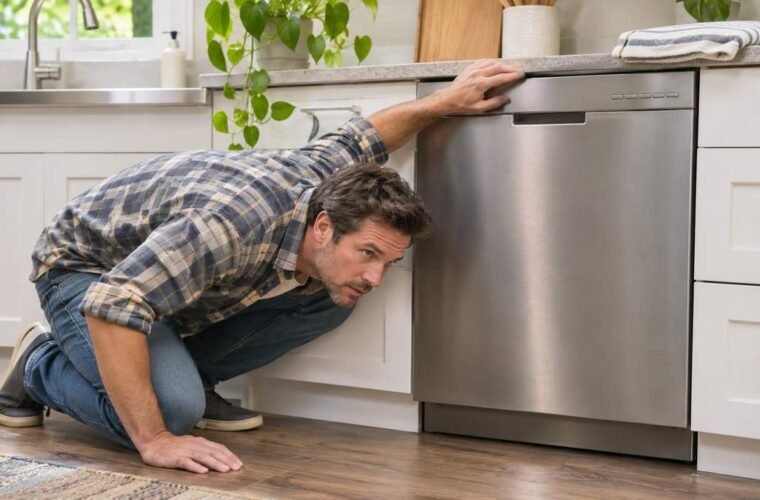
KitchenAid asks whether the dishwasher is level, and that’s not housekeeping. An unlevel cabinet twists the frame, and your strike moves a few millimeters out of the door’s path.
Put a level on the top edge of your open door.
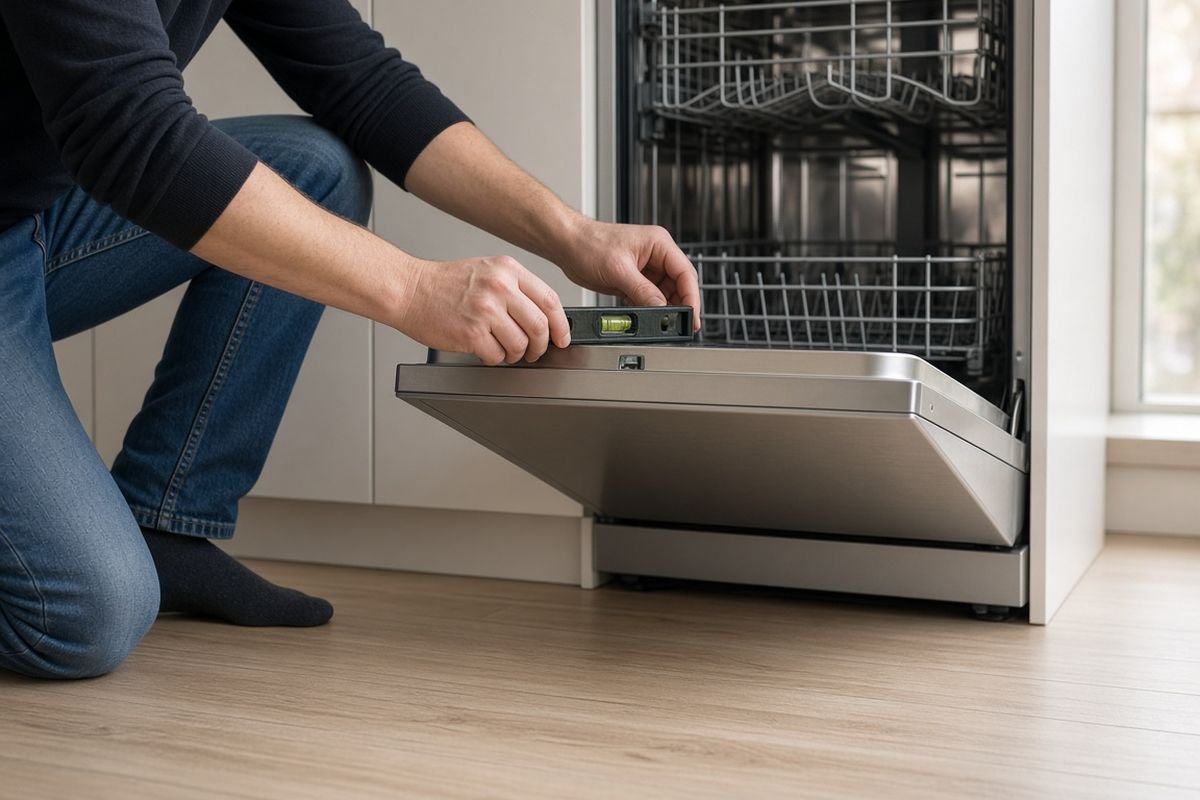
Adjust the front legs until the machine sits square.
Samsung has a second adjustment for sagging doors, and the numbers are the useful part. Open the door to about 30 degrees and find the tension screws at the front left and front right.
Turn both sides the same amount.
Clockwise adds tension, counterclockwise takes it away.
Test with your door at 20-30 degrees, and keep the two sides equal or the door sits crooked in the frame.
Samsung’s own warning matters here. Don’t adjust the tension with the door fully open, and on a fully built-in machine with a custom panel, keep the panel at or under 10 kg.
Heavier than that, and your door drops no matter what you do to the screws.
Three things that look like a latch fault
Rule these out before you buy anything. Each one stops your machine dead without the latch being involved.
- Child Lock. Look for a padlock icon on your display. Samsung’s release is a three-second hold on the Child Lock, Heated Dry or Sanitize button, depending on your panel.
- Delay Start. If it’s lit, your machine is waiting, not refusing. Press Delay Start to cancel it.
- The Start button. Press it, don’t hold it. On Samsung machines a hold longer than three seconds cancels your cycle and drains the tub.
No lights at all is a different fault.
Check your breaker, then the wall switch many kitchens have beside the dishwasher.
When your latch has to be replaced
A latch that won’t hold is one part, and it comes out as one part on almost every machine you’ll open.
Cut the power at the breaker first, because your latch carries the door switch wiring.
The inner door panel comes off, the old assembly unclips, and the new one drops into the same orientation.
Photograph your wiring before you disconnect it.
Here’s the part most owners skip. If your door closes but the machine ignores it, test the switch before you order the plastic.
A latch that looks perfect and tests open is a switch fault. That’s a different part, and I’ve seen people pay for a latch that was never the problem.
Stop and call a technician when the hinge springs are involved, when your door drops hard on its own, or when a new latch changes nothing. Door springs sit under tension, and a slipping hinge is a finger trap.
One more check, and it’s free. A recalled model gets repaired at no cost, so run your model number through our appliance recall lookup before you pay for a latch.
Dishwasher door won’t latch closed: quick answers
Why does my dishwasher door bounce back open?
A door that clicks and bounces is hitting something, usually the steam flap at the top of the tub or a dish edge in the seal. Push it closed once, then check the flap retracts.
Why won’t the latch catch after the door sags?
A sagging door drops the hook below the strike, so the two never meet. Level the machine first, then set the front tension screws equally on both sides.
Can I run a dishwasher with the door not latched?
No. The latch closes the door switch, and without that switch your cycle never starts. Forcing the door or taping it shut leaves the switch open and risks the hinge.
Is the door latch one part or several?
The latch assembly is one part on most machines, and it carries the door switch. Replace the assembly rather than the hook alone, and test the switch before ordering.
Your door is the cheapest thing to check and the last thing to replace.
Almost all of mine turn out to be a flap, a plate edge, or a machine that walked out of level.
Where to go next
If your door now latches and the machine still won’t run, the fault moved inward. Our dishwasher that beeps but won’t run and the Bosch beeps-on-start guide both begin at the door switch.