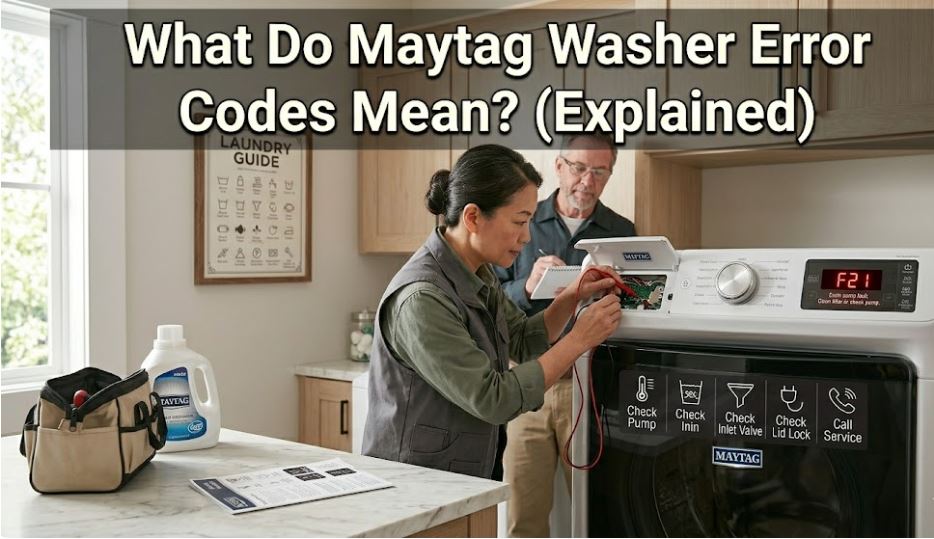
Your Maytag washer stops mid-PowerWash cycle, water still filling the extra-large drum, and an unfamiliar code flashes across the display: “HC” or “F8 E3” or “Ld.” Your family’s laundry is sitting in dirty water, you bought Maytag for its legendary durability and cleaning power, and you need to determine if this is something you can fix yourself or requires a professional service call.
Maytag washer error codes are diagnostic indicators identifying malfunctions in their robust drive systems, precision water controls, large-capacity load management, PowerWash technology components, and heavy-duty transmissions designed for maximum cleaning power and durability.
Key codes include load capacity errors (Ld, indicating overload beyond the washer’s weight limit), water temperature precision failures (HC, affecting PowerWash performance), drain system blockages (F9 E1, Dr, in their high-flow drainage systems), door lock issues on extra-large capacity drums (F5 E2, dL), drive motor failures (F7 E1, affecting agitator/impeller operation), and water inlet complications (F8 E1, LF, when fill systems can’t provide adequate flow).
This home troubleshooting guide decodes every major Maytag washer symbol and error code with diagnostic procedures you can perform yourself before calling for service. You’ll learn what codes mean for your Maytag’s PowerWash and Deep Clean systems, how to troubleshoot considering their extra-large capacity and powerful agitation, repair cost expectations for Maytag’s durable components, and preventive maintenance that keeps your washer running reliably for years.
Maytag Washer Error Codes: Quick Home Diagnostic Reference
Maytag error codes reflect their heavy-duty construction designed for durability in home use. This chart shows common codes with Maytag-specific troubleshooting considerations.
Understanding how Maytag’s robust engineering affects error diagnosis helps you troubleshoot effectively and avoid unnecessary repairs.
| Error Code | System Affected | Maytag-Specific Factor | Primary Cause | Why It Differs | DIY Repair? |
|---|---|---|---|---|---|
| Ld / OL | Load capacity | 6.2 cu ft drums handle more weight | Overload beyond motor capacity | Built for heavy loads but still has limits | Yes – reduce load |
| F8 E1 / LF | Water inlet | PowerWash requires higher flow rate | Slow fill, low pressure | PowerWash cycles need more water faster | Yes – clean screens |
| F9 E1 / Dr | Drain system | High-flow drain pumps move more water | Drain blockage, pump failure | Larger pumps handle big loads | Yes – clear blockage |
| HC | Hot/cold inlet | PowerWash monitors temperature precisely | Reversed hoses, temp sensor issue | Precision temp control for best cleaning | Yes – check hoses |
| F5 E2 / dL | Door lock | Heavy doors require stronger locks | Door lock failure | Extra-large drum doors built heavier | Check alignment first |
| F7 E1 / F7 E7 | Drive motor | Powerful motors handle heavier loads | Motor speed sensing failure | Larger motors than basic washers | Usually requires service |
| Sud / Sd | Suds detection | Large capacity retains more suds | Excessive detergent | Big drum needs less detergent per load | Yes – reduce detergent |
| UL / DC | Load balance | Heavy-duty suspension system | Unbalanced load | Built to handle more but balance still matters | Yes – redistribute |
| F1 E2 | Control communication | PowerWash programming complexity | Control board malfunction | Advanced cycle technology | Try reset, may need service |
| dU / F5 E1 | Door unlock | Safety interlocks on large drums | Door won’t unlock after cycle | Extra safety for high water capacity | Wait, then manual release |
| Ld (different) | Long drain | High-flow drain pump timing | Partial drain restriction | Powerful pump detects issues faster | Yes – clean drain path |
| rL / F34 | Cycle interference | Clean washer cycle protection | Items detected during self-clean | Advanced cleaning cycle safety | Yes – remove items |
Why It Differs: How Maytag’s heavy-duty construction affects error diagnosis compared to basic washers
Understanding Maytag Washer Error Codes: System-by-System Home Diagnostics
Maytag’s reputation for durability comes from their heavy-duty engineering. Error codes require troubleshooting approaches that account for their robust construction. Let’s examine codes with Maytag-specific considerations for homeowners.
Load Capacity Error Codes: Understanding Your Washer’s Limits
Maytag washers with extra-large drums (5.8-6.2 cubic feet) can handle bigger loads than basic washers, but their motors include sophisticated protection to prevent damage from overloading.
Ld / OL – Load Capacity Exceeded: The washer detects weight beyond safe operating parameters for the motor and transmission.
Maytag motor and capacity specifications:
- Basic washers: 1/2 HP motors, 35-40 lb max load capacity
- Maytag heavy-duty: 3/4 HP motors, 50-55 lb max load capacity
- Reinforced transmission: Heavy-duty gears for durability
- Load sensing: Weighs items during initial fill for protection
Why Maytag triggers Ld differently: While Maytag can handle heavier loads than basic washers, the error code protects the motor and transmission. What feels like a reasonable load based on drum size might exceed the 50-55 lb weight limit even though the drum isn’t visually full. Basic washers might attempt to wash overloaded items (risking damage), while Maytag washers shut down protectively.
Ld troubleshooting for Maytag:
- Remove approximately 30% of items from the load
- Ensure load is distributed evenly around agitator/impeller
- Note that wet items weigh significantly more (towels absorb 3-4x their weight)
- Restart cycle after load reduction
- If Ld appears on reasonable loads, transmission or motor sensor may need service
Load capacity optimization: Maytag’s 6.2 cu ft capacity doesn’t mean fill it completely. Optimal washing occurs at 70-80% capacity, allowing items to move freely during PowerWash agitation.
Water Inlet Error Codes: PowerWash Flow Requirements
Maytag’s PowerWash and Deep Clean cycles require more water flow than basic washers to achieve their superior cleaning performance.
F8 E1 / LF – Long Fill Error: The washer cannot fill to the required level within the expected timeframe.
Maytag fill system requirements:
| Washer Type | Required Flow Rate | Fill Time (Large Load) | Inlet Pressure |
|---|---|---|---|
| Basic washers | 2.0 GPM | 8-10 minutes | 20 PSI minimum |
| Maytag standard cycles | 2.5 GPM | 6-8 minutes | 25 PSI minimum |
| Maytag PowerWash/Deep Clean | 3.0+ GPM | 5-7 minutes | 30 PSI recommended |
Why PowerWash triggers F8 E1 more frequently: PowerWash and Deep Clean cycles use more water and fill faster to achieve proper cleaning action. Inlet systems that work fine on Normal cycles may not provide adequate flow for PowerWash.
F8 E1 resolution for Maytag washers:
- Check household water pressure – should be 40-80 PSI for optimal operation
- Clean inlet screen filters (both hot and cold)
- Verify both supply valves are fully open (not 3/4 open)
- Inspect inlet hoses for kinking or internal deterioration
- Test flow rate: disconnect inlet hose, turn on supply—should fill 5-gallon bucket in 2 minutes or less
Deep Clean cycle consideration: Deep Clean automatically uses maximum water fill. If your home’s water pressure is marginal (20-25 PSI), Deep Clean may trigger F8 E1 while other cycles work normally.
HC – Hot/Cold Inlet Reversed: Hot water enters the cold inlet or vice versa, detected by Maytag’s precision temperature monitoring.
PowerWash temperature precision: Maytag’s PowerWash and Deep Clean cycles monitor temperature within ±2°F compared to ±5°F on basic washers. This precision is essential for PowerWash’s cleaning performance.
HC resolution:
- Turn off both water supply valves
- Swap hot and cold hose connections at back of washer
- Verify hot connects to left inlet, cold to right (facing back)
- Run rinse cycle to confirm proper temperature
Temperature precision affects cleaning power—PowerWash cycles calibrated for exact temperatures won’t perform optimally with reversed connections even if the washer operates.
Drainage System Error Codes: Large-Capacity Water Removal
Maytag’s extra-large drums hold more water than basic washers, requiring powerful drainage systems that can experience different issues.
F9 E1 / Dr – Drain Error: The washer cannot pump water out within the allocated time, typically 8 minutes.
Maytag drain system specifications:
- Pump capacity: 18 GPM (gallons per minute) vs. 12 GPM basic washers
- 6.2 cu ft drum capacity: holds 25-30 gallons at full fill
- Drain hose requirement: 1.5-inch minimum diameter
- Standpipe height: 39-96 inches above floor
High-flow drainage troubleshooting:
Drain pump filter access:
- Locate drain pump filter access (front-load: bottom front panel; top-load: inside drum or back panel)
- Place towels—3-4 gallons may drain from filter cavity
- Unscrew filter counterclockwise slowly
- Remove common blockages: coins, bobby pins, small socks, fabric softener pods
- Check impeller behind filter—should spin freely without obstructions
Common Maytag-specific drain issues:
- Fabric softener buildup – Maytag’s large capacity means more softener residue accumulates
- Pump impeller hair wrap – Commercial pumps more susceptible to long hair tangling
- Drain hose too small – 1.25-inch hoses restrict Maytag’s 18 GPM output
- Standpipe overflow – High flow rate can overflow undersized standpipes
Prevention: Clean drain pump filter every 3 months on heavily-used Maytag washers versus every 6 months on standard washers.
Ld (Long Drain context): When Ld appears during drain phase (not load detection), it indicates partial restriction. Maytag’s powerful drain pump detects flow resistance faster than basic washers, triggering early warning before complete blockage occurs.
Door Lock Error Codes: Secure Latching for Large Drums
Maytag’s extra-large drums and high water capacity require strong door locks with advanced safety systems.
F5 E2 / dL – Door Lock Failure: The door lock mechanism cannot secure the door or the control board doesn’t receive confirmation.
Maytag door lock specifications:
- Cycle rating: 75,000+ door cycles (built for long-term durability)
- Lock force: Higher engagement force for larger, heavier doors
- Safety interlock: Extra protection against opening during 25-30 gallon fills
- Strike plate: Reinforced metal for durability
F5 E2 diagnostic procedure:
- Inspect door seal gasket for items preventing full closure
- Clean strike plate area with degreaser—detergent buildup thicker on large-capacity washers
- Listen for lock actuator click when closing door firmly
- Verify door sits flush against seal with no visible gaps
- Test lock manually by gently pulling on door after locking—should be secure
Front-load specific: Maytag front-load washers have heavier doors (15-20 lbs vs. 10-12 lbs standard) due to larger openings. Hinges rarely sag but check for proper alignment.
dU / F5 E1 – Door Unlock Failure: Door remains locked after cycle completes, trapping clothes inside.
Manual release procedure:
- Unplug washer from power outlet
- Locate manual release tab (usually near door lock, accessible from front or inside)
- Pull release tab while maintaining slight outward pressure on door
- On front-load models, wait 5 minutes for water to settle before forcing release
Safety note: Maytag front-load drums can hold 25+ gallons. Never force the door if water is visible—drain first using drain pump filter method.
Drive Motor and Transmission Error Codes: Robust Powertrain Components
Maytag’s powerful motors and reinforced transmissions experience different failure modes than basic washers due to their heavy-duty construction.
F7 E1 / F7 E7 – Motor Speed Sensing Error: The motor cannot achieve or maintain required speed, or speed feedback isn’t reaching the control board.
Maytag motor design:
- Motor power: 3/4 HP (larger than 1/2 HP on basic washers)
- Direct-drive vs. belt-drive configurations on different models
- Reinforced transmission: Heavy-duty gears for durability
- Tachometer precision: Accurate speed monitoring for PowerWash cycle control
F7 diagnostic approach for Maytag:
- Manually rotate drum—should turn smoothly without binding
- Listen for grinding from transmission area (bearing failure)
- Observe during fill—drum should remain stationary (no slow drift)
- Check for overloading—consistently heavy loads stress motor
- Inspect drive belt condition (on belt-drive models)
Agitator vs. impeller models: Agitator models use different transmission assemblies than impeller models. F7 errors on agitator models often indicate transmission gear wear, while impeller models point to motor control unit failures.
Motor thermal protection: Maytag motors include sophisticated thermal monitoring. F7 E7 specifically indicates motor overheating, usually from:
- Consecutive heavy loads without cooldown
- Overloading beyond capacity repeatedly
- Blocked motor cooling vents (lint accumulation)
- Failed motor cooling fan (on models with active cooling)
Recovery: Unplug for 2-3 hours allowing complete cooling. If F7 E7 returns on first light load after cooling, motor or MCU replacement needed.
PowerWash Cycle-Specific Error Codes
Some errors appear primarily or exclusively when using Maytag’s signature PowerWash cycle due to its aggressive washing action.
Sud / Sd During PowerWash: PowerWash’s extended agitation and higher water volume amplify suds detection sensitivity.
Why PowerWash triggers Sud more often:
- Longer agitation time (50% extended) creates more suds from same detergent
- Higher water volume (120% of normal fill) dilutes detergent less
- Aggressive wash action whips more air into water
- Commercial pressure sensors more sensitive to foam interference
PowerWash detergent guidelines:
- Use 1/3 to 1/2 the amount you’d use for Normal cycle
- Maytag’s 6.2 cu ft capacity doesn’t mean more detergent—means more clothes per tablespoon
- HE detergent mandatory—regular detergent will trigger Sud 100% of the time
UL / DC During PowerWash: Unbalanced load detection more sensitive during PowerWash’s aggressive spin cycles.
PowerWash balance requirements: The cycle’s high-speed final spin (900-1000 RPM on top-load, 1200 RPM on front-load) requires better balance than Normal cycles (600-800 RPM).
Balance optimization:
- Mix large and small items in every PowerWash load
- Avoid washing single heavy items (bath mat alone)
- Add 2-3 towels to balance heavy comforters
- Ensure washer is perfectly level using carpenter’s level
- Check leveling legs haven’t vibrated loose (commercial motors create more vibration)
Control Board and Electronic Error Codes
Maytag’s advanced wash cycles use sophisticated programming that can experience electronic failures.
F1 E2 – Control Board Communication: Control board cannot communicate with user interface or other electronic components.
PowerWash programming complexity: Maytag’s control boards manage more complex wash cycles than basic washers—temperature precision, extended agitation timing, water volume adjustments, and soil sensing.
F1 E2 resolution:
- Unplug washer completely for 5 minutes (full power reset)
- Check control panel for moisture damage (wipe dry if damp)
- Inspect wire harnesses for loose connections or corrosion
- Plug in and test with simple Rinse cycle (least complex programming)
- If F1 E2 persists, control board replacement likely needed
Control board costs: Maytag boards cost $200-$400 versus $150-$250 for basic washer boards, reflecting their advanced PowerWash/Deep Clean programming.
rL / F34 – Items Detected During Clean Washer Cycle: The washer detected items in the drum during self-clean cycle initiation.
Maytag’s clean washer cycle runs at higher temperatures than basic washers (160°F vs. 140°F) for more effective sanitization. The safety check prevents melting items left in drum.
Preventive Maintenance for Your Maytag Washer
Maytag’s durable construction requires regular maintenance to keep it running optimally for years.
Weekly (for households doing 7+ loads per week):
- Wipe door seal gasket completely dry after last daily load
- Leave door open 4-6 hours daily for complete drum drying
- Inspect drain pump filter for accumulation
Monthly:
- Run clean washer cycle with Affresh or washer cleaner tablets
- Check inlet hoses for bulging or cracks
- Verify washer remains level (check with carpenter’s level)
- Clean detergent dispenser drawer thoroughly
Quarterly:
- Deep clean drain pump filter and inspect impeller
- Descale with citric acid if you have hard water
- Inspect drive belt (on belt-drive models) for glazing or cracks
- Test all fill and drain functions
Annual professional service:
- Complete inspection of all hoses and connections
- Hose replacement if over 5 years old
- Control board connection check
- Seal and gasket inspection for wear
Maintenance frequency: For households running 10-15 loads weekly, consider professional inspection every 12-18 months to catch small issues before they become expensive repairs.
Also read: Why Your Maytag Washing Machine Drains But Won’t Spin (Fixed!)
Common Maytag Washer Error Code Questions
Why does my Maytag washer show Ld errors when I’m not overloading it?
Maytag’s load detection system measures weight more precisely than consumer washers because of their commercial-grade motors and transmissions. What feels like a reasonable load based on drum size might exceed the 50-55 lb weight limit even though the drum isn’t visually full. Remember that wet items weigh significantly more than dry—8 large wet bath towels can exceed 50 lbs, while the same towels dry weigh only 15 lbs.
Additionally, Maytag’s load detection accounts for water absorption during the cycle. Items that seem fine during loading can trigger Ld once they’ve absorbed water and the motor attempts agitation. The washer protects its commercial transmission from damage, shutting down before stressing components. This is actually a feature, not a flaw—consumer washers that attempt to wash overloaded items experience premature transmission failure. Follow the 70-80% drum fill guideline, and weigh questionable loads if you’re consistently getting Ld codes on what seem like reasonable loads.
Do Maytag’s PowerWash and Deep Clean cycles cause more error codes?
Yes, PowerWash and Deep Clean cycles trigger certain error codes more frequently because they demand more from all washer systems. These commercial-grade cycles use 20-30% more water (triggering F8 E1 if inlet pressure is marginal), create more suds from the same detergent amount (Sud codes), require higher spin speeds for better water extraction (UL balance codes), and stress the motor more (F7 codes on marginally healthy motors).
This doesn’t mean the cycles are problematic—it means they expose limitations in your water supply, venting, detergent usage, or load balancing that regular cycles tolerate. Think of PowerWash like accelerating hard in your car versus cruising—it reveals engine issues that normal driving masks. If you get error codes primarily on PowerWash/Deep Clean but not on Normal cycles, the codes are telling you to optimize your setup: increase water pressure, reduce detergent by 50%, improve load balancing, or reduce load size. The cycles work perfectly when all systems meet their commercial-grade requirements.
Can I use generic replacement parts on my Maytag washer?
For Maytag washers built with heavy-duty components, aftermarket parts frequently don’t meet the same performance specifications or durability standards. Maytag’s robust components are designed for longer service life—motors built for extended operation, reinforced transmissions, powerful pumps rated for higher flow rates, and door locks rated for more cycles. Generic parts are manufactured to minimum standards and may fail prematurely in Maytag washers.
Critical components requiring genuine Maytag parts include drive motors (F7 codes), transmissions, drain pumps (F9 codes), control boards (F1 codes), and door lock assemblies (F5 codes). The cost premium is noticeable—genuine Maytag drain pumps cost $120-$180 versus $60-$90 aftermarket—but aftermarket pumps rated for lower flow rates can fail when pushed to handle Maytag’s 18 GPM output. For basic components like hoses, inlet screens, and drain filters, quality aftermarket parts work fine. The guideline: electrical components, motors, pumps, and transmission parts should be genuine Maytag to ensure proper performance and longevity.
How do I decide between repairing and replacing my Maytag washer based on error codes?
For Maytag washers built for durability, extend the repair threshold beyond basic washers due to their superior longevity. If your washer is under 8 years old, repair makes economic sense for any error code under $500 total cost. Maytag’s heavy-duty transmissions, powerful motors, and reinforced drums are designed for 15-20 year lifespans, justifying higher repair investments than basic washers designed for 10 years.
For washers 8-12 years old, calculate differently than basic models. A $400 motor replacement (F7 codes) is worthwhile on a 10-year-old Maytag washer because the transmission, drum bearings, and structural components easily have another 5-8 years of reliable operation. The same repair on a basic washer at 10 years wouldn’t make sense.
For washers over 12 years old, repair if the fix costs under $250 unless it’s a simple component (inlet valve, door lock, pump filter). Transmission or motor failures after 12+ years suggest considering replacement, unless you have one of Maytag’s premium models that justify repairs even at 15 years old due to their exceptional build quality.
Find the best-selling washing machines on Amazon!
Why does my Maytag show F8 E1 only when using Deep Clean cycle?
Deep Clean cycle automatically uses maximum water fill levels to achieve its intensive cleaning power—typically 120-130% of Normal cycle water volume. This higher fill volume requires faster inlet flow rates to complete filling within the cycle’s timing parameters. If your household water pressure is marginal (20-30 PSI) or your inlet screens are partially clogged, Normal cycles may fill adequately in 8 minutes while Deep Clean cannot fill to its higher level in the allotted time.
Additionally, Deep Clean often runs with hot water at maximum temperature, and heating large volumes of water takes time. If your home’s water heater can’t supply hot water fast enough, the cycle triggers F8 E1 waiting for adequately heated water. Solutions include: cleaning inlet screens to maximize flow, increasing household water pressure (install booster pump if chronically low), upgrading to larger-capacity water heater, or using warm instead of hot water for Deep Clean cycles. The F8 E1 isn’t a washer malfunction—it’s feedback that your home’s water supply system can’t meet Deep Clean’s commercial-grade requirements.
Master Your Maytag Washer Through Proper Diagnostics
Understanding Maytag washer error codes through the lens of their heavy-duty engineering enables accurate troubleshooting and smart repair decisions. Maytag builds home washers with robust components designed for durability and superior cleaning performance—troubleshooting them effectively means understanding how this construction affects diagnostics.
Start by recognizing Maytag-specific factors when codes appear: Does your home’s water supply provide adequate pressure and flow for PowerWash cycles? Is your detergent usage right for their large capacity (you need less per load)? Are loads balanced appropriately for their powerful spin cycles? This Maytag-focused diagnostic approach prevents misdiagnosis and helps you fix problems correctly the first time.
Leverage Maytag’s durability when making repair decisions. Their robust components justify higher repair investments because you’re maintaining a washer engineered for 15-20 years of service. A $350 repair on a 10-year-old Maytag washer makes financial sense because the heavy-duty transmission, reinforced drum, and durable bearings have another 5-10 years of reliable operation ahead. Understanding this long-term value—buying quality once, maintaining it properly, and using it for 15-20 years—maximizes your investment in Maytag’s legendary durability and cleaning power.

Hi, I’m Barlgan! I created Repair Me Yourself to empower homeowners to tackle appliance repairs with confidence. From decoding error codes to fixing cooling issues, I break down complex repairs into simple, actionable steps that save you time and money.