A Samsung dishwasher not draining is usually blocked on the drain path: the filter, the hose that runs to your sink, or the plumbing under it.
Samsung’s troubleshooting page starts at the sink, not inside the machine. Work it the same way.
Water that can’t get down the sink looks just like water that never left the tub. Your panel code is what separates the two. Read it before you take anything apart.
Force a drain, then listen to the pump
Some Samsung models combine START with Cancel & Drain. Hold START for three seconds and the dishwasher cancels the cycle and pumps the tub out.
That’s one controlled attempt instead of a guess. Keep a hand on the lower front panel while it runs.
- It hums and nothing moves. Something is jammed at the impeller, or your hose is pinched behind the cabinet.
- The level drops, then climbs back. Water is leaving and returning. That’s a routing fault, not a blockage.
- Nothing happens at all. Check that Control Lock is off, then cut the power.
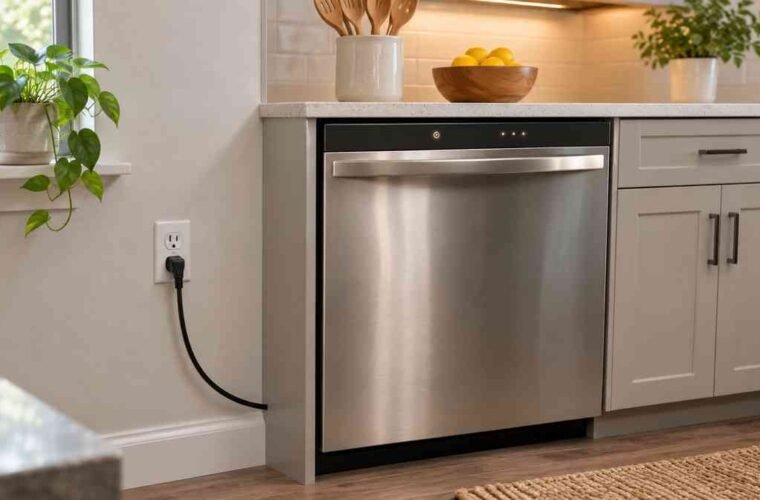
Samsung’s reset isn’t a button. Unplug the machine or switch its breaker off, wait one to five minutes, then power it up.
That wipes the stored code, so read the code first. A reset won’t empty a filter full of food. The fault comes back on the next wash, and now you’ve lost the code that pointed at it.
Bail the standing water out before you open the sump. The cup and towel method in our dishwasher draining steps keeps it off your floor.
Want a second read on the sound? The pump test in our dishwasher not draining guide works on any brand.
What 5C, OC and LC each rule out
Samsung files 5C, SC, 5E and SE as drain errors. The machine knows water is still in the tub and can’t move it.
The codes beside them point at other parts of the same path.
Each one shortens your list.
- 5C, SC, 5E, SE. Drain error. Water isn’t leaving, so the sink, hose and filter checks below all apply. Samsung groups SC with 5C, so a panel reading SC isn’t a second fault.
- OC, 0C, oE. Over-level water. There’s more water in the tub than there should be, which points at filling as much as at draining.
- LC, LE. Leak sensor. Samsung says the unit turns itself on and won’t turn off while the sensor sees moisture. On Waterwall models the same code can mean the water reflector is blocked.
- 3C. Pump operation error. Samsung calls the pump failed and sends you to service after one restart.
LC is the code that costs money when it’s misread. Stop.
If your base pan is wet, quit running cycles and go find the leak. A pump that keeps restarting itself to drain can run itself dry.
The rest of the panel, including codes with nothing to do with water, sits in our Samsung dishwasher error code list.
Check the sink and disposal before the filter
Samsung sends you to the sink your hose empties into, before anything inside the machine. Food waste in the disposal stops the dishwasher from emptying, and the machine reports it as its own fault.
The test takes you half a minute. Run the tap for about 30 seconds and watch the water go down.
Samsung is blunt about the result.
If your sink doesn’t drain, the problem is in the house plumbing, and a plumber is the right call.
If the sink runs free, clear the disposal with cold water. Then check the installation leftover. Samsung names it: on a unit installed recently, the disposal’s knockout plug has to come out, or your drain outlet is sealed at the fitting.
“Not an expert whatsoever, but do you have a garbage disposal in your sink? Mine was clogged once. Apparently the dishwasher drained through the garbage disposal. With the garbage disposal not working, the water in the dishwater couldn’t completely drain”
– r/Apartmentliving, September 2026 (46 upvotes)
Both of those sit outside the machine, and both are free. Most of the “it never drained right” calls I’ve been on ended at the disposal, not at a part.
When it started points at one part
Here’s the question I ask first on a call. Not which code is showing. When did the water start staying in your tub?
Each answer narrows the fault to one part.
Your code only says whether the tub is holding water.
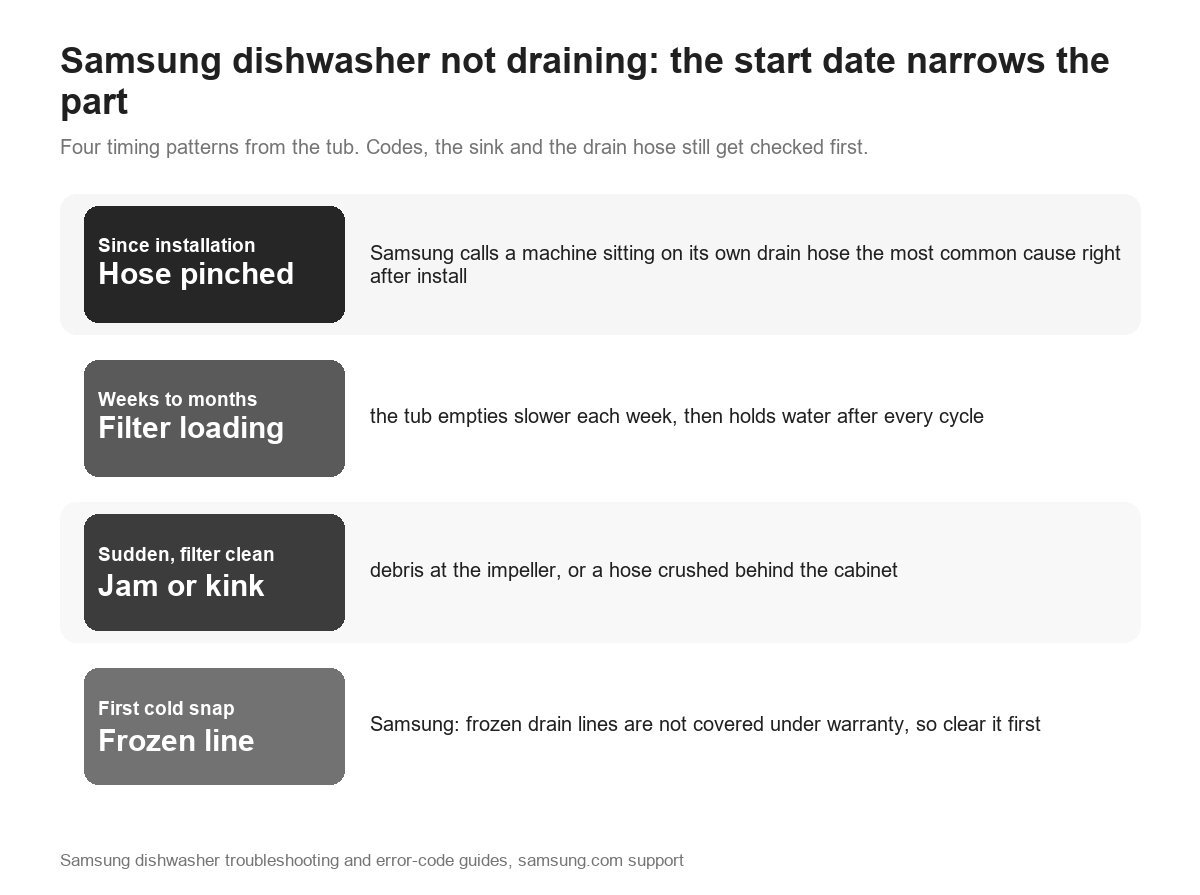
Since the day it went in, the hose is the suspect. Samsung names a dishwasher sitting on top of its own drain hose as the most common cause right after installation.
The machine’s weight pinches the hose shut.
Over weeks and months, your filter and sump load up instead. Draining gets slower. Then the tub holds water after every cycle, and the panel starts throwing 5C.
When a machine that drained fine for years stops suddenly, look for three things. A jam at the impeller, a hose crushed by something shoved into your cabinet, or a frozen line in the first cold snap.
Samsung says frozen water or drain lines aren’t covered under warranty.
Clear the line before you book service, and you’ve saved yourself the visit.
Clean the filter and sump the way Samsung specifies
Samsung’s cleaning guide splits the job by filter type.
Reassembly is where a cleaned machine starts failing again.
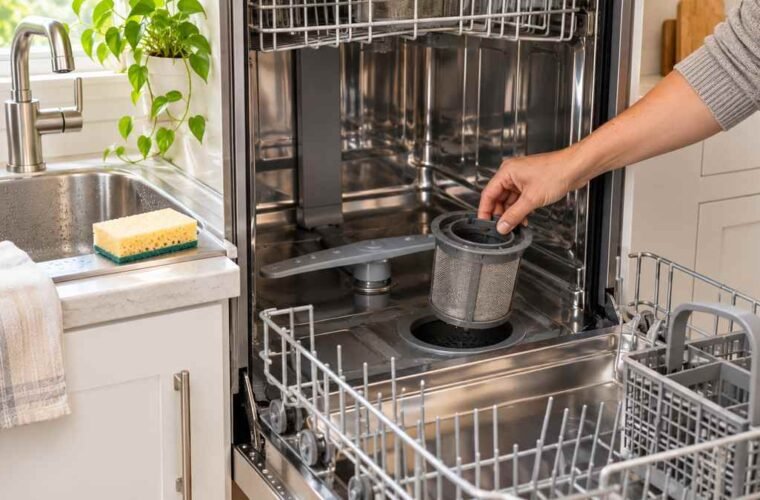
- Fine filter models. Switch off, open the door, turn the filter counterclockwise to release it, then lift it out. The fine filter is the flat mesh layer under the insert. Rinse both under running water and use a toothbrush on the edges.
- Micro filter models. Take the bottom rack out, turn the handle counterclockwise to release the cover, and lift the cylindrical micro filter out from underneath. Rinse both, dry them, then turn the handle clockwise to lock the cover.
- Models with no removable filter. Wipe the sump and drain area with a wet cloth, then run an empty Normal cycle with detergent. That carries the loose debris out, as long as the machine can still drain.
Samsung repeats one warning twice, and it is the step owners skip: a filter or pump cover that goes back missing or in the wrong position causes drain and overflow errors on its own.
Turn the handle to its stop. Check your cover sits flush.
I’ve pulled covers that were refitted a tooth off, and they throw a drain error on the first cycle.
Once the filter is out, look into your sump and wipe the grease film off the walls. Debris that gets past the filter stops a few inches further on, at the impeller.
On models with a removable drain pump, that’s also where the pump lifts out.
Samsung says the steps will be listed in your manual’s table of contents.
If the pump isn’t in that list, it doesn’t come out on your machine. Bosch, GE, Frigidaire and Whirlpool filter variants are in our dishwasher filter cleaning guide.
The hose needs a high loop, not just a clear run
Samsung’s next check is the hose, and the faults it names are installation faults rather than wear.
Your hose has to reach an air gap or climb into a high loop above where it connects to the sink.
Without either, water backflows into the dishwasher and the cycle never finishes draining.
Then look for a pinch. Follow the hose from the machine to your cabinet and check for a kink, or a spot where the machine’s weight or the cabinet base flattens it.
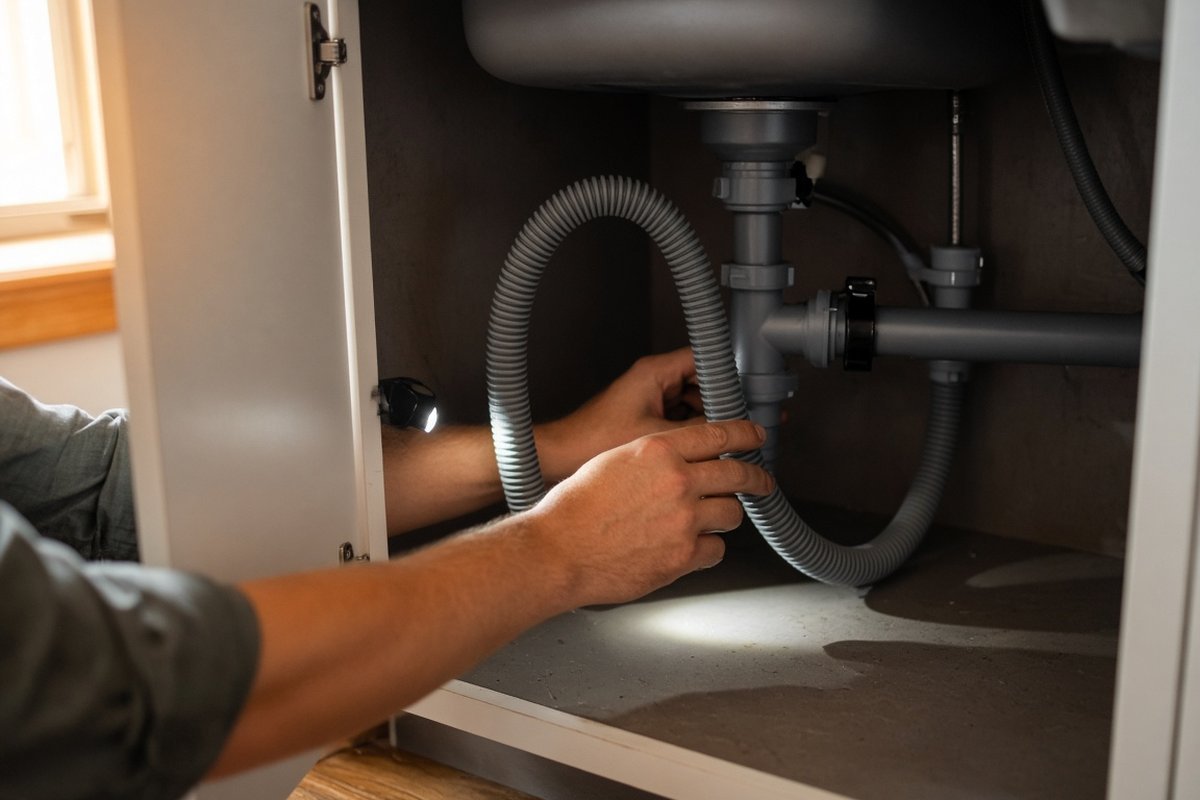
Straighten a bent hose and run the drain test again.
Samsung treats a hose damaged past straightening as a service call.
This check is worth doing before the filter for two reasons. It’s free, and on a machine installed within the last year it’s the likelier of the two. I’d look at your hose first on anything that new.
No blockage and still not draining
Clean filter, free-running sink, hose with its loop. At that point you’ll find your fault in the pump housing or in the wall behind the sink.
Debris that gets past the filter stops at the impeller. Samsung says a removable pump can be lifted out and cleaned once the filter is out.
Wear gloves for that one.
Broken glass clears the filter and stays at the pump.
Samsung’s own fault tree ends at service, and that’s the right place for a machine under a cabinet full of water. Stop and call a technician if four things are true.
The pump hums with the impeller turning freely by hand. The machine leaks while it drains. A code returns inside one cycle of clearing. Your sink backs up as the dishwasher drains.
One money check before you pay for a pump. Recalls are separate from drain faults, and a recalled model gets repaired at no cost.
Run your model number through our appliance recall lookup while the door panel is open.
It reads CPSC filings by brand and model.
Samsung dishwasher not draining: quick answers
Why is my Samsung dishwasher holding water in the bottom?
Standing water in the tub means the drain path is restricted or the pump isn’t moving water. Check the sink and disposal first, then the filter and sump, then the hose for a pinch or a missing high loop.
What does the OC code mean on a Samsung dishwasher?
OC is an over-level water error: there’s more water in the tub than there should be. Samsung’s entry for it points at the drain and overflow checks, not at the water supply.
Is there a reset button on a Samsung dishwasher?
No. Samsung’s reset is a power cycle: unplug the dishwasher or switch its breaker off, wait one to five minutes, then power it up. That clears stored codes without repairing the cause.
How do I force a Samsung dishwasher to drain?
Hold START for three seconds on models with the combined START and Cancel & Drain button. Samsung’s panel guide uses that press to cancel the cycle and drain the tub, and it’s the quickest way to hear whether your pump is running.