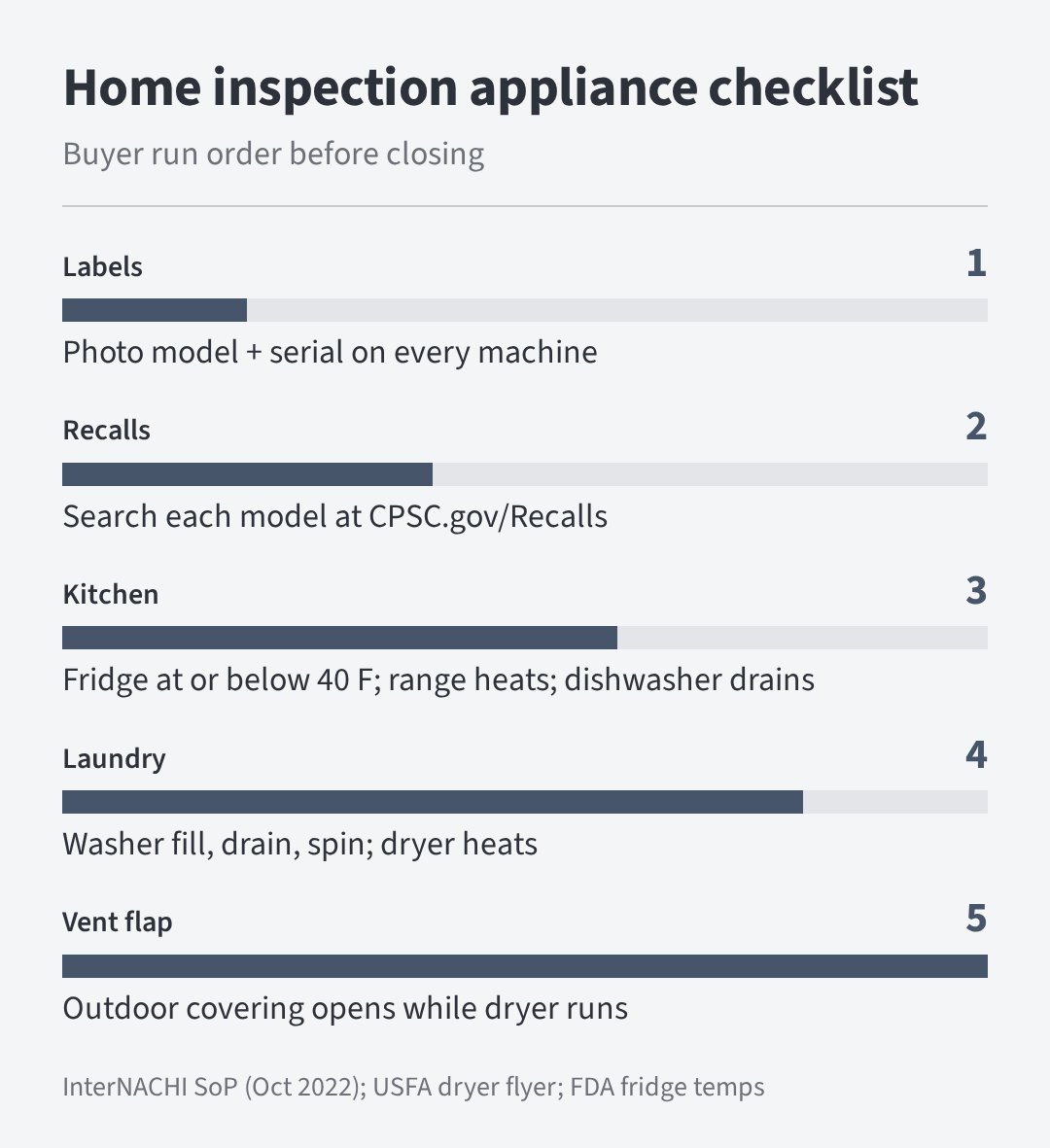
A home inspection appliance checklist is the short function run you do yourself: photograph every model and serial tag, search those models for recalls, then run the fridge, range, dishwasher, washer, and dryer long enough to see heat, cold, drain, and spin. Under InterNACHI’s Standards of Practice, household appliances are not a required inspection item, so the report alone is not a repair diagnosis.
I spent years on in-home service calls after starting as a helper in an Ohio shop. The calls that followed a closing often started the same way: the inspector noted that the washer “powered on,” and two weeks later the tub would not drain. A buyer who runs a real short cycle catches that before the moving truck.
Why the inspection report is not an appliance diagnosis
InterNACHI’s Standards of Practice (last revised October 2022) list what a general home inspection must cover. Household appliances sit outside that required list.
In the interior section, the inspector is not required to “inspect or move any household appliances,” and a later line repeats that the inspector is not required to “inspect appliances.” Under plumbing exclusions, the inspector is not required to “inspect clothes washing machines or their connections.” The same standards say the inspector is not required to research manufacturers’ recalls. Those lines are why a clean report can still leave you with a dead ice maker or a dryer that never heated.
Some inspectors still operate built-ins as a courtesy. Scope varies by contract and state rules. Treat anything they write about appliances as a snapshot of what they saw that day, not a warranty.
Home inspection appliance checklist: before you touch a machine
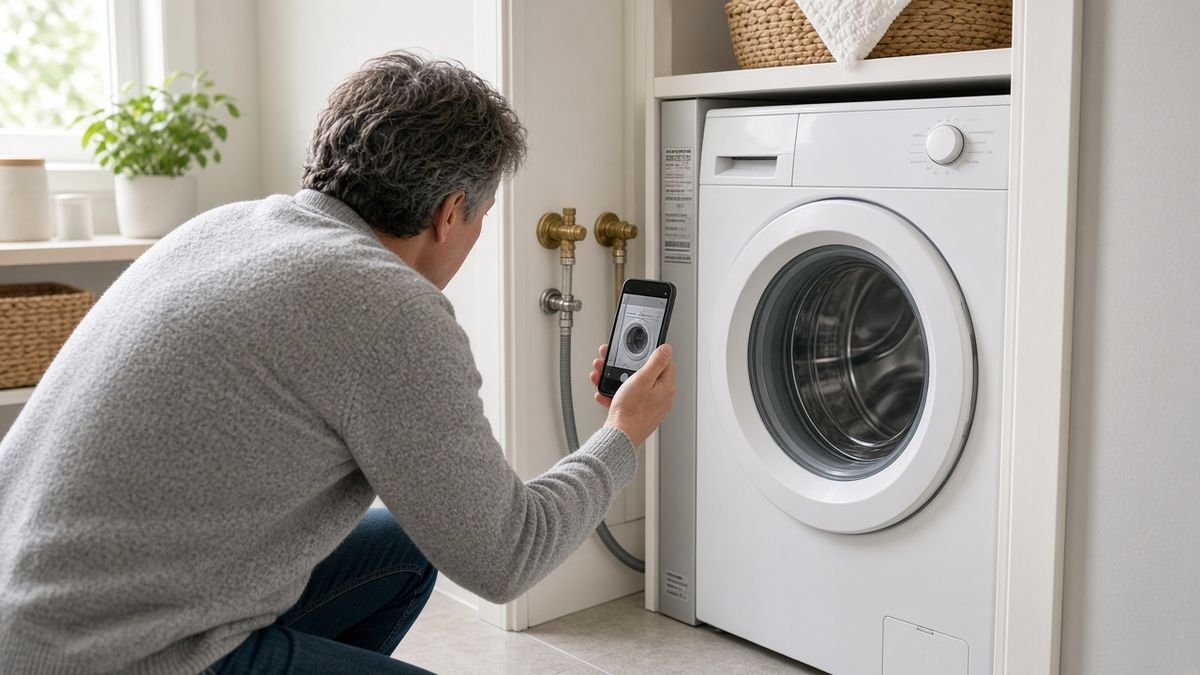
Confirm the purchase contract lists every appliance that is supposed to stay, including a garage fridge or basement freezer if those were promised. Photograph the model and serial labels on each one. Those numbers are what you need for a recall search, a parts order, and an age check later.
Search each model on the U.S. Consumer Product Safety Commission recalls page. Match any notice against the full model and serial rules on that notice. A brand match alone is not enough.
Ask the seller for manuals, receipts, and any repair invoices. A receipt dates the machine better than a guess from the kitchen remodel year. When you want to decode age from a serial tag after you own the place, use our appliance age calculator instead of guessing from the finish color.
Kitchen run order
Work the kitchen in the order that shows a problem fastest.
- Refrigerator and freezer. The FDA advises keeping the refrigerator at 40°F or below and the freezer at 0°F. Few built-in displays are exact, so bring a cheap appliance thermometer if you can. Check door gaskets with a dollar bill: if it slides out easily all the way around, the seal is weak. Listen for a compressor that never seems to shut off, and look for rust or water stains under the unit.
- Range and oven. On a gas cooktop, every burner should light cleanly. On electric, each element should heat. Set the oven to a moderate bake and confirm it actually gets hot. Do not run a self-clean cycle during a showing. If you smell gas and cannot clear it by airing the room, leave and call the utility. Gas-line work is not DIY.
- Dishwasher. Run a short cycle with the seller’s permission. It should fill, wash, and drain without puddles at the toe-kick or under the adjacent cabinet. A machine that only “turns on” and never completes a drain is not a pass.
If a fridge is already warm or iced over heavily, price a repair or replacement before you lean on it after closing. Our guide on whether to repair or replace a refrigerator walks that call once you own the machine.
Laundry run order
Washers and dryers cause more post-closing service calls than most kitchen toys, because a short “power on” test misses drain and heat faults.
- Washer. Run a small load or rinse cycle. Watch fill, agitation or tumble, drain, and spin. Look under the machine for drips. Feel the supply hoses for bulges or cracks. Front-loaders deserve a look at the door boot for tears or heavy mold smell.
- Dryer. Confirm the drum turns and the air gets hot on a timed cycle. Pull the machine forward only if you can do it safely without stressing a gas connector. Check that the transition duct is not crushed behind the cabinet.
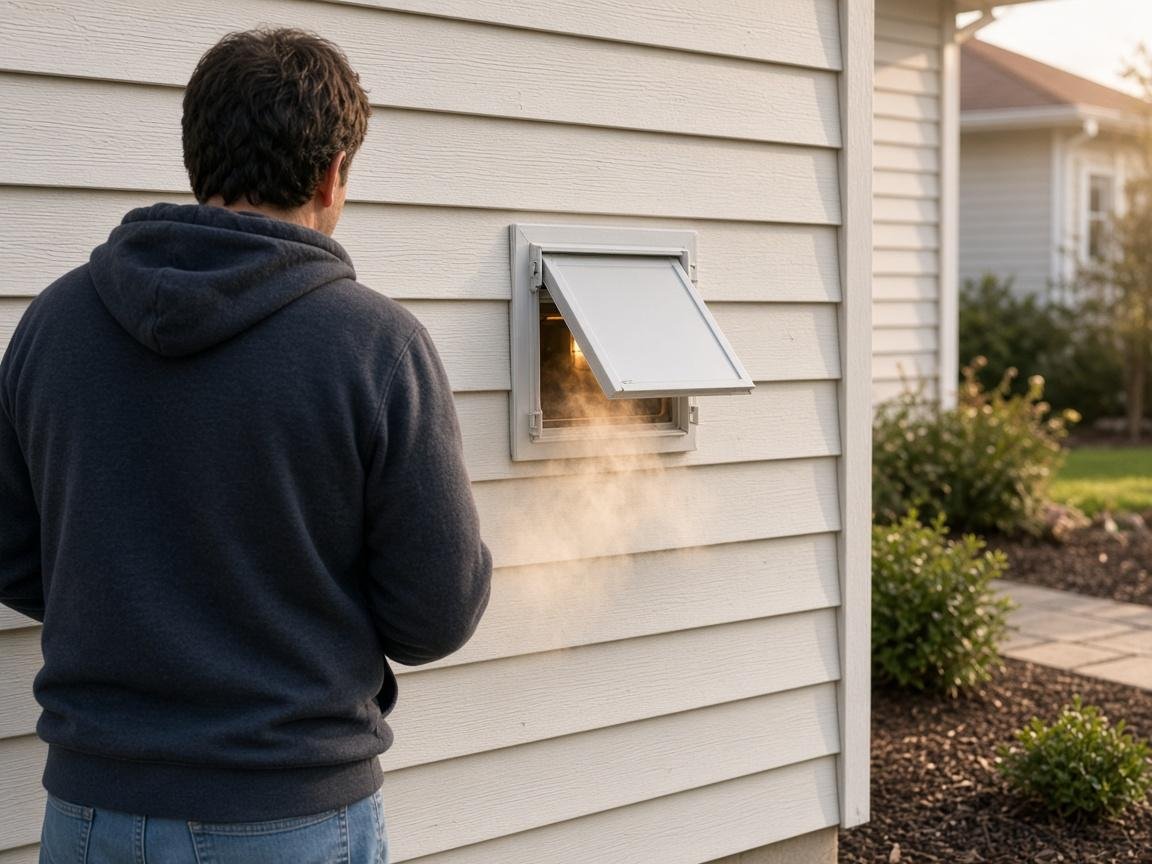
- Outdoor vent. The U.S. Fire Administration’s clothes dryer fire safety flyer tells homeowners to make sure the venting behind the dryer is not damaged, crushed, or restricted, and that the outdoor vent covering opens when the dryer runs. Stand outside while someone starts a cycle. If the flap stays shut or barely moves, treat the vent as restricted until it is cleaned or repaired.
Typical washer life and repair-versus-replace framing live in our washing machine lifespan guide. Use it after you own the machine, not as a substitute for the walk-through run.
Water clues around the machines
Slow leaks show up as dark subfloor, soft laminate, swollen toe-kicks, or a musty smell before you see a drip. Check under the dishwasher, behind the fridge if you can see the line, and around the washer shutoffs.
Washer hoses of unknown age are a common flood source on service calls I took. You do not need to replace them during the showing. Plan to swap unknown rubber hoses soon after move-in, and shut the valves when you leave for a long trip.
Hookups in older and mixed-era homes
The machine can look fine and still be wrong for the house. Electric dryers need the matching receptacle and breaker. Gas dryers need a proper gas supply and a safe connector. A laundry closet that only has a 120-volt outlet will not run a standard electric dryer without an electrician. A kitchen that lost its built-in dishwasher opening during a remodel may not accept a standard 24-inch unit without cabinet work.
Those details show up more often in older or mixed-era housing stock than in a uniform new subdivision. When you are still comparing listings, read how each home describes laundry location, fuel type, and what conveys, then bring this checklist to the walk-through. Buyers reviewing Paia’s eclectic housing inventory will see plantation-era cottages and later builds side by side; the listing notes on laundry and kitchen layout are the map for which hookup questions to ask before you schedule the appliance run above. I am not based on Maui – the same hookup mismatch shows up anywhere the housing ages are mixed.
After you get the keys
Re-run the short kitchen and laundry checks on move-in day. Movers bump hoses and vent ducts. Replace washer hoses you cannot date. Clean the dryer lint path and confirm the outdoor flap still opens. Photograph every rating label again and store the pictures with the closing packet.
Date each machine while nothing is broken. Search recalls again under your name as the new owner. Budget for the oldest high-use unit first – usually the fridge or washer – instead of waiting for a holiday weekend failure.
FAQ
Do home inspectors have to test appliances?
Under InterNACHI’s Standards of Practice (October 2022 revision), inspectors are not required to inspect household appliances or clothes washers. Individual inspectors may still operate some units. Read your inspection agreement for the actual scope.
What belongs on a home inspection appliance checklist?
Inclusions list, model and serial photos, a CPSC recall search, a short kitchen run, a washer fill-drain-spin, dryer heat, and a live check that the outdoor dryer vent covering opens. Add water staining and hose condition around every water-using machine.
Can I skip the dryer vent if the dryer gets hot?
No. Heat at the drum does not prove the outdoor path is clear. The USFA flyer specifically calls out crushed or restricted venting and an outdoor covering that must open while the dryer runs.
When should I call a pro during the walk-through?
Leave gas smells, flexible gas connectors that look damaged, and sealed-system (refrigerant) work to licensed pros. For those, stop the DIY checks and get a specialist in before you rely on the machine.